

Customer expectations have never been higher. Instant replies, for one, aren’t that old but now they’re non-negotiable.
And no human team can maintain such levels of coverage, 24/7 365.
This is just one reason why AI customer service agents have become mission-critical for businesses on the cusp of 2026. It’s also one of the areas where AI consistently brings serious value across industries.
Modern AI voice agents generate instant responses, but they also resolve routine inquiries and provide 24/7 coverage. And with the right provider, you can elevate your service quality, lower costs, and also free up your human reps to get more from their highest-value work.
It should be no surprise, then, that the market is increasingly crowded.
Today we set out to help you make the best possible choice, so you can avoid costly mistakes that risk your budget, time, and customer trust.
Here we give a detailed breakdown of the top 10 AI customer service agents for 2026. You’ll learn each one’s capabilities, ideal use cases, strengths, and limitations.
Let’s dig in.
Why Your Business Needs an AI Customer Service Agent
Have you lost customers because they couldn’t reach support fast enough? They probably moved to a competitor who answered instantly—likely with AI.
We led with this, but here are more reasons why you should carefully weigh your AI customer service providers:
- Response Time Is Everything: Customers won’t wait minutes, let alone hours. AI agents respond instantly and prevent frustration.
- Support Volume Is Exploding: Human teams burn out. AI agents don’t. They handle thousands of interactions simultaneously.
- Repetition Kills Productivity: Order checks. FAQs. Your team spends their day in loops. AI customer service agents handle the routine stuff, so your human team can focus on the complex, high-value issues that actually need them.
- Consistency That Builds Trust: Every customer gets the same accurate, friendly, brand-aligned experience—no mood swings, no errors, no “I forgot to escalate.”
- Lower Costs, Higher Coverage: Scaling a support team is expensive. AI support agents let you expand coverage so you can scale both effectively and more efficiently.
- Competitive Pressure: Your competitors are either using or already testing AI support. AI agents help you keep your business advantage.
Keep reading to discover the customer service AI providers that deliver on these needs and more.
Best 10 AI-Powered Customer Service Providers
1. Pete & Gabi
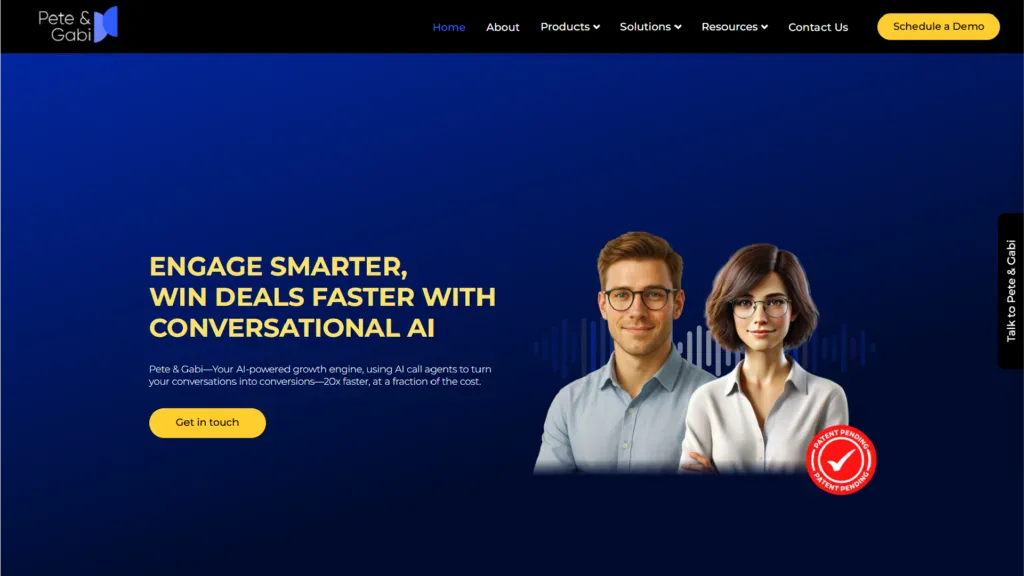
We’ve ranked this provider #1 because it provides the most complete blend of natural conversation quality, enterprise-level automation, and real operational impact.
Pete & Gabi is a conversational AI platform specializing in natural, human-like voice interactions for customer service across industries like hospitality, banking, retail, and telecommunications.
Unlike basic chatbots, their AI agents do more than handle basic inquiries—they listen, respond, resolve issues, follow up, and route conversations intelligently with warmth and precision, just like a human rep.
Designed for teams under pressure, Pete & Gabi’s AI customer service agents help businesses deliver 24/7 responsive support, eliminate wait times, and maintain consistent service quality, all while reducing operational load and support costs.
With conversational AI capabilities spanning more than 15 languages, Pete & Gabi help effectively bridge the gap between automation and genuine customer engagement.
Key Features
- AI-powered voice conversations with natural tone and adaptive responses
- 24/7 inbound call handling with instant pickup (no hold times)
- Sentiment analysis to detect frustration and prioritize escalations
- Seamless handoff to human agents with complete conversation context
- Easy CRM integrations
- Real-time call transcripts, summaries, and sentiment scores
Pros
- High call volume handling without quality degradation
- Fast deployment (live launch within days)
- Sentiment awareness capabilities
Cons
- Best suited for voice-first support
- Premium pricing compared to basic chatbot solutions
Best For
Enterprises and teams that need 24/7 intelligent voice support coverage.
2. CallAgent AI
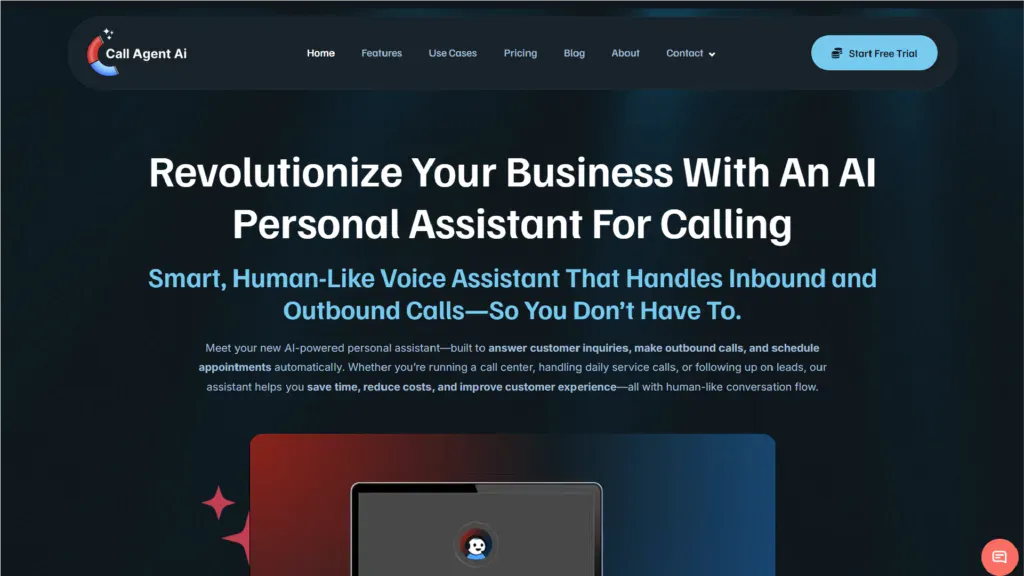
CallAgent AI is a customer support automation platform built around AI voice assistants that handle inbound and outbound calls.
With a focus on automating repetitive tasks while routing complex issues to human reps, this AI platform effectively automates Tier 1 support—password resets, order tracking, account inquiries, and FAQ responses.
CallAgent AI uses natural language processing to understand customer intent and deliver scripted responses that cover common scenarios.
Note that while their AI customer service agent may be effective at handling predictable workflows, their conversational flexibility is more limited compared to fully adaptive AI solutions.
Key Features
- AI-powered voice assistants for inbound and outbound support
- Customizable call scripts and workflows
- CRM and helpdesk integrations
- Automated call routing and escalation
- Real-time call transcripts
Pros
- Efficient at resolving repetitive, high-volume inquiries
- Quick deployment for standard customer service workflows
- Cost-effective for businesses prioritizing volume over conversational depth
Cons
- Conversations can feel scripted when queries fall outside preset workflows
- Limited adaptability for nuanced or emotionally charged interactions
Best For
Businesses that need cost-effective voice automation for routine customer service calls and predictable support tasks.
3. Synthflow AI
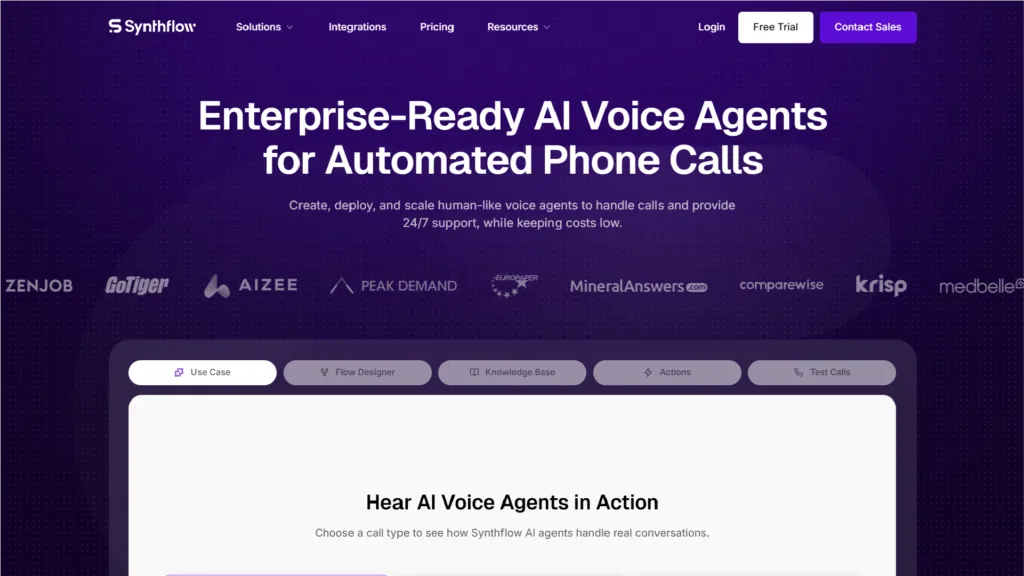
Synthflow AI is a no-code AI voice agent builder that enables businesses to create custom voice assistants for customer service without technical expertise.
With a drag-and-drop workflow editor, this platform allows teams to create structured call flows, deploy voice assistants quickly, and adjust logic without engineering support.
Synthflow AI offers multilingual output, CRM integrations, and white-label options with a focus on accessibility and speed.
However, its conversation quality can also feel more rigid and scripted compared to fully adaptive AI platforms, particularly when handling complex or emotionally nuanced customer interactions.
Key Features
- No-code visual workflow builder
- Multilingual AI voice capabilities
- CRM and scheduling integrations
- White-label deployment options
- Custom conversation path design
- Call analytics and reporting dashboard
Pros
- Easy setup without requiring technical expertise
- Flexible customization for different customer service scenarios
- Fast deployment with visual workflow configuration
Cons
- Conversations can feel less natural and more pre-scripted
- Limited advanced reasoning compared to top-tier agents
Best For
Teams and agencies that need quick-to-deploy, customizable AI voice agents with straightforward workflows.
4. Air AI
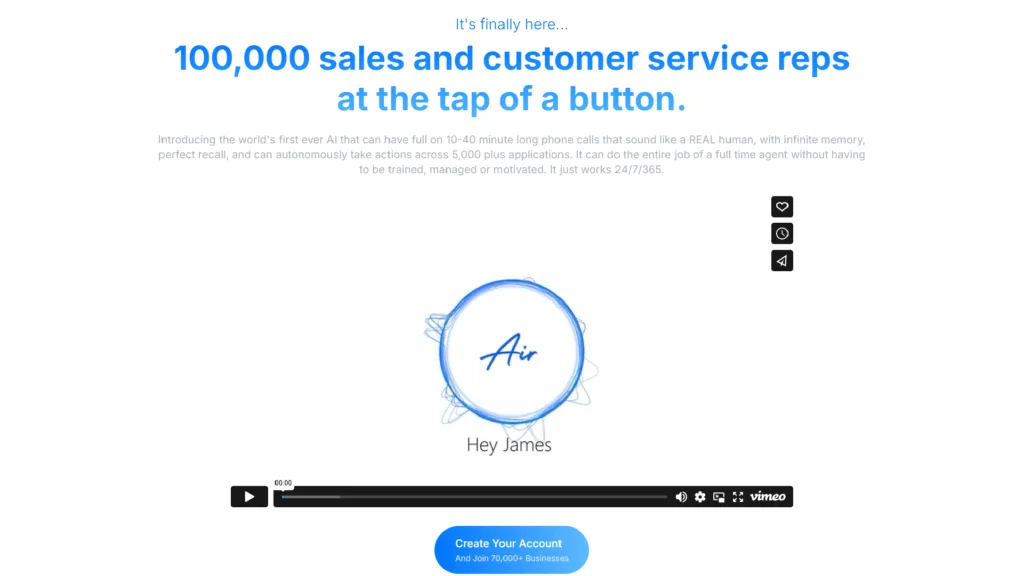
Air AI is an AI voice agent platform that positions itself as a fully autonomous conversational AI capable of handling customer service calls with minimal human intervention.
This platform boasts an ability to manage extended, multi-turn conversations without relying on rigid scripts or decision trees.
Air AI is designed to handle complex customer inquiries, adapt to different conversation flows in real time, and complete full interactions from start to finish—whether that’s troubleshooting issues, processing requests, or escalating when necessary.
It also integrates seamlessly with CRM and support systems, logging call data and next steps automatically.
Key Features
- Automated voice and chat interactions
- Real-time analytics and reporting
- Customer sentiment tracking
- Case escalation to human agents
- Integration with CRMs and helpdesk tools
Pros
- Handles complex, nuanced customer conversations autonomously
- Adapts conversational flow in real time without pre-defined paths
- Strong performance in industries requiring detailed troubleshooting
Cons
- May require longer setup and training period
- Premium pricing compared to simpler AI voice tools
Best For
Businesses with complex customer service needs that can handle high volumes with minimal setup.
5. Retell AI
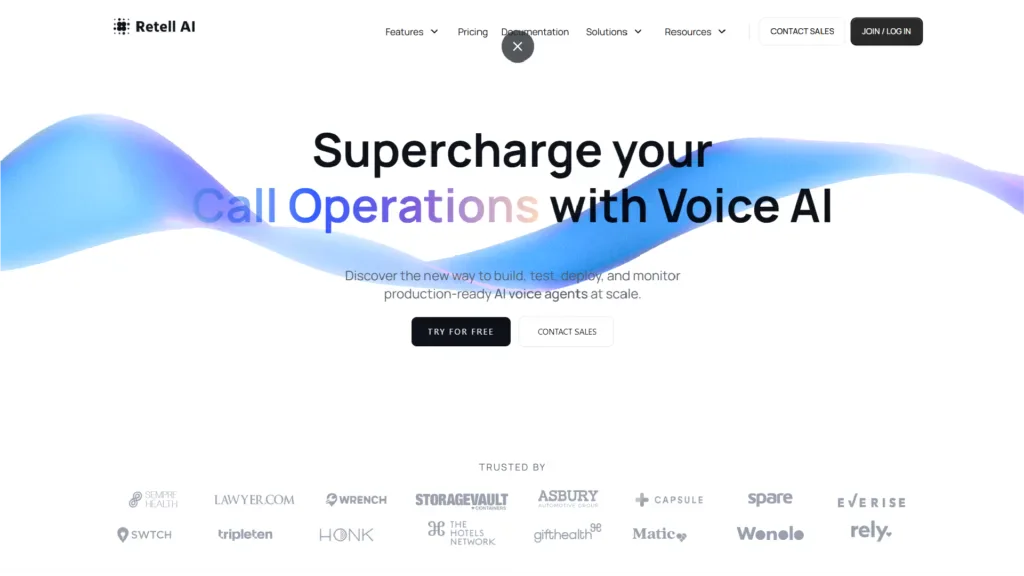
Next on our list is Retell AI—a conversational AI platform designed to power voice agents for customer service.
With a focus on low-latency, real-time interactions and developer-friendly customization, Retell AI is built for businesses that want to build and deploy AI voice agents quickly.
This AI customer service platform offers API-first architecture that allows technical teams to integrate voice AI into existing customer service workflows with flexibility. It also emphasizes speed and responsiveness, delivering near-instant voice responses that reduce awkward pauses and create smoother customer interactions.
Its developer-centric approach can be effective for the right use cases, but it can mean that non-technical teams may find setup more challenging compared to no-code alternatives.
Key Features
- API-first architecture for flexible integration
- Context-aware AI conversations
- Multi-channel support (voice, chat, email)
- Automated follow-ups and reminders
- Integration with popular CRMs platforms
Pros
- Fast, responsive voice interactions with minimal latency
- Highly customizable for technical teams with specific use cases
- Strong API documentation for developer-friendly deployment
Cons
- Requires technical expertise for setup and optimization
- Not ideal for non-technical teams seeking plug-and-play solutions
- Conversational quality depends heavily on training and configuration
Best For
Tech-forward businesses with in-house development teams that need a flexible, API-first AI voice platform for custom customer service implementations.
6. VoiceSpin
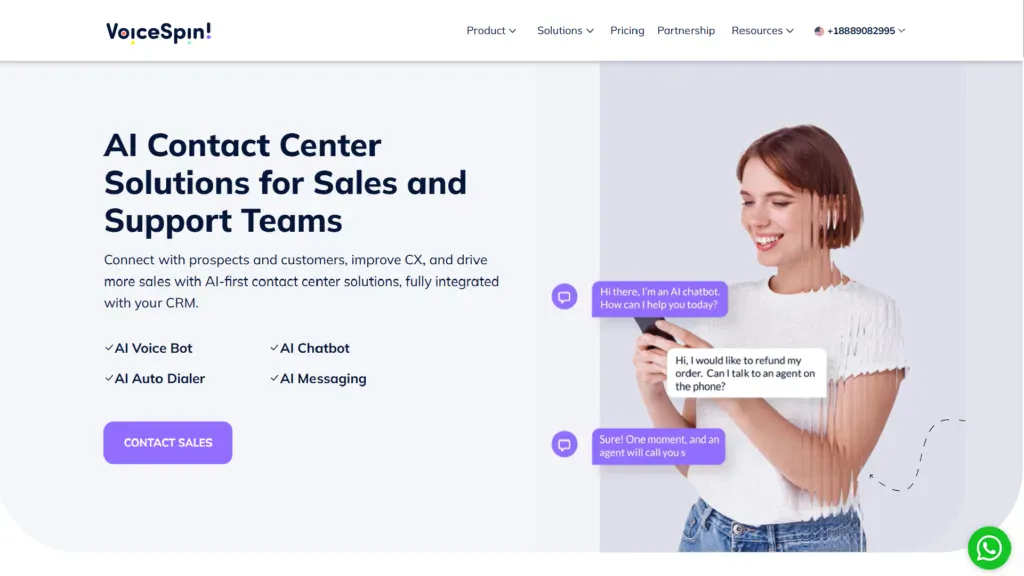
VoiceSpin is a cloud-based contact center platform that integrates AI-powered voice automation to enhance customer service operations with call routing, analytics, and agent assistance tools.
Designed for contact centers managing high call volumes, VoiceSpin combines traditional call center features with AI-driven automation to streamline customer interactions.
This platform also boasts real-time sentiment analysis capabilities that help its agents adjust tone and messaging, improving customer satisfaction.
It has a broad feature set, making it better suited for businesses needing full contact center capabilities than standalone AI voice agents. Its text-based chat capabilities are also limited compared to other multi-channel solutions.
Key Features
- AI-powered call routing based on customer intent
- Real-time agent assistance and coaching
- Automated call summarization and ticket creation
- Seamless CRM integrations
- Call recording, analytics, and reporting dashboards
- IVR and queue management tools
Pros
- Comprehensive contact center platform with AI enhancements
- Delivers natural, human-like voice interactions
- Reduces wait times and call queue backlogs
Cons
- More complex setup compared to standalone AI voice agents
- Better suited for contact centers than small teams needing simple AI automation
- Pricing reflects full platform capabilities, not just AI voice features
Best For
Organizations with heavy call volumes that need a full-featured platform with AI-enhanced call routing, agent assistance, and automation built in.
7. Zendesk
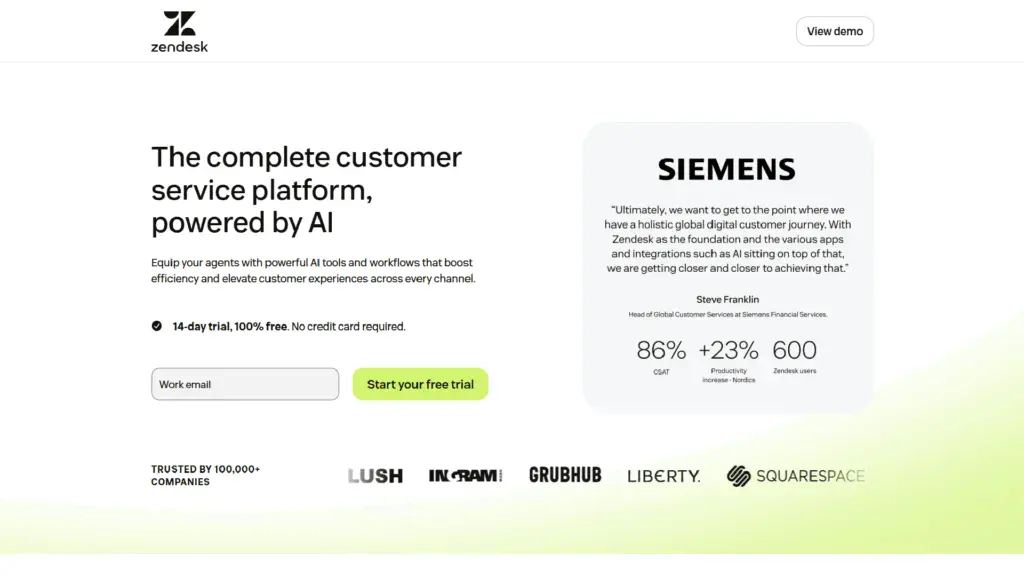
Zendesk is a widely recognized customer service platform offering AI-powered support across multiple channels, including chat, email, and voice.
Known primarily as a helpdesk and ticketing system, Zendesk has expanded its AI capabilities to automate responses, deflect tickets, and assist agents in resolving customer inquiries faster.
Its customer service AI agents automate routine queries, provide suggested responses to support staff, and help route complex tickets to the right agents.
Zendesk’s strength lies in its robust integrations and workflow management. It is worth mentioning that its AI capabilities are less conversational and proactive compared to purpose-built voice-first agents.
Key Features
- AI-powered Answer Bot for automated ticket deflection
- Omnichannel support (email, chat, voice, social media)
- Knowledge base integration for self-service
- Workflow automation and ticket routing
- Analytics and reporting dashboards
Pros
- Strong omnichannel capabilities
- Seamless integration with existing systems
- Scalable for enterprises of all sizes
Cons
- AI is less conversational, more reactive
- Requires customization for optimal automation
- Limited proactive engagement compared to voice-first AI
Best For
Businesses that want a robust, enterprise-grade customer service platform that combines automation with comprehensive workflow and analytics capabilities.
8. Tidio
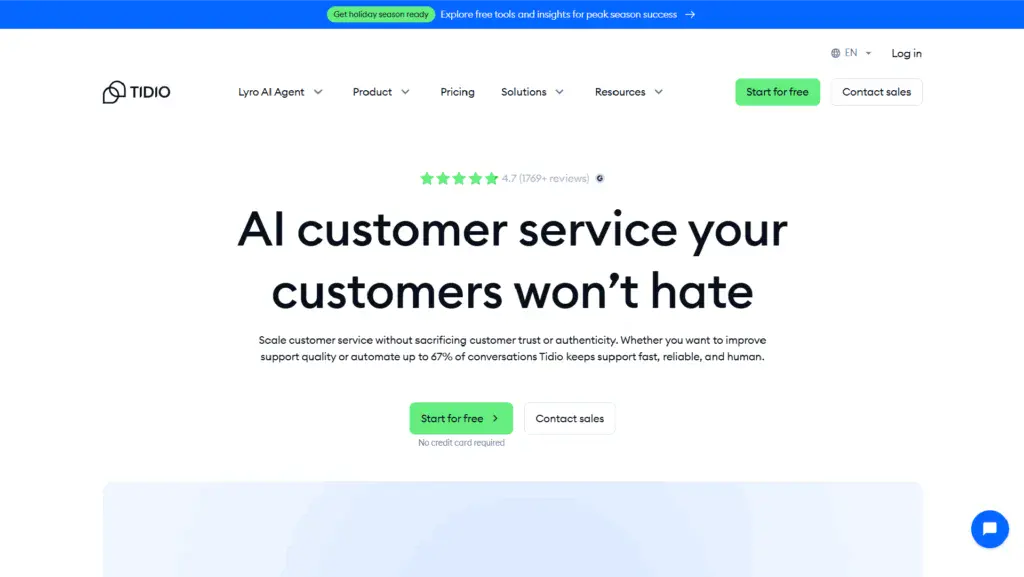
Tidio is a customer service platform that combines live chat, chatbots, and AI automation to help small and mid-sized businesses manage customer inquiries across websites, messaging apps, and email.
Unlike the other options on this list, Tidio does not offer voice AI capabilities.
However, its AI agents can handle common inquiries, qualify leads, and guide customers through FAQs across most text-enabled channels.
Tidio’s AI customer service automation is designed for businesses that want quick deployment without technical expertise—setup takes minutes, and the visual chatbot builder allows teams to create automated workflows easily.
Key Features
- AI-powered chatbot
- Live chat with real-time visitor monitoring
- Multi-channel support (website, email, Messenger, Instagram)
- E-commerce integrations (Shopify, WooCommerce, BigCommerce)
- Mobile app for managing support on the go
Pros
- Fast, easy setup with no technical expertise required
- Affordable pricing for small and mid-sized businesses
- Strong e-commerce integrations for online retailers
Cons
- Limited voice-based engagement
- Advanced AI capabilities are less sophisticated
- May lack scalability for enterprise needs
Best For
Small to medium businesses looking to automate chat-based customer support and lead qualification while maintaining a simple, user-friendly setup.
9. Voiceflow
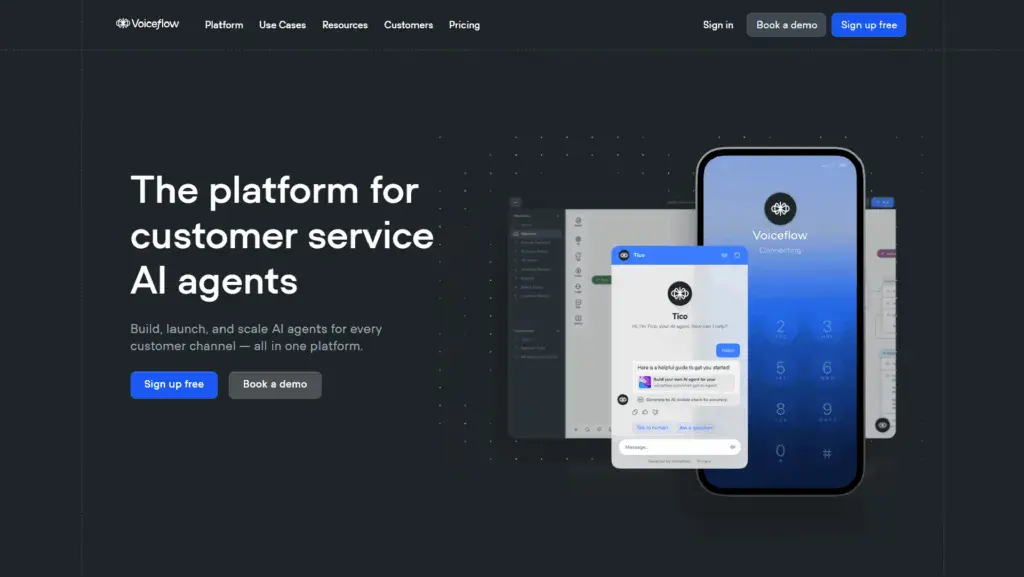
Voiceflow is yet another no-code platform for building conversational AI agents.
With its visual canvas interface, Voiceflow allows teams to map out conversation flows, define decision logic, and create multi-turn interactions through drag-and-drop simplicity.
The platform excels at voice-first customer interactions, making it ideal for customer service, sales support, and interactive voice response (IVR) systems. It’s also particularly appealing to businesses that want full control over conversational design.
While highly flexible, success with Voiceflow depends on thoughtful workflow planning to ensure conversations feel natural and effective.
Key Features
- Drag-and-drop conversation builder
- Voice and chat agent creation
- Multichannel deployment (phone, web, app)
- Integrations with CRM and third-party tools
- Testing and analytics dashboards
Pros
- Highly customizable for businesses with specific conversational needs
- Accessible to non-technical teams
- Flexible deployment across voice and chat channels
Cons
- Requires significant time investment to design and refine conversation flows
- Conversational quality depends on manual workflow configuration
- Steeper learning curve compared to fully automated AI platforms
Best For
Businesses that want full control over conversational design and need a no-code platform to build custom AI agents tailored to customer service workflows.
10. PolyAI
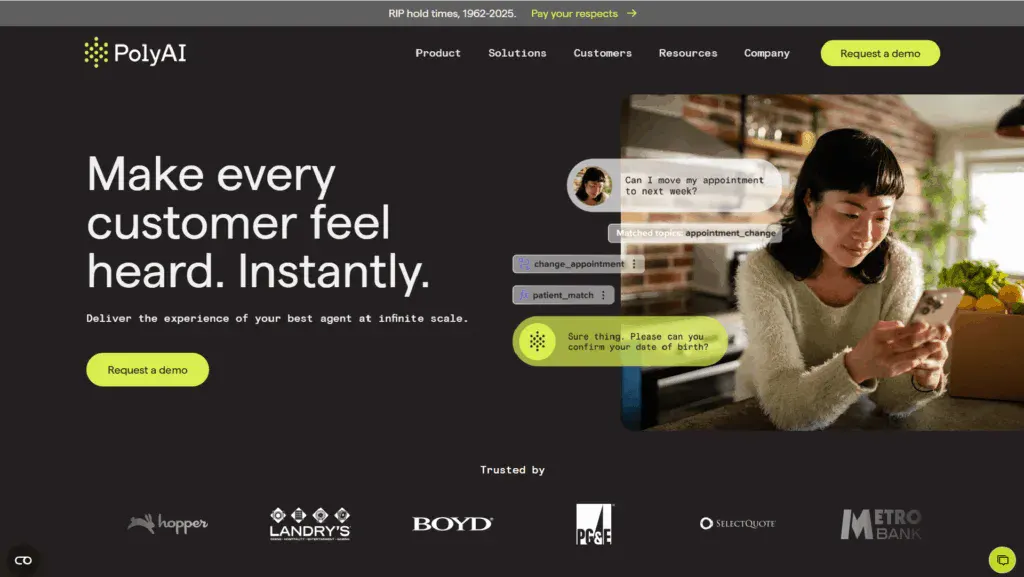
And finally, we have PolyAI.
PolyAI is an enterprise-grade conversational AI platform designed to handle high-volume customer interactions via voice and chat.
Its agents understand natural language, respond intelligently, and can carry context across conversations, making it ideal for complex support scenarios.
PolyAI’s voice agents are designed to understand diverse accents, handle interruptions, and navigate multi-turn dialogues without relying on rigid scripts. The platform also integrates with existing CRM tools, ensuring proper information management.
Key Features
- Enterprise-grade voice AI with natural conversation quality
- Handles multi-turn dialogues and diverse accents
- Multilingual support
- Integration with CRM systems
- Real-time call transcripts and analytics
Pros
- Can handle complex, nuanced interactions
- Strong multilingual capabilities for international businesses
- Scalable for large enterprises
Cons
- Higher cost compared to simpler AI agents
- Implementation can be more complex for smaller teams
- Less suited for small-scale, basic support needs
Best For
Enterprises and large customer service teams that need intelligent, human-like AI agents capable of managing high-volume, multilingual support efficiently
Choosing the Right AI Customer Service Agent for Your Business
Selecting the perfect AI customer service agent means understanding what truly aligns with your operational needs to drive measurable results.
Consider these points:
- What’s your biggest customer service pain point? Are you drowning in after-hours calls, struggling with high ticket volumes, or losing customers to long hold times?
- Does it sound human or robotic? Conversational quality varies dramatically across providers. Natural tone, contextual awareness, and the ability to handle interruptions should be non-negotiables.
- Does it integrate with your existing helpdesk and CRM? With AI increasingly adept at unifying systems, your AI agents shouldn’t create silos. Be sure they sync easily with your support stack before you take the leap.
- How scalable is the platform? Choose AI that scales with your business—handling hundreds of calls during peak volume without degrading response or inflated cost.
- Does it offer transparency and analytics? You should be able to see what’s happening at every stage—call transcripts, resolution rates, etc.
- What does the pricing model look like? Understand whether you’re paying per call, per minute, or a flat rate. Ensure the ROI calculation justifies your investment.
Wrapping It Up
AI customer service agents are how businesses rise to the growing expectations of customer demands.
The 10 platforms in this guide represent the best AI customer service solutions available at the end of 2025—each with distinct strengths, trade-offs, and ideal use cases.
Some excel at voice. Others dominate multi-channel. A few prioritize ease of use over depth. Now you just need to figure out which fixes your key pain points.
If your biggest issues are missed calls, long hold times, and customers hanging up before they get help, Pete & Gabi has been built for you.
Ready to eliminate hold times and scale support without adding headcount?
Explore Pete & Gabi’s AI voice agents today.
FAQs
Can AI customer service agents actually resolve issues, or do they just answer basic questions?
It depends on the platform. Basic AI tools handle simple FAQs and route calls, but more advanced AI customer service agents can resolve issues autonomously. Or escalate complex cases to human agents with full context.
How can AI improve customer service operations?
AI agents increase speed and consistency, reducing wait times and errors. They handle high volumes of inquiries simultaneously, ensuring customers get timely responses while freeing human agents to focus on complex cases.
Can AI agents understand and respond naturally to customers?
Yes. Modern AI agents use natural language processing (NLP) and sentiment analysis to interpret intent, detect emotion, and craft responses that feel human, allowing personalized and context-aware conversations.
How do I know if the AI sounds natural enough for my customers?
Test it for yourself. Most AI providers offer demos or trial periods where you can experience conversation quality firsthand. Listen for natural pauses, contextual responses, and the ability to handle interruptions or off-script questions.
Share on