



Conversations are critical to business in the financial services today. With complex products, volatile markets, and regulatory requirements in flux, two-way dialog is key for both customers and providers alike.
Which is why bandwidth is also proving to be a serious issue. Even with overwhelmed teams trying to keep up, customers still get left waiting. New leads get lost in the noise, with current clients tempted by competitors who can give the instant, personalized service at scale they crave.
This is where effective voice AI agents are becoming critical to sustained growth.
Here we mean real, conversation-driven AI that answers, qualifies, follows up, and moves work forward without slowing humans down.
But getting real results isn’t just about deployment or the system you pick. It’s also about what you do with it.
Keep reading for a deep dive into 10 critical AI use cases financial services teams are using now to move faster, protect margins, and seize on this competitive advantage.
Revenue Growth
Missed calls, slow follow-ups, unqualified leads, and prospects who never hear back are four solvable problems plaguing financial service providers today.
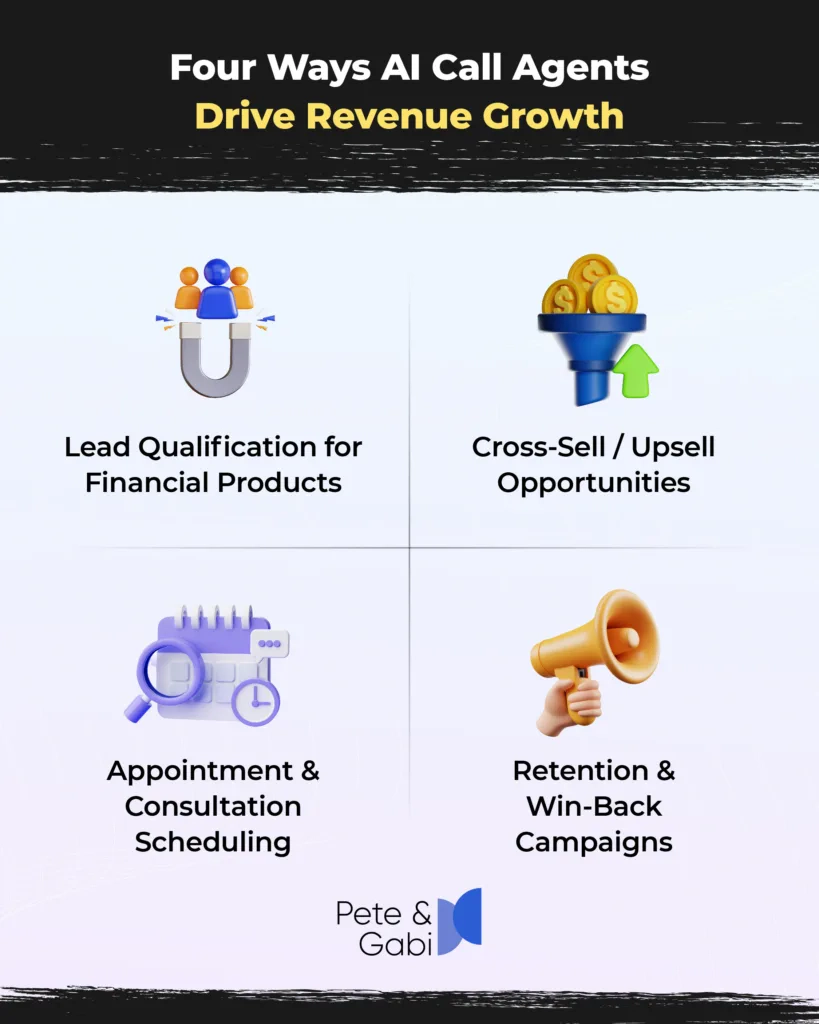
1. Lead Qualification for Financial Products
Lead qualification is the only way to separate actual buyers from tire-kickers.
But doing this manually can bury your team in calls with prospects who can’t afford products, don’t meet credit requirements, or aren’t ready to move forward.
AI agents can already solve this effectively by reaching out to leads to ask qualifying questions about credit scores, income, loan amounts, and more.
This ensures that only interested, qualified prospects get routed to your human advisors, keeping your sales team focused on closing deals.
2. Appointment & Consultation Scheduling
Scheduling shouldn’t take three days of email ping-pong.
AI voice agents handle also can handle this entire process automatically.
They check your team’s availability in real-time, cross-reference with the lead availability, and book appointments on their own. Conversational AI can be used to reach out to confirm appointments and manage rescheduling if needed in a human-like, personalized way.
This gives firms time-to-consultation, fuller advisor calendars, and prospects who convert before being tempted by faster-moving competitors.
3.Cross-Sell / Upsell Opportunities
It’s often true that the best upsell opportunities are already in one’s own customer base. But manual outreach to identify and pitch upgrades is resource-intensive and often drops down in priority.
But AI voice agents are unlocking these revenue opportunities at scale.
They analyze customer profiles and history to identify upsell opportunities in real time. And at the ideal moments, they pitch personalized offers—from higher-yield savings accounts to premium credit cards—while updating your customer data in the process.
4. Retention & Win-Back Campaigns
In most cases, churn doesn’t happen overnight. It starts with inactivity, unanswered questions, or forgotten accounts.
Unfortunately, most teams are too busy chasing new leads to follow up on dormant accounts.
Smart voice AI is being deployed proactively for this use case to reach out to at-risk or inactive customers, reintroduce relevant offers, send reminders, and collect feedback after key interactions.
This keeps relationships warm and gives your team additional chances to retain value.
Client Experience Automation
Client service is the backbone of financial services, yet it’s where many firms struggle.
Here are four ways financial institutions automate client service to improve satisfaction and reduce operational costs.
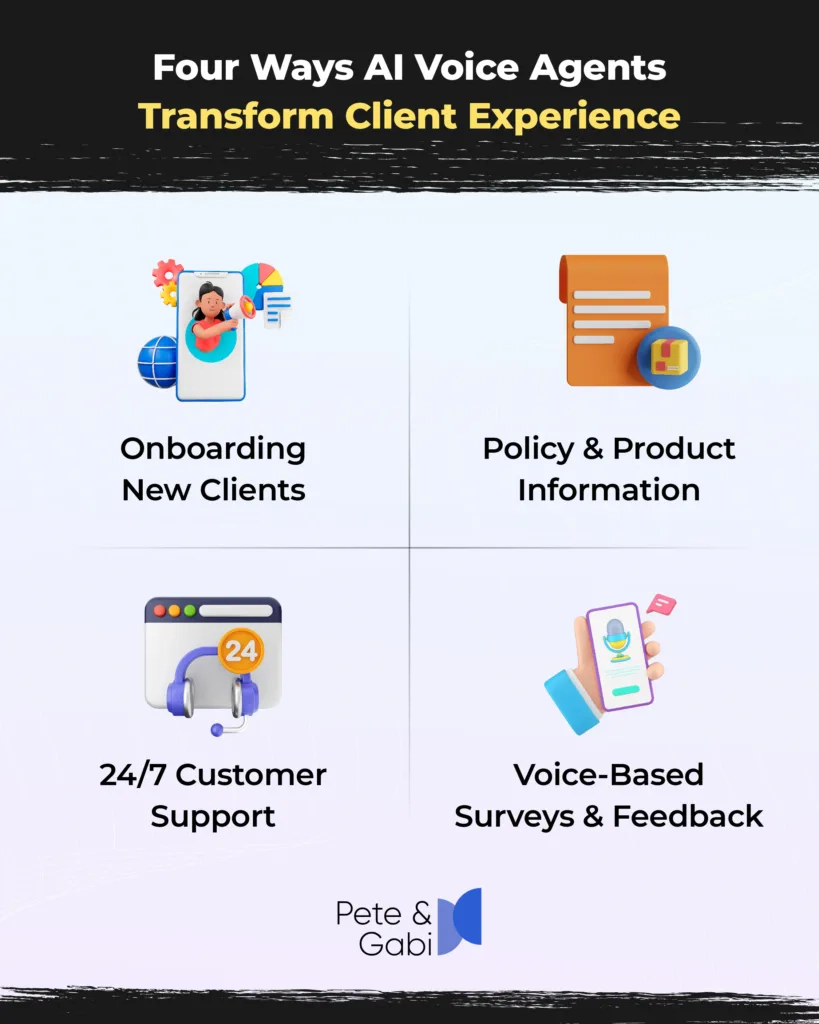
5. Onboarding New Clients
First impressions matter—especially in financial services, where trust is key. But manual onboarding often introduces delays, confusion, and drop-offs.
Always-on conversational AI can be highly effective in this arena.
It guides new customers through onboarding step by step: collecting documents, explaining KYC/AML requirements, activating services, and walking users through app or portal setup.
Every step also gets tracked, and clients receive proactive updates on what’s needed next.
This ensures every customer gets clear, consistent guidance without wasting your team’s time on repetitive work.
You also unlock faster client activation and reduce support tickets in the process.
6. 24/7 Customer Support
Most support teams get buried in high-volume, low-complexity calls—from account inquiries to routine FAQs—that come in at all hours.
AI agents handle this first-content load consistently and around-the-clock.
Customers get immediate answers without hold times and your support team can focus on complex issues that require their human judgment.
7. Policy & Product Information
Explaining insurance policies, investment options, risk disclosures, and fee structures takes a lot of time and bandwidth. These explanations can also introduce inconsistencies in message and brand.
This presents two problems: the scale of conversations and the consistency in explanations.
Conversational AI agents solve both problems.
They provide clear, accurate explanations of products and policies on demand, answer client questions, and guide prospects toward suitable products based on their needs.
They also handle multiple calls per time, helping you scale your operations as needed.
8. Voice-Based Surveys & Feedback
As a business, feedback is critical for client retention and service improvement. Yet, manual surveys often get ignored, and phone-based outreach is far too resource-intensive.
AI call agents have been solving this ask already for companies with a high degree of effectiveness.
They run post-interaction surveys, call clients after service delivery for satisfaction scores, collect detailed feedback, and flag dissatisfied clients for immediate human follow-up.
This generates practical insights to improve service, turns up early warning signs of churn, and ensures clients feel heard—all without your team’s involvement.
Risk Management & Operations
Here are two critical ways AI voice automation also strengthens risk management and improves operational control, to keep customers protected.
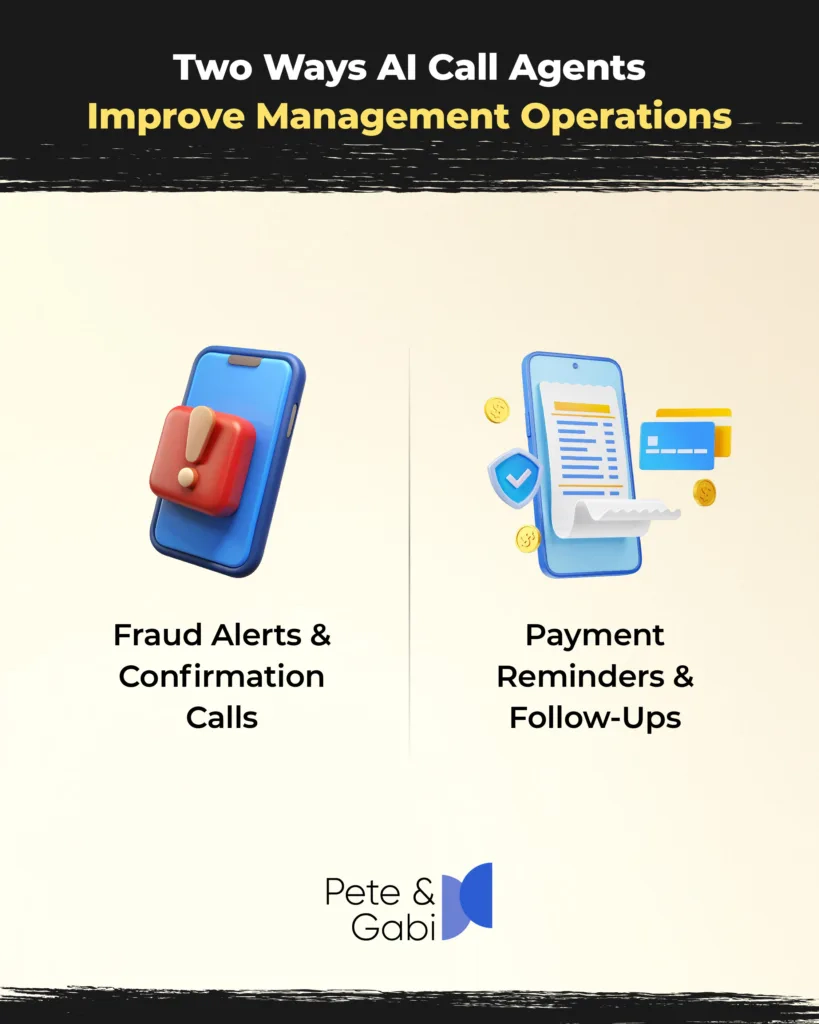
9. Fraud Alerts & Confirmation Calls
Fraud doesn’t wait for business hours. And every minute of delay in verifying suspicious transactions increases the risk of financial loss.
AI voice agents handle the work of contacting customers immediately when suspicious activity is detected.
They confirm identity, verify transactions, and escalate genuine threats to fraud teams in real time. They can also assist with KYC verification, ensuring compliance without bottlenecking in onboarding or account access.
This means faster fraud response and a reduction in false positives.
10. Payment Reminders & Follow-Ups
Late fees can damage relationships, while delinquencies increase risk.
Standing between are manual reminder calls which are often too resource-intensive at scale.
AI voice agents can automate payment reminders for loans, credit cards, insurance premiums, and other obligations. They call customers before due dates and follow up on missed payments.
And if a customer needs assistance, the AI agent routes them to a human with full context.
This proactive approach reduces delinquency rates, improves cash flow, prevents costly write-offs, and keeps customers in good standing.

Wrapping It Up
Financial services firms deploying voice AI with these use cases are capturing clients faster, operating leaner, and delivering experiences customers expect. From revenue generation to retention and risk management, these techniques are giving firms a competitive edge.
AI agents do more than just handle calls. They help you scale revenue operations, strengthen risk management, and unlock service bottlenecks.
Don’t wait to fall behind. Deploy conversational AI coverage like this for your business today.
Schedule a Pete & Gabi personalized demo to see how this can work for you.
FAQs
What is voice AI in financial services?
Voice AI uses conversational AI agents to handle phone-based interactions like lead qualification, appointment scheduling, support inquiries, reminders, and alerts—automatically and at scale.
Is voice AI secure enough for financial institutions?
Yes. Modern voice AI platforms are built with security, compliance, and data protection in mind, supporting KYC workflows, identity verification, call logging, and integrations that meet financial industry standards.
Can voice AI replace human agents?
No—and it shouldn’t. Voice AI handles the high-volume, repetitive conversations, while human teams focus on that aspect of the job that requires their human judgment and reasoning: complex decisions, relationship-building, and closing high-value opportunities.
What types of financial businesses get the most from voice AI?
Banks, lenders, insurers, fintech, wealth managers, and credit providers are all seeing the benefits. As long as your business manages high call volumes, requires strict compliance, and has competitive customer expectations, voice AI agents can be a game changer.
Share on