

It’s a new year. Do you know where your old customers have gone?
Almost every company has a CRM full of them: contacts who bought at some point but have since gotten lost in the shuffle.
The data’s invariably inconsistent, as are the reasons they’re not still buying. Maybe life got busy, priorities shifted, or a salesperson they loved left the company. Maybe a competitor’s won them over, or maybe they just reached out one time too many and couldn’t get through.
Meanwhile, your sales team has bigger fish to fry, leaving them without the time to circle back, check-in, update, and see if the customer’s needs could be met again.
With AI, these contacts no longer have to remain lost.
AI sales agents built for customer reactivation are helping businesses re-engage dormant accounts at scale. They’re recovering revenue that may be too cost prohibitive by volume for human salespeople, and in the process updating contacts and bringing in new leads.
In this blog, we extensively evaluate 10 AI agents that are thriving in this space. You’ll learn each one’s key features, best deployment scenarios, strengths, and potential weaknesses.
Why You Should Deploy Customer Reactivation AI Agents in 2026
New leads are expensive. But most businesses kick off the new year primarily chasing fresh demand.
Here’s why deploying AI reactivation agents isn’t optional for businesses anymore:
- Lower Cost Per Sale, Higher ROI: Reactivating dormant accounts costs far less than acquiring net-new customers.
- Lost Revenue Is Easier to Win Back than New Deals: Inactive customers already know your brand, which makes driving sales a more straightforward process compared to new leads.
- Always-On Follow-Ups without Team Burnout: Conversational AI agents can work the backlog your team never has time for, including on nights, weekends, and across global time zones.
- Personalized Outreach at Massive Scale: Every AI-powered outreach call adapts to history, behavior, and intent, allowing it to perform far better than more generic outreach like emails.
- Clean Pipelines, Real-Time Insight: Customer reactivation AI agents also update your CRM, surfacing intent and flagging real opportunities.
It’s a new year. Time to go get that revenue you’re leaving on the table.
Best 10 AI Agents for Customer Reactivation
So without further ado, here are the top ten AI platforms helping businesses win back revenue right now:
1. Olivia (by Pete & Gabi)
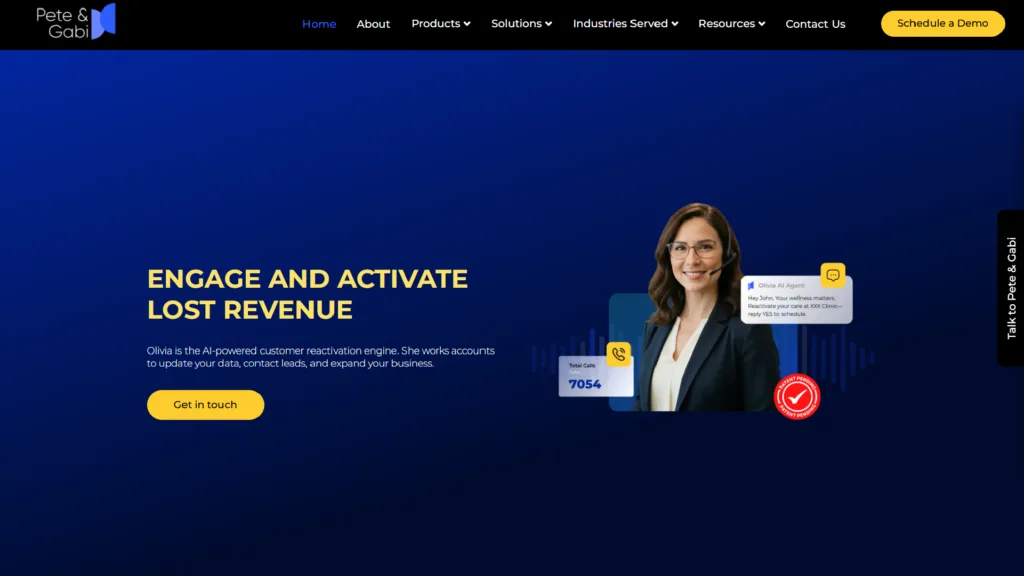
First on our list is AI sales agent Olivia. She delivers the most complete blend of scalable customer reactivation execution and real revenue recovery impact.
Olivia is an AI sales agent built specifically to bring back lost customers, reduce customer churn, and recover revenue from dormant accounts that manual outreach never has time to reach.
She handles high-volume outbound calling, qualifies intent in real time, updates CRMs, and escalates hot conversations directly to sales teams.
Unlike generic AI dialers or email automation tools, Olivia holds natural, human-like conversations that adapt to objections, assess customer sentiment, and offer personalized win-back incentives in real time.
This solution is also plug-and-play, integrating easily with existing CRMs. Its claim to fame is that it starts generating revenue within days.
Key Features
- AI-powered outbound calling at scale
- Personalized customer re-engagement based on history and behavior
- Real-time intent qualification and objection handling
- Automated CRM updates with call outcomes and notes
- Instant escalation of hot leads to sales reps
- 24/7 reactivation without added headcount
Pros
- Built specifically for customer reactivation and revenue recovery
- Handles high-volume reactivation without quality degradation
- Fast deployment
- Clear, measurable ROI tied to recovered deals
- Captures consent and highly compliance-ready
Cons
- Voice-first approach (limited visual chat capability)
- Best results require clean escalation rules
Best for
Revenue teams focused on customer win-back, churn reduction, and monetizing existing pipelines.
2. ChurnZero
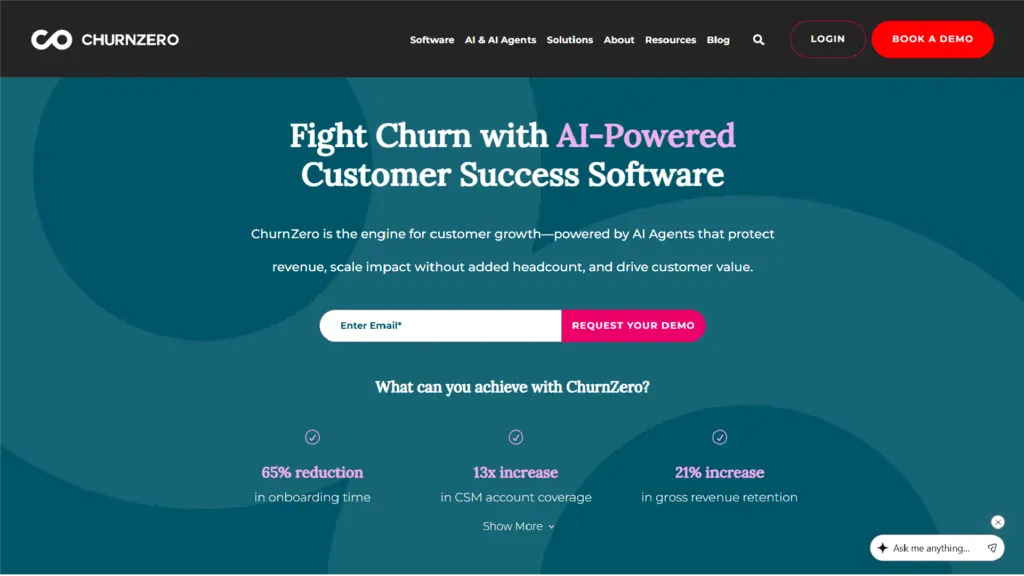
Next on the list is ChurnZero. This platform is an AI-powered customer success solution designed to help subscription-based businesses identify churn risk before it’s too late.
ChurnZero excels at tracking usage data, health scores, and lifecycle signals, giving teams early warning signs when accounts may be slipping. It’s automated playbooks, in-app messages, and email workflows help CS teams respond at scale.
ChurnZero uses predictive analytics and automated workflows to identify at-risk customers, trigger re-engagement campaigns, and guide customer success teams toward proactive retention strategies.
Note that it is designed to stop short of execution, telling teams what to do but stopping short of directly contacting customers.
Key Features
- Predictive churn analytics and customer health scoring
- Automated CS playbooks and alerts
- In-app messaging and email automation
- Advanced reporting and analytics
- Product usage tracking and engagement monitoring
- Integration with major SaaS platforms
Pros
- Strong visibility into churn risk
- Excellent for ongoing customer monitoring
- Deep analytics for CS teams
Cons
- Limited live conversation capabilities
- Built for human follow-through
- Not designed for outbound reactivation at scale
Best for
SaaS companies with mature customer success teams focused on churn prevention rather than customer win-back.
3. Salescloser AI
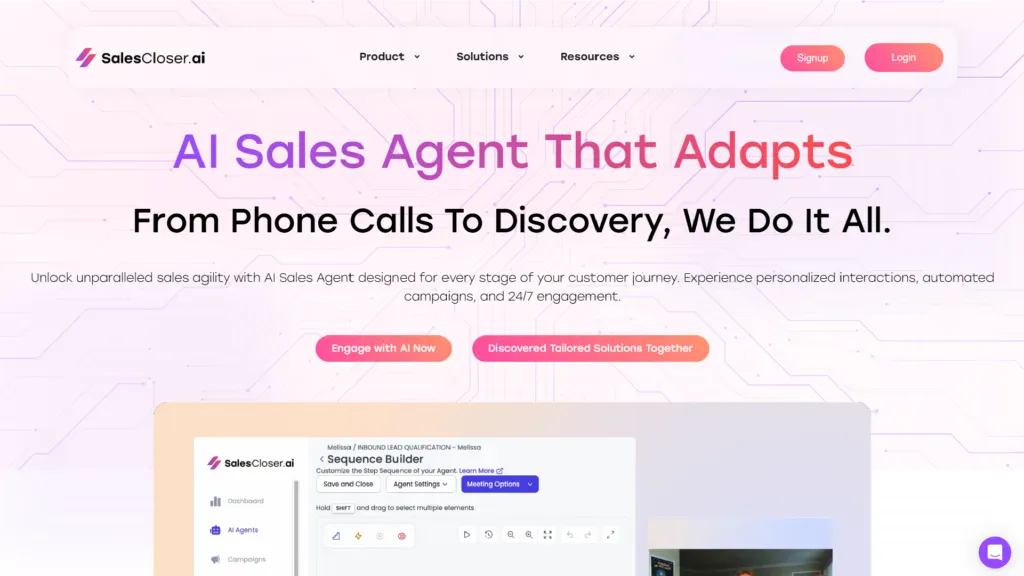
Salescloser AI positions itself as an AI sales assistant built to increase customer outreach productivity and follow-up speed.
The platform supports AI-driven conversations across voice and text, helping sales teams reach more customers without manual dialing. It assists with outbound engagement and call scheduling to keep pipelines moving.
It excels at outreach and qualification, which is the product’s bread-and-butter.
Note that complex win-back scenarios, objection-heavy calls, and CRM-driven recovery workflows may require significant customization or human intervention.
Key Features
- AI-powered outbound sales conversations
- Automated follow-ups and reminders
- Multi-channel engagement (voice + text)
- Call recording and transcription
- CRM data sync and activity tracking
Pros
- Increases outbound activity volume
- Reduces manual follow-up work
- Useful for sales engagement
Cons
- Not purpose-built for customer reactivation
- Limited depth in objection-heavy win-back calls
- Less CRM-centric than other revenue recovery tools
Best for
Sales teams looking to boost outbound efficiency and customer engagement volume.
4. Scratchpad
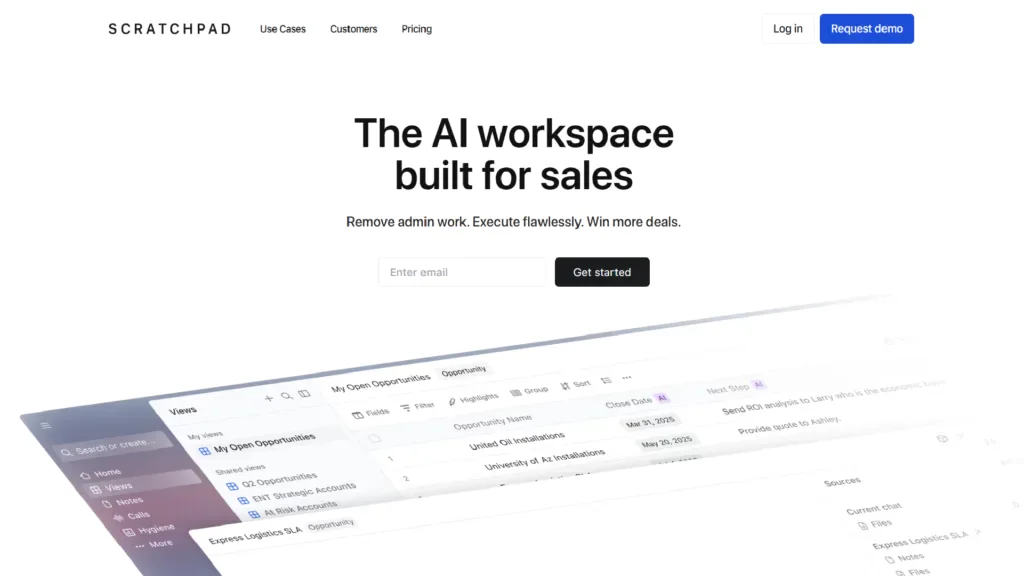
We include Scratchpad on this list, though strictly speaking it’s not a customer reactivation tool by design.
This platform offers teams a sales execution and productivity layer designed to make reps faster at driving repeat business from customers.
Scratchpad does surface inactive opportunities, flags accounts that need attention, and makes it easier overall for reps to execute manual reactivation outreach by reducing the friction of CRM data entry.
This means better customer segmentation and more focused targeting of at-risk or churned customers.
The platform’s AI-powered workflow makes it easier to identify which accounts to call and track what happens next.
Key Features
- CRM-native sales productivity tools
- Pipeline management and forecasting support
- Guided workflows for reps
- Real-time deal updates inside Salesforce
Pros
- Improves CRM accuracy and rep efficiency
- Reduces admin work for sales teams
Cons
- No outbound engagement or calling is included with this tool
- Provides insights but relies on human execution
Best for
High activity sales teams that want better CRM hygiene.
5. Relevance AI
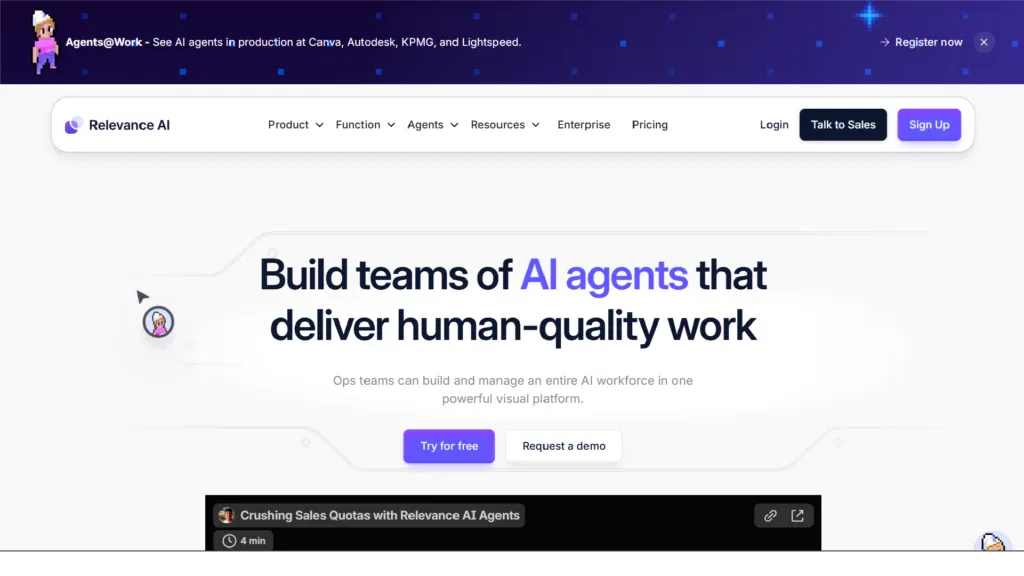
Relevance AI positions itself as a flexible agent-building and orchestration platform focused on powering internal AI workflows.
It enables teams to design custom AI agents for tasks like data enrichment, research, classification, and internal process automation. For technical teams, it offers powerful building blocks to create tailored AI systems.
In the arena of customer reactivation, Relevance AI can help identify dormant accounts, generate personalized outreach messaging at scale, and trigger automated workflows based on customer behavior.
Note that it’s not designed for live voice-based customer re-engagement or AI phone calls, but rather data enrichment and content generation.
It’s built to scale your customer win-back campaigns.
Key Features
- Custom AI agent orchestration
- Workflow automation and data processing
- Content generation at scale
- Customer sentiment and churn analysis
- Integration with CRMs and databases
Pros
- Highly customizable for advanced AI use cases
- Strong internal automation capabilities
- Ideal for technical and ops teams
Cons
- Not plug-and-play for sales teams
- Requires AI and ops expertise to deploy
Best for
Teams building internal AI systems that want to include customer reactivation workflows.
6. Pipefy
Pipefy is a workflow automation platform that helps teams streamline processes across sales and customer success—including customer reactivation workflows.
While not primarily an AI phone agent for customer reactivation, Pipefy uses AI-powered process automation to trigger re-engagement workflows when customers become inactive, fail to renew, or exhibit churn signals.
The platform automates task assignments, follow-up reminders, and multi-step win-back sequences, routing reactivation efforts to the right team members at the right time.
For instance, when a customer goes dormant, Pipefy can automatically notify the account manager, trigger an email sequence, create a follow-up task, and track reactivation progress through completion.
Key Features
- AI-powered workflow automation for sales and customer success
- Automated task assignment and follow-up reminders
- Customizable reactivation process templates
- CRM and communication tool integrations
- Progress tracking and reporting dashboards
Pros
- Strong workflow orchestration for customer retention processes
- Easy to customize for different reactivation scenarios
- Helps ensure reactivation tasks don’t fall through the cracks
Cons
- No autonomous AI voice agents for customer reactivation
- Still requires human execution for outreach
- Built for process management over automated conversation
Best for
Customer success and sales ops teams that need to automate reactivation workflows, task routing and follow-up reminders.
7. Drift AI
Drift AI is a conversational marketing and sales platform that uses AI-powered chatbots and live chat to engage customers and book meetings in real time.
While Drift isn’t an AI agent purpose-built for customer reactivation, it does offer automated re-engagement capabilities through chat and email that can achieve many of these objectives.
The platform can identify returning visitors (including past customers who churned), trigger personalized chat experiences, and route high-value accounts to sales reps automatically.
Drift excels at inbound reactivation—when a lost customer returns to your website, Drift can recognize them, start a conversation, address past objections, and book a meeting on the spot.
It’s particularly effective for B2B SaaS and tech companies where customers research online before re-engaging.
Key Features
- AI-powered chatbots for lead qualification and re-engagement
- Real-time meeting scheduling with calendar sync
- Account-based marketing (ABM) targeting for high-value accounts
- CRM integration
- Intelligent conversation routing
Pros
- Effective at capturing returning website visitors
- Strong inbound reactivation
- Seamless integration with sales and marketing tools
Cons
- Chat-based only (no voice calling or AI phone agents)
- Reactive, not proactive (waits for customers to return to your site)
- Limited for high-volume outbound customer reactivation
Best for
B2B sales and marketing teams that want to re-engage lost customers when they return to your website through real-time conversational chat.
8. Braze
Braze is a customer engagement platform designed to orchestrate personalized marketing campaigns. It works across email, SMS, push notifications, and in-app messaging.
It’s not an AI sales agent, but it does offer AI-powered customer re-engagement features through predictive analytics, behavioral triggers, and automated messaging sequences.
The platform also identifies customers at risk of churning, triggers win-back campaigns, and personalizes outreach based on user behavior and lifecycle stage.
Braze really excels at multi-channel customer retention services, sending personalized re-engagement messages at scale across multiple touchpoints.
Key Features
- AI-powered predictive churn analytics
- Multi-channel campaign orchestration (email, SMS, push, in-app)
- Behavioral triggers and automated win-back sequences
- Personalization engine based on user behavior and preferences
- Integration with mobile apps, CRMs, and data platforms
Pros
- Strong multi-channel customer re-engagement capabilities
- Effective for mobile and app-based businesses
- Advanced personalization and segmentation features
Cons
- No voice-based AI agents or conversational AI for sales
- Primarily messaging automation (email, SMS, push)
Best for
E-commerce, media, and subscription businesses that need to reduce customer churn.
9. Gainsight
Gainsight comes in at number nine.
A customer success platform designed to help businesses reduce customer churn, improve retention, and drive product adoption, it makes use of AI-powered health scoring, predictive analytics, and automated workflows.
Gainsight can help you identify at-risk customers and trigger proactive outreach, by guiding customer success teams toward retention strategies before churn happens.
This platform can also automate email-based re-engagement campaigns and provide visibility into account health across your portfolio.
Note that it doesn’t offer conversational AI agents for customer reactivation. Gainsight is a customer success orchestration platform, not a voice AI tool.
Key Features
- Predictive churn analytics and customer health scoring
- Automated customer success playbooks and workflows
- Product usage tracking and engagement monitoring
- Email-based re-engagement campaigns
- Integration with CRMs, support platforms, and product analytics tools
Pros
- Strong predictive analytics for identifying churn risk early
- Comprehensive customer success management features
- Well-suited for B2B SaaS and subscription businesses
Cons
- No autonomous AI voice agents for customer reactivation needs
- Requires customer success team involvement for execution
Best for
B2B subscription-based businesses that want to prevent churn through data-driven workflows and proactive retention strategies.
10. Blueshift
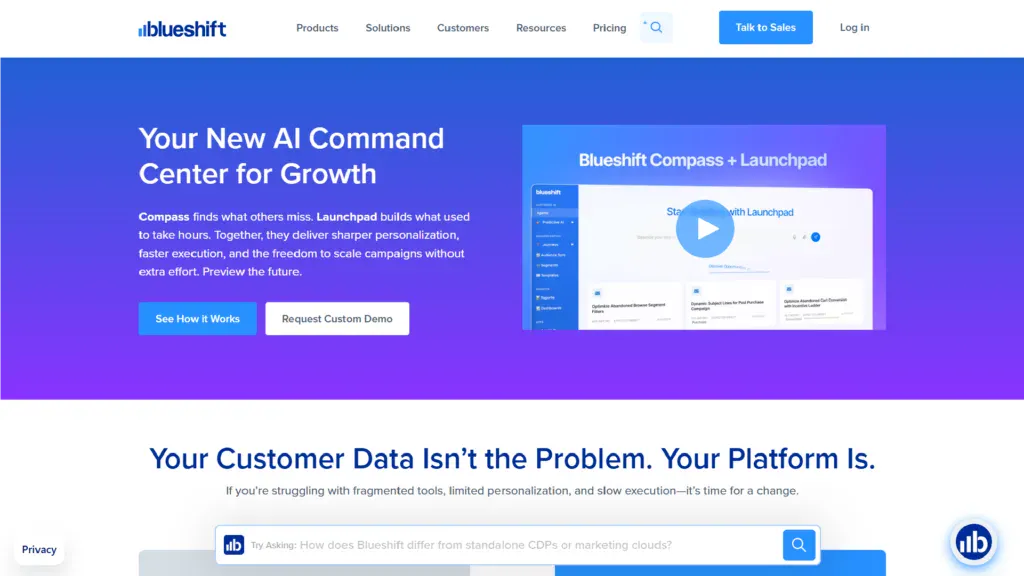
And finally, we have Blueshift, an AI-powered customer engagement platform designed to orchestrate personalized marketing campaigns across email, web, SMS, and paid media channels.
It leverages predictive analytics and machine learning to identify customers at risk of churning, trigger automated win-back campaigns, and personalize messaging based on real-time customer behavior and purchase history.
The platform also excels at multi-channel customer re-engagement—automatically sending personalized offers, product recommendations, and re-activation messages across touchpoints when customers become inactive.
Blueshift excels at reducing customer churn through data-driven messaging automation but does not offer conversational AI voice technology for sales uses.
Key Features
- AI-powered predictive churn analytics and customer segmentation
- Multi-channel campaign orchestration
- Real-time personalization based on customer behavior
- Automated win-back sequences and re-engagement workflows
- Integration with e-commerce platforms, CRMs, and data warehouses
Pros
- Strong multi-channel customer re-engagement capabilities
- Advanced personalization and predictive analytics
- Effective for e-commerce and B2C subscription businesses
Cons
- No voice-based AI agents or conversational AI
- Primarily for digital messaging automation (email, SMS, push)
Best for
Marketing teams optimizing digital lifecycle campaigns for customer re-engagement.
Choosing the Right Customer Reactivation AI Agent for Your Business
There are a lot of players in the field, each bringing their own type of solution to bear for businesses today.
So which kind do you need?
Here are some questions to ask for choosing the right AI customer reactivation agent for your business:
- Can it actively reach out, or does it wait for engagement? Reactivation requires execution as well as intelligence. AI systems that make outbound calls and follow-ups with the right information.
- Does it sound human? There’s a wide variety in the quality of conversational AI on the market. Pay attention to the quality of voice agents, including how they respond to users in real-time.
- Can it handle objections and uncertainty? Customer reactivation use cases make this one critical. It must be able to answer “Why now?” and “What’s changed?” in real time.
- Does the platform integrate cleanly with your CRM? Every call, outcome, and insight should sync automatically.
- Can it scale without burning out your team? When demand spikes, the best AI agents adapt seamlessly. Most also work after hours and across time zones but be sure it can take autonomous action to keep the conversations going.
- Is escalation controlled and transparent? You should be able to decide when humans step in and ensure they have full context when they do. Note that not all systems offer live transfer, if this is important to your workflow.
The best AI agent for customer reactivation isn’t the one that flags inactive customers or sends out reminders you exist.
It’s the tool that actually takes action and brings them back.
Taking the Next Step
The question isn’t whether you have lost revenue sitting in your CRM, because you most certainly do.
It’s about how you turn dormant accounts into active sales at scale and update your data in the process.
If you’re ready to convert past demand into present revenue, few solutions on the market can touch Olivia—the AI agent purpose-built to bring customers back.
Schedule a demo to see her address your specific needs.
FAQs
What is a customer reactivation AI agent?
A customer reactivation AI agent is a conversational AI system that proactively contacts inactive leads, stalled deals, or past customers to restart conversations. Unlike email-only tools, these agents engage prospects through real voice and text interactions.
How does AI customer reactivation differ from email or SMS campaigns?
Email and SMS campaigns broadcast messages with the goal of getting replies. AI reactivation agents conduct live, two-way conversations. They follow up consistently, respond in real time, ask qualifying questions, and adapt based on customer intent.
Can customer reactivation AI work with existing CRMs?
Yes. Modern AI reactivation platforms integrate directly with CRMs and sales tools to sync contact records, log conversations, update deal stages, and write notes automatically and with higher consistency.
Can AI really handle objections and win back lost customers?
Yes. Systems built for customer reactivation don’t just use scripted responses. Their advanced conversational AI can navigate nuanced conversations, offer personalized win-back offers, and respond naturally with the right solutions or incentives.
Share on