

In business, everyone knows AI is the future. But not everyone has the time or money to devote to exploring it now.
To experiment in sandboxes, monitor, slowly integrate, ensure the AI is secure and compliant, or deal with miscues or outright misfires on things like complex product data.
At a larger scale, Forrester reports enterprises are even deferring some of their planned AI spends (they estimate 25% to 2027) because companies know it’s coming and hugely transformative but they want proof of impact and nitty-gritty use cases up front.
We’ve profiled a few areas where AI is already doing just this. Where it’s gained real, reliable traction, from coding assistance to customer service first contact to recruiting follow-up and initial screening.
Today we’re writing about another of these: voice AI for sales outreach. While a lot of AI projects are highly speculative, this area is seeing a boom of investment because companies of varying size are already clocking impressive gains.
With 2026 as the “show me the money” year for AI (per firms like Menlo Ventures), voice AI is surging in sales uses for companies seizing on its ability to extend their reach and generate tangible results with minimal pain.
Leading the Pack: Voice AI Adoption Surges into 2026
One reason AI companies remain focused on math competitions is that the answers are ultimately right or wrong. The process to get to the answer can be clearly tracked and the logic analyzed.
Voice AI in sales gives similar benefits, and that’s no doubt one reason it’s risen among business use cases.
You can count the calls that have connected, the meetings booked, and the revenue opportunities generated. For reactivation use cases, you also get customer data updates and hours saved for your sales team, but those areas are a little harder to quantify cleanly (and more like the broader AI claims across the board).
In customer service, Gartner projects conversational AI in contact centers will resolve 80% customer service issues automatically by 2029, and early successes have seen that integration in voice AI get well underway. Just last week, voice AI startup Deepgram hit a $1.3 billion valuation with over a hundred million dollars invested for it to scale internationally and continue its mad growth. Meanwhile venture capitalists like Simon Wu, partner at Cathay Innovation, told Business Insider that 2026 is the year voice AI becomes the default for not just customer service, but also sales and support workflows.
This is driven by data. In sales, one of the most efficient uses today is outreach, as with dormant accounts that aren’t getting serviced or follow-ups that aren’t getting made quickly or routinely enough.
On a per-call basis, these can feel like a waste of time for talented sales reps, who burn hours digging into what data they have, dialing and chasing the customers, and finishing with manual data updates.
But at scale, conversational AI systems are executing this use case with extreme effectiveness and consistency.
They’ve gotten good enough to sound and feel human, operate reliably within guidelines, be compliant, secure, and yield real ROI fast. They can also be fairly light-weight, getting on their feet in days and showing payback in weeks.
No doubt the years to come will see expansion of this capacity, but today they’re operating as a reliable play for companies tapping into AI efficiency to extend reach without undergoing extensive technical overhaul.
By the Numbers: AI Calling Agents for Sales and Support
Another reason this area in AI is so hot is that it’s repetitive, acts on data you have, and doesn’t require all new KPIs to measure.
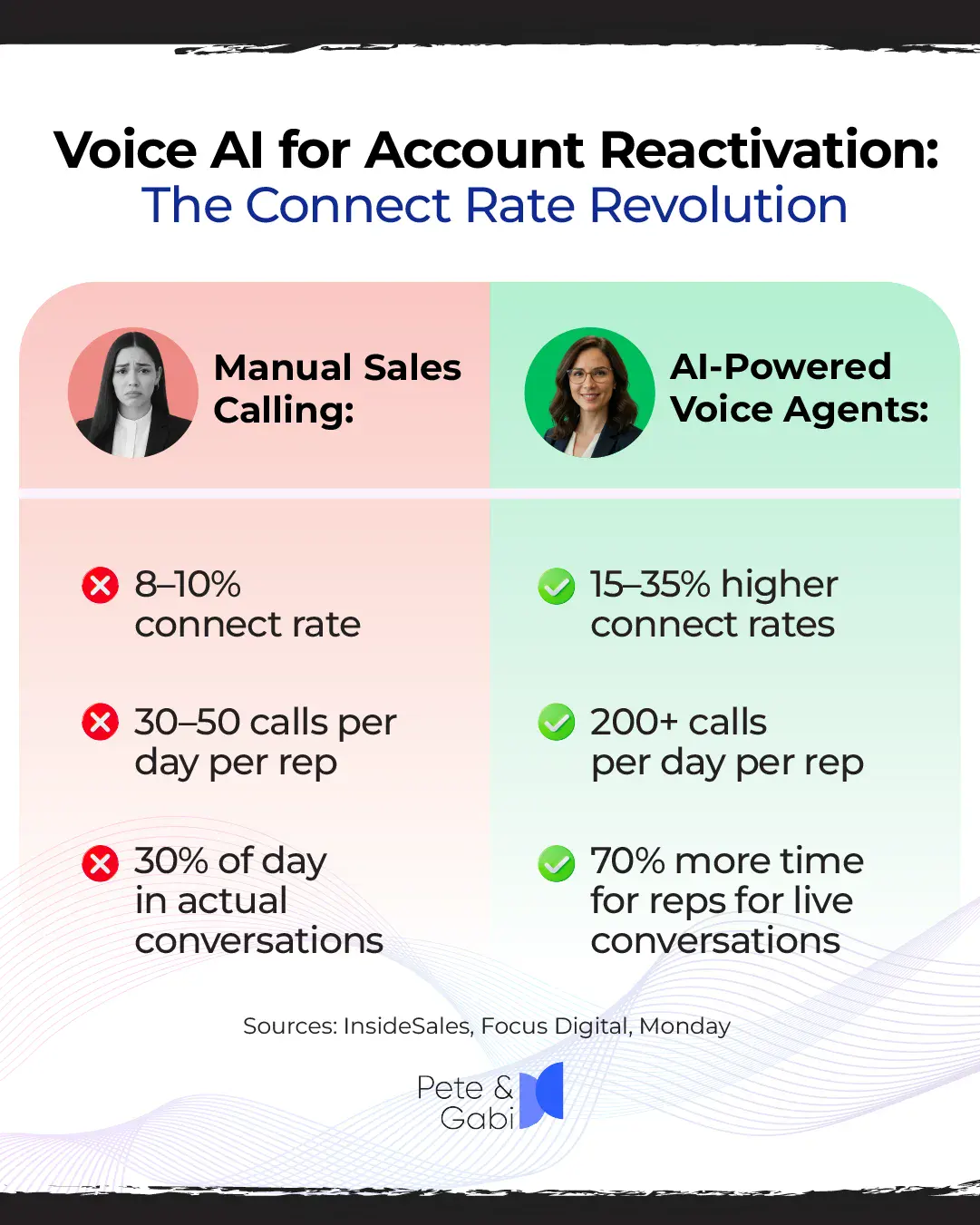
Companies see the success in radically improved connect rates, with those using AI-powered outreach averaging 15 to 35% increases (with providers themselves boasting higher, of course).
There’s also no question about volume, with AI systems able to handle huge numbers of calls (from hundreds to thousands per day) versus the 40-odd made by reps on average (again, highly variable, though consistently well less-than-half of AI’s bandwidth).
Here’s a look at more of these metrics:
Qualification and conversion rates with these systems show improvement largely across the board. There are scores of examples from providers, like pilots: a voice AI agent dialed 8,000 numbers not getting serviced, connected with 11.5% live on the phone, and qualified 17.5% of these. This was 12 times higher engagement than e-mail for the customer over the same list.
Or the legal services firm that implemented voice AI and boosted its qualification by 60% to 85% among answered calls. This translated to 72 qualified appointments per month versus 30 previously. They ultimately doubled monthly closed deals as a result.
For Pete & Gabi’s Olivia AI, a global distributor revived $139,000 in the first 30 days, working through a backlog of accounts. From the first 1000 calls, the stats were:
- 475 voicemails
- 413 conversations
- Prospect details collected from 35
- Additional inquires made by 25
- 12 conversions
- $21,000+ closed
These are anecdotal but demonstrate why this use case is so prevalent and the tech is witnessing a real surge of investment.
Speed is another metric you can track in conversion, and effective AI systems also win here easily, responding to inbound contacts some 70% faster, with AI cold calls getting 35% + higher meeting conversion rates.
In other words, more calls, faster, by fewer agents, with more conversions. For those asking how to win back inactive customers with higher quotas and limited bandwidth, automation is now providing a surprisingly effective answer.
Conversational AI for Sales in Action
At a larger scale, Verizon has shared the impact of its use of Google AI in this arena for sales.
They started deploying AI features in the summer of 2024 (hitting full scale January 2025) and slashed their reps phone time.
They consequently saw their sales numbers surge by 40% since deployment.
Verizon is also using AI assistants to help reps get the right answers on the fly.
“We are doing reskilling in real time from customer care agents to selling agents,” CEO of Verizon’s consumer group Sampath Sowmyanarayan told Reuters.
Google Cloud CEO Thomas Kurian added: “Compared to what other people are doing, this is enormous scale.”
The company handles 170 million calls annually and also uses generative AI to predict call reasons with approximately 80% accuracy. This leads to more effective routing, and they’ve been able to tie it directly to loyalty and churn reduction goals.
But companies of varying sizes are gaining these benefits without such complex or unique integrations. They’re reaching more customers faster with AI, improving the data in their CRM directly, and realizing revenue at scale that’s been deemed too costly to chase until now.
This is further improved by routing high value opportunities directly to reps to close, with all the history and context provided, searchable, and updated on-the-fly.
The AI Sales Agent Revolution
Much of the change in this area is due to how fast voice AI systems have improved over the last 18 months. At a Federal Reserve conference in July, OpenAI CEO Sam Altman warned the financial industry of a “significant impending fraud crisis” due to AI’s ability to consistently fool voice-print authentication.
Around the same time, the Washington Post reported on a deepfake of Secretary of State Marco Rubio being used to successfully contact US officials and foreign ministers. These audio messages were accompanied by texts that also matched his writing style.
And while such deepfakes open the door to fraud and real security concerns, they also showcase how effective voice AI has gotten at sounding human and responding like we do.
For business use cases, regulations like the TCPA also cover AI, according to the FCC. This means that business AI usually must self-identify, and most systems capture consent by default.
It also avoids the incredibly unpopular experience of users thinking they’re talking to humans when they’re not and has witnessed a surprisingly fast rise in consumer acceptance of contact by self-acknowledged voice AI systems.
Telnyx’s Consumer Insight Panel from November is the latest showing commonly cited trends: customers heavily prefer AI to hold times or a lack of service (80%) and accept customer service provided the system has comprehension and natural conversational flow capabilities (72%), with a whopping 87% of consumers having talked to voice AI in some capacity within the past six months.
Far lower latency and improved responsiveness have made conversational voice AI the contact of choice over answering systems, chatbots, or emailers. They also bring ready transcripts, controlled knowledge access (like policies, catalogs, order history), and the ability to tie into and update calendars, CRMs, analytics, with full and searchable audit logs.
Better Catalog Capability: Automated Voice Outreach AI and Product Depth
Human reps take time to come up to speed on policies, brand voice, and especially complex product offerings or large catalogs. Increasingly AI is giving a big advantage here, too, both for customer reactivation outreach and for assisting human agents in answering questions on-the-fly.
Over the past two years, Verizon’s deployment resolved this for AI and humans alike by feeding 15,000 internal documents into Google’s Gemini to give their system the specificity it needed for both voice AI and agent assistance.
Today it’s even easier for systems to get up to speed on proprietary data, with systems able to work from connected systems like CRMs or knowledge bases specifically built out of approved sources like catalog data, company policies, pricing rules, FAQs, and more.
This capability ensures systems are working consistently from uniform criteria, rather than interpreting or inventing solutions on their own. And if they don’t know or are unclear, they can then transfer the call to someone who does.
Smart Transfer Remains Critical for Customer Retention Services
As mentioned above, this use case is thriving in part because it’s well defined. And the more insight companies can make available to systems, the better they perform.
This includes data like customer segmentation which helps AI systems know why customers have gone dormant or inactive. Companies that can categorize a finite list of reasons further empower voice AI systems to resolve customer issues in outreach at scale, again following repeatable patterns but with personalization and full interaction.
Still escalation or live transfer remain essential. The use cases discussed here are about bandwidth, speed of contact, and getting to customers who aren’t being serviced now. In short, they’re about conducting outreach you can’t get to today and returning direct revenue and opportunities from it while also improving customer contact.
Closing deals and resolving complex issues still require human reps. Because while customers value voice AI systems for transactional use and ready information (72–80% acceptance rates), they also consistently distrust them for personal issues, complexity, or where emotions are concerned (39% baseline to a high of 53%).
Voice AI systems and AI assistants help human agents put their time where it’s best used, while also responding faster and more effectively. They shift human conversations to focus on edge cases or conduct sales-focused interactions.
To this end, effective systems provide clear triggers that are customer-defined for live-transfer, in addition to compliance or regulatory-requested transfers, and the potential to automatically schedule (and confirm) meetings and follow-ups on demand.
Conclusion: Sales Means Getting More than AI-Powered Follow-Up Calls
We’re talking about using AI agents for more than just outbound calling here. These sales use cases draw from company data, personalize outreach, address objections, and transfer live to reps (or schedule meetings).
They reactivate customers and work accounts. They execute on your intelligence, within brand and on-message. But no, they can’t replace reps.
This use case is surging, however, because of ROI like this:
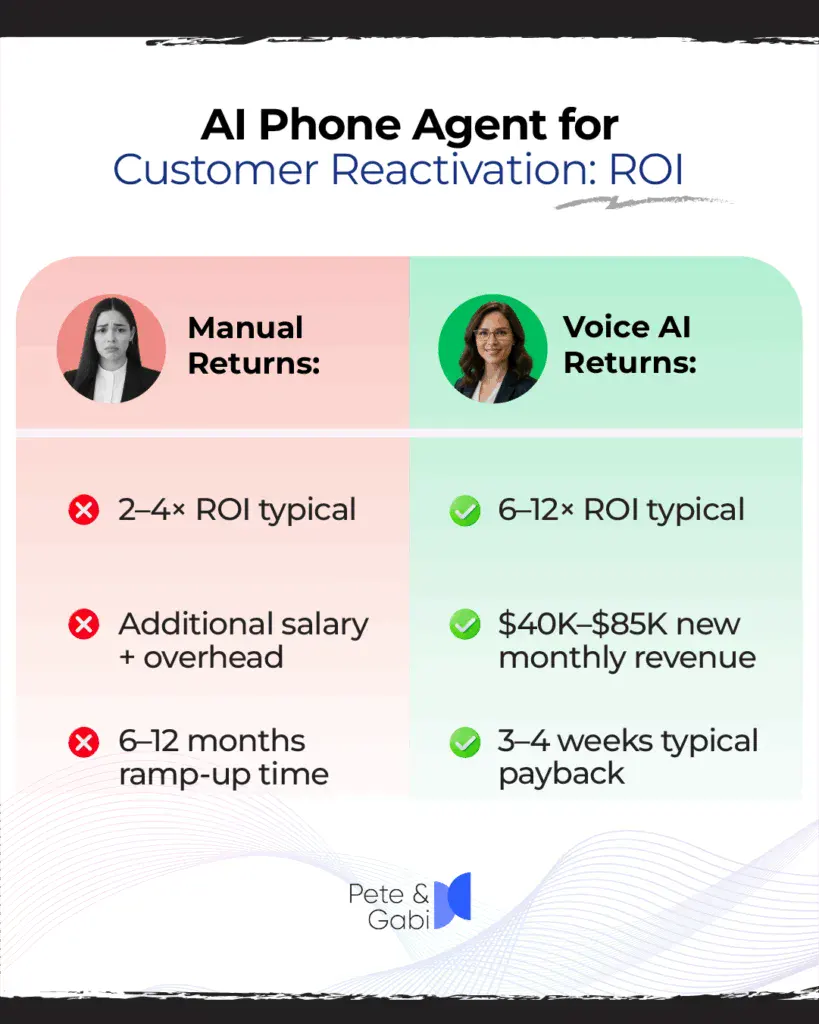
AI phone agents can bring real-time execution at scale, closing a loop that’s outside the reach of most sales teams manually. And it works in conjunction with safety and governance by design. This means least-privilege permissions, full audit logs (call records, outcomes, transfers, personal data updates), consent captured and recorded for outbound calling, minimized data with clear retention policies, and human overrides and transfer/escalation rules.
Depending on need, many providers today also get up to speed fast, scale on demand, and work within highly defined guidelines.
In a world of big-picture, inconsistent, slow-to-gain AI, the use cases discussed here for voice AI are a surging, win-now play for businesses.
And business is booming.
FAQs
How does voice AI improve connect rates in outbound calling?
It improves speed of contact, coverage, and persistence. Drawing from company data, these systems conduct structured outreach at a consistent volume, across time windows, with clear retry logic. They get to contacts that sales reps often can’t, and by taking on repetitive volume, aid with burnout and conduct updates to reduce the administrative burden.
Can voice AI handle complex B2B product catalogs and technical questions?
This depends on implementation, but this use case is thriving for so many businesses because the answer can be yes. It requires grounding in actual product catalogs, business policies, transfer rules, and customer history. This helps agents stay on track, asking clarifying questions when needed or transferring to reps without making mistakes or fabricating data.
Practically, how much technical overhead is there? How hard is it to integrate with Salesforce or HubSpot, for example?
This depends on need and system, but voice AI platforms like Olivia are on their feet in days with first revenue 48–96 hours after kickoff. Most can integrate with your CRM or internal systems directly, and don’t require extensive technical expertise or on-site coding.