

In a world where it’s five times more expensive to acquire new customers than to keep the ones you already have, businesses are now enhancing their commitments to customer reactivation.
Prioritizing the reactivation of dormant accounts in your CRM becomes a no-brainer when you consider a 5% increase in customer retention that can eventually boost your revenue from 25% to 95%, according to reports (demand Sage). However, most organizations still struggle.
Why?
Since sales teams are mostly stacked with the demands of converting and onboarding new prospects, finding the time to chase old customers seems impossible.
Now here comes the good news.
One of the use cases where businesses today are seeing the most gains from AI deployment is customer reactivation. Why? AI agents easily take on the high-volume work of reaching out to churning customers to find out why each one stopped buying.
This blog breaks down how conversational AI helps you turn the silent accounts in your CRM into paying customers without overworking your current team or hiring more staff.
Hidden Economics of Dormant Customers

Most businesses don’t realize the hundreds of thousands (potentially millions of dollars) that they are leaving behind in their CRM because the ‘customer already bought.’ It gets even worse when you realize that those dormant customers are even costing you money.
In other words, you’re not only losing out on potential profits. You’re actually leaking it too.
We’ll break it down.
In business, every dormant account falls into one of three categories of financial loss. And the longer they stay inactive, the more that loss compounds.
Sunk Acquisition Costs
A new customer acquisition comes with an upfront cost, driven by ads, emails, content marketing, or other acquisition channels. Nevertheless, many businesses treat customer acquisition as a renewable expense rather than a capital investment that needs protection.
In 2025, the average customer acquisition cost across the SaaS industry was around $1200, according to GTM 80/20. Hence, imagine a customer going dormant after a single purchase. That’s an investment you fully never recoup.
And that’s just one customer.
If your CRM is filled with say, 1000 dormant accounts, the math goes up to 1.2 million dollars in buried customer acquisition spend.
Unrealized Lifetime Value
Customer Lifetime Value (LTV) is a metric that measures the total contribution a customer brings to your business over the course of their relationship with a company. In other words, customers cannot only be one-off buyer.
So, where it gets more interesting?
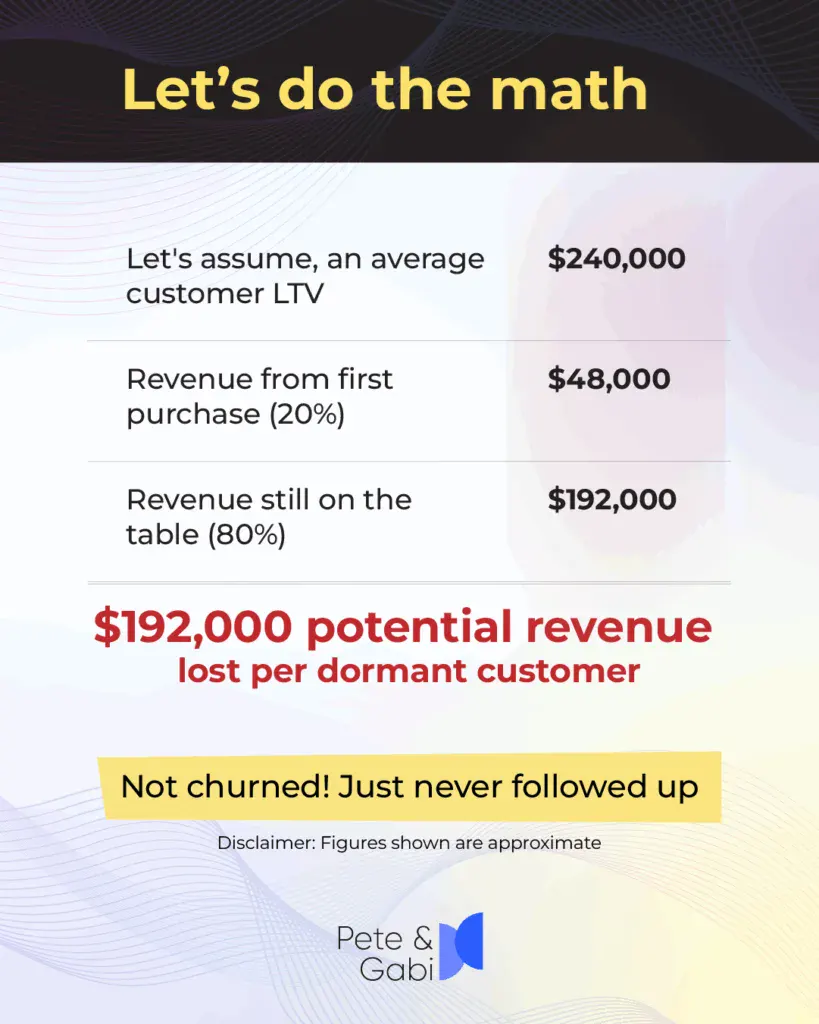
On average, customers only spend 10-30% of their total potential LTV during their first purchase. This means that if you leave dormant customers in your CRM, or worse leave them to churn and be snapped up by the competition, you risking leaving 70-90% of potential revenue behind.
Opportunity Cost of Replacement:
As mentioned earlier, acquiring new customers costs significantly higher than retaining or reactivating your existing customers.
And that’s just the beginning.
Familiarity and credibility built with your existing customers goes in vain since these values must be kickstarted again from scratch with the new customers, it eventually delays the revenue from new prospects as well.
As a result, customer reactivation becomes a vital aspect of running a profitable business that’s prevents leakage in revenue.
Abiding that, let’s explore how AI agents can assist you in reactivating dormant customers and win back stranded revenue.
Why Manual Reactivation Fails (Even When You Try)
There’s always the option of putting your sales reps on manual customer reactivation duties. But you’ll quickly find that this process very rarely offers ROI that justifies the time and effort teams put in.
And no, it’s not because your team is slacking. Or inefficient. Or not talented.
More often than not, it’s a capacity problem.
There are simply too many contacts to call and not enough working hours per day. And let’s not forget, your sales team still has to go after active customers and new leads to drive revenue goals.
So, they resort to randomized follow-ups (calling those who ‘feel’ most promising) and risking burnout while chasing voicemails for hours. Then, comes the tedious manual CRM updates that follow for the new customers they actually connect with.
Overall, manual customer reactivation is slow, painstaking, and yields marginal results for a critical problem. Let’s focus on what wins…
AI-Powered Customer Reactivation: It Actually Works!
AI customer reactivation utilizes conversational voice automation to run scalable win-back campaigns. These voice AI agents scan through your CRM at scale, initiating calls to dormant customers and engage them in natural language to understand why they’ve been inactive, and identifies the pain points you need to rectify.
Depending on these calls, AI will transfer the customer calls to your sales team, enabling them to close with tailored offers that win them back. During this period, AI call agents update your CRM with customer categories, conversation contexts, and potential next steps.
Thereby, it renders a structured solution on a scale that takes manual-only initiatives unviable.
AI-powered customer reactivation actually works!
AI Reaches to Dormant Customers at Scale
How many customer outreach calls can your sales team manage a day? 30? 50?
Bridge Group Inc’s sales development report suggests that the average number of calls made by most sales teams per day is 40 and only about 4.6 calls yield quality conversations. Let’s round it up to 5.
However, it falls short from the results of what a conversational AI can achieve. Modern conversational AI systems can handle hundreds of conversations simultaneously by maintaining consistency and precision across all conversations.
AI Conducts Personalized Conversations Every Time
Many businesses often rely on templated emails under the guise of customer reactivation, ignoring that today’s customers want to be recognized, understood, and valued rather than a generic mass outreach.
To identify those specific customer details, conversational AI crawls through your CRM in real-time, such as, purchase history and past interactions impetuously. With this, the AI agent can reference customized information, providing customers with a genuinely valued experience.
Throughout the conversation, the AI probes why they stopped buying, addresses their pain points, and proposes relevant solutions. Unlike templated email campaigns, natural conversation yields higher engagement and significantly improves reactivation.
AI Hands off Warm Leads to Humans at the Perfect Moment
Voice-first AI-lead customer reactivation campaigns win because it eliminates friction between the buyer ‘s decision and the actual sale.
The AI agent immediately hands off to a human sales rep with full context of the conversation to close immediately when the customers show re-engagement signals. Hence, it keeps customer engagement high, and deals get closed faster.
Closing the sale entirely depends on the customers acting by themselves in other reactivation channels like emails and SMS reminders. In such traditional methods, many may forget, postpone, or eventually walk away.
Stop the Silence and Reactivate Your Revenue
Every customer who stopped buying from you is sitting in your CRM doing nothing.
You have two choices.
Ignore them and waste all the money you spent getting them in the first place? Or actually try to get them back using AI?
And that’s AI call agents take over!
Voice AI calls dormant accounts, engages with them naturally, discovers reasons for inactivity, and drives them with a reason to come back. And operates 24/7 with complete consistency.
Implement conversation AI agents to power your customer reactivation campaigns.
FAQs
Why should companies use AI in conjunction with human representatives to reactivate customers?
Before reaching out to the complicated scenarios that require human skill, customer reactivation largely requires simple but repetitive calling at a scale that exhausts teams.
And this is the point at which AI augmentation becomes essential.
By contacting thousands of contacts, asking questions to identify pain spots, and determining how to win these clients back, AI bots take care of the laborious tasks. Your sales team only can step in for the key interactions that close the transaction.
How soon can lost revenue be recovered with AI-powered reactivation?
Implementing conversational AI usually takes one to two weeks. After deployment, AI agents actively begin outreach, initiate reactivation, and win back dormant clients to regain revenue.
What differs between AI-powered consumer reactivation from conventional follow-up campaigns?
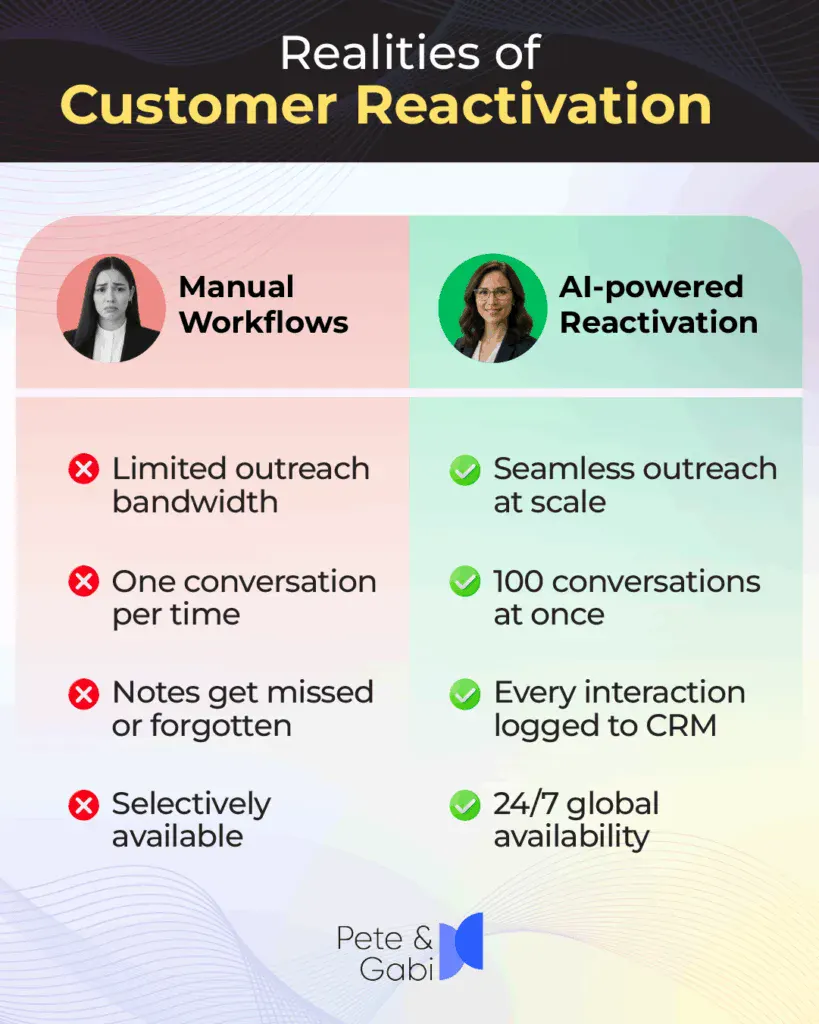
Conventional follow-up campaigns are restricted by bandwidth, working hours, and selective availability, and they rely solely on human input. Conversely, AI agents manage high call volumes without becoming tired or making mistakes, and they are always accessible to continue reactivation efforts even when your team is not working.
Can AI voice agents personalize reactivation dialogues without coming across as scripted?
By engaging in genuine dialogue, contemporary AI voice operators adjust in real-time to client thoughts and reactions. Conversational AI is able to listen, deliver pertinent answers in context, and clarify as needed. Robotic scripts, inflexible queries, and irrelevant answers are no longer a concern for businesses.
Conversational AI implementation typically takes one to two weeks. In order to recover revenue, AI agents actively start outreach, start reactivation, and win back dormant clients after deployment.
Share on