

Healthcare providers are facing a strange reality. Demand for care has never been higher, yet growing administrative burdens mean clinicians spend much of their time on phone calls, paperwork, and scheduling rather than with patients.
This growing gap can be filled by the new generation of AI voice/text-based agents with the ability to conduct natural-oriented conversations that have goals. In comparison to chatbots of the past, modern AI healthcare agents can call patients and answer complicated insurance questions; they collect data from patients; and sort patients concerns in real-time without needing to have a human on the other end of the conversation.
The use of AI agents is not in the future; clinics, hospitals, and specialty practices have started deploying them in their patient communication workflows already, with measurable success: a decrease in no-shows, faster patient response times, increased patient satisfaction scores, and reduced staff time required for patient communications are all examples of how successful they have been. The question has shifted for healthcare leaders from whether to implement AI agents within their organization, to choosing workflows they will implement as their priority.
For instance, a call reminding a patient about colonoscopy preparation can be handled very differently from a follow-up call after surgery. Modern AI agents can be trained to recognize these scenarios and respond appropriately with remarkable accuracy.
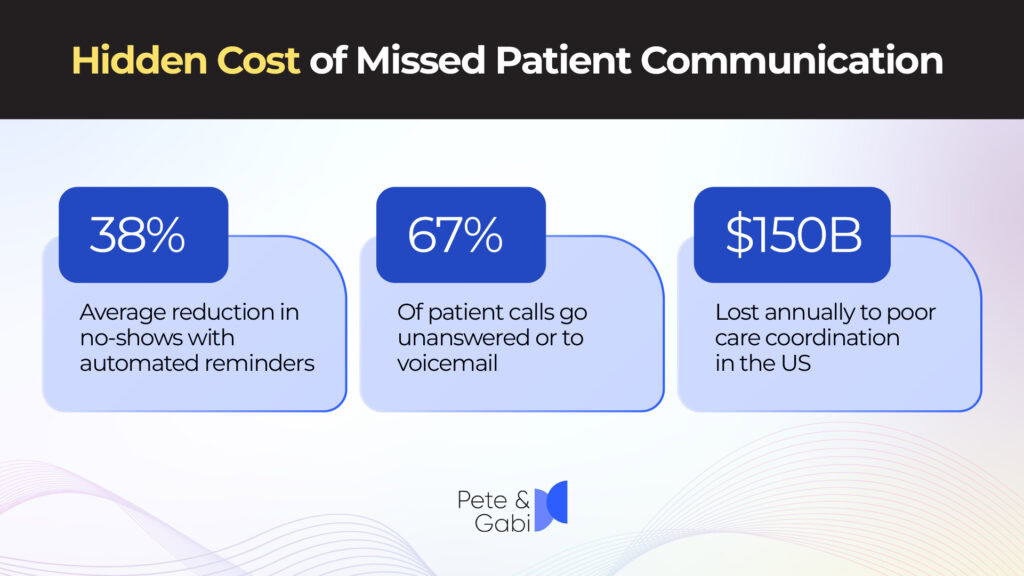
Source: PMC
How AI Agents Fit into Healthcare Workflows Without Disrupting Them
AI agents excel in integration into existing global healthcare systems. Connecting with EHR, schedule, and customer relationship management (CRM) systems allows these agents to leverage the actual data available on patients such as appointment schedule, their medication schedule and how insurance will be billed for those medications to provide a more customized interaction between patients and providers. Patients will not only receive generic reminders for their appointments but will also get calls with context specific to their appointment, including the provider, date/time of appointment and documents needed to prepare for that appointment.
The 15 Use Cases: Where AI Call Agents Deliver the Most Impact
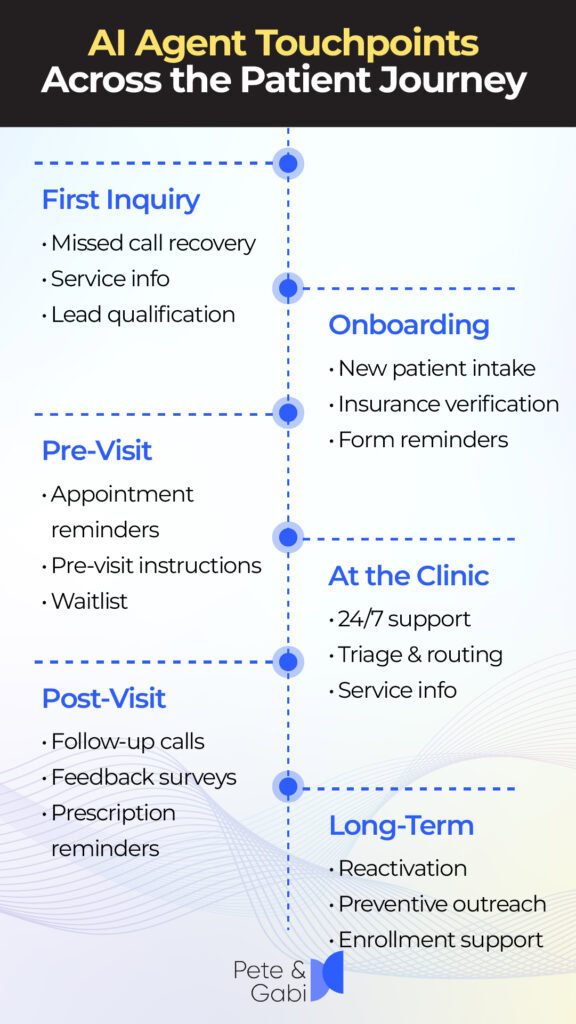
The use cases relate to every aspect of a patient interaction or ongoing relationship from the time they first make contact with a provider to the long-term retention of that patient, grouped by similar functions.
- Appointment Reminders: From an automated voice or text message system between 48 and 72 hours prior to the visit, send out reminders of scheduled appointments. With the use of an AI agent to confirm, reschedule or cancel appointments in real time and update the schedule, these reminders reduce the number of “no shows” on average by 30-40% and enable the provider to recoup substantial revenue weekly when you have patient flow working smoothly.
- Missed Calls: Inbound missed calls represent possible patient losses. An AI agent detects missed calls and calls the caller back within a few minutes of detecting that the call was missed. Messages left by the AI agent are human-like and allow for a follow-up call prior to the prospective patient calling another provider for the same service. The AI agent ensures that no lead will be lost to the provider after hours.
- Pre-Visit Instructions: Call or send out a message (via phone or a digital method) specific to each procedure, such as fasting windows, holding specific medications, what time to arrive, completing forms, etc., to your patient before their appointment. Sending this information at the appropriate timeframe before their appointment will reduce patient confusion and last-minute cancellations based on not being adequately prepared for their appointment.
- Waitlist Management: Once an appointment becomes available, due to a cancellation, all patients on the waitlist will be contacted. The AI will call them in the order that they were placed on the waitlist. This allows practices to fill their same-day cancellations typically within minutes rather than hours by eliminating several steps of staff calling down a roster of patients manually.
- Reminder Systems: The delayed appointment check in process that is caused due to incomplete intake forms is reduced through the use of an AI. Patients receive timely reminders of any outstanding forms needed to complete the check-in process. Patients will receive links to complete their forms, will receive calls to remind them that their forms have not been completed, and once complete will be sent a confirmation that their forms have been received. This ensures that every patient is prepared for their appointment and that their appointment will begin on time.
- 24/7 First Touch Support: Most healthcare facilities are either unreachable or unavailable for at least 16 hours of every day. However, if you contact the office after hours, an AI agent will answer your call, determine the nature of your request, provide appropriate information, and if it is an urgent request, the agent will escalate it to a higher level immediately. Therefore, patients can be assured that their inquiries have been heard and clinical staff members will be paged only when necessary.
- Triage & Routing: The AI will gather information about the patient’s symptoms by means of a structured conversation, utilize basic triage logic in determining the priority of the patient’s needs, and route patients to needed clinical resources, including: real-time routing of urgent cases to on-call clinical staff, routing of non-urgent requests to the next available appointment slot, and resolving informational questions at the time of discussion with the patient.
- Follow-Up Calls: Following a patient’s visit to the office or procedure, there is significant medical value in performing follow-up calls; however, due to staff time limits, it is one of the top areas of underperformance. As a solution, AI agents can perform standardized follow-up calls 24 to 72 hours after visits to determine the patient’s recovery and flag for clinical review for any concerning responses, at a volume of hundreds, thousands, or millions of calls at once.
- Reminders for Refill of Prescribed Medications: Non-adherence to medication is a leading factor improving outcomes in Chronic Disease Management. AI agents can reach out simultaneously to all patients when they are due for refills, confirm the patient’s pharmacy, process refill requests when the pharmacy accepts that integrated solution, and report to the clinical team before a gap in therapy reaches the level of creating a clinical intervention.
- Insurance Verification Inquiries: The veracity of incoming patient inquiries related to their insurance is consistently the most received and the most time-consuming. AI agents can accurately answer this type of inquiry, using online payer information that is constantly updated, in a few seconds allowing billing staff to use their time on more complex exceptions.
- Service Information: A significant number of incoming telephone calls to front desks are about office hours, location, parking, insurance accepted, specialties offered, and availability of providers. AI agents can provide an answer to these types of inquiries instantly at any time, and without requiring a human to be on the telephone to support the patient. It can save the volume of original calls being routed to the front desk of 20% to 35%.
- New Patient Onboarding: First Impressions Count! AI Agents will provide first-contact with your new patient inquiries instantaneously, collecting all of the necessary information (insurance, demographics, reason for visit, preferred appointment time) to perform an intake call or schedule an appointment without the need of having a staff member call back the patient. The experience for the patient begins with interaction and not through an answering service!
- Post-visit Surveys: Surveying patients regarding their satisfaction with AI agents has a greater chance of getting a higher number of survey responses than using email. Additionally, conducting post-visit patient surveys via AI agents generates much better, more reliable and clearer feedback. AI agents can focus on the specific areas of the visit that the patient had experienced and will be able to alert the facility about any negative feedback immediately, which will result in them being able to provide immediate service recovery.
- Patient Re-Engagement Campaigns: Every physician has a percentage of patients that have not been seen in 18 months or longer. AI Agents conduct outbound re-engagement campaigns to reengage referred and/or overdue patients who are due for an annual physical, follow-up appointment or condition-specific screening, converting them into an active appointment without a single staff hour being utilized for a phone call!
- Upsell Opportunities for Wellness Services: AI agents provide outreach for wellness services such as flu shots, colon cancer screenings, cardiovascular lab work, and weight loss services. The outreach is both a new revenue stream for the company as well as a service that benefits the health of the community. In addition to doing that, AI agents will conduct outbound phone calls to patients to provide them with an opportunity to learn about how each service works and to sign up for an appointment for that service at the time of the call
Meet Olivia: OurAI Agent Built to Help Dormant Patients Reconnect With Care
All seventeen use cases described in this article become significantly more actionable when powered by a purpose-built AI agent like Olivia, developed by Pete & Gabi. Olivia is a conversational voice AI designed specifically for outbound reactivation and re-engagement she scans your CRM for dormant contacts, places personalized calls using each patient’s history and context, handles objections naturally in real time, and routes warm, qualified leads directly to your team with full conversation context already logged. In a healthcare setting, that means lapsed patients who haven’t visited in over a year receive a call that references their care history and offers a relevant reason to return whether that’s an overdue annual physical, a preventive screening, or a seasonal wellness campaign. Olivia integrates with leading CRMs, operates 24/7 across time zones, and updates records automatically after every interaction, making her a practical starting point for any practice ready to stop leaving reactivation revenue on the table.
FAQs
Can AI call agents handle sensitive medical information securely?
Yes. Most conversational AI companies have incorporated HIPAA compliance into their products to ensure the highest levels of security.
How do AI call agents enhance patient experience?
AI call agents can help provide patients access 24/7, reduce wait time for responses to questions, offer personalized reminders based on each patient’s health, and ensure there are follow up communications for all patients after their appointments; therefore, helping patients feel better supported and reducing friction associated with obtaining appropriate health care.
Will AI call agents replace human employees?
No. AI call agents will be used to assist staff with repetitive and administrative tasks like sending appointment reminders, verifying insurance coverage, and taking patient intake information so that medical staff can concentrate on providing complex care to their patients and having relationships with their patients.
How do AI call agents connect with current healthcare systems?
AI call agents can communicate directly with EHR, scheduling, and CRM databases, allowing them to access real patient information rather than relying on generic messaging. It includes details such as a patient’s appointment date and time, medications, and insurance information before communicating with the patient.
Share on