

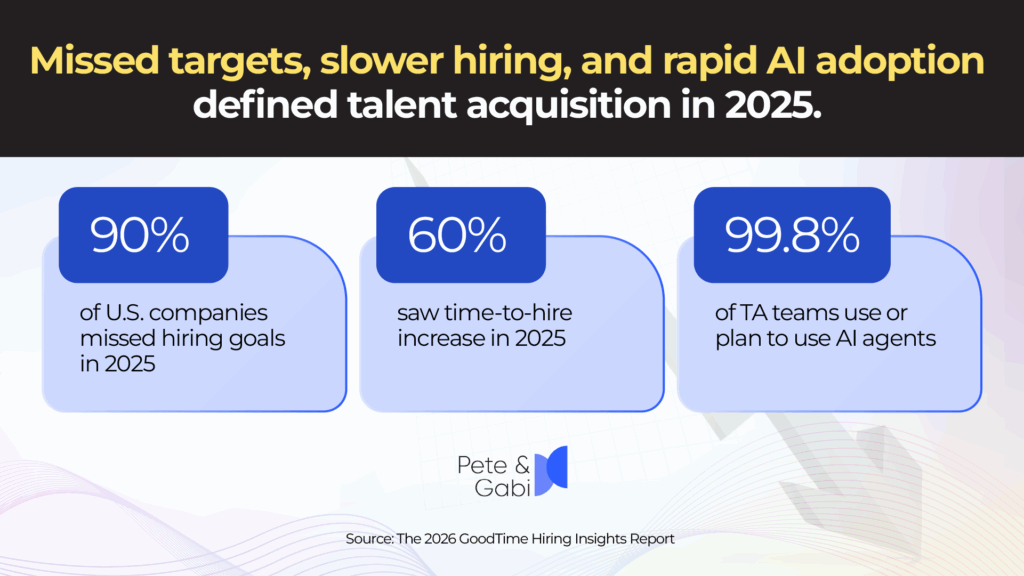
The process of hiring is structurally strained, and the figures render it hard to believe otherwise. The 2026 GoodTime Hiring Insights Report, with a sample of over 500 talent acquisition leaders in the United States, stated that 90% of the American companies were missing their hiring targets in 2025. Scheduling is seen to take 38 percent of the working week of a recruiter. The average time-to-hire was rising at 60% of organizations and only one out of nine succeeded to decrease it.
These are not the outcomes of the talent shortage. They are the product of a process architecture that has failed to keep up with the complexity of contemporary hiring. The applications have grown. LinkedIn is getting approximately 11,000 applications per minute going through its platform as of mid-2025, and the infrastructure that most teams use to handle, assess, and react to those applications cannot keep up.
The most substantive structural response to this problem is voice AI hiring assistant. This is not a move to remove human judgment in hiring decisions as research has repeatedly demonstrated human judgment to be irreplaceable in the areas of cultural fit, long-term potential, and under-resources. Voice AI hiring agents can be used to automate resume review, first-contact outreach, initial screening, interview scheduling, and early-stage evaluation.
This shift is forcing teams to rethink their hiring stack. Here are the tools leading that change.
10 Best AI recruiting automation tools in 2025-2026
The following platforms are the most substantive solutions in the existing market of AI-driven candidate screening and interviewing. Their philosophy, where they fit in the hiring funnel, and when they most effectively add value to the hiring process vary greatly. Depending on the area of greatest friction in your team, you can choose the right alternative.
1) Rebecca AI by Pete & Gabi
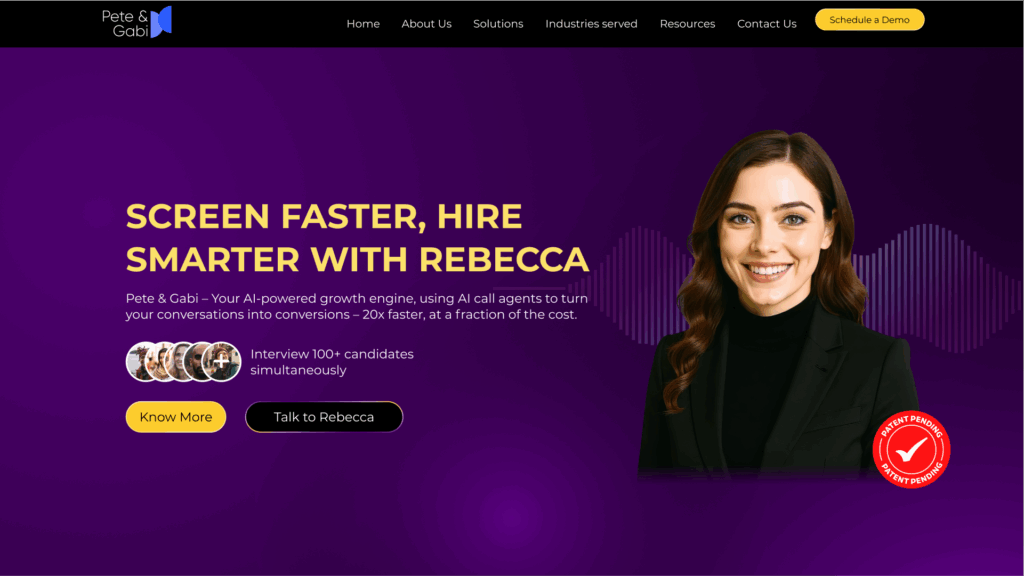
Rebecca AI is built on the idea that the greatest value opportunity in the AI hiring funnel is not when a candidate enters a portal, but the couple of minutes right after they apply. Instead of relying on the candidates to schedule the interview or reaching out themselves, Rebecca AI starts an end-to-end AI-driven conversation the second an application is received. No time constriction, no drop-off point, no time between application and first contact. The outcome is an increased rate of conversion at the initial stages: candidates will interact when the intent is new, and hiring teams will get access to the structured evaluation information without any manual processing. Rebecca AI is designed by Pete & Gabi, with a particular target of markets in which speed-to-contact is a direct competitive differentiator including staffing, healthcare, technology and high-volume professional positions.
Best: Recruiting in volume, staffing agencies, healthcare, technology and any position where first-mover advantage in the engagement with candidates dictates the rate of offer acceptance.
2) TuraHire: AI-Based Recruitment Software
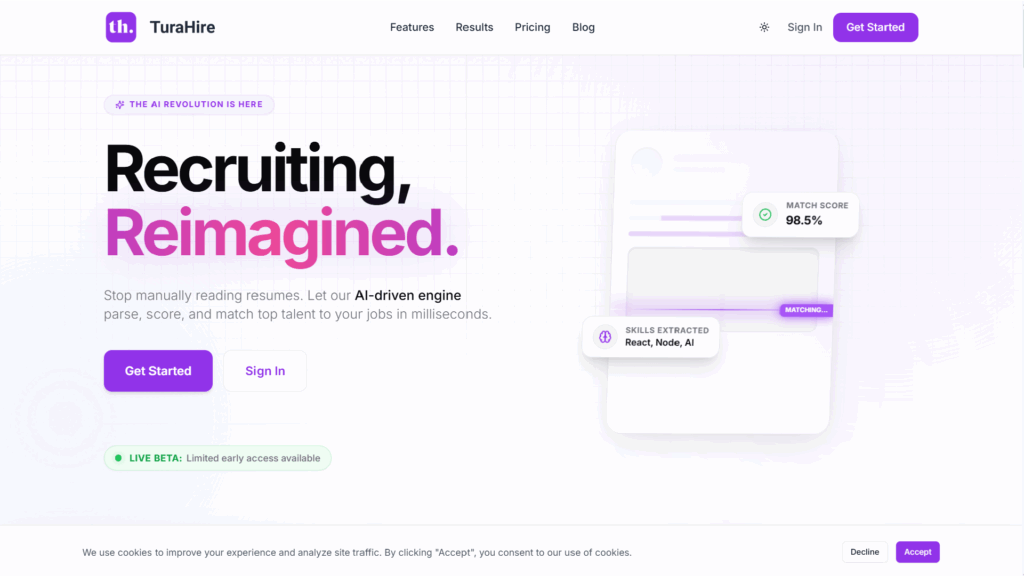
TuraHire is designed around recruiting teams that must automate the upper end of the hiring funnel with a high level of efficiency, but without losing configurability. Its AI-assisted resume parsing extracts structured information out of unstructured ones, transforming a stack of resumes into a scorable, rankable, and filterable shortlist. Automated interview scheduling is directly linked to both team and candidate calendars and removes the email back and forth. Multi-channel outreach integrates the use of email, SMS, and LinkedIn in a single workflow to make sure that no applicant gets to the channel gap. TuraHire positions itself as being able to reduce hiring time by half by configuring intelligent workflows.
Ideal use cases: Mid-market and growth-stage teams, developing scalable hiring processes that require automation in parsing, scheduling, and outreach facilities, and need to be powered by a single, well-integrated platform.
3) HireVue: AI Video Interviewing and Assessment
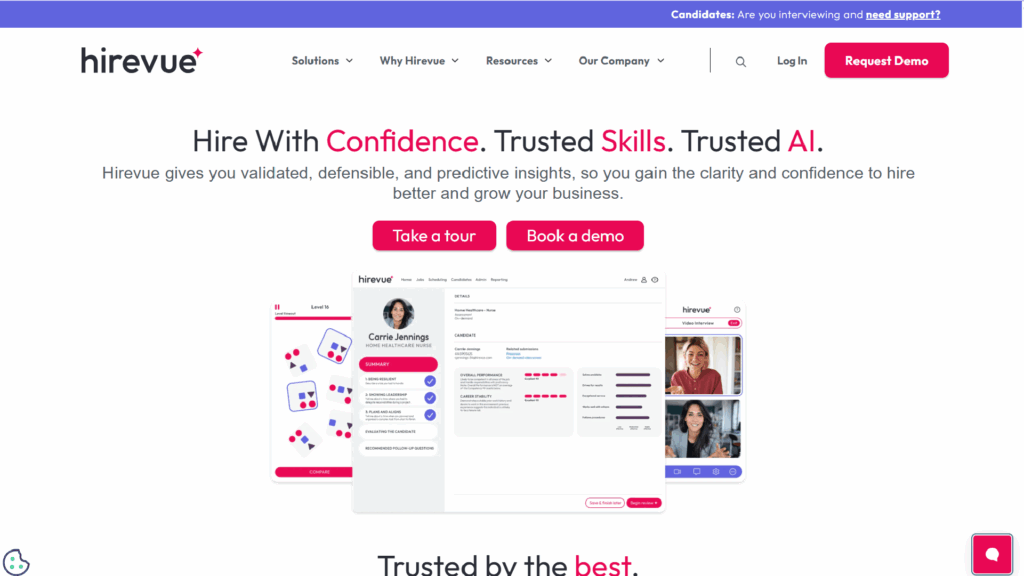
HireVue is a widely adopted enterprise AI hiring platform for structured video interviews and assessments. It supports both one-way and live video interview formats with standardized scoring, making it useful for organizations prioritizing consistency and benchmarking.
Best: Enterprise HR teams that need professional and graduate education applicants to assess candidates in bulk and with verifiable results (need to verify the audit trail of this assurance).
4) Paradox (Olivia) — AI-powered 24-hour assistant
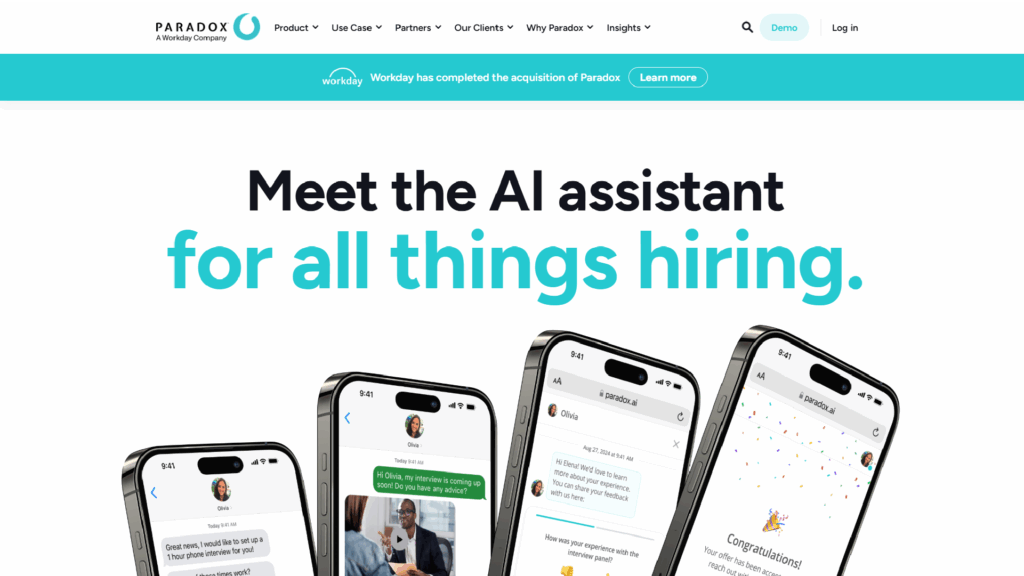
Paradox’s AI assistant Olivia manages the screening of the candidates, scheduling of interviews, notifications, and initial onboarding using a mobile-first conversational interface that the candidates engage with either through text messaging or chat.
Best: Retail, hospitality, healthcare and other high-volume hourly-worker recruitment settings in which the speed of candidate response and scheduling automation are the key areas of friction.
5) TurboHire – End to end automation in recruitment
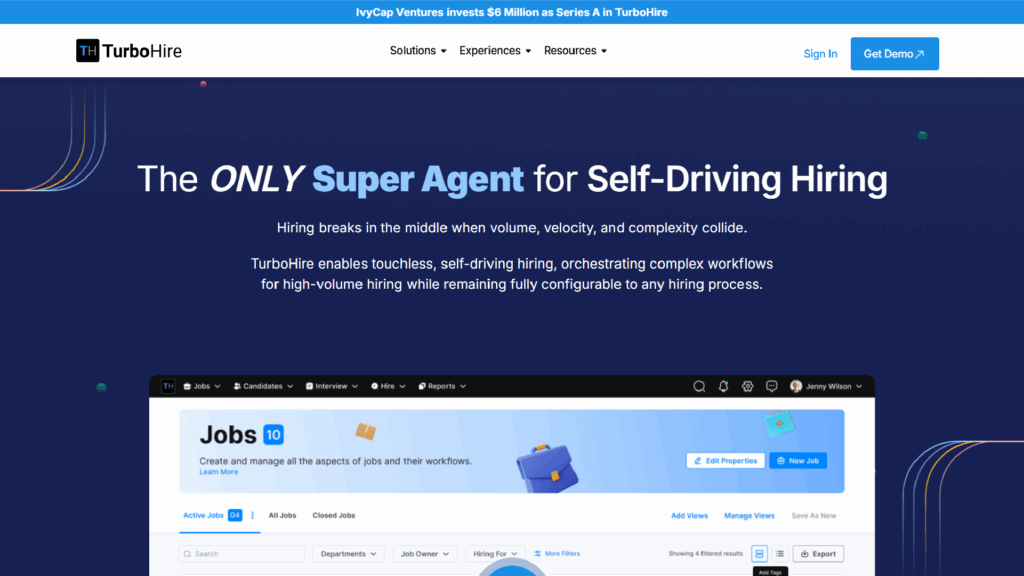
TurboHire is a full-service offering with a sourcing, screening, interviewing, engagement and analytics platform that is designed to serve all six parties to a hiring process: recruiters, candidates, interviewers, approvers, and leadership instead of being optimized toward a recruiter experience. TurboHire has native AI, agentic AI, and generative AI capabilities with more than 50 integrations with job boards, assessments, communication tools, and background verification providers.
Best use: Mid-to-enterprise groups in the Asia-Pacific markets and international organizations that require end-to-end automation of hiring with high mobile accessibility and the workflow design that is inclusive of the stakeholders.
6) Greenhouse: Structured Hiring with AI Feature
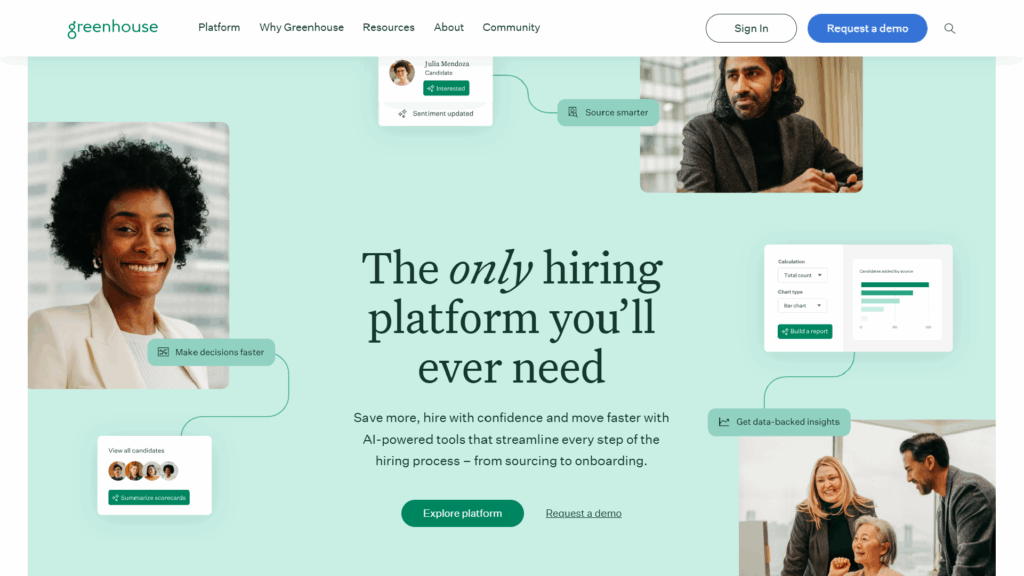
One of the most popular applicants tracking systems in the mid-market and the enterprise sector is the Greenhouse. Its structured hiring framework ensures consistency among interviewers and assists in achieving the DEI goals on the process level. Features include candidate filtering, automation of the scorecards, and email personalization. The platform is also integrated with more than 500 tools and highly mobile in terms of hiring managers who are reviewing candidates at home.
Ideal use: Mid-to-large organizations that have dedicated HR teams and have structured and collaborative recruitment processes (especially where they make DEI commitments, have audit obligations requiring some consistency in their processes).
7) Phenom: Talent Intelligence Platform
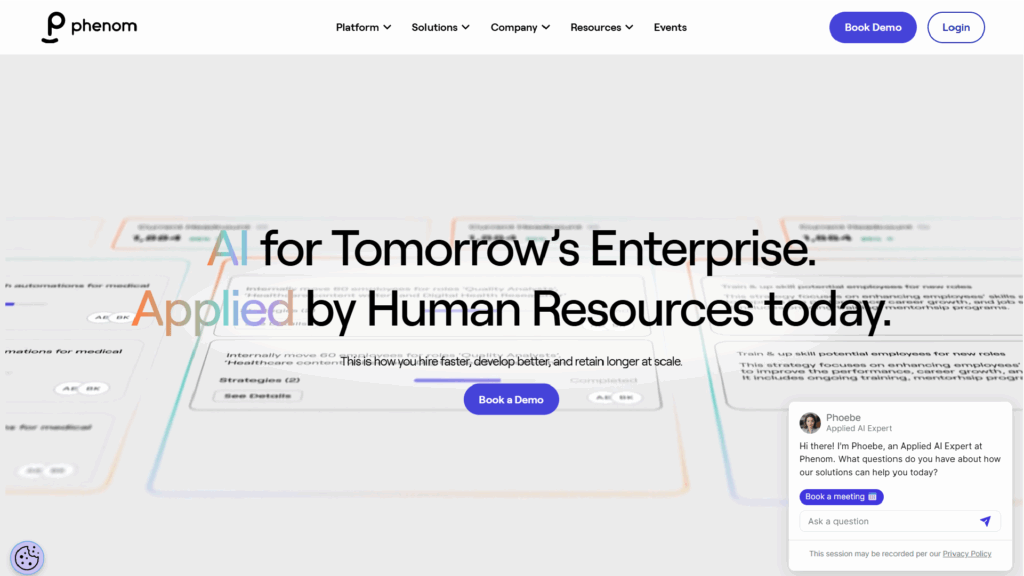
Phenom is a talent intelligence platform, encompassing candidate experience, recruiter productivity, and hiring manager enablement, as part of an integrated offering. Its agentic AI performs tasks automatically. The platform monitors the health of pipelines in real-time, detects drop-off locations before they build up, and actively proposes changes to the workflow. This is a significant difference to the previous-generation automation tools, which carried out functions in line with a set of predetermined triggers. Phenom also provides generative AI such as automated writing of job descriptions, writing personalized outreach email to candidates, and content generation on career sites.
Best use: Enterprise organizations that want an integrated platform of talent intelligence and candidate experience with reactive automation and prescriptive and agentic AI functionality.
8) Manatal: AI Recruiting with Social Media Profile Enrichment
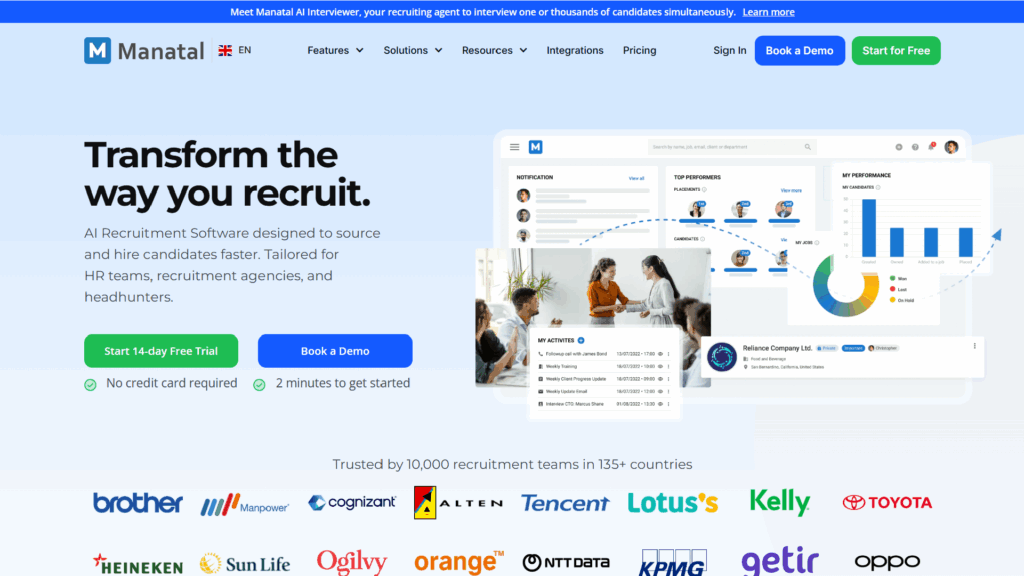
Manatal integrates ATS and CRM with a unique layer of social media enhancement, creating more complete profiles of the candidates by extracting the information on LinkedIn, Github, and others. Its AI candidate matches members against vacant positions and connects to over 2,500 job boards. One Chrome extension allows importing LinkedIn profiles with a single click, which is especially effective in teams that need network-based sourcing extensively. The pricing of Manatal is set at SMB and staffing agency customers, and its price does not need technical implementation support due to a user-friendly onboarding process.
Best use: SMBs, staffing firms, and recruiting teams that source a large amount of LinkedIn-based and professional network recruited candidates and need more enriched candidate profiles and do not require the complexity of enterprise level implementation.
9) Humanly.io: Structured Screening with Conversation Intelligence
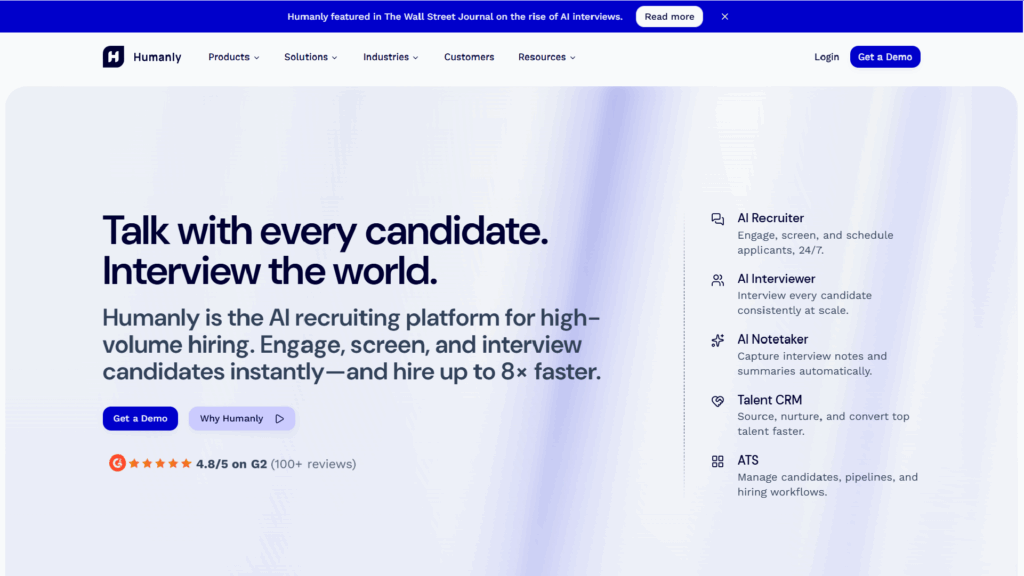
Humanly does more than resume parsing to examine the interviews of the screening. Its chatbot verifies pre-screening chat and creates well-organized roundups of candidates – finding patterns of communication, comparing their reactions with competency models, and creating reliable profiles that recruiters can review. The bias resistant scoring system has been developed to minimize variability in interviewers among large-scale screening regimes, and this directly applies to the SHRM result that 48 percent of HR managers recognize bias in their hiring practices. Incorporates humanly with leading ATS platforms and is framed as an augmentation tool to hire teams that desire to have structured and consistent evaluation information without the additional interview rounds.
Best use: When a team does large volumes of first-line screening calls and desires a structured, uniform, and consistent evaluation of its candidates with less manual note keeping and exposure to bias at any point in the evaluation process.
10) Workable: AI-Driven Recruiting of Challenging Teams
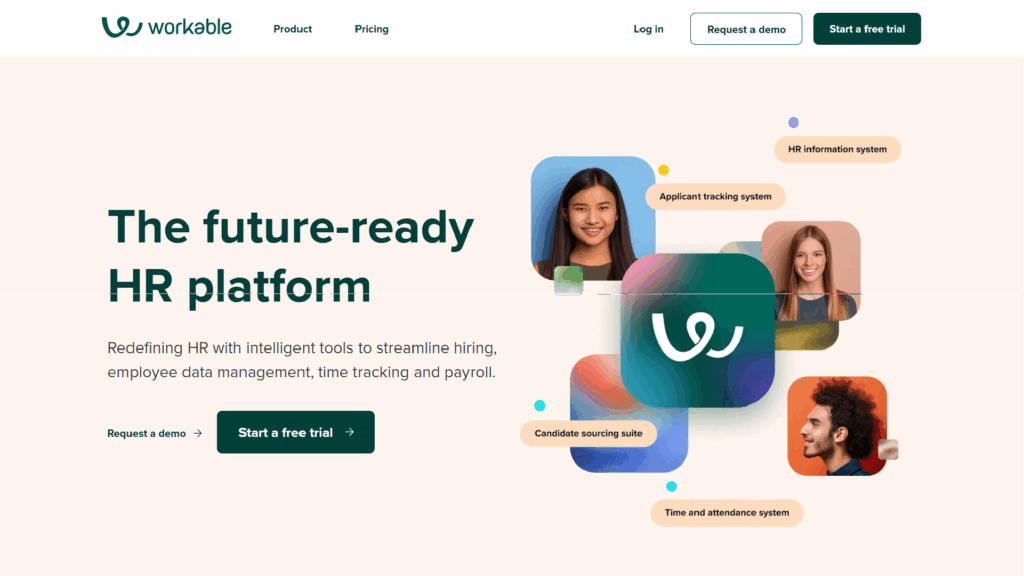
Workable addresses complete staffing life cycle with specific expertise in AI job descriptions, sourcing and analytics in pipeline. One-click employment distribution on over 200 job boards, AI-generated job descriptions that, according to research by Textio, use 25 to 50 less biased language than human writers, and automated recruitment sourcing software all make it an accessible point of entry to those teams that are scaling their recruiting department.
Ideal use: Developing SMBs and mid-market teams, requiring a full- stack recruiting platform that has high job posting, sourcing and analytics capabilities, yet does not need enterprise level implementation needs.
The Hiring Team That Wins the Hire.
Recruitment is becoming increasingly difficult because the processes of recruiting employed by most organizations have not been restructured to correspond with the pace and scale at which the talent market functions.
The 44 days over an average time to hire with a window of ten days of maximum candidate availability is a problem of process architecture. The most impactful areas of friction in AI recruitment automation include: resume review, first contact, scheduling, initial evaluation, and all of them are processed more consistently than the volume of manual processes can. This is now well supported by the peer-reviewed academic literature, multi-year field research on large employers and multi-thousand respondent industry surveys.
Multiple studies report that AI will best perform when it functions as a first pass filter, which reveals and sorts the candidates, rather than a final determiner which overrides human judgment. The teams with the highest success are not the ones that purchased the most AI tools. It is they who reshaped their workflows to take into account a particular ability of AI and left the decisions, which demand a human judgment, to the human judgment.
The variable which is most consistently raised by multiple reports is the speed-to-contact. The first employer who gets to the talent in the competitive talent market obtains a significant strategic benefit in defining the consideration set of such a talent. Voice AI hiring platforms that connect within minutes of posting an application before interest wanes and a rival picks up the phone are not providing a feature. They are providing alternative hiring theory.
Frequently Asked Questions:
How AI screens job candidates automatically?
The mechanism is layered. NLP takes structured and unstructured candidate information – resumes, cover letters, response to application forms and LinkedIn profiles – and derives skills, tenure, job titles, educational background, and indicators of competencies. Machine learning models then rank every candidate by how they match the role specifications and give one shortlist instead of a stack of documents. The criteria can be adjusted: there are teams that lay the highest emphasis on recent experience; there are teams that place the strongest emphasis on competency signals or geographic availability. At any volume, at any time of day, the AI uses the same weighting on all the candidates.
What does AI do to gauge the responses of candidates?
The effectiveness of AI assessment also differs significantly among platforms, and the difference between a keyword-matching engine and a competency-scoring system is important when HR departments are conducting a purchasing decision.
On the superficial level, speech-to-text transcription with the help of NLP is utilized in AI systems, which interpret responses, both written or spoken, and detect target phrases and words, as well as conceptual groups. They are then compared with a pre-established rubric. That is the lowest useful level of AI testing and that is what a majority of the entry level systems provide.
More advanced systems are contextually evaluative: not only what a candidate said, but how they said it, whether their answer reflected organized thought, and their communication patterns consistent with role specific competency predictors.
How to reduce time to hire with AI?
AI saves time to-hire as it deals with the bottlenecks where time takes the longest to see. Scheduling, which still takes 38% of the working week of a recruiter according to GoodTime, is the largest operational burden in most of the hiring.
To HR teams conducting the audit: analyze where your time-to-hire average is piling up, and phase three or four points where you see the greatest bottleneck and automate them. In most instances, the greatest margin is recorded when it is application to screening window and scheduling to first interview window. They can both be tackled using present tools. The competitive stakes are the greatest in the window between the time the application is received and the first meaningful interaction, the window in which applicants will judge how your process values their time.
Share on