

Effective sales outreach isn’t guesswork; it’s built on proven methods. Sales reps cannot generate leads by sending out 500 emails hoping someone will respond or reach out with a drip email three days after losing the deal to a competitor. A lead is most likely to convert when you contact them right as they’re thinking about the problem your product solves, almost by perfect timing.
With the challenge in sales outreach today, companies are using AI sales agents as the basis for implementing a sales outreach program through the identification and response to real-time behavioral signals of interest from prospects. This allows sales reps to change what was once serendipity into an established scalable process for achieving success with outreach.
This article explains how that’s possible through a better understanding of what intent signals are, how AI phone agents identify and react to intent signals, and why companies that are engaged in this approach can recover sales revenue that previously disappeared into a CRM.
What Are Real-Time Intent Signals?
Intent signals are behavioral data points that show when a prospect or dormant customer is actively considering a problem or purchase. The different types of intent signals can indicate where a prospect or customer is in their decision-making process if acted promptly.
Intent signals monitored by AI sales agents fall into four categories:
- CRM Behavior: Dormancy duration and recency of activity are key signals of an account’s readiness for re-engagement. Has it been a significant amount of time since they last transacted or had a conversation with your organization, what is the last activity on their account for moving up in status from stage one, and/or has the customer received a proposal but never responded to?
- Engagement Activity: An opened win-back email and a clicked link into the pricing page for an email campaign will improve that customer’s ability to be engaged with your organization, as that customer will score higher than someone who has not opened or clicked through on any type of email. These scores are captured by AI and prompt an agent to call the customer within minutes of the event, rather than days.
- Account History: Customers who have purchased a similar type of product during the prior year at roughly the same time of the year will likely have a propensity to show similar types of intent this year. Using AI, a designation is given to types of purchases to identify patterns to create an awareness within your organization as it relates to orders coming back in.
- Conversation Tone: AI systems monitor the tone of a prospect’s voice as well as their response time and their response shopping patterns to determine whether the prospect is interested in the product/service. If an agent is listening to the tone of a prospect’s voice become softer while they are discussing a potential solution for their problems with the agent, they have the ability to recognize to advance the prospect in the conversation at a faster pace if the prospect has stated, “What does the next step look like?”
The main idea is: By the time a sales rep manually identifies these signals and takes action, the opportunity has typically passed. For instance, a prospect who viewed your pricing page at 2:00 pm and received a call the next day at 9:00 am is a different type of prospect than the one who viewed your pricing page at 2:00 pm. AI agents can operate at all times.
The Timing Problem That’s Costing You Revenue
Research from Harvard Business Review and InsideSales.com shows that if you do not respond within 5 minutes of the initial intent signal, the chances of successfully qualifying that lead are reduced by 400%. The same holds true for re-engaging dormant accounts; they must be acted upon in real-time as soon as the prospect expresses intent.
The challenge
Manual re-engagement is time-based, resulting in missed opportunities due to batch processing. Emails are sent out in batches, quick follow-ups are not completed and calls take too much time to complete, causing the lost window of opportunity to occur in virtually all re-engagement attempts
Outreach Speed: Manual vs. AI Sales Agent
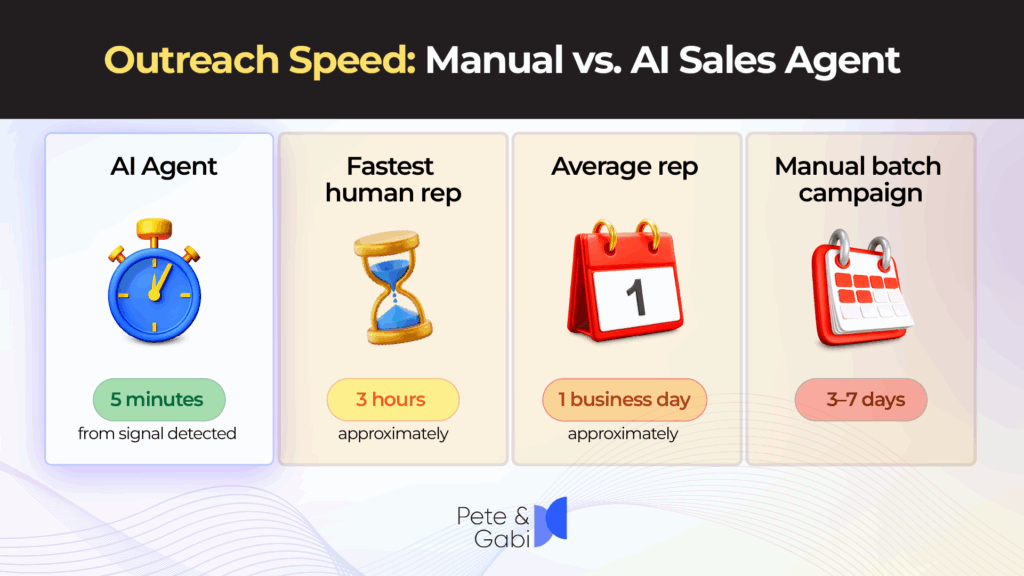
Qualification odds drop 400% after 5 minutes (HBR, 2011).
The compounding effect is clear. In a month, a sales team could only fulfill its maximum productivity by reaching 200-300 dormant accounts or less using manual processes. With an AI Agent, it will be possible to reach every 5,000 dormant accounts simultaneously within hours of that account exhibiting interest (intent where indicated). The difference between this and using a manual process is not marginal, it creates an entirely new way for an organization to operate.
How AI Sales Agents Actually Read and Act on Intent
The process isn’t magic, it’s a tightly orchestrated workflow that connects data intelligence to real-time conversation. Here’s how an AI sales agent operates from signal detection to closed loop:
Step 1
CRM Scan: Pulls dormancy flags, engagement history, and account data to identify candidates.
Step 2
Signal Score: Ranks accounts by intent strength and recency of signal, prioritizing who to call first.
Step 3
Auto-Dial: Launches a personalized outbound call within minutes of the signal firing.
Step 4
Live Conversation: Adapts in real time based on the customer’s tone, objections, and responses.
Step 5
Warm Handoff: Routes hot leads to reps with full context that is ready to close, no cold transfers.
Personalization at the Conversation Level
Reactivation calls vary between generic and conversion calls because they have different contexts. AI Agents understand customer data such as last activity, product usage and objections preventing reactivation by using it for context.
Since they are integrated with a CRM system, messages can be personalized in real-time as opposed to being sent from a static list of contacts. Every message that is sent is customized based on the customer’s intent.
For example, Pete & Gabi utilized AI voice agents to reach out to 1,000 inactive accounts. The outcome of this was 413 actual conversations with 12 deals closed and generated $21,116 in revenue with all transactions being managed using AI.
Why Manual Reactivation Keeps Failing (And Will Keep Failing)
Salespeople are not unsuccessful at competing with the competition to reactivate customers because they do not want to. They do not; however, reactivating customers is structurally deprioritized every time a pipeline with new potential sales appears. When an account executive must choose between calling a brand-new lead immediately or calling a customer that has become inactive for an extended period (e.g., 6 months), the account executive will most often contact the new lead. Account executives are not unsuccessful at making reactivation calls because of a lack of motivation but rather because of a lack of incentives.
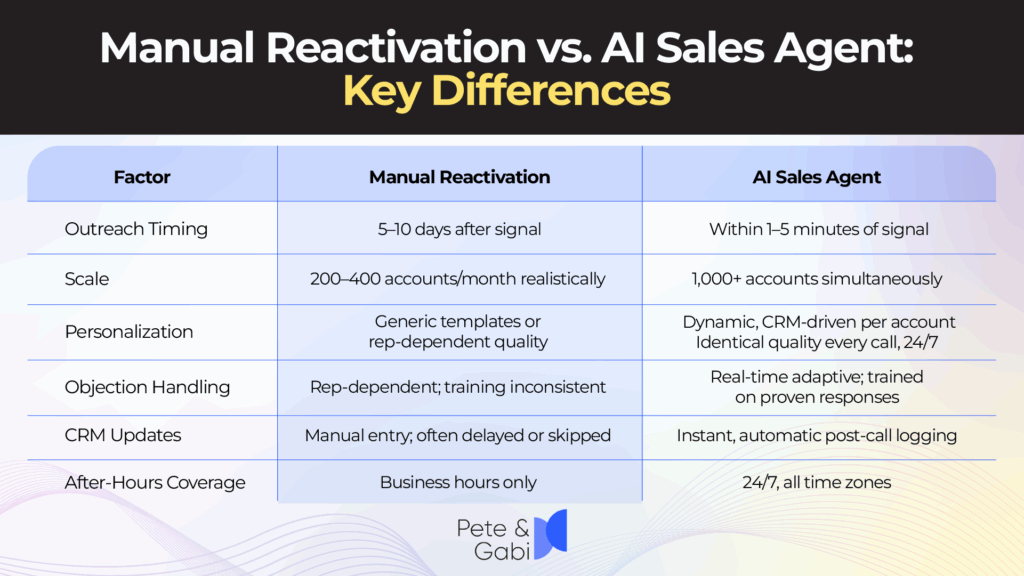
The numbers don’t lie. AI-based reactivation does not replace the sales team; it picks up some of the work that they cannot reasonably allocate time to complete. When the AI has created “warm”, qualified conversations for them, the sales representative can allocate time to these conversations.
Getting Started: What You Actually Need to Deploy This
A lot of people believe that deploying an AI Sales Agent requires a long-time frame, often months, and therefore extensive engineering; it doesn’t. You can have an Olivia AI agent up and running in less than a week.
All you need is good CRM data, a clearly defined target, and a well-defined conversation flow.
Once the Agent is in place, it will learn and enhance itself on its own.
The teams that are successful are not overbuilding; they are executing rapidly and learning through that execution rather than trying to figure out what they’re doing before they start executing.
Frequently Asked Questions
What are real-time intent signals in sales?
Behavioral signals that indicate the level of readiness of a potential customer or a current customer to make a purchase or to re-engage are intent signals. Unlike traditional data sources, these signals are live and therefore provide much more predictive accuracy. Olivia AI continuously scans your CRM in search of the signals mentioned above and will begin making contact to prospects (via email and/or text) within minutes of identifying them as warm.
How does AI personalize outreach without sounding robotic?
AI agents do not follow strict schedules or scripts; they can change and adapt to new information based on the context provided by the CRM and the use of natural language processing (NLP) to modify tone, address objections and maintain relevance. All these modifications occur in real-time with Olivia AI and allow every call to each individual potential or current customer to be personalized and not generic.
Can AI sales agents handle objections during reactivation calls?
AI agents do not get discouraged or quit when encountering objections; instead, they overcome these objections by analyzing and identifying patterns of behavior, creating intelligent responses to those objections. Olivia AI will overcome any objection regarding dormancy and will only send warm, fully contextualized leads to the salesperson.
How quickly can an AI sales agent be deployed?
Most teams can go from zero-to-live in 5-10 days with Olivia AI simply by connecting their CRM to Olivia AI, selecting their ideal customer profile and developing their desired conversation(s). No technical work is required.
What CRM systems do AI sales agents typically integrate with?
Many AI sales platforms connect directly to your CRM, that enables them to retrieve customer information, log calls, and update everything in real-time. Olivia AI handles everything automatically, so she personalizes each call based on the customer information that you provide, and she updates your CRM on your behalf with no manual effort from you.
How does an AI agent know when to hand off a call to a human rep?
AI Agents do not hand off based on random criteria; each agent has specific triggers and uses real-time sentiment analysis to determine when to hand off. Therefore, representatives only get involved in a conversation when it is truly ready for their involvement. After handing off, Olivia AI provides complete context to the representative picking up the hand-off, resulting in the representative receiving a warm lead (qualified customer) as opposed to a cold lead.