If you are reading this article you already know that voice AI agents have turned the corner in sales across industries.
They are refielding calls and serving as a first contact for teams of all kinds, but they a’re also reactivating customers, updating accounts, upselling and cross-selling, and keeping leads not only warm but informed and able to get what they need 24/7, 365 days of the year.
And given the pace of change, more enterprises are buying than building (from 53% in 2024 to 76% per Menlo Ventures) and looking for the right partner.
So how do you pick from among the leaders in the field?
Pete & Gabi? Bland AI? Retell? Vapi? And new platforms are launching quarterly, all promising “human-like conversations” and “seamless automation.”
This guide is here to help. Below, we deep dive into Pete & Gabi, Bland AI, Retell, and Vapi to compare their capabilities, effective use case coverage, conversation quality, and what each platform really delivers.
Keep reading for insights to help you pick the ideal AI phone agent for your business.
The Conversational AI Landscape in 2026
Platform | Best For | Sales Calls | Lead Qualification | Setup |
Pete & Gabi | Enterprise, full-cycle sales & reactivation | Adaptive, objection-aware | Real-time scoring + handoff | Days, no dev team |
Bland AI | High-volume, simple/repetitive calls | Scripted, limited depth | Basic, rule-based | Fast, low-cost |
Retell | Custom-built, developer-owned voice agents | Fully customizable | Build-your-own logic | Weeks–months, dev required |
Vapi | API-first, execution speed & orchestration | Fully customizable | Build-your-own logic | Weeks–months, dev required |
The conversational AI market isn’t a monopoly. It’s a spectrum, with various platforms solving different, and often overlapping, problems.
As a result, understanding where your voice AI platform sits on the spectrum is critical to avoid making a costly mismatch.
Enterprise-Grade, Full-Cycle AI Voice Agents (Tier 1):
These are the platforms deliver end-to-end conversational AI. Automation tools in this category deliver natural voice quality, intelligent objection handling, seamless CRM integration, and scalable automation across complex use cases.
Many of the voice AI platforms in the enterprise-grade spectrum are seeing broad adoption in sales, customer service, revenue reactivation, and recruiting.
Developers First and API Driven Systems (Tier 2):
This Tier focuses heavily on flexibility and customization. Technical teams design bespoke voice agents for unique workflows and interact with platforms through APIs. To meet the requirements of this Tier, the voice quality needs to be clear, latency low, and the system should have an extremely configurable integration. Given that these options provide extreme customisation, they are typically deployed, optimised, and maintained through in-house developers and have little intention to be plug and play. Retell and Vapi are examples of voice AI platforms that follow these principles.
Affordable, Repetitive, High Volume Automation systems (Tier 3)
This Tier consists of systems designed for automating high volume, low complexity calls at volume. Appointment reminders, confirmations and basic qualifications will be the Two-way calling systems built for Tier 3 using voice AI. The Tier 3 voice AI systems will be fast to deploy and will provide a cost-effective solution; however, they will not provide the same level of depth and engagement found with voice AI systems built for Tier 1 or Tier 2. Bland AI would fall into Tier 3.
Bland AI vs. Vapi vs. Retell AI: Which Fits Sales Calls and Lead Qualification?
Choosing between Bland AI vs Vapi vs Retell AI often comes down to two questions: how the platform handles live sales calls, and how it qualifies leads at scale. Bland AI runs high-volume, scripted calls well but struggles with objections. Retell and Vapi both offer deep customization for Vapi vs Retell AI vs Bland AI comparison shoppers who have engineering resources but require build time before they qualify a single lead. For teams needing adaptive, objection-aware conversations and real-time lead scoring without a dev team, that’s where Pete & Gabi fits.
Option 1: Pete & Gabi
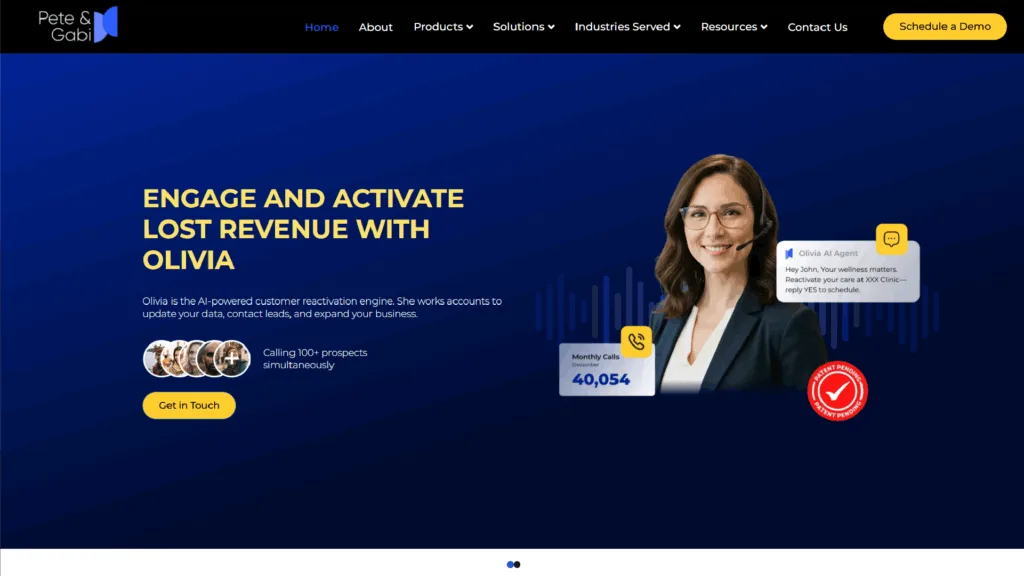
Built for the most significant conversations regarding your bottom line, such as Sales, Reactivation, Recruiting, and Customer Service, Pete & Gabi is the ultimate solution for revenue-related conversations.
It helps with missed calls, follow-ups, and hand-off to “nearly human” voice agents that adapt in real-time to handle objections, analyze sentiment, and escalate to human agents as needed. Although it is a Tier-1 system, it integrates seamlessly with your current technology to stack and deploy quickly (i.e., days instead of months).
If you’re looking for deep, scalable conversations without a technical build, Pete & Gabi is worth evaluating. Where Bland AI trades depth for speed, and Retell and Vapi trade simplicity for full customization, Pete & Gabi sits at the enterprise-capability end with plug-and-play deployment.
Option 2: Bland AI
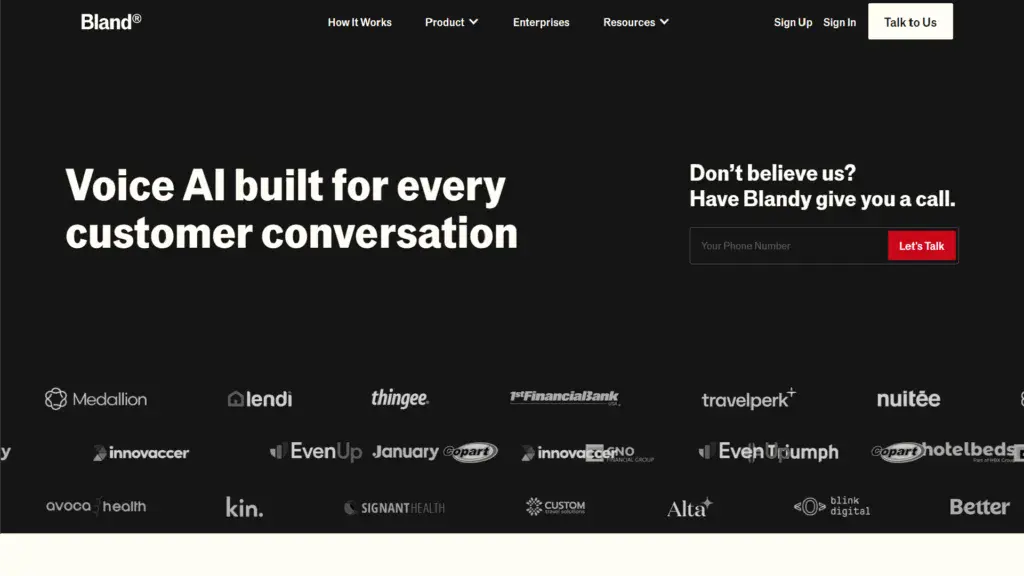
The Bland AI platform has limitations. It’s not intended to be a complete solution that generates revenue. Since it’s a voice AI that falls under the Tier 3 classification, it is flexible and designed to allow for rapid experimentation and prototyping. The system is very effective with speed and cost by handling a large number of simple calls in parallel. It provides other benefits as well such as fast deployment and lower operational costs compared to Tier 1 systems; however, because of its flexibility and speed it does not have the ability to carry out complex conversations with depth and can become very difficult to manage objections or adapt to circumstance.
While Bland AI has the ability to create call flow patterns that are easily executed, the complexity of the process can make it impractical for many users. For this reason, teams requiring cost-effective, high-volume automation for routine, repetitive calls (e.g., appointment reminders, confirmation of schedules, outreach) or internal processes where predictable behaviour is more important than conversational intelligence, would be good candidates for using Bland AI.
Option 3: Retell
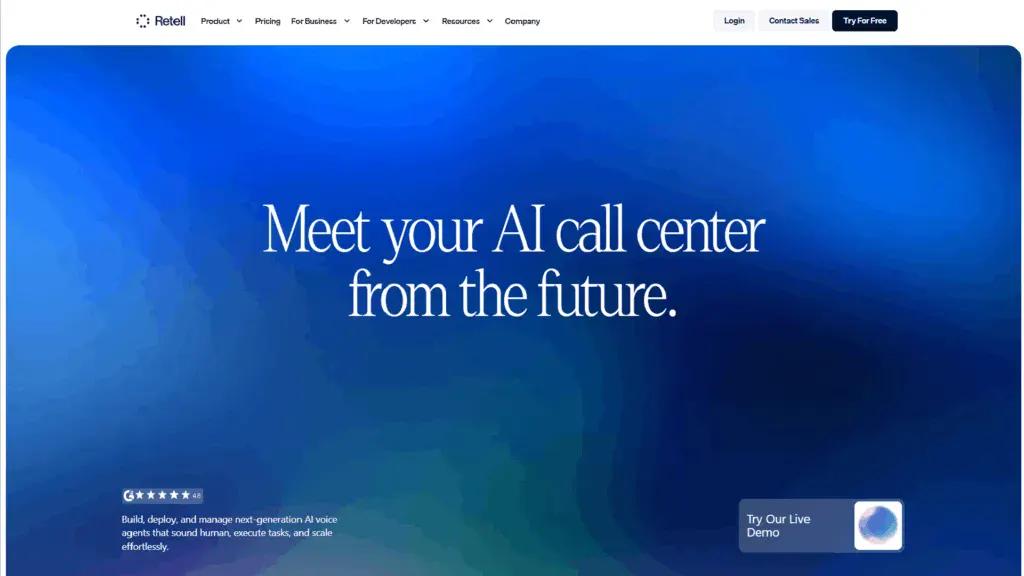
Retell is a developer-focused, Tier 2 conversational AI product created for developers that want complete control of their voice agent’s behavior, how they interact with others, and how they scale. There is a strong emphasis on API-centric and highly customizable; it allows in-house developers to create custom-built voice AI tailored to specific workflows and their own data, combined with full integrations into their backend systems. Retell has a strong reputation for providing hyper-realistic voice synthesis and the ability to have very low-latency conversations that seem very natural and responsive.
The downside to using Retell is that there is a high technical burden to set it up and keep it running. Therefore, it can be difficult for users who do not have technical skills. Companies who would best benefit from using Retell would be those that want to build their custom solutions, have the necessary engineering support to do so, require more customization than other platforms (i.e., Pete & Gabi or Bland AI) and place more importance on voice quality and emotional modeling than services like Vapi.
Option 4: Vapi
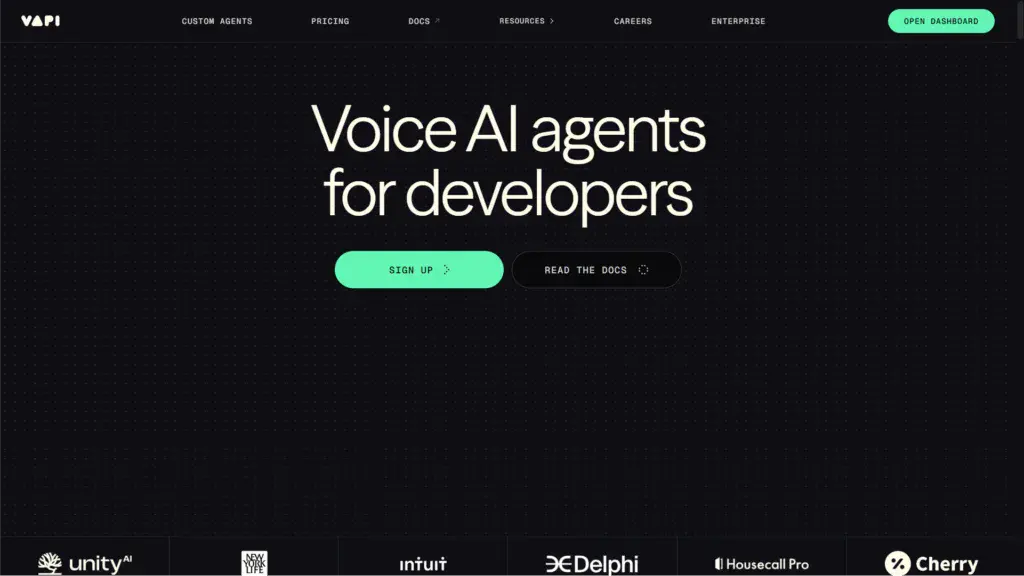
Vapi offers an extremely low-latency voice interaction, an excellent quality of voice, detailed documentation, and flexible configurations through programming to enable developers who wish to create customized voice agents or utilize their own infrastructure as an API-based deployment solution. Vapi is designed more for organizations requiring total developer flexibility and integration, speed, and workflow orchestration through the creation of their voice agent applications, as compared to Retell, which provides more advanced features for modeling human voice emotions, therefore, Vapi prioritizes execution speed and integration versus human emotion modeling within a voice workflow application or voice agent.
Vapi includes very low-latency voice interaction and high-quality audio with comprehensive documentation and programmable flexible options available to developers to create custom voice agent applications or leverage their infrastructure as an API deployed solution. Unlike Retell, which has many advanced features for modeling human voice emotive characteristics, Vapi focuses first on execution speed and integration over modeling human emotions in a voice application or agent and is therefore well suited for companies that need total development flexibility and integration and the creation of custom voice agent applications with fast response times and workflow orchestration.
Taking the Next Step
If you’re looking to deploy a high-performance enterprise-grade conversational AI platform rapidly and executing nuanced conversations, Pete & Gabi is the best choice. You will also be able to obtain significant results without having to recruit new development resources. If you are looking for affordable, high-volume automation for simpler, more predictable call handling, you can consider Bland AI. However, you will find that both Retell and Vapi provide offers obtaining total customisation freedom by your in-house development team.
Are you ready to deploy the conversational AI system that is designed to provide a real impact on your revenue from the first day of production?
Schedule a Pete & Gabi demo.
FAQs
What differs between Pete and Gabi, Bland AI, Retell, and Vapi?
All these platforms offer varying benefits depending on how they are used, and whether or not they have a complex deployment process, or more technical requirements than other platforms. For instance, Pete & Gabi are designed to be used by enterprises through use of plug-and-play Voice AI. On the other hand, Retell and Vapi have developer-focused platforms that require development teams with significant technical ability to build, deploy, and support custom/unique applications/systems. Lastly, Bland AI is at the bottom of this reverse continuum providing affordable solutions to reduce time spent on calling using repetitive calls that have a defined script.
Do I need a developer for deploy an AI phone agent?
It depends on the platform; you cannot deploy using Pete & Gabi or Bland AI without assistance from a developer.
How long does it usually take to deploy each (voice AI) platform?
With companies like Pete & Gabi most teams go live within days; however, depending on the complexities associated with their development Retell & Vapi could have an establishment of a voice AI deployed anywhere from a couple of weeks – couple of months.
Which platform could be utilized for sales automation as well as customer reactivation/retention?
Pete & Gabi’s designs are purpose-built around sales objectives of nuanced conversation, handling objections, reading sentiment, personalized messaging, the ability to escalate intelligently; and execute based on an *intelligent framework
Which is best for sales calls: Pete & Gabi, Bland AI, Vapi, or Retell AI?
For scripted, high-volume outreach, Bland AI is fastest to deploy. For fully custom-built sales conversations, Vapi and Retell both offer developer-level control but neither includes objection-handling or lead scoring out of the box. Pete & Gabi is built specifically for sales calls, with objection-handling and lead scoring included from day one, without requiring a development team to set up.