Recruiters and candidates both use AI. That’s just a fact. And according to Insight Global stats from late last year, 99% of C-level decision makers are investing more money into AI hiring, with 98% of hiring managers saying AI in their process has improved it.
AI agents handle time-consuming and repetitive tasks like outreach, screening, and scheduling and give that time back to recruiters to do more with what they’re good at.
But which voice AI solution is best for your recruitment workflow?
Today we break down 10 of the top voice AI solutions for staffing providers that transform how agencies operate and compete. You’ll learn each one’s key capabilities, advantages, weaknesses, and the ideal scenario for its deployment.
Why Your Hiring Workflow Needs Conversational AI Recruiters
Hiring speed is critical for landing top talent, but recruiters can only handle so many calls, screens, and follow-ups.
Here’s how AI agents for recruiting remove that friction.
- Faster Candidate Engagement: AI agents for recruiting reach candidates within minutes, not days.
- 24/7 Outreach: AI staffing assistants keep conversations flowing around the clock, ensuring qualified candidates don’t slip through after hours or between shifts.
- Consistent Screening at Scale: AI call agents for staffing apply your criteria uniformly across hundreds of candidates, bringing greater consistency.
- Lower Cost-Per-Hire: Automating calls and screenings reduces recruiter workload and operational and agency reliance, contributing to the bottom line.
- Real-Time Hiring Intelligence: Every AI-powered conversation feeds live insights into your ATS, sharpening decisions and accelerating offers.
Keep reading as we break down the top AI staffing agencies delivering conversational AI recruiting today.
Top 10 Recruitment Automation Platforms with AI Voice Calling
Here’s our coverage of the top AI recruiting platforms for 2026: their key features, pros, cons, and what kinds of organizations they best serve.
1. Rebecca AI by Pete & Gabi
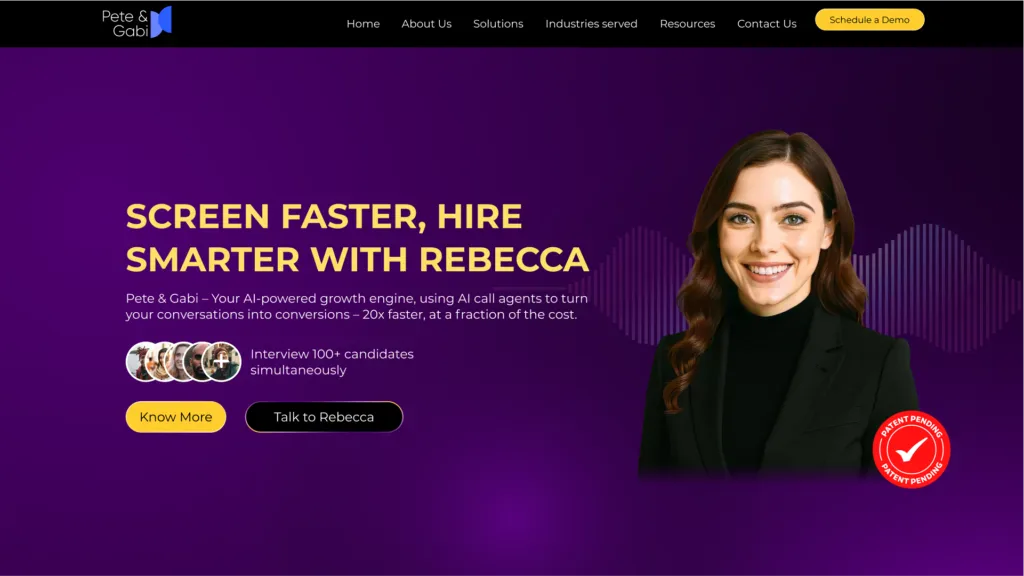
First on our list is Rebecca AI by Pete & Gabi, a purpose-built conversational AI recruiter designed to automate high-volume hiring workflows end to end.
Rebecca goes far beyond basic screening tools.
She actively conducts outbound candidate outreach, holds real-time screening conversations, qualifies talent against role-specific criteria, and schedules interviews automatically.
She doesn’t use static scripts or pre-recorded prompts. Rebecca adapts in real time based on candidate responses, tone, and intent.
Built for scale, this hiring AI agent integrates directly with ATS platforms and CRMs, syncing every conversation and insight instantly. This gives your recruiters a live, qualified pipeline without chasing candidates, juggling calendars, or being required to do a ton of manual data entry.
Rebecca AI boasts consistent time-to-hire and cost-per-hire drops for their clients.
The platform is also renowned for its deployment speed and consistency.
Teams launch in days, not weeks.
Key Features
- Live, adaptive screening interviews
- Automates candidate outreach at scale across multiple channels
- Provides intelligent interview scheduling with calendar syncing and reminders
- Real-time ATS integration and data syncing
- 24/7 candidate engagement across global time zones
- Customizable conversation flows
- Multi-language capabilities
Pros
- Handles hundreds of screening calls simultaneously
- Seamless handoff to human recruiters with full candidate context
- Highly natural conversations instead of robotic assessments
- Comprehensive analytics on pipeline health
- Fast deployment with minimal technical overhead
Cons
- Voice-first platform (limited chat capabilities)
Best For
Staffing agencies and recruitment teams that need human-quality AI conversations for end-to-end hiring automation at scale.
2. Hirevue
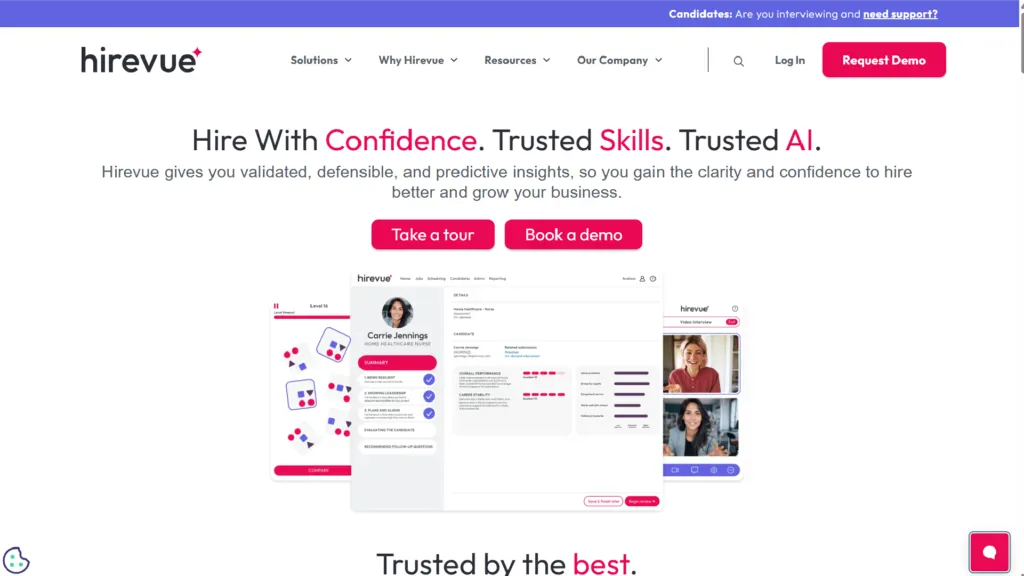
Hirevue is well known for its pre-recorded video interviews and structured assessments.
Their platform allows candidates to respond to predefined questions via recorded video, which hiring teams can then review asynchronously. Hirevue also offers interactive assessments and games aimed at predicting job fit and performance.
It thrives at standardization with workflows that are largely static—candidates are given fixed questions for screening.
On the implementation front, Hirevue typically requires longer setup timelines and technical configuration, particularly for enterprise deployments. While powerful for compliance-driven organizations, this is prioritized over speed and flexibility.
Key Features
- Pre-recorded video interview assessments
- Enterprise-grade compliance and security features
- ATS integration capabilities
- Standardized interview question libraries
- AI-powered candidate insights
Pros
- Strong compliance and audit trail features
- Standardized evaluation reduces interviewer bias
- Suitable for compliance-heavy hiring
Cons
- Not a conversational candidate experience
- Longer deployment timelines
Best For
Large enterprises prioritizing standardized assessments and compliance over interactive candidate experience and deployment speed.
3. Spark Hire
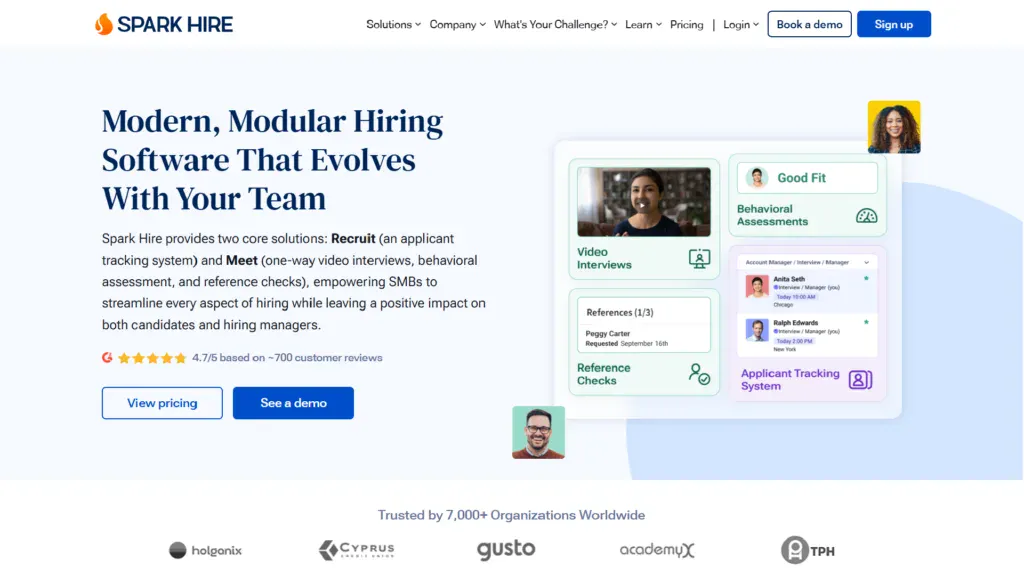
Spark Hire is a video interviewing platform designed to simplify early-stage candidate screening.
Its core offering centers on one-way and live video interviews, allowing candidates to record responses or meet hiring teams virtually.
Recruiters can review interviews in their own time, collaborate with hiring managers, and move candidates forward without scheduling initial calls.
One of the Spark Hire’s draws is its easy deployment and minimal technical requirement.
For small to mid-sized teams, this platform offers a straightforward way to reduce phone screening time.
Note that it does not automate outreach, screening conversations, or scheduling.
Recruiters source candidates, follow up manually, and manage no-shows.
Key Features
- One-way and live video interviewing
- Interview question templates and guides
- Basic ATS integration
- Team collaboration and feedback tools
- Candidate video response libraries
- Mobile interview capabilities
Pros
- Affordable pricing for smaller agencies
- Simple interface with minimal learning curve
- Supports both asynchronous and live interviews
Cons
- No automated outreach or screening
- Manual coordination still required
- Limited scalability
Best For
Small staffing agencies that need basic AI video interview functionality without fully automated recruiting workflows.
4. Paradox AI
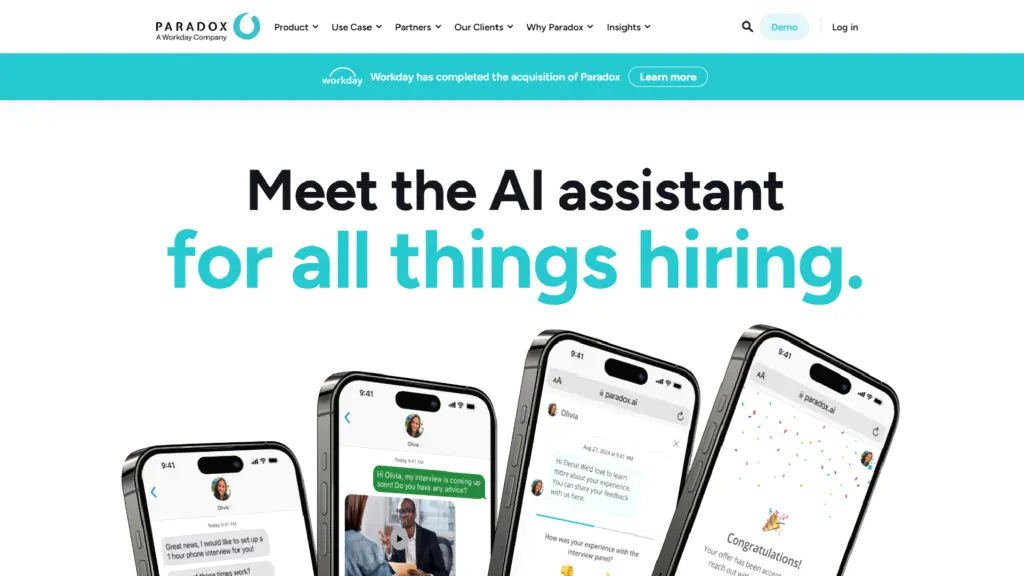
Next on our list is Paradox AI.
This platform is best known for Olivia, its conversational assistant focused on automating recruiting coordination and candidate communication.
Paradox AI excels at handling high volumes of inbound candidate interactions, answering questions, guiding applicants through workflows, and scheduling interviews. It also integrates well with major ATS platforms across hiring environments.
Paradox’s strength lies in orchestration over in-depth screening.
It does pre-qualify candidates through chat-based flows but doesn’t conduct live screening conversations as other voice-first AI recruiter systems on this list do.
This makes the platform’s outreach more reactive than proactive, but Paradox AI shines when scale and candidate responsiveness are the primary goals.
Key Features
- Text-based candidate engagement
- Automated interview scheduling and reminders
- 24/7 candidate question handling via SMS and chat
- ATS integration for data syncing
- Automated candidate status updates
- Mobile-friendly interface
Pros
- Strong text-based engagement for mobile candidates
- Fast deployment and easy setup
- Effective for high-volume, entry-level recruiting
Cons
- Limited live screening depth
- Less suited for technical roles
- Chat-first, not voice-first
Best For
Organizations hiring high volumes of hourly or entry-level workers who prefer text-based communication over phone calls.
5. Eightfold AI
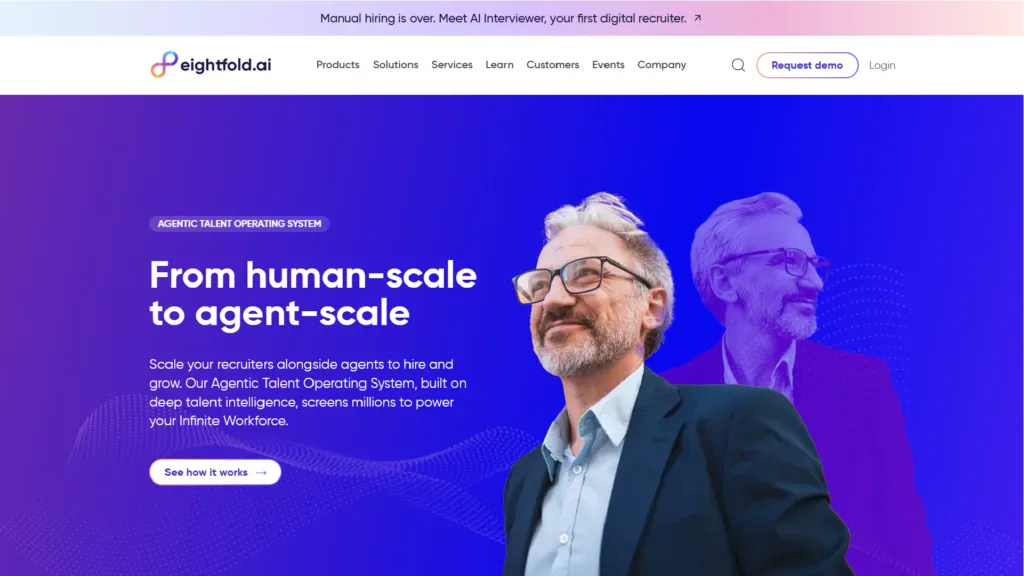
Eightfold AI positions itself as a talent intelligence platform, using AI to match candidates to roles based on skills, experience, and potential—not just resumes.
This platform excels at rediscovering internal and external talent pools, surfacing qualified candidates already in your ATS or talent database. For large organizations, this can significantly reduce time spent sourcing new candidates.
Note that it doesn’t conduct outreach calls, hold screening conversations, or engage candidates in real time—recruiters engage with identified candidates manually.
Eightfold AI is also among the options on this list with heavier implementation needs, as it works best when deeply integrated with enterprise HR systems and large datasets.
Key Features
- AI-powered talent matching and job recommendations
- Skills-based candidate profiling
- Internal mobility and career pathing tools
- Diversity and inclusion analytics
- Workforce planning insights
- Predictive analytics for hiring outcomes
Pros
- Strong talent intelligence for enterprise organizations
- Reduced bias through data-driven matching
- Comprehensive workforce analytics
Cons
- No conversational AI or outreach
- Longer setup timelines
- Not built to drive day-to-day hiring speed
Best For
Large enterprises focused on talent intelligence and workforce planning over conversational recruitment automation.
6. Tally AI
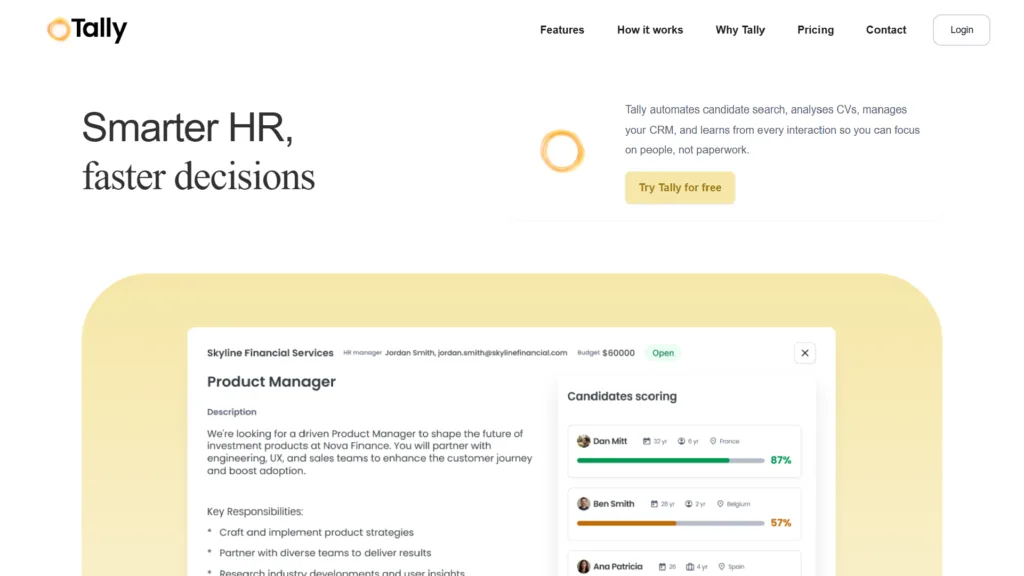
Tally AI focuses on automating candidate screening through conversational assessments, primarily via chat-based interactions.
The platform engages candidates early, asking structured screening questions and scoring responses automatically. It helps recruiters filter large applicant pools fast and reduce manual resume review.
With a focus on improving screening efficiency, it isn’t built for outbound candidate sourcing, voice-based conversations, or complex objection handling. Its workflows do still require recruiters to step in after initial qualification.
Candidates answer questions without a focus on real-time voice AI.
Key Features
- Automated phone and text-based screening interviews
- Role-specific question libraries
- Candidate scoring and ranking
- Seamless ATS integration for data syncing
- Multi-language screening support
- Automated interview scheduling
Pros
- Handles high-volume screening automatically
- Reduces recruiter time on initial qualification calls
- Supports multiple languages
Cons
- No voice or live conversations
- Limited outbound automation
- Shallow engagement for technical roles
Best For
Teams looking to automate early-stage screening for high-volume, straightforward roles with clear qualification criteria.
7. Ribbon AI
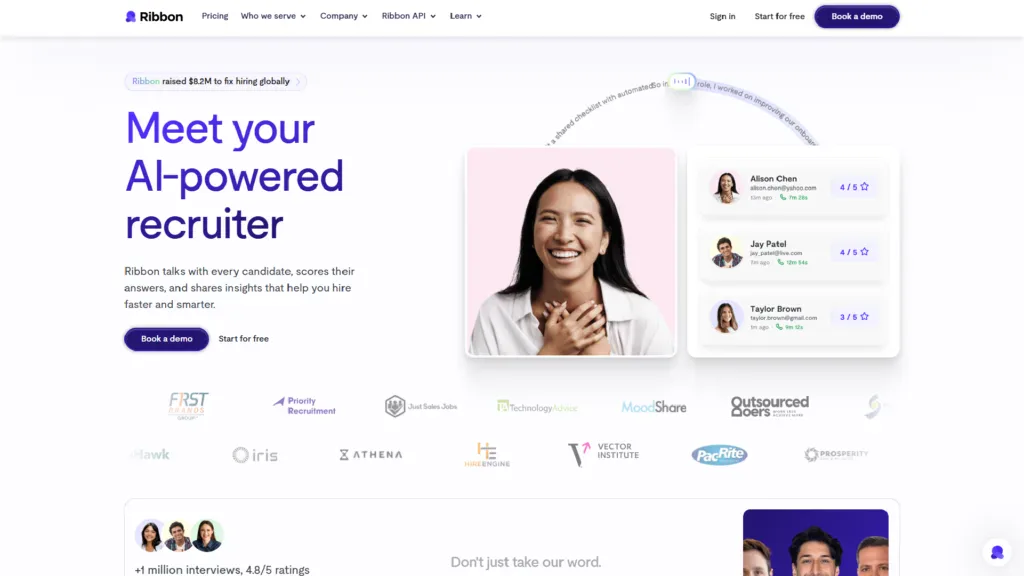
Ribbon AI is yet another AI-powered platform designed to automate recruiting coordination and candidate communication.
The platform handles interview scheduling, reminders, and candidate updates, reducing the back-and-forth that consumes recruiter time. Ribbon AI also easily integrates with calendars and ATS systems to keep workflows organized.
Ribbon AI excels at improving scheduling efficiency and candidate engagement through timely and continuous updates. It’s not a screening or candidate outreach engine, so it doesn’t conduct interviews or source talent.
Key Features
- Conversational candidate engagement via chat and voice
- Automated interview scheduling and reminders
- Application status updates and FAQ handling
- ATS integration for communication tracking
- Multi-channel engagement (SMS, email, voice)
Pros
- Improves candidate experience and reduces drop-off
- Automates routine communication efficiently
- Strong focus on employer brand enhancement
Cons
- No candidate screening or outreach
- Limited impact on time-to-hire
- Not a full recruitment AI solution
Best For
Hiring teams overwhelmed by scheduling logistics but not seeking additional recruiting automation.
8. Humanly
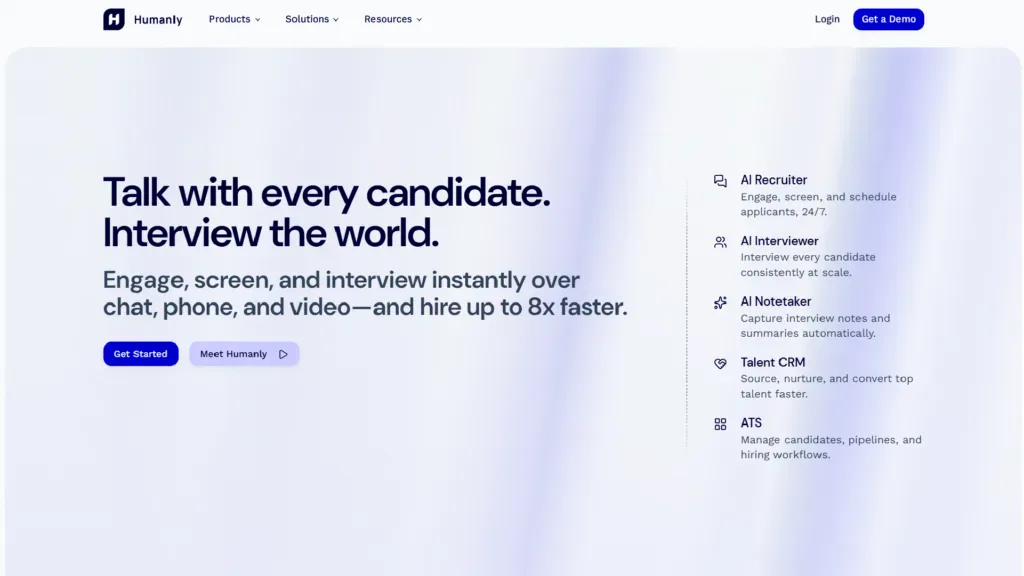
At number eight, we have Humanly.
This platform delivers conversational AI-powered recruiting workflows through chat and focuses on improving candidate experience in high-volume hiring scenarios.
It automates pre-screening, answers FAQs, and routes candidates through structured workflows. Humanly is particularly effective for frontline and hourly roles where speed and responsiveness are critical.
It also seamlessly integrates with ATS platforms and helps reduce recruiter workload during peak hiring periods.
Like other chat-first tools, note that Humanly can struggle with technical nuance and deeper qualification.
It boasts limited outbound capability with its AI solution primarily engaging applicants who initiate contact.
Key Features
- Automated voice and chat screening interviews
- Candidate evaluation and scoring
- Interview scheduling with calendar integration
- ATS data syncing and reporting
- Structured interview question frameworks
Pros
- Improves candidate responsiveness
- Reduces recruiter admin work
- Strong for frontline hiring
Cons
- Limited technical screening depth
- Conversations feel more structured than natural
- Longer setup and configuration timeline
- Less adaptive intelligence compared to leading platforms
Best For
High-volume recruitment teams focused on inbound candidate engagement and experience.
9. Ascendia AI
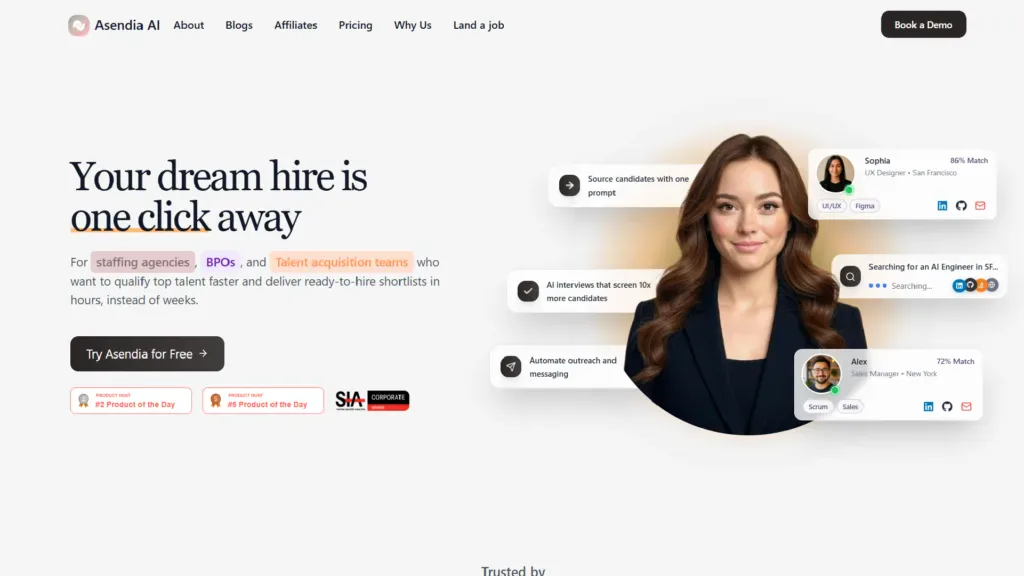
Ascendia AI positions itself as a data-driven AI recruiting assistant, combining predictive analytics with candidate engagement automation.
The platform helps teams identify quality matches faster by ranking applicants based on skills, experience, and behavior patterns drawn from historical data. It also supports automated messaging and candidate nurturing, aiming to reduce manual outreach and qualification workload.
Where Ascendia really stands out is its emphasis on intelligence over volume.
By scoring and surfacing top talent earlier, Ascendia AI helps recruiters spend less time chasing dead ends and more time engaging high-potential candidates.
Its conversational capabilities are more text-centric and structured over fully voice-enabled. It does automate engagement across email and SMS effectively, without providing real-time voice screening functionality.
Key Features
- Skills-based candidate matching
- Candidate sourcing and profile analysis
- Automated messaging and candidate nurturing
- Seamless ATS integration
- Data-driven talent insights
Pros
- Strong focus on skills-based hiring
- Combines recruiting with talent development
- Reduces early-stage screening work
Cons
- Limited voice engagement capabilities
- Less impact on high-volume hiring
Best For
Recruiters who want smarter candidate prioritization and reduced early-stage noise without additional recruitment automation.
10. XOR AI
And for our last entry, we present XOR AI.
XOR AI is a multi-channel AI recruiting automation platform designed to handle candidate outreach, screening, scheduling, and follow-ups across voice, SMS, and chat.
Its AI assistants hold structured conversations to pre-qualify applicants, answer FAQs, and gather key data before routing candidates to human recruiters. This platform also helps to automate interview scheduling.
XOR AI is built for omnichannel engagement.
The platform’s AI agent reaches candidates where they prefer to interact, improving response rates and keeping pipelines active without manual effort.
The platform is focused on automating structured qualification over depth and adaptability in voice AI platforms built for live conversation.
Key Features
- Multi-channel conversational AI (SMS, WhatsApp, chat, voice)
- Automated candidate screening and qualification
- Interview scheduling with calendar integration
- ATS integration and data syncing
- Mobile-first candidate engagement
- Automated status updates and communication
Pros
- Broad engagement channels
- Strong candidate response rates
- Reduced candidate coordination load
Cons
- Less adaptive conversational depth
- Not optimized for technical screening
- Requires manual handoffs for complex hires
Best For
High-volume, omnichannel recruiting teams seeking broad engagement without full conversational automation.
Selecting the Best AI Recruiter for Your Hiring Team
With a wide variety of options, choosing the right AI-powered platform for recruitment automation means first understanding what you need up front and focusing on those pain points.
Effective questions to ask to this end include:
- What’s your biggest recruiting bottleneck? Is it candidate outreach? Screening? Scheduling?
- Do you need voice, chat, or both? If you’re hiring technical or senior roles, voice-based screening builds rapport better than text. For high-volume hourly hiring, SMS may fit the bill.
- How fast do you need to deploy? Depending on technical overhead needs, deployment times can vary from weeks-to-months. Some can even go live in days.
- Does it integrate seamlessly with your ATS? Manual data entry defeats the purpose of automation, so we recommend only choosing a platform that offers real-time data syncing.
- Can it handle your role complexity? Entry-level screening needs different AI capabilities than technical or executive hiring. Make sure the recruitment AI agents can scale with your needs.
- What’s the true cost per hire? Look beyond subscription fees by factoring in deployment time, training requirements, and how much recruiter bandwidth the solution will actually free up.
- Will candidates engage with it? Robotic, scripted experiences can kill response rates. Talk to the provider about candidate experience before you buy.
Considering questions like these can help narrow the field effectively for your team.
The Bottom Line
Recruitment automation is here to stay. And no matter the choice you make, the solution should reduce your manual outreach demands and fix your screening bottlenecks.
AI voice calling in particular is helping leading businesses and hiring companies win in competitive talent markets.
The platforms in this guide offer AI automation to help cut costs, accelerate time-to-hire, and keep candidates engaged without burning out your team.
And when you’re ready to slash your recruiting costs by 60% and fill roles 80% faster, schedule a Rebecca AI demo to see how she can work for you.
FAQs
What is an AI staffing assistant and how does it work?
An AI staffing assistant is a conversational AI agent that automates recruitment tasks like candidate outreach, screening interviews, and interview scheduling. It conducts real-time voice and/or chat conversations with candidates, asks role-specific questions, evaluates responses against your criteria, and routes qualified candidates to human recruiters.
Can AI voice agents for staffing replace human recruiters?
No. AI agents for recruiting handle repetitive, time-consuming work. Human recruiters focus on relationship-building, complex assessments, and closing placements. AI hiring agents cannot replace the judgment and negotiation and client management skills that experienced recruiters have.
How quickly can AI recruitment automation be implemented?
Deployment timelines vary by platform. Most advanced AI call agents for staffing can be deployed in days to weeks. However, some enterprise platforms may take several weeks or months due to complex integrations and customization requirements.
What’s the typical ROI for recruitment automation with AI calls?
Most staffing agencies see ROI within 30-60 days. Time-to-fill drops as AI handles outreach and screening faster than manual processes, while cost-per-hire decreases as recruiter hours shift from administrative work to closing candidates.