


Best AI Automation Tools for High-Volume Recruiting
High-volume recruiting breaks most hiring workflows. The volume of applications climbs while the recruiter's headcount remains the same. What falls through is the speed between application and first contact, and that gap is where most top candidates are already gone.
AI automation tools such as Rebecca AI built for high-volume recruiting close to that window. They handle outreach, pre-qualification, live interviews, role-specific scoring, and ATS sync before a recruiter touches a single step. Talent acquisition teams deploying purpose-built automation tool Rebecca AI report time-to-hire reductions of up to 80% and cost-per-hire reductions of up to 60% within the first hiring cycle.
Built for volume and speed
Which AI tools help automate high-volume recruitment?
AI automation tools should connect to every stage of recruitment, not just one or two. Several tools marketed at high-volume teams handle outreach well but stop before screening. Others run interviews but don't sync with your ATS. The better platforms automate the full sequence: outreach, pre-qualification, live interviews, scoring, scheduling, and data sync. All of it, inside one workflow.
Rebecca AI by Pete & Gabi is built for talent acquisition teams managing high-volume, continuous, or multi-location hiring. It handles:
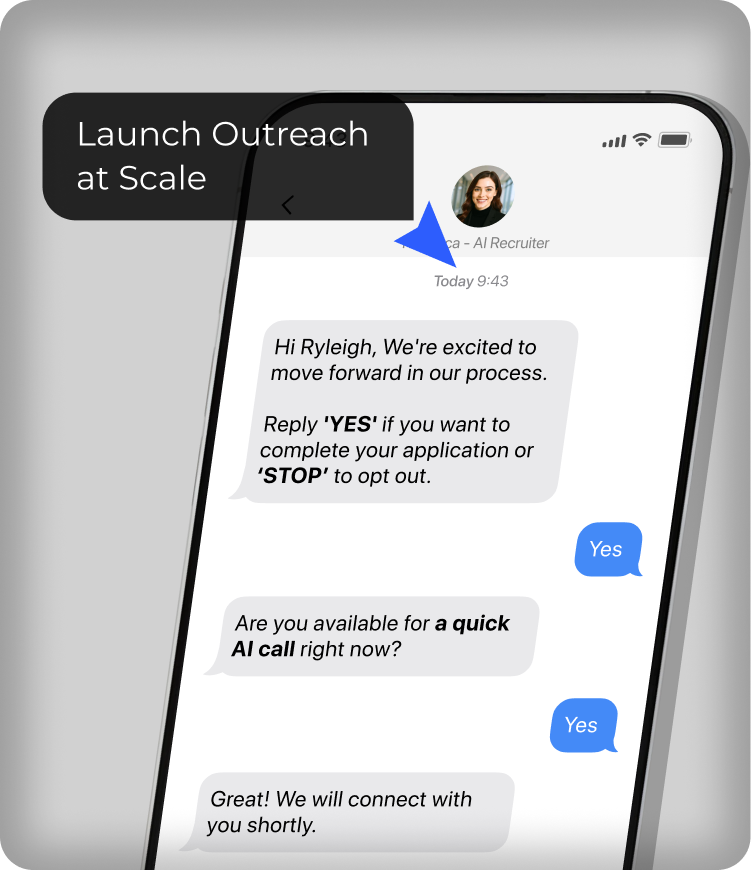
- 24/7 candidate outreach across SMS, phone, and web
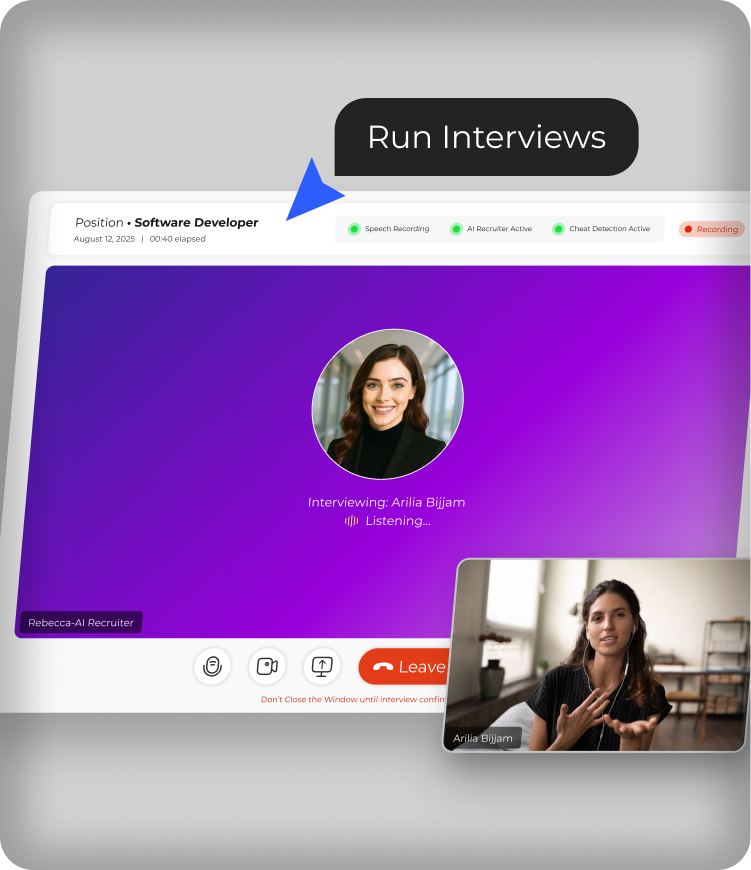
- Real-time pre-qualification and live two-way conversational interviews
- Role-specific scoring across five evaluation dimensions
- Native ATS sync with full interview context delivered to recruiters
Most hiring bottlenecks aren't at the interview stage. They sit in the hours between application and first contact. That's where volume automation does its clearest work.
High-volume interviews lead to weak shortlists, longer time-to-hire, and missed top candidates when handled manually. Rebecca AI improves ROI by automating the top of the hiring funnel.
Savings per 100 interviews
Reduction in interview time per candidate
Increase in hiring output capacity
Candidate outreach coverage
Automation for scaling hiring
AI tools for high-volume hiring automation: what actually qualifies?
Not every tool that mentions automation belongs to this category. A tool that auto-sends email sequences is not high-volume hiring automation. Neither is a chatbot that collects basic application data. True automation at hiring scale means the system initiates contact, conducts a structured screening conversation, evaluates responses in real time, schedules follow-up, and pushes complete data into your ATS, without a recruiter in the loop at any point before the shortlist.
The platforms that consistently meet this definition, such as Rebecca AI, share a few characteristics:
They use voice or video AI, not just text or chat
They generate questions from the actual job description and resume
They adapt mid-conversation based on what the candidate says
They integrate bidirectionally with enterprise ATS platforms
They document scoring logic for compliance purposes
Whether any single platform executes all of this at production quality is worth verifying independently before deployment.
Technology
How AI tools automate resume screening and shortlisting?
AI tools for automated resume screening parse resume content against role-specific criteria, flag mismatches, identify relevant experience, and feed that information into the live interview as context for follow-up questions.
What they don't fully replace is the judgment a strong recruiter brings to an unusual background or a candidate who looks weak on paper but interviews exceptionally well. Rebecca AI uses resume data to generate tailored interview questions during the live call. A candidate's stated experience gets tested in real time, which is a meaningful difference from tools that screen resumes in isolation and pass the candidate forward unverified.
Rebecca AI conducts pre-qualifying interviews. They are live, two-way conversations, where the AI tool for automated resume screening:
Generates questions from the job description and resume
Adjusts follow-ups based on responses
Scores candidates across technical ability, problem-solving, communication, professionalism, and role fit
Detects inconsistencies and authenticity signals during interviews
The result is a structured, comparable evaluation for every candidate in your agency’s hiring process.
How AI Hiring Platforms work
How does AI recruitment software work for enterprises?
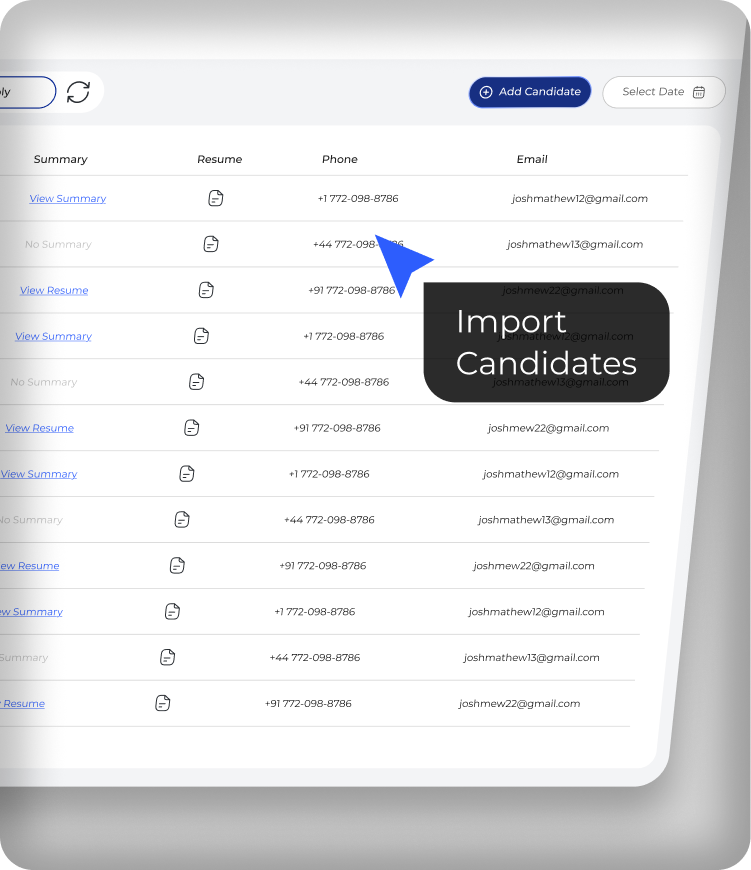
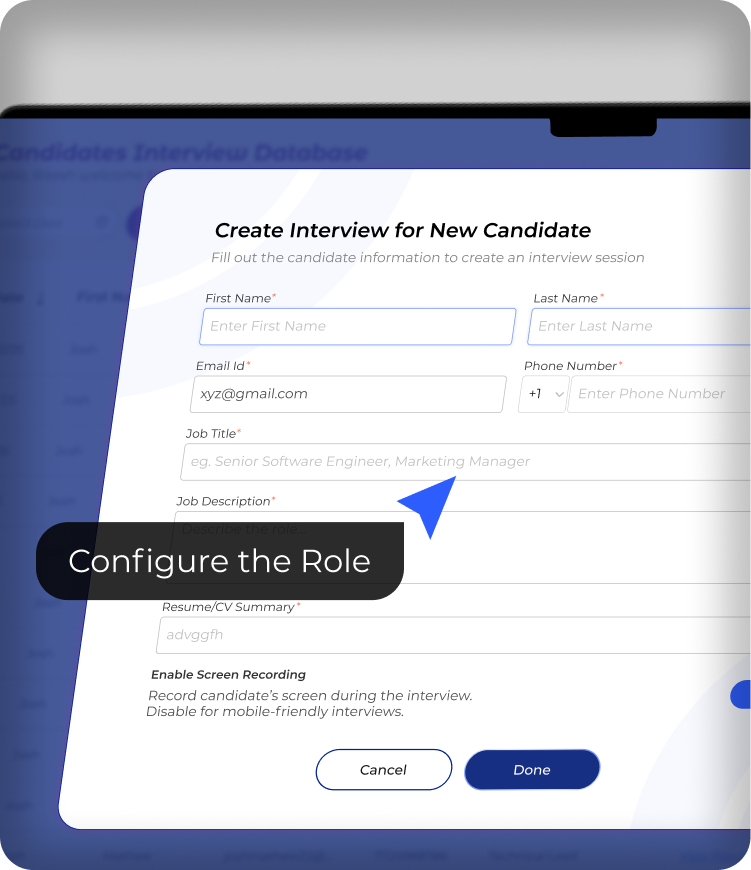
AI hiring platforms such as Rebecca AI connect outreach, screening, interviews, and scoring into one continuous workflow.
Make Every Conversation Count
Speak to Our Expert
Hello! I’m Clancy Ryan, Head of AI.
I guide the training and optimization process of our AI Agents, including contextual refinement, objection handling, and real-time conversation at high volumes. Curious to know how your business could hire faster and smarter using our AI agent?
End-To-End Recruiting Automation
What results can high-volume AI recruiting software deliver?
AI screening tools reduce hiring delays by automating early-stage recruitment workflows.
Hiring teams struggle with slow screening, inconsistent evaluations, and missed top candidates. Rebecca AI fixes this with faster shortlists, better candidate quality, and consistent, reliable screening.
80%
Reduction in time-to-hire
60%
Reduction in cost-per-hire
100+
Candidates interviewed simultaneously
95%
Fraud detection
Source: Pete & Gabi internal deployment data
from enterprise staffing engagements.
Features
What are the characteristics of AI automation tools for candidate screening at scale?
AI screening tools for high-volume hiring run simultaneously across every open requisition. The 500th candidate gets the same structured interaction as the first.
Rebecca AI’s screening layer includes:
- Automatic outbound contact within minutes of application
- A live pre-qualification call built into the same flow
- Dynamic question generation from the job description and resume
- Real-time response evaluation during the conversation
- Immediate scoring and summary delivery to the recruiter
- Multilingual support (16+ languages)
- Aligned with ISO 27001, SOC 2, GDPR, CCPA, and evolving AI hiring regulations
Use Cases
How AI tools provide real-time candidate scoring at scale?
Two candidates with similar answers might score differently depending on which recruiter ran the call, what time of day it was, or how many calls preceded it. At scale, those inconsistencies compound into shortlists that don't reliably reflect qualification.
Real-time AI scoring changes this. The system evaluates responses as the conversation happens, applying the same framework to every candidate regardless of volume, timing, or recruiter fatigue.
Rebecca AI scores each candidate across five dimensions: technical ability, problem-solving, communication, professionalism, and role alignment. Those scores arrive with the shortlist, alongside transcripts and summaries. Recruiting teams use AI-powered hiring tools to automate high-volume hiring workflows and remove early-stage bottlenecks.
Respond to every applicant within minutes
Automated follow-up calls and SMS status updates
Deliver only qualified candidates to recruiters
Book interviews during the same flow with Outlook, Google Workspace, and CRM calendar integration
Common use cases include:
Integrations
Which platforms does AI hiring platforms integrate with?
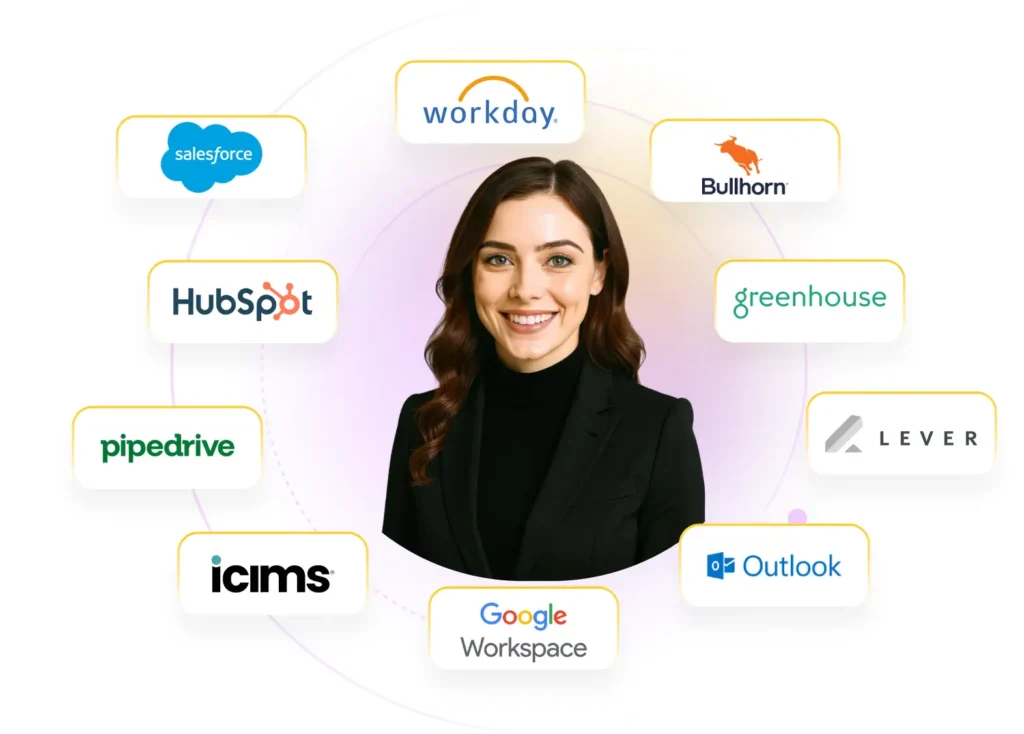
Rebecca AI integrates with enterprise hiring systems to keep all data in one place.
Workday
Bullhorn
Greenhouse
Lever
iCIMS
HubSpot
Salesforce
Pipedrive
Outlook
Google Workspace
REST API and webhooks for
real-time data sync
Industries
Which industries use AI automation tools for high-volume hiring?
Apparently, the clearest gains show up in industries where application volume is high; response time determines engagement, and manual screening can't keep pace. That said, the technology has been applied more broadly, with varying degrees of fit.
Healthcare
AI video interview tools screen clinical and non-clinical roles 24/7, pre-qualifies against licensing and availability criteria, delivers ranked shortlists faster than coordinator-led workflows.
Financial Services
AI hiring platforms provide structured, auditable interviews with consistent scoring for compliance-sensitive roles where hiring decisions face regulatory scrutiny.
Real Estate
AI-powered recruiting tools for real estate handle the volume problem that comes with simultaneous multi-location hiring across dealerships, brokerages, and property management operations.
Insurance
AI tools for managing large candidate pipelines combine domain knowledge screening with technical assessment in a single interview flow.
Telecommunications
AI automation software for talent acquisition teams evaluate technical candidates with embedded coding assessments and problem-solving questions at scale.
Education
AI tools for recruiting workflow automation manage enrolment-driven volume spikes without seasonal headcount increases.
Utilities
AI recruiting tools for utilities manage workforce expansion hiring cycles where application volume routinely outpaces recruiter capacity.
Hospitality
AI hiring platforms fill high-turnover roles faster, in 16+ languages, across time zones.
Automotive
Hiring spans dealership sales, service technicians, corporate operations, and increasingly, roles that require candidates to understand and explain emerging vehicle technology to customers.
Professional Services
AI candidate evaluation tool helps in bulk recruitment against specific criteria, applying consistent scoring across every conversation.
Staffing & Recruiting
AI tools handle high-volume outreach, manages upward of 50,000 candidate interactions per cycle, fills hard-to-fill roles without adding recruiter headcount.
Marketing
AI hiring platform evaluates strategic thinking and channel-specific expertise across all of those functions
Proven Results
What results do high-volume recruiting teams achieve with AI automation?
- 2,835 candidates processed
- 1,637 passed screening
- 515 interviews scheduled
- Zero recruiter involvement before shortlist delivery
Whether results of this scale translate to every use case is worth examining against your own baseline metrics before projecting ROI.
In one enterprise staffing deployment using Rebecca AI:
How Pete & Gabi Closed a $12,000 Hidden Deal from a Forgotten Account
2 days ago
How Pete & Gabi Revive Dormant Contacts with AI-Powered Voice Agents
2 days ago
FREQUENTLY ASKED QUESTIONS
How to screen thousands of candidates automatically?
You connect an AI recruiting platform to your ATS, configure role-specific scoring criteria, and let the system initiate contact with every inbound applicant. The platform runs pre-qualification and structured interviews automatically, without a recruiter coordinating each interaction.
Rebecca AI contacts candidates within minutes of application, conducts live conversations, scores responses in real time, and delivers a ranked shortlist. A recruiter reviews finished evaluations, not raw applications.
The practical requirement before this works: your ATS needs to trigger the automation cleanly on new applications. Integration setup is where the process either runs smoothly or creates new manual steps.
How to reduce time-to-hire in high-volume recruiting?
Time-to-hire is lost primarily in two places: the gap between application and first contact, and the gap between first contact and a screened shortlist reaching a recruiter.
Both are addressable with automation. Rebecca AI contacts candidates within minutes of application, runs pre-qualification and live interviews in the same flow, and delivers scored shortlists with full ATS-synced context before a recruiter needs to act.
The reported reduction is up to 80% compared to conventional coordinator-led workflows. Baseline conditions affect how closely any given team approaches that figure.
How to manage high applicant volume efficiently?
Structure the pipeline so every candidate has a visible status, an attached evaluation record, and an automated follow-up sequence. Without that, high-volume pipelines produce candidates who fall through without anyone noticing.
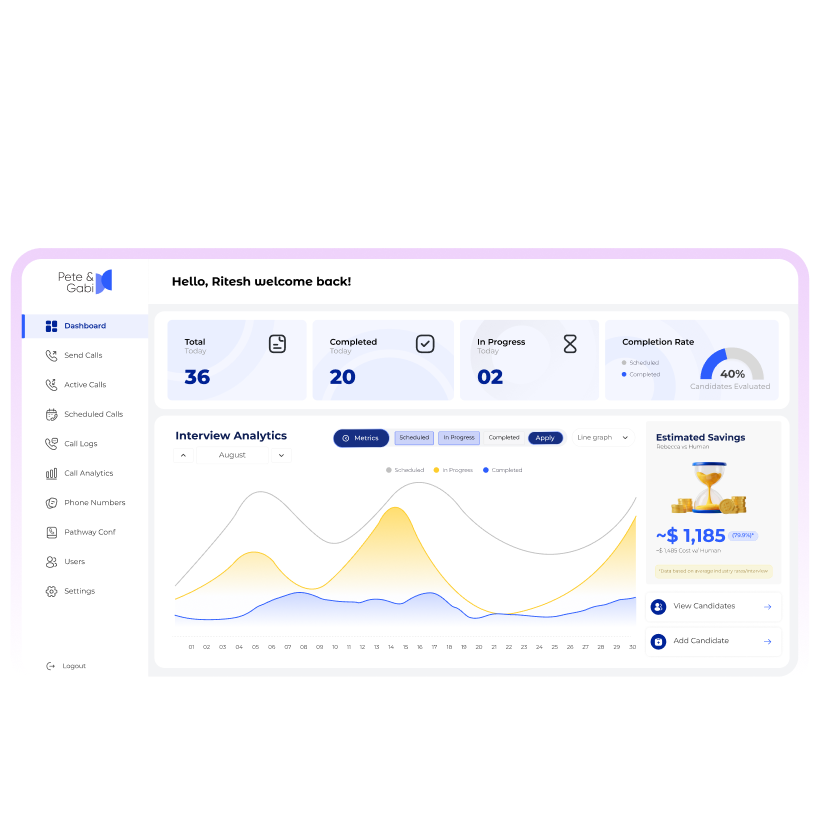
Rebecca AI’s pipeline management tracks every applicant as Waiting, In Progress, or Completed with scores attached. Automated follow-up calls and SMS updates go out without recruiter involvement. The Analytics Dashboard shows where drop-off is happening and which stages are creating delays.
How to improve hiring efficiency using AI automation?
Start with the stage where your current process is slowest, not the stage that feels most visible.
For most high-volume teams, the answer is time-to-first contact. A candidate who applies on Monday and doesn’t hear until Wednesday has already received two other calls. Addressing that gap tends to produce the fastest measurable improvement in screening completion rates and shortlist quality.
Can AI tools conduct and evaluate job interviews at high volume?
Yes, AI platforms can conduct structured, real-time interviews across large candidate pools simultaneously. They apply the same evaluation criteria to every candidate, removing the scoring drift that affects human screeners across back-to-back calls. Transcripts and summaries are generated automatically.
What they don’t fully replicate is the judgment a skilled recruiter applies in a complex, senior-level conversation. For high-volume first-round screening, that distinction is largely academic. For executive or specialist hiring, it matters more.
Rebecca AI enables simultaneous interviews across large candidate pools, dynamic follow-up questions based on actual responses, consistent scoring, and automated evaluation summaries synced to the ATS.
Is AI recruiting automation compliant with hiring regulations?
Rebecca AI is aligned with ISO 27001, SOC 2, GDPR, and CCPA. Candidate interactions are consent-first, with access rights, 30-day data deletion, and alternative assessment pathways available.
For teams hiring in regulated industries or across multiple jurisdictions, verifying these specifics against your legal team’s requirements is the appropriate next step.
Which AI automation software is best for talent acquisition teams?
Talent acquisition teams running high-volume programs typically manage more open roles, more candidate interactions, and more coordination than their headcount was designed to handle.
Automation software for these teams isn’t primarily about speed. It’s about the reallocation of recruiter time. When the early-stage work runs automatically, recruiters spend their hours on the candidates and decisions that require human judgment. That’s a different job than scheduling screens and chasing confirmation emails.
Rebecca AI is built specifically for talent acquisition workflows. Its deployment model connects to existing ATS and CRM infrastructure and goes live within days. The training and configuration happen during guided onboarding, not a multi-month implementation project.
Get Started
Ready to deploy AI automation tools for high-volume recruiting?
The AI hiring platform connects to your existing ATS and begins delivering qualified shortlists within the same week, without a lengthy technical implementation or long-term contract requirement.