Pete and gabi

Try Pete & Gabi for yourself

Talk to AI to Increase Sales & Leads

or call us directly at

+1 224 445 2200

It’s “Show Me the Money” Time: Voice AI Leads Practical AI into 2026  

Voice AI for customer reactivation

In business, everyone knows AI is the future. But not everyone has the time or money to devote to exploring it now.   To experiment in sandboxes, monitor, slowly integrate, ensure the AI is secure and compliant, or deal with miscues or outright misfires on things like complex product data.   At a larger scale, Forrester reports enterprises are even deferring some of their planned AI spends (they estimate 25% to 2027) because companies know it’s coming and hugely transformative but they want proof of impact and nitty-gritty use cases up front.  We’ve profiled a few areas where AI is already doing just this. Where it’s gained real, reliable traction, from coding assistance to customer service first contact to recruiting follow-up and initial screening.    Today we’re writing about another of these: voice AI for sales outreach. While a lot of AI projects are highly speculative, this area is seeing a boom of investment because companies of varying size are already clocking impressive gains.  With 2026 as the “show me the money” year for AI (per firms like Menlo Ventures), voice AI is surging in sales uses for companies seizing on its ability to extend their reach and generate tangible results with minimal pain.  Leading the Pack: Voice AI Adoption Surges into 2026  One reason AI companies remain focused on math competitions is that the answers are ultimately right or wrong. The process to get to the answer can be clearly tracked and the logic analyzed.   Voice AI in sales gives similar benefits, and that’s no doubt one reason it’s risen among business use cases.  You can count the calls that have connected, the meetings booked, and the revenue opportunities generated. For reactivation use cases, you also get customer data updates and hours saved for your sales team, but those areas are a little harder to quantify cleanly (and more like the broader AI claims across the board).   In customer service, Gartner projects conversational AI in contact centers will resolve 80% customer service issues automatically by 2029, and early successes have seen that integration in voice AI get well underway. Just last week, voice AI startup Deepgram hit a $1.3 billion valuation with over a hundred million dollars invested for it to scale internationally and continue its mad growth. Meanwhile venture capitalists like Simon Wu, partner at Cathay Innovation, told Business Insider that 2026 is the year voice AI becomes the default for not just customer service, but also sales and support workflows.   This is driven by data. In sales, one of the most efficient uses today is outreach, as with dormant accounts that aren’t getting serviced or follow-ups that aren’t getting made quickly or routinely enough.   On a per-call basis, these can feel like a waste of time for talented sales reps, who burn hours digging into what data they have, dialing and chasing the customers, and finishing with manual data updates.   But at scale, conversational AI systems are executing this use case with extreme effectiveness and consistency.   They’ve gotten good enough to sound and feel human, operate reliably within guidelines, be compliant, secure, and yield real ROI fast. They can also be fairly light-weight, getting on their feet in days and showing payback in weeks.  No doubt the years to come will see expansion of this capacity, but today they’re operating as a reliable play for companies tapping into AI efficiency to extend reach without undergoing extensive technical overhaul.  By the Numbers: AI Calling Agents for Sales and Support Another reason this area in AI is so hot is that it’s repetitive, acts on data you have, and doesn’t require all new KPIs to measure.   Companies see the success in radically improved connect rates, with those using AI-powered outreach averaging 15 to 35% increases (with providers themselves boasting higher, of course).   There’s also no question about volume, with AI systems able to handle huge numbers of calls (from hundreds to thousands per day) versus the 40-odd made by reps on average (again, highly variable, though consistently well less-than-half of AI’s bandwidth).   Here’s a look at more of these metrics:  Qualification and conversion rates with these systems show improvement largely across the board. There are scores of examples from providers, like pilots: a voice AI agent dialed 8,000 numbers not getting serviced, connected with 11.5% live on the phone, and qualified 17.5% of these. This was 12 times higher engagement than e-mail for the customer over the same list.   Or the legal services firm that implemented voice AI and boosted its qualification by 60% to 85% among answered calls. This translated to 72 qualified appointments per month versus 30 previously. They ultimately doubled monthly closed deals as a result.  For Pete & Gabi’s Olivia AI, a global distributor revived $139,000 in the first 30 days, working through a backlog of accounts. From the first 1000 calls, the stats were:   These are anecdotal but demonstrate why this use case is so prevalent and the tech is witnessing a real surge of investment.   Speed is another metric you can track in conversion, and effective AI systems also win here easily, responding to inbound contacts some 70% faster, with AI cold calls getting 35% + higher meeting conversion rates.   In other words, more calls, faster, by fewer agents, with more conversions. For those asking how to win back inactive customers with higher quotas and limited bandwidth, automation is now providing a surprisingly effective answer.  Conversational AI for Sales in Action At a larger scale, Verizon has shared the impact of its use of Google AI in this arena for sales.   They started deploying AI features in the summer of 2024 (hitting full scale January 2025) and slashed their reps phone time.   They consequently saw their sales numbers surge by 40% since deployment.   Verizon is also using AI assistants to help reps get the right answers on the fly.   “We are doing reskilling in real time from customer care agents to selling agents,” CEO of Verizon’s consumer group Sampath Sowmyanarayan told Reuters.   Google Cloud CEO Thomas Kurian added: “Compared to what other people are doing, this is enormous scale.”   The company handles 170 million calls annually and also uses generative AI to predict call reasons with approximately 80% accuracy. This leads to more effective routing, and they’ve been able to tie it directly to loyalty and churn reduction goals.  But companies of varying sizes are gaining these benefits without such complex or unique integrations. They’re reaching more customers faster with AI, improving the data in their CRM directly, and realizing revenue at scale that’s been deemed too costly to chase until now.   This is further improved by routing high value opportunities directly to reps to close, with all the history and context provided, searchable, and updated on-the-fly.  The AI Sales Agent Revolution   Much of the change in this area is due to how fast voice AI systems have improved over the last 18 months. At a Federal Reserve conference in July, OpenAI CEO Sam Altman warned the financial industry of a “significant impending fraud crisis” due to AI’s ability to consistently fool voice-print authentication.   Around the same time, the Washington Post reported on a deepfake of Secretary of State Marco Rubio being used to successfully contact US officials and foreign ministers. These audio messages were accompanied by texts that also matched his writing style.  And while such deepfakes open the door to fraud and real security concerns, they also showcase how effective

Your Business Needs an AI Call Agent—Here’s How to Deploy One 

AI Call Agent for Business

If you’re reading this article, you’ve probably reached that point where manual calling workflows can’t keep up with your business demands anymore.  Maybe your reps are buried in callbacks. Leads are waiting hours, you’re losing revenue, and too many customers are churning.   Sounds like you’re ready to bring in a conversational AI call agent.  But that’s where many businesses get it wrong.   In this guide, we break down the journey: selecting the right platform, shaping your agent’s persona, and loading it with the knowledge needed to deliver desired results.  Let’s get to it.  Signs Your Business Is Ready for an AI Call Agent  Before we get into the steps to choosing an AI call agent, let’s make sure you’re solving the right problem. If any of these sound familiar, you’re already overdue:  If these pain points hit home, an AI call agent can transform the way your business operates.  8 Steps to Acquiring an AI Call Agent for Your Business  If you deploy conversational AI the right way, you can go from “We need help” to “Why didn’t we do this sooner?” in a matter of days.   Here’s how.  1. Choose the Right Platform  Your AI agent is only as strong as the platform behind it. Look for a solution built for real conversational depth—not rigid scripts or robotic voices.   As a rule of thumb, top platforms should offer natural speech, fast response times, reliable uptime, and customizable personas.   Also, ensure the conversational AI solution you choose supports your specific use cases—whether it’s outbound calls, inbound support, appointment scheduling, or lead qualification.   Most importantly, choose a platform that can scale as your call volume, locations, or product lines grow.  2. Set Up Your Business Phone Number  Your AI agent needs a dedicated line to operate.   Whether you’re using Twilio or another reputable telecom provider, secure a number that aligns with your brand—local, toll-free, or both.   Once you have it, connect the number directly to your AI platform. This becomes the bridge between your customers and your conversational AI agent.   It’s also important to make sure your call routing rules are clear from day one—what rings where, how it routes, and after-hours logic all matter for creating a smooth caller experience.  3. Define Your Agent’s Role & Persona  This is where the success of your conversational AI deployment takes shape.   The prompt you write becomes its blueprint—tone, personality, responsibilities, and boundaries.   For example: “You are a warm, efficient receptionist for GreenLeaf Health. You answer inquiries, schedule consultations, and route urgent calls correctly.”   Remember, a well-crafted persona ensures consistency.   Think of it like onboarding a new hire:   The clearer the instructions, the better the performance.  4. Build a Knowledge Base That Feeds Accurate Answers  Your AI agent can only answer questions using the knowledge you give it.   For this, you’ll need to upload as much relevant information as you can—from your FAQs, product descriptions, and website pages to policies, pricing details, and other internal guides.   The goal is to create a library of information the agent can reference—something a human team would normally have to check manually.   A well-built knowledge base reduces errors, cuts escalations, and ensures callers get correct answers every time. Continue to update this information regularly as your business evolves.  5. Configure Call Functions & Workflows  Now it’s time to teach your agent what to do, as well as say, during calls.   Set up how it transfers callers to your team, books appointments, updates CRM fields, or escalates urgent issues. (See step 8 below for connecting to systems.)  You can also add call-ending rules, voicemail detection, and fallback flows when customers ask something outside the knowledge base.   From here, your AI voice agent becomes operational. And instead of just conversing, it can complete tasks your team no longer needs to handle manually.  6. Test Your AI agent in Realistic Scenarios  Before you go live, stress-test your AI like you would a new employee.   Give it easy calls, complex calls, angry customers, confused customers, urgent situations, and scenarios that require escalation.   You should also test how well your conversational AI handles speech quirks, accents, fast talkers, and overlapping dialogue.   Listen closely for tone, clarity, and accuracy. Then tighten the knowledge base where needed, refine the persona, and adjust workflows.   This test phase is crucial to protecting your brand reputation and ensuring your AI agent performs well from day one.  7. Publish & Deploy Your Agent  Once your tests look good, you’re ready to launch.   Publishing your agent makes it officially available on your connected phone number. You can also add your payment method if required and set usage limits.  Your AI is now ready to take real calls—whether it’s inbound support, outbound follow-ups, intake calls, or scheduling appointments.   It’s also a good idea to go live in phases. Maybe start with after-hours, overflow calls, or a single department before scaling across the entire business.  8. Integrate with Your Existing Systems  Finally, sync your AI voice agent with your existing tech infrastructure.  To unlock true efficiency, connect your agent to your CRM, helpdesk, calendar, or scheduling tool.   Integrations allow the AI to automatically log call details, update customer records, schedule meetings, or trigger workflows—all without manual intervention.   This creates a seamless loop between your customer conversations and backend systems. Over time, integration turns your AI agent into a full member of the team—one that works consistently, accurately, and around the clock.  Implementation Mistakes to Avoid  Rolling out an AI call agent can transform your operations—but only if you avoid the pitfalls that frequently sabotage performance.   These include:  Bringing It Together Adding an AI call agent is about transforming how your business communicates, engages leads, and drives revenue.   When deployed thoughtfully, it handles repetitive calls, engages customers instantly, and frees your team to focus on high-value work.   The difference isn’t marginal—it’s operational clarity and measurable ROI.   Follow the steps in this guide, avoid common pitfalls, and watch your workflows evolve.   Ready to turn calls into revenue 24/7? Let Pete & Gabi handle the conversations while your team closes deals.  FAQs  What is an AI call agent and how does it differ from traditional IVR?   An AI call agent can hold natural, human-like conversations, understand context, and make decisions in real time—unlike traditional IVR systems, which follow rigid menus and frustrate callers.  How quickly can my business deploy an AI call agent?   Depending on your setup and integrations, top AI agent solutions can be live in just days. However, full training, testing, and integration with CRMs or calendars may take a few weeks for peak performance.  Will an AI voice agent replace my staff?   No. AI agents handle repetitive, high-volume calls, freeing your team to focus on complex tasks, high-value conversations, and closing deals faster.  Can the AI handle multiple business functions at once?   Yes. From inbound lead qualification to appointment scheduling and follow-ups, conversational AI agents multitask seamlessly without missing a beat.  How do I measure ROI after

The Real Estate Edge: 8 AI Agent Use Cases You Can’t Ignore 

AI for Real Estate

Real estate is a volume game. Not one you lose because your real estate team is incompetent, but because there aren’t enough hours in the day to work every lead, chase every follow-up, and nurture every client.  But conversational AI can solve these problems.  AI voice agents are quietly changing the game for real estate companies. In this article, we’ll show you how.  Here we break down eight use cases showing exactly how AI agents are rewriting the real estate playbook for connecting with leads, following up, and sealing deals.  Inbound Lead Management  Before you can close deals, you have to know quickly which leads are worth chasing.  Since the company who responds first can be the one who gets the listing or the buyer, and your human team can’t be everywhere at once, here’s how AI redefines lead acquisition in real estate.  1. Property Inquiry Handling  The lead inquiry stage is where many real estate companies lose out on potential business.  Why? There was no one there to pick up the phone.  Thankfully, this is one critical gap AI voice agents are filling with 24/7, instant responses to buyer and seller questions.  Whether it’s 8am on Saturday or 10pm on Tuesday, these AI systems answer every call, providing accurate info in real-time and following up with more details via SMS.  And when a lead shows serious intent, the AI routes them directly to a live agent for a smooth handoff.   2. Follow-Up with Cold or Dormant Leads Every business CRM has these:   But most teams don’t have the bandwidth to chase them all. So, these leads may sit there forever.  This is where AI voice agents take action.  They reach out automatically, striking up natural conversations to re-engage ignored leads. If the buyer is still searching, they offer fresh real estate listings and connect qualified prospects with an agent instantly.  Conversational AI agents find otherwise lost revenue in your pipeline and prevent leads from falling through the crack.  3. Mortgage Prequalification Routing  Most homebuyers start browsing before they know what they can even afford—which means real estate agents often spend time nurturing leads who aren’t really ready to buy.   AI voice agents help filter out valuable prospects early.   They capture essential mortgage readiness details like income range, down payment capacity, and credit standing through natural conversations.  Once they identify serious, finance-ready buyers, they automatically route them to your in-house financing team or partnered loan officers.  This means faster prequalification, less manual back-and-forth, and more deals that move from “just looking” to “ready to close.”  Sales Enablement  Capturing a lead is one thing, but converting is another.   This is where many real estate teams lose momentum—endless qualification rounds, slow scheduling, and leads dropping away.  Here are three ways conversational AI turns engagement into closed deals for real estate companies.  4. Lead Qualification  Not every lead is worth your time. But figuring out which ones are can eat up valuable hours.  AI voice agents handle this for you by pre-screening inbound calls with the questions that matter—like buying intent, budget, location preference, timeline.  And while they’re talking, the AI scores and categorizes each lead in your CRM automatically.   High-intent buyer looking in the right price range? Tagged and prioritized.   Window shoppers with no clear timeline? Noted and nurtured for later.  With conversational AI handling qualification, your team wastes less time on tire kickers.   5. Appointment Scheduling & Reminders  Real estate companies using AI agents already know: Scheduling showings shouldn’t require six emails and three missed calls.   Conversational AI agents book property viewings and consultations in real-time, right on the call.   No back-and-forth to double check calendars. Just a “when works for you?” and it’s done.  And automation confirmations and calendar invites are not where it ends.  AI agents also send reminder calls and texts before the appointment, reducing no-shows.  6. Open House Promotions  Getting people to show up to an open house can sometimes feel like pulling teeth. But AI voice agents are changing this part of the real estate game, too.  They call your lead lists directly and announce upcoming open houses with a personal touch, getting far better results than generic email blasts.   They can also answer basic questions in real-time and let prospects RSVP right on the call.  And once that’s done, they follow up automatically with a text containing the date, address, and directions—ensuring your event stays top of mind.  With AI agents, open house promotions become proactive, personal, and more effective, without overloading your team.  Customer Experience & Feedback  Great experiences are how leading real estate companies keep their customers coming back. Here’s how AI helps you build a positive company reputation and drive customer retention.  7. Client Survey & Feedback  Great real estate companies don’t just close deals—they build lasting relationships with customers.   But manually collecting feedback after every showing or sale can be a grind.  AI voice agents make it effortless and personalized.   They call recent clients to gather feedback, measure satisfaction, and even record testimonials in real time. Quick, natural conversations that feel like a courtesy check-in.  And when customers have positive experiences, those clients can be nudged to share their reviews on Google or Zillow.  Less-than-happy ones? The feedback goes straight to your CRM for follow-up and improvement.  Putting conversational AI on feedback duty is how top-performing real estate teams turn post-sale silence into insights, reputation boosts, and repeat business—on autopilot.  8. Multilingual Buyer Support  Not every client speaks English. But with multilingual AI voice agents, language doesn’t have to be a barrier to conversion.   These agents can qualify and assist leads in their preferred language—from Spanish to French to Mandarin—with natural, human-like fluency. This means all your prospects or customers get top-notch experiences regardless of the language they speak.  For real estate teams expanding into diverse or international markets, deploying multilingual AI agents ensures inclusivity and profitability without limitations.  Taking the Next Step  The real estate industry runs on conversations—every inquiry, showing, and follow-up starts with one. But your human team can only handle so many.  AI voice agents change the equation.   They work nonstop, across time zones and languages, ensuring no lead slips through, no buyer feels ignored, and no deal dies in the dark.  The real estate companies winning today aren’t necessarily the ones working the hardest. They’re the ones working the smartest.  Ready to secure your AI-powered advantage?   Pete & Gabi are AI voice agents that call, qualify, and book—so your team closes more deals without the grind.  Schedule a demo now to learn more.  FAQs  How do AI agents help real estate teams save time?  They take care of the repetitive, high-volume tasks that usually drain your sales and leasing teams—like answering FAQs, scheduling viewings, or reviving cold leads. That means your team can focus on closing deals, not chasing calls.  What happens if a lead asks a question the AI can’t answer?  AI agents are trained on your property listings, pricing, policies, and FAQs—so they handle 90% of inquiries instantly. But when a question requires human judgment or falls outside their scope, they seamlessly route the call to your team.  Can AI agents integrate with my CRM or existing tools?  Yes. Most AI voice agents connect directly with leading CRMs and marketing platforms.

Stop Guessing about AI Calling: Voice Agents & Smart Automation Explained in 15 Questions 

Voice Agents and Smart Automation

AI calling is no longer the next big thing—it’s increasingly the standard for how businesses connect to, qualify, and convert leads to customers.   From sales to support and appointment scheduling, conversational AI is redefining what it means for businesses to be “always available” by delivering instant, relevant, and intelligent conversations on-demand.   It’s no wonder there’s so much buzz around voice AI automation.  If you’re wondering how it all works—and what it means for your team—you’re in the right place. This blog answers 15 of the most common (and most important) questions about AI calling as a driver of business growth today.  1. What Is AI Calling and How Does It Work?  AI calling is exactly what it sounds like—outbound and inbound calls managed by artificial intelligence that sounds and feels human.   Instead of robotic scripts, AI voice agents listen, understand intent, and respond naturally in real time. They use conversational AI to process speech, detect tone, and carry context across the entire conversation.   So when someone says, “I’m calling about my order,” the AI doesn’t just hear words—it understands what to do next.   Think about conversational AI agents as having consistent, high-quality reps on every call, 24/7.  2. How Can Voice Agents Increase Revenue, Not Just Cut Costs?  Deploying AI call agents for your business does not just reduce your overhead. It helps you make more money, too.  By responding instantly, they keep leads from turning to faster competitors. Conversational AI also qualifies every prospect in real time and transfers hot leads directly to your sales team.  And if follow-ups are required, AI agents never drop the ball.  Many AI calling solutions that are built for sales automation also have personalized upselling and cross-selling capability baked into their design.  This means more conversions, fuller pipelines, and a sales process that turns routine calls into revenue opportunities.  3. Can You Recommend AI-Powered Voice Solutions to Boost Sales Calls?  There are several AI calling providers to choose from. But far fewer are optimized for sales.   Pete & Gabi is one. It boasts AI voice agents that hold conversations with high-quality conversational AI, qualify intent in seconds, and transfer ready leads to your team with all the needed context.  Another example is Synthflow. It offers a solid, no-code platform for deploying AI voice agents that sound natural and scale fast.   Retell AI provides advanced voice agents that handle conversations from qualification to hand-off on autopilot.  4. What AI Tools Support Staffing and Recruiting at Scale?  AI recruiters and interviewers are game-changing solutions for staffing and recruiting operations currently getting hammered by AI-driven submissions from candidates.   These AI agents handle reaching out to prospects and even conduct intelligent screening conversations for open roles.  They ask role-specific questions and probe deeper based on candidate responses in real-time. This ensures prospects actually meet your requirements before consuming your precious human recruiter time.  AI recruiters handle the admin grind—from initial outreach and prospect qualification to booking interviews and even conducting them.   AI recruiting agents perform like dedicated hiring assistants working round-the-clock.   5. How Does an AI Voice Agent Use Sentiment Analysis to Personalize Offers?  Conversational AI agents use natural language processing (NLP) with sentiment analysis to detect tone, emotion, and intent in real time.   If a prospect sounds budget-conscious, the AI call agent pivots to value messaging instead of premium features. If excitement spikes, it leans in with a confident upsell or limited-time offer.  And if frustration creeps in, it softens tone and addresses concerns.   Every word, pause, and inflection becomes data that guides the next response.    This contributes to conversations that are more personal than programmed.  6. What Compliance Standards Do Voice AI Platforms Meet?  Reputable AI call agent platforms are built for full regulatory compliance.   Every call, transcript, and data point is handled in accordance with industry regulations like the GDPR, HIPAA, and major data protection frameworks worldwide. They should also abide by TCPA rules for calling consent and disclosure requirements  To ensure privacy and security as well as compliance, all conversations should be fully encrypted.  Whether you’re handling customer data, patient info, or sales leads, AI voice agents should keep privacy airtight so your business can focus on performance, not paperwork.   7. Can an AI Voice Agent Upsell or Cross-Sell during a Live Booking Call?  Well-trained and fine-tuned AI voice agents are proving highly effective in this area.   They understand conversational context and listen for cues to seize the perfect moment to suggest an upgrade or add-on.   If a caller books a hotel suite, the AI agent might recommend spa treatments or additional services based on their preferences.   By analyzing conversation context in real-time, AI call agents identify upsell moments and present offers naturally within the conversation flow—not as pushy interruptions.  These context-aware conversations mean knowing when to suggest add-ons and when to stay focused on completing the present transaction.   8. How Do AI-Driven Recruitment Systems Speed up Candidate Follow-up and Pipeline Management?  The dramatic speed benefit of AI over manual recruiting is one thing that’s powering such high rates of adoption.  With AI-driven systems, candidate calls get picked up immediately. Follow-ups don’t wait either. And calls, texts, and reminders go out instantly, ensuring that candidates stay warm, engaged, and informed at every stage.  Need to confirm an interview? Done in seconds.   Want to update candidates on their next steps? Automated completely.  Instead of juggling endless follow-ups, your team gets a clean, moving pipeline where every candidate is updated, qualified, and ready to go forward without the manual grind. 9. What’s the Impact of AI Calling on Sales and Customer Engagement Metrics?  AI-powered calling moves business metrics that matter.  Companies deploying AI call agents report 40-50% higher lead-to-conversion rates because response times drop from hours to seconds. Sales cycles also shrink as conversational AI handles qualification and nurturing automatically, keeping prospects warm without human follow-up delays.   Many businesses also report dramatic jumps in customer engagement scores because callers no longer wait on hold or leave voicemails.  These aren’t marginal improvements. They’re competitive advantages

AI Voice Agents Are Redefining B2B Client Prospecting in 2025 

AI Voice Agents

Prospecting has always been the grind of sales.  The endless dialing. The unreturned voicemails. The wasted hours chasing “interested someday” prospects while the hot leads slip through the cracks.   Sales leaders know the pain: Your best reps spend too much time qualifying instead of closing.  Enter 2025. AI voice agents are flipping the script.   No longer gimmicks or “nice-to-have” tools, they’re a core part of the B2B prospecting engine, making calls, qualifying leads, booking meetings, and following up with clockwork precision.  And the numbers back it up:  That’s not incremental improvement. It’s transformation.  Are AI Voice Assistants Really Effective for B2B Cold Outreach?  Cold calling isn’t dead, it’s just evolving. Over 50% of B2B leads in the U.S. still come from cold outreach.   The problem has never been the channel itself, but the execution.  AI voice assistants fix the bottlenecks:  And when a prospect signals interest, the agent doesn’t try to “sell,” it warms the lead, captures key info, and routes them to a human rep ready to go deeper.  Industries like SaaS, financial services, and business services are leading adopters. Prospects in these spaces are comfortable with AI call automation, provided it’s efficient and respectful of their time.   In more trust-heavy sectors (enterprise consulting, legal), AI voice agents work best as the front-end filter, letting humans handle complex conversations.  How Voice Agents Reshape the Sales Funnel  Think of conversational AI as the engine that keeps momentum alive through every stage of the funnel:  Top of Funnel (TOFU): Rapid Qualification  AI voice agents hit cold lists and inbound leads with the same energy. Within seconds, they ask structured questions, budget, authority, need, timeline, and sort contacts into qualified versus not ready. No rep wasted on a dead end.  Middle of Funnel (MOFU): Nurture Without Neglect  Here’s where most pipelines leak. Research shows 44% of reps stop after one follow-up, even though 80% of deals require five or more. Voice agents never forget. They follow up at scheduled intervals, remind prospects of meetings, and handle FAQs with brand-aligned messaging.  Bottom of Funnel (BOFU): Keeping Deals Warm  Deals stall. Prospects go silent after proposals. AI voice agents keep the line warm, rescheduling no-shows, clarifying next steps, even routing in additional decision-makers. Reps walk into every touchpoint with a prospect who’s informed and engaged.  The Metrics That Matter   Deploying voice AI without measurement is like flying blind. Here’s what winning teams track:  These aren’t vanity metrics. They’re hard proof that AI voice agents aren’t shiny toys, they’re ROI-generating machines.  The Realities of Deploying AI Voice Agents in B2B Prospecting  AI voice agents are reshaping client prospecting, but they’re not without challenges. Knowing them upfront helps teams avoid missteps and unlock real results.  Technical Barriers That Shape Prospecting Outcomes  Regulatory Guardrails in the US  Prospecting with AI voice agents doesn’t just require tech, it requires compliance discipline.  For B2B sales teams, this means building compliance into call flows, not bolting it on later. Teams that ignore it risk lawsuits instead of leads.  How Voice AI Becomes a Prospecting Game-Changer (When Done Right)  The real transformation happens when companies combine the tech with the right process.   Here’s what leading teams in 2025 are doing:  Prospecting Trends Shaping 2025  By the end of 2025, AI voice agents won’t just call prospects, they’ll prioritize, personalize, and predict conversions.  Closing Thought  Prospecting is where most sales pipelines leak.   In 2025, AI voice agents patch those leaks, qualifying faster, persisting longer, and surfacing high-intent leads at scale.  The sales automation tools that win treat AI voice agents not as a gimmick, but as a core prospecting partner.  And while different platforms bring this to life, top AI solutions for outbound sales teams like Pete & Gabi show what’s possible: 24/7 coverage, consistent qualification, and reps freed to close deals.  The transformation is here.   The only question is: are you ready to keep up?  FAQs  1. Can AI voice agents really do cold outreach that sounds human?  Yes. Candidates and sales professionals report that AI voice agents pause naturally, handle interruptions, and mimic tone well enough to pass initial screenings. But the closer you get, the more critical nuance—accent, pacing, response timing—becomes.  2. What is the most practical use-cases for voice AI in prospecting?  Common real-world use cases include following up with warm leads (e.g. those from ads or forms), qualifying leads via structured questions, booking appointments, and routing leads to human reps when needed.   3. How much cost saving or output improvement can businesses get using voice AI?  The gains can be large: some report 20x output vs traditional call centers, major cuts in operational cost, drastically reduced screening workloads. But exact numbers depend on the implementation.   4. How do you ensure voice AI integrates well with existing sales tech (CRM, etc.)?  Success depends on syncing call and qualification data automatically into your CRM, having seamless hand-offs to sales reps, and training the voice agent with up-to-date scripts, objections, and flows.  

AI Agents Transform Healthcare: Here Are 15 Practical Use Cases

AI Agents Transform Healthcare: Here Are 15 Practical Use Cases

Healthcare is being reshaped by AI.  Beyond skillful clinicians, it’s conversational AI taking on critical operational roles that once bogged down human staff.   Far from replacing human expertise, these AI-powered agents act as powerful extensions—working around the clock to reduce admin burdens, improve patient experiences, and capture revenue.  But how exactly are voice AI agents helping practices pull ahead?  In this blog, we’ll explore 15 practical use cases that showcase how AI agents are transforming healthcare.  Patient Communication & Support Patient communication is the heartbeat of healthcare, yet it’s where so many practices fall short. If patients can’t reach you, they’ll find providers they can.  Here are four ways healthcare practices improve patient communication and boost positive experiences.  1. Appointment Reminders No-shows don’t just waste time—they drain revenue. To prevent this, healthcare practices use AI call agents to call or text patients with timely reminders of upcoming visits.   Every patient receives personalized messages containing appointment dates, time, and location details, dramatically cutting down on missed appointments.   This ensures you keep your schedule full while your staff stays focused on providing care.  2. Automated Follow-Up Calls  Patient care doesn’t end when they leave your office. Unfortunately, many healthcare providers struggle to keep up with follow-ups amongst all their other workflows.  AI agents conduct post-visit follow-ups, check on recovery progress, answer FAQs, and collect valuable feedback. These calls show patients you care about them while flagging issues that need further attention.   The result? Improved patient experience and loyalty without overwhelming your staff.  3. Prescription Refill Reminders Missed refills disrupt care outcomes and harm patient health. But keeping up with every patient’s refill schedule is easier said than done.   AI agents automatically alert patients when it’s time to renew, offering refill instructions or routing to their pharmacy. This proactive communication improves adherence and also prevents last-minute calls or treatment lapses.   4. Pre-Visit Instructions  Preparation makes or breaks appointments. If the patient is not adequately prepared, the appointment may have to be rescheduled.  AI agents deliver pre-visit instructions tailored to each patient—whether it’s fasting before lab work, bringing insurance documents, or filling out digital forms.  The result? Improved operational efficiency and enhanced patient experience. Inbound Call Handling From new patient inquiries to urgent care questions, every missed or delayed response is lost revenue and diminished trust. Keep reading to see how wellness providers use AI agents to ensure instant, reliable call handling.  5. 24/7 First-Touch Support Patients call at all times of day or night. Even after business hours, they expect someone to pick up.   AI agents provide this round-the-clock first-touch support. They capture patient details, identify urgency levels, and escalate emergencies to the right contacts.   This ensures patients always feel heard while reducing call abandonment metrics.  6. Triage & Routing on Autopilot  Every patient call isn’t equal. While some require immediate clinical attention, others can be handled administratively.   AI agents triage incoming calls by collecting key details such as symptoms, urgency, and patient history. They route critical cases to on-call clinical staff in real time, while routine inquiries get handled automatically.   This smart prioritization helps reduce staff overload and ensures urgent cases get the attention they need.  7. Instant Insurance Verification & Support  One of the biggest bottlenecks for front-desk teams is answering repetitive questions.   AI agents in healthcare help manage calls by confirming accepted providers, explaining coverage basics, and informing patients about what documents are required. They free up staff from the endless back-and-forth while ensuring patients get accurate, consistent answers instantly.   The result? Faster patient intake and smoother onboarding for new or returning patients.  8. Smart Inquiry Management  Patients sometimes call simply to confirm the basics—office hours, location, or whether a specialist is available. Instead of tying up staff in these cases, AI agents provide the information with human-like clarity and improved consistency.   Whether it’s sharing directions, outlining available services, or guiding patients to the right department, conversational AI ensures patients get the answers they need.   This means greater operational efficiency and better patient experience.  Administrative Tasks & Operations Behind every seamless patient experience is an ocean of administrative work—calls, forms, reminders, and follow-ups. These eat up your staff’s time.   Here are four ways healthcare practices use AI call agents to take on repetitive yet essential tasks.  9. New Patient Onboarding on Autopilot  Welcoming a new patient shouldn’t overwhelm your staff.   AI agents specific for healthcare help you streamline your process by collecting essential intake details and confirming personal information with natural, conversational calls.   They also automatically schedule introductory appointments or intake calls, ensuring new patients feel supported from the go.   10. Intuitive Waitlist Management  Empty appointment slots are lost revenue and wasted time.   AI agents help medical providers eliminate the gaps by monitoring cancellations and immediately contacting waitlisted patients.   This real-time responsiveness ensures your schedule stays filled, and your patients get quicker access to care.   11. Personalized Feedback & Satisfaction Surveys  Quality care isn’t just about treatment—it’s also listening to patients after their visit.   AI agents help healthcare providers handle post-appointment feedback, gathering insights on patient satisfaction, staff professionalism, and care experience.   With AI handling your feedback surveys, your team doesn’t have to play phone tag. Instead, they get data delivered in easy-to-use reports on autopilot.   12. Form & Document Reminders  Missing paperwork can derail appointments and create frustrating delays. To prevent this, a core use for AI agents is proactive reminders.  AI nudges patients to complete intake forms, insurance documents, or consent paperwork before scheduled visits.   This helps reduce no-shows and last-minute rescheduling while also ensuring providers have everything needed ahead of time.  Revenue and Business Growth Even beyond streamlining workflows, AI agents can directly contribute to the business bottom line. Here are three ways voice AI is helping practices unlock sustainable financial gains.  13. Patient Reactivation Campaigns on Autopilot AI agents can automatically reach out to patients who haven’t visited in months, prompting them to book annual checkups or follow-up services.   This proactive engagement fills gaps, revives dormant relationships, and brings consistent revenue back into the practice. 

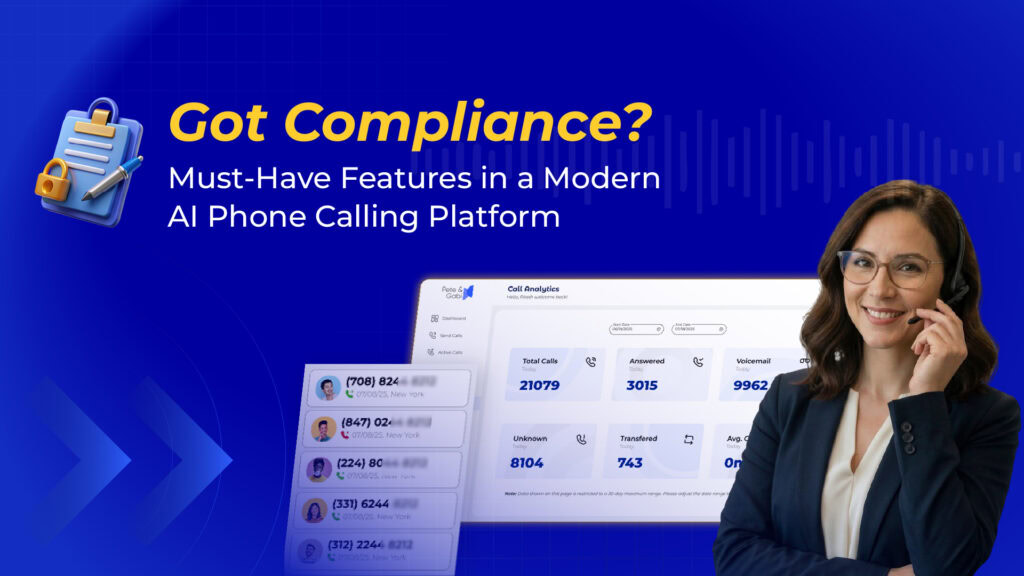
Got Compliance? Must-Have Features in a Modern AI Phone Calling Platform

Features of an AI phone calling platform

Data from DemandSage shows that 90% of companies using AI agents show improved productivity and smoother operations. So it’s no surprise 63% of businesses plan to increase their automation budgets for 2026. The message is clear: AI calling platforms can deliver. But will they? And will they meet your specific needs, learn and improve, and do so reliably? For this, you need to choose the right provider. Because the news is also full of companies making costly AI mistakes. And not just wasted money—also damaged relationships and competitive disadvantages. Here we cover the non-negotiable features that separate winning AI calling platforms from expensive disappointments. What Are AI Phone Calling Platforms? AI phone calling platforms are advanced systems powered by conversational AI that make and receive calls. And they should do so in a human-like fashion, not relying on pre-recorded scripts. So how do they work? Built on natural language processing (NLP) and machine learning, they understand intent, respond intelligently, and adapt in real time. They listen and adjust responses intuitively to keep the conversation going and going smoothly. These platforms aren’t simple automation—they can handle outreach, lead qualifications, customer support, scheduling, and even more complex inquiries. By combining scalability with human-like interactions, they hit the low-hanging fruit easily—freeing teams from repetitive tasks. They also ensure customers, prospects, or candidates get fast, accurate, and personalized conversations every time. 9 Features to Look for in AI Phone Calling Platforms Here is the difference between AI platforms that deliver results and those that waste your time and money, and why they matter when choosing an AI calling solution. 1. Natural Language Processing (NLP) At the heart of any AI calling platform is Natural Language Processing (NLP). This is what allows virtual AI call agents to understand context, interpret intent, and respond in a way that feels natural to the caller. Instead of rigid scripts, NLP enables dynamic, two-way conversations—essential for customer service, sales, and recruitment. With NLP, AI can detect tone, handle variations in speech, and engage callers like a real person. This intelligent call automation feature makes conversations smoother and is critical for higher satisfaction and better outcomes. 2. Seamless Integrations AI phone calling platforms don’t drive the best results in isolation. By easily connecting with CRMs, ATSs, and scheduling tools, they streamline workflows and keep your team in sync and ready to act. Your recruitment team is going to need candidate details automatically pulled from their ATS, and CRM integrations allow sales teams to sync leads with call notes. These eliminate manual data entry, reduce errors, and ensure your team is always making data-driven decisions in real time. 3. Live Transfer and Intelligent Call Routing Even the best AI cannot handle every situation. For this, and regulatory compliance (see below), real-time call transfer is a critical feature. When a call requires human expertise—whether it’s a high-value lead, sensitive customer complaint, or legal compliance issue—your AI calling system must be able to seamlessly hand off to a live agent. This transfer should feel natural, coming with all context and notes so the caller doesn’t have to repeat themselves. 4. Call Summaries & Transcripts Every call is a goldmine of data your team should be able to access—using call records to analyze customer interactions and predict buyer behavior, as well as refine AI conversation flows. Your AI phone calling platform must be able to compile call summaries and real-time transcriptions, so crucial information doesn’t get lost. Summaries give quick highlights for busy managers, and full transcripts are essential for compliance, training, and quality assurance. It can also help uncover trends in customer needs. Over time, these insights drive better decision-making and continuous improvement. 5. Multilingual Support This is particularly important if your company operates across multiple regions. AI phone calling platforms with multilingual capability can engage callers in their preferred language, breaking down barriers and enhancing accessibility. Whether it’s English, Spanish, French, or beyond, multilingual AI ensures businesses serve global markets without needing multiple teams of native speakers. This not only widens your customer base, but it also shows that your brand values inclusivity, which is both a practical and competitive advantage. 6. Real-Time Personalization Capabilities According to McKinsey, personalized marketing reduces customer acquisition costs by up to 50 percent, increasing marketing ROI by 10 to 30 percent. This makes personalization a must-have capability in AI call agents. With real-time personalization, your AI agent can tailor calls to each customer’s unique needs based on data from CRM records, past interactions, and more. This improves call engagement rates and drives successful outcomes. It also ensures every interaction feels human, relevant, and timely. By adapting in real-time, AI platforms create less robotic and more engaging experiences, ultimately increasing conversions and improving customer loyalty. 7. Scalability As your business grows, so will your call volume. This means it’s essential to pick an AI-powered call provider that scales easily with you. Whether you’re a small contractor scaling up or an enterprise handling global campaigns, scalability guarantees no lead is left waiting. Flexibility is crucial for peak periods, rapid expansions, or handling sudden surges in demand while keeping costs predictable. Bottom line: your AI phone calling platform should handle hundreds of calls simultaneously without sacrificing quality. 8. Analytics & Reporting Dashboards Visibility is critical for measuring AI outcomes. This makes it essential your AI calling platform includes an analytics and reporting dashboard. Data drives decisions—turning raw call data into actionable insights. With a reporting dashboard, it’s easy to track call performance, monitor conversion rates, and uncover patterns in customer behavior. AI-powered call analytics allow managers to identify what’s working, improve lagging areas, and see where opportunities lie. Some platforms include data-backed optimizations. This not only improves accountability but also ensures your calling strategy continually evolves. 9. Compliance & Security Features Finally, security and compliance are the foundation of any reliable AI voice assistant. From data encryption to call consent tracking, compliance and security safeguards help protect both businesses and customers. As every industry relies on its own

How to Automate Cold Calls without Losing the Human Touch 

AI-powered voice agent making a cold call with human-like tone and empathy

You lose all the calls that you don’t make. So it’s no surprise that, according to Salesforce, 83% of sales teams that integrated AI into their outreach workflow in 2024 reported significant revenue growth—in that same year. Still, some sales leaders are worried that automating cold calls means they’ll lose the essential human touch that’s essential for their brand. But here’s what they don’t know: modern conversational AI doesn’t have to eliminate human connection, if deployed the right way. In this blog, we’ll show you how to weaponize cold calling automation while maintaining the human elements that help close deals. You’ll also discover the critical mistakes that turn automation into spam and how to avoid them completely. What “Human Touch” Really Means in Sales Conversations The human touch in sales doesn’t have to mean having a human make the call. It’s about delivering interactions that feel personal, respectful, and genuinely valuable to prospects. The quality of connection matters far more than the delivery method. Fact: if one of your burned-out reps is reading robotic scripts on a call, that conversation will be less “human” than an AI call agent that adapts on the fly to prospect needs. Below are some of the core elements that create authentic human connection in sales conversations. Empathy and Emotional Intelligence Reading conversational cues, acknowledging prospect concerns with understanding, and responding to emotional states are the foundations of good prospect engagement. Sales reps—whether human or AI agents—should recognize frustration, excitement, or hesitation and adjust their tone and approach accordingly. AI, like humans, can’t just bulldoze through predetermined scripts. Personalization Based on Prospect Needs The best cold calling conversations are tailored to the prospect in question. Relevant details like company information, industry challenges, and role-specific pain points should be the topic of discussion rather than generic pitches. This includes referencing recent developments, understanding priorities, and presenting solutions that align with the prospect’s circumstances. Responsive Conversation That Shows You’re Listening Authentic human-like connection in sales conversations means actually listening. It means hearing and pivoting conversation direction based on responses, interest levels, and conversation signals. While the goal is to eventually get prospects into your sales funnel and convert them, your voice AI agent doesn’t have to be pushy. What they should do is hold conversations that show you’re interested in what prospects care about. Respect for Prospect Time and Preferences We’re all busy, and the human touch in cold calls means respecting the wishes of your prospects. Acknowledging busy schedules, asking permission to continue conversations, and honoring communication preferences are key. Cold calls should be efficient and deliver value quickly, while respecting “not now” signals without aggressive persistence. Common Mistakes That Kill the Human Touch During Cold Calls Even well-intentioned automation with all of these capacities can backfire in certain situations. Leading this list? When sales teams make critical implementation errors that turn powerful sales-driving tools into spam machines. Prospects hate this, and so would you. Below are other pitfalls to look out for when automating sales calls with conversational AI. The Smart Automation Approach: Five Strategies to Maintain Human Connection During Sales Calls Smart automation eliminates human limitations like fatigue, inconsistency, and rushed conversations. It can also amplify the qualities prospects value most—relevance, empathy, and responsiveness. Here are five best practices that make automated calls feel more human. Prioritize Intelligent Personalization at Scale Smart AI calling systems tap into your existing CRM data to have conversations that actually matter to each prospect. Instead of generic “Hi, how’s your day?” openers, the AI can reference the prospect’s industry challenges, recent company news, or role-specific pain points that show you’ve done your homework. Your conversational AI should be able to adjust its approach based on who it’s talking to. A C-suite executive would get a different conversation style than a department manager or a startup founder from human salespeople, and it also should from AI. With intelligent personalization, prospects feel like the conversation was created specifically for them—not like the next number on a call sheet. When they get calls that talk about actual business challenges, prospects are naturally more willing to engage, and this translates directly into more qualified opportunities in your pipeline. Choose Conversational AI That Listens and Adapts There’s no point talking to someone who isn’t listening. Your AI calling solution should pick up on subtle cues and adjust the conversation accordingly. If someone raises an objection, the system can’t just barrel through a script. It should acknowledge the concern and address it thoughtfully. If a prospect says, “we don’t have budget for this,” smart conversational AI recognizes this to mean “show me the ROI” or “we need to understand the value first.” It doesn’t just launch into a price justification speech. This ensures your leads feel understood rather than just sold to, and it helps improve your chance of booking a meeting and making an eventual conversion. Set Up Your Agents for Respectful Persistence An AI system isn’t smart if it can’t learn. They should know when prospects are actually available and receptive to conversations. Instead of calling at random times, they analyze patterns—knowing that CFOs are typically swamped during month-end or that restaurant managers are unreachable during a lunch rush. And if a prospect is stressed and asks for a raincheck, your conversational AI shouldn’t hammer them with daily follow-ups. It should circle back at a more appropriate time. Timing is crucial—the exact same message can be a productive conversation or create annoyance depending on when it’s delivered. And of course, prospects appreciate respectful persistence and well-timed follow-ups since they are considerate, professional, and more human. Ensure Seamless Human Handoffs Another friction point is handoffs. Prospects shouldn’t have to start over or repeat themselves when they are transferred to a human rep. Instead, your voice AI solution should provide your sales rep with a complete briefing on what was discussed—including specific concerns, timeline, and preferences. This means when your salesperson picks up the phone, they can say “Hi John, I understand you’re

Ethical Standards in AI Voice Technology: An Exploration of Transparency, Trust & Boundaries

Ethical Standards in AI Voice Technology

Summary: Maintaining trust is more challenging and essential than ever. With 90% of US consumers buying only from brands they trust (Capital One, 2025), and 96% saying excellent service builds that trust, it is critical for companies to ensure their AI systems are transparent, respectful, and compliant. This article explores the rising concerns around AI deception, privacy, and deepfakes, outlines regulations like the TCPA, BIPA, and the EU AI Act, and provides a checklist for businesses seeking to deploy voice AI systems responsibly. Introduction: No matter what your business is, trust is critical. Most American consumers (90% per Capital One research in 2025) prefer to buy from brands they trust. 62% will pay more for an identical product from a company they trust, and 75% of consumers age 18–34 say trust is even more important than in the past. And critical to that? Customer service, with 96% stating excellent customer service, builds trust in an organization. So, what happens to that trust when customers can’t get through to you, don’t get called back, deal with burnt out agents, or interact with unreliable or deceptive AI? In today’s article, we address some of AI’s most critical (and challenging) dimensions, exploring:   Why AI-powered outreach transparency is so important How different regions are regulating ethical AI for voice systems What AI calling providers must do to ensure customer safety and trust remains high How Pete & Gabi was built to maintain trust, ensure compliance, and provide voice AI with the highest ethical standards At a time when building trust in AI is both essential and often overlooked, voice system providers play a critical role in ensuring it’s done right. Why Voice AI Ethics Matter The truth is, most people still prefer dealing with humans, that is, provided that person is available, knowledgeable, and interested in helping. So, with voice AI technology having improved to the extent that most people can’t tell voice AI from human in blinded tests (per University of California Berkeley, OpenAI, and ElevenLabs research), the potential for deception is significant. Deepfake scams powered by AI have become an increasingly common form of fraud, feeding a spike in scams that’s already caused $1 trillion in annual, global losses. Customers are wise to be suspicious of who they’re talking to. This is why AI systems that fool people into believing they’re real are not only unethical, they’re also increasingly illegal (see below). Consent and Concerns over Privacy AI systems, unlike humans, have perfect recall. Some can analyze biometric data and even incorporate predictive analytics. Visible, high-profile lawsuits involving training data, concerns over AI systems spitting back out private information, and the growing quality of AI deepfakes are leading customers to become increasingly concerned over whether their data is being handled safely and kept private. And governments, in turn, are increasingly enacting legislation to ensure transparency and enforce a customer’s right to opt-out of data collection. Without transparency of use and effective ethical standards, AI systems can lead to consumer anxiety and distrust. They can also lead businesses to inadvertently break regional laws or regulations, triggering fines, damaged reputations, or even the risk of being dragged through the courts. Current and Emerging Regulations Impacting AI Calling Technology AI regulations vary widely and evolve rapidly, though not as fast as the technology itself. In the US, much is currently left to individual states, and there are a variety of laws either already in place or working their way through legislatures now. Many are aimed at bringing protection for consumers in the area of voice AI and data privacy with AI systems. This variability can be highly challenging for companies, both for managing regional variations and in keeping up with changes. As of now, the following regulations impact voice AI systems: Sources here include: Marashlian & Donahue PLLC, the FCC, the Skadden Foundation, the IAPP, ISACA, and the Government of Canada. Keeping up with it all is no small feat. And with over 40 state attorneys general acting to enforce existing consumer protection laws in AI cases, it’s not going to get easier any time soon. Deploying AI in Customer Communication: The Must-Haves To protect both business and customers, companies must demand more from their AI partners. At the very least, all voice AI systems must enforce transparency by either directly acknowledging they are AI, or providing that information upon request, and without fail. And it is best practice to always disclose AI involvement in customer interactions from the get go. Customers must also be given a means of opting out and reaching a human agent. For voice AI systems that do not enable live transfer, they must still provide some means of connecting customers or clients with human agents in a timely fashion. All recordings, too, should be disclosed, especially if it’s being used for training or emotional conditioning of systems. This should be explicit with the purpose clearly noted. AI agent boundaries should be reinforced with internal stress testing, rule-based limits, machine learning systems that improve AI behavior with experience, and regular monitoring of calls. This includes checking across languages, accents, and dialects for bias and translation issues, feedback loops for improvement, and clear audit trails that provide transcripts and details of call outcomes. And to assuage fears of voice cloning, consent must always be used before training models on call data. Vetting Providers of AI Voice Agents Any provider of an AI voice system should be willing and able to discuss the ways they maintain compliance and trust. They should be knowledgeable of rules and regulations by region and have a means to ensure you aren’t violating these with cross-regional calling. The following should be non-negotiable when implementing an AI system: How Pete & Gabi Builds Ethical AI Voice Assistants With Pete & Gabi, we built the system that we wanted. One that we felt was lacking. Refined for more than four years on thousands of calls across industries, we devoted hundreds of hours of developer time and more than

What is AI-Powered Automated Calling and How Does It Work 

How AI Automated Calling Works

Conversational AI has completely changed the game.   While people may say they don’t want to talk to a machine, their behavior with AI says otherwise, considering:   ChatGPT averages 123.5 million daily active users, and processes over one billion queries a day, according to their most recent reports.   87%+ of consumers report positive or neutral interactions with chatbots. (Ecommerce Bonsai)  And 82% of consumers would rather use a chatbot if talking to a person required waiting, per Tidio. (Up 22% from just 2022.)  Through the combination of enormous datasets, sophisticated autocompletion, and advances in affective computing, these systems keep getting better at understanding and anticipating what people want.  Pair that with multimodal capacities for audio and video, and it’s easy to see why AI automation has changed the way businesses handle calling.  Reports, from The New York Times and Washington Post through to Wired and the MIT Technology Review all highlight how people have even fallen in love with chatbots, and while these may be extreme cases, the bottom line is this: conversational AI works.  It’s not right to say a revolution is happening with AI in customer service in 2025, because the truth is: it’s already happened.   In this article, we go back to the beginning, covering what AI-powered calling is, how it works, and how it’s redefined communication for businesses in 2025.   Reaping the Benefits of AI-Powered Calling  “AI-powered automated calling” is a catch-all for conversational AI solutions to a business’s telephonic communication problems, whether inbound or outbound.  These platforms can make or field calls entirely without human intervention, combining conversational AI with advanced data processing.   They allow AI to share information, upsell and re-connect, gather customer insights, pre-screen candidates, prospect for potential clients, and even do administrative work like scheduling.   They’re already being deployed across businesses and departments to do the heavy lifting, freeing teams and individuals to focus on higher-value tasks. AI-powered calling is bringing companies greater:  Efficiency: Exponential cost reductions  Scalability: Making hundreds to thousands of calls simultaneously  Personalization: Tailored calls utilizing business data AI calling automation is driving real business benefits- increasing productivity, revenue and operational efficiencies:  Conversational AI Technology: The Mind Behind the Call  So, what is ‘Conversational AI’ exactly?   Let’s look at how it works and why people find it so engaging.  How It Works  Conversational AI reduces language into tiny pieces that can be transformed, analyzed and processed by computers.  AI-calling relies on several things working together to fully parse human language, like:  Powerful Data Processing: It all begins with those massive datasets of human language. This is processed so queries and responses are understood with context, intent, and sentiment. That allows on-the-fly adjustments to emulate human communication.   Natural Language Understanding (NLU): This is part of Natural Language Processing (NLP) and how AI parses speech. It identifies keywords, context, and even emotional undertones, to assist with interpretation. For example, if a customer says, “I need help with my bill,” the AI recognizes “help” as intent and “bill” as subject.  Natural Language Generation (NLG): With meaning registered, the system is ready to make the response. Unlike old calling automation systems that needed pre-recorded messages, NLG makes customized dialog that fits business goals and the context of the conversation.  Voice Synthesis: With the response words selected, AI converts it to audio, giving it a natural-sounding tone and demeanor. Advanced systems go further, using neural voice synthesis, to mimic human inflection and tone even more effectively.  Machine Learning Algorithms: While the above elements are all fine and well, it’s not much good without continual improvement. What makes AI calling systems so powerful is the capacity they have to adapt and keep adapting from each and every interaction. Machine learning refines accuracy and applies this learning to each new scenario. In other words: the more they’re used, the better they become. Here’s an example of a typical flow:  Conversational AI vs Interactive Voice Response (IVR) Systems  Traditional calling automation systems like IVR waste our time by making us wait through long menus, don’t hear us correctly the first time (maybe ever), and never budge from their programming.   And even after you do all that waiting and cringe through misheard choices, you typically still end up on hold to get to a person who can actually do what you called to get done in the first place.  Maybe you’ve had similar experiences with Siri and Alexa too (pre-AI).   Conversational AI has changed this game entirely.   Instead of rigid channels, it brings natural exchange. Instead of listening to options that aren’t quite right, you get your need met or even exceeded on the first go.   Conversational AI allows for:  Natural Conversational Interactions: Just talk to it and tell it what you need. It’s that easy.  Contextual Understanding: Maybe you don’t know what you want, and they can handle open-ended queries, too. That means switching seamlessly between topics, adjusting speed and even, in the best solutions, directly transferring calls to human agents when needed.  Dynamic Responses: The AI gives personalized dialog every time, in real time.   Affective Computing: Adding AI Empathy in Customer Interactions  Affective computing techniques take this all to the next level. As a field of study that merges computer science, cognitive science, and psychology, it helps give machines the ability to interpret and adapt to human emotions.  By analyzing tone of voice, word choice, pace, volume, and context, these approaches empower systems to adapt their responses to a user’s emotional state.  Why Empathy Matters  Just like in life, between real people, empathy aids trust and improves communication. And no, AI doesn’t have real empathy, but the best conversational AI systems successfully emulate it, by:  Using a calm, reassuring tone to de-escalate frustrated callers.  Using positive, enthusiastic language to enhance sales calls.  Adjusting call endings based on need.  Speeding up or slowing down and clarifying based on perceived understanding.  Pete & Gabi: AI-Powered Automated Calling  Now we bring it all together.  Pete & Gabi takes all this, the best from conversational AI and affective computing techniques,