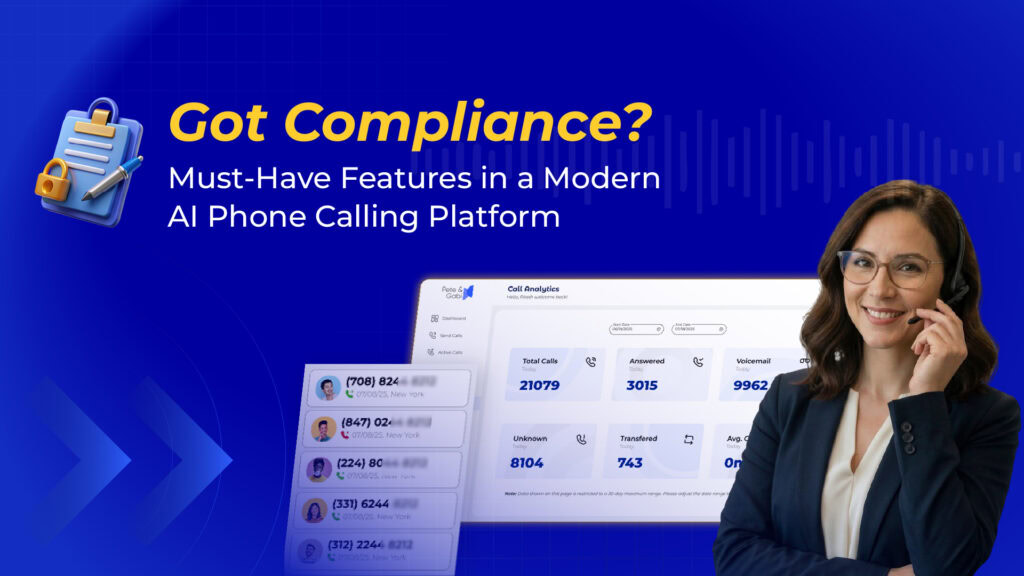
Got Compliance? Must-Have Features in a Modern AI Phone Calling Platform

Data from DemandSage shows that 90% of companies using AI agents show improved productivity and smoother operations. So it’s no surprise 63% of businesses plan to increase their automation budgets for 2026. The message is clear: AI calling platforms can deliver. But will they? And will they meet your specific needs, learn and improve, and do so reliably? For this, you need to choose the right provider. Because the news is also full of companies making costly AI mistakes. And not just wasted money—also damaged relationships and competitive disadvantages. Here we cover the non-negotiable features that separate winning AI calling platforms from expensive disappointments. What Are AI Phone Calling Platforms? AI phone calling platforms are advanced systems powered by conversational AI that make and receive calls. And they should do so in a human-like fashion, not relying on pre-recorded scripts. So how do they work? Built on natural language processing (NLP) and machine learning, they understand intent, respond intelligently, and adapt in real time. They listen and adjust responses intuitively to keep the conversation going and going smoothly. These platforms aren’t simple automation—they can handle outreach, lead qualifications, customer support, scheduling, and even more complex inquiries. By combining scalability with human-like interactions, they hit the low-hanging fruit easily—freeing teams from repetitive tasks. They also ensure customers, prospects, or candidates get fast, accurate, and personalized conversations every time. 9 Features to Look for in AI Phone Calling Platforms Here is the difference between AI platforms that deliver results and those that waste your time and money, and why they matter when choosing an AI calling solution. 1. Natural Language Processing (NLP) At the heart of any AI calling platform is Natural Language Processing (NLP). This is what allows virtual AI call agents to understand context, interpret intent, and respond in a way that feels natural to the caller. Instead of rigid scripts, NLP enables dynamic, two-way conversations—essential for customer service, sales, and recruitment. With NLP, AI can detect tone, handle variations in speech, and engage callers like a real person. This intelligent call automation feature makes conversations smoother and is critical for higher satisfaction and better outcomes. 2. Seamless Integrations AI phone calling platforms don’t drive the best results in isolation. By easily connecting with CRMs, ATSs, and scheduling tools, they streamline workflows and keep your team in sync and ready to act. Your recruitment team is going to need candidate details automatically pulled from their ATS, and CRM integrations allow sales teams to sync leads with call notes. These eliminate manual data entry, reduce errors, and ensure your team is always making data-driven decisions in real time. 3. Live Transfer and Intelligent Call Routing Even the best AI cannot handle every situation. For this, and regulatory compliance (see below), real-time call transfer is a critical feature. When a call requires human expertise—whether it’s a high-value lead, sensitive customer complaint, or legal compliance issue—your AI calling system must be able to seamlessly hand off to a live agent. This transfer should feel natural, coming with all context and notes so the caller doesn’t have to repeat themselves. 4. Call Summaries & Transcripts Every call is a goldmine of data your team should be able to access—using call records to analyze customer interactions and predict buyer behavior, as well as refine AI conversation flows. Your AI phone calling platform must be able to compile call summaries and real-time transcriptions, so crucial information doesn’t get lost. Summaries give quick highlights for busy managers, and full transcripts are essential for compliance, training, and quality assurance. It can also help uncover trends in customer needs. Over time, these insights drive better decision-making and continuous improvement. 5. Multilingual Support This is particularly important if your company operates across multiple regions. AI phone calling platforms with multilingual capability can engage callers in their preferred language, breaking down barriers and enhancing accessibility. Whether it’s English, Spanish, French, or beyond, multilingual AI ensures businesses serve global markets without needing multiple teams of native speakers. This not only widens your customer base, but it also shows that your brand values inclusivity, which is both a practical and competitive advantage. 6. Real-Time Personalization Capabilities According to McKinsey, personalized marketing reduces customer acquisition costs by up to 50 percent, increasing marketing ROI by 10 to 30 percent. This makes personalization a must-have capability in AI call agents. With real-time personalization, your AI agent can tailor calls to each customer’s unique needs based on data from CRM records, past interactions, and more. This improves call engagement rates and drives successful outcomes. It also ensures every interaction feels human, relevant, and timely. By adapting in real-time, AI platforms create less robotic and more engaging experiences, ultimately increasing conversions and improving customer loyalty. 7. Scalability As your business grows, so will your call volume. This means it’s essential to pick an AI-powered call provider that scales easily with you. Whether you’re a small contractor scaling up or an enterprise handling global campaigns, scalability guarantees no lead is left waiting. Flexibility is crucial for peak periods, rapid expansions, or handling sudden surges in demand while keeping costs predictable. Bottom line: your AI phone calling platform should handle hundreds of calls simultaneously without sacrificing quality. 8. Analytics & Reporting Dashboards Visibility is critical for measuring AI outcomes. This makes it essential your AI calling platform includes an analytics and reporting dashboard. Data drives decisions—turning raw call data into actionable insights. With a reporting dashboard, it’s easy to track call performance, monitor conversion rates, and uncover patterns in customer behavior. AI-powered call analytics allow managers to identify what’s working, improve lagging areas, and see where opportunities lie. Some platforms include data-backed optimizations. This not only improves accountability but also ensures your calling strategy continually evolves. 9. Compliance & Security Features Finally, security and compliance are the foundation of any reliable AI voice assistant. From data encryption to call consent tracking, compliance and security safeguards help protect both businesses and customers. As every industry relies on its own