There’s a version of AI recruiting that candidates never see. It has no face or voice and lacks a ‘human touch’. What candidates experience is similar to a form, a black hole, and then silence.
That version exists in a lot of enterprise hiring stacks right now. And candidates have often complained of the ‘robotic’ experience, calling it dry and brutal.
Then there’s a different approach, one where the first contact isn’t a generic email but an actual conversation. Where a candidate gets called, asked intelligent questions, and told what happens next. Where the hiring process is designed, keeping the applicant in mind.
That’s exactly why Pete & Gabi built Rebecca AI.
Which part of hiring does AI recruitment software automate?
Most talent teams don’t lose candidates at the offer stage. They lose them in the gap between application and first contact. That gap, in traditional enterprise hiring, can stretch into weeks. By then, the candidate has accepted something else, moved on, or simply stopped caring.
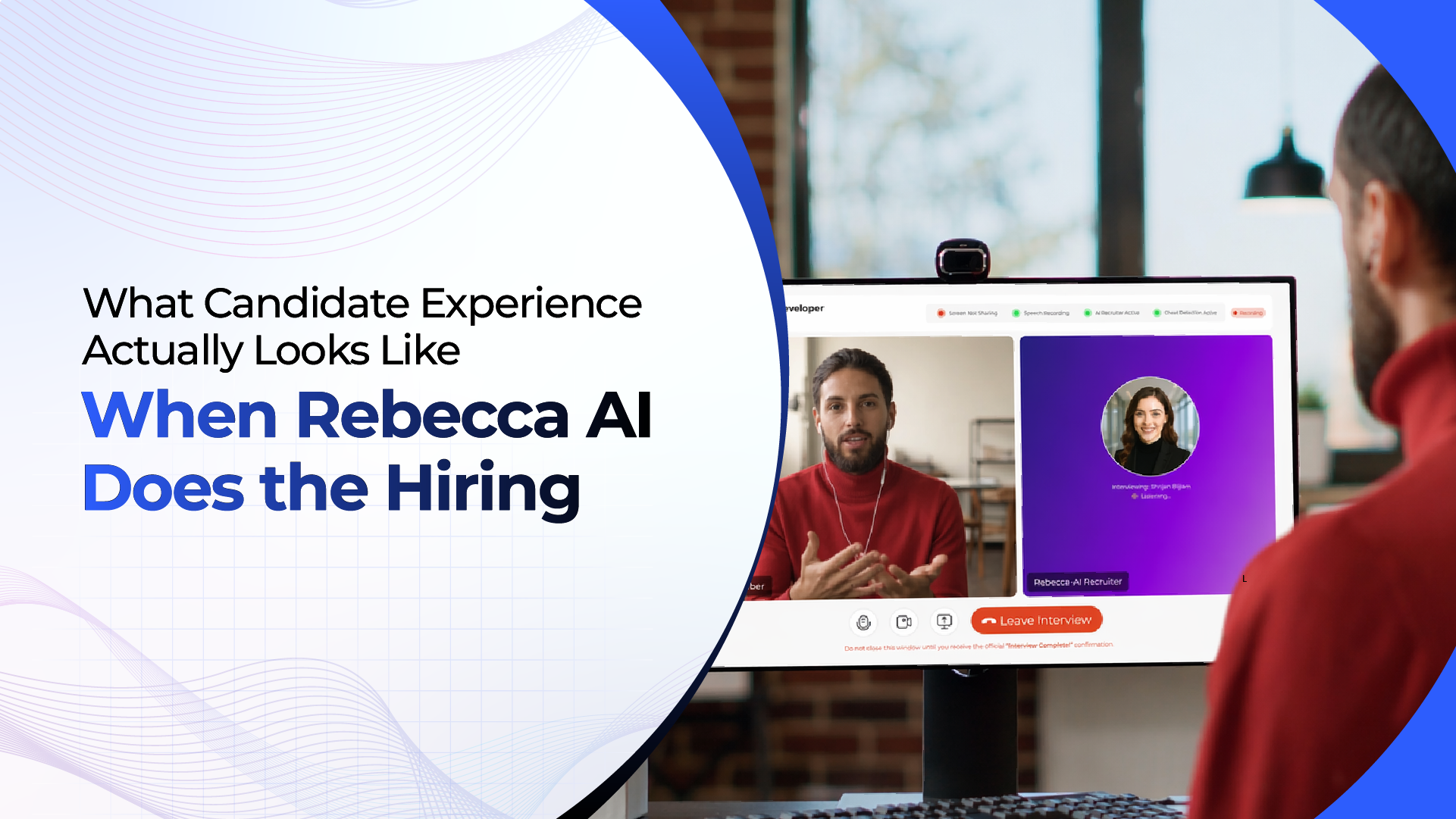
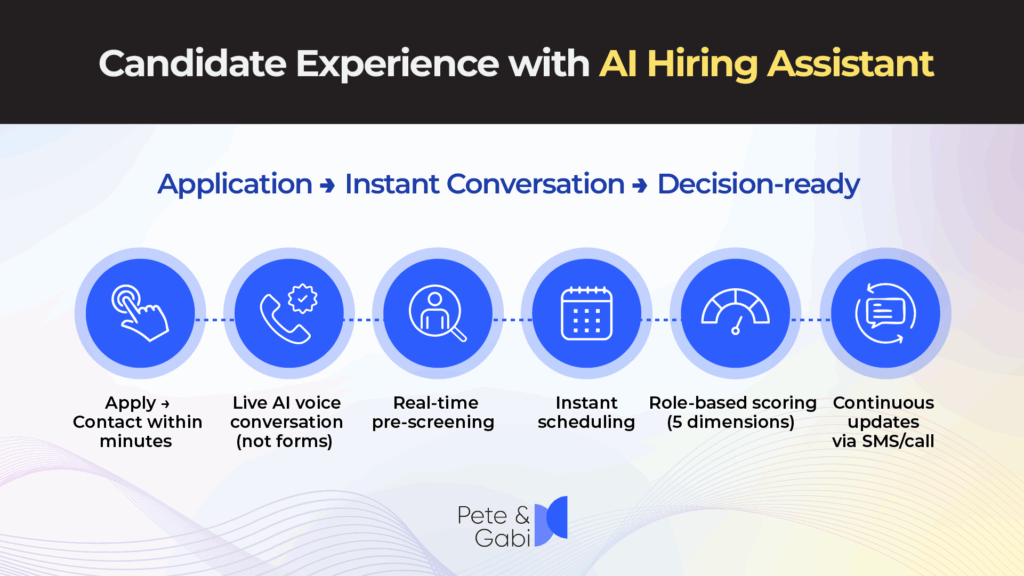
Automated hiring software has tried to close this gap for years, mostly through email triggers and chatbot prompts that nobody finds convincing. What’s changed is the voice layer. Rebecca AI hiring assistant contacts applicants within minutes of application, across SMS, phone calls, and web links. She initiates a live, human-like conversational screening, asking intelligent questions based on the candidate’s responses.
The AI hiring platform generates questions from the job description and the candidate’s resume. She adjusts follow-up questions based on responses and does not use a static script. As a result, the conversation is structurally more adaptive than most alternatives available today to claim to offer.
What does a candidate experience with AI hiring software?
When a candidate applies for a role, within minutes, they receive a call or a message. Rebecca AI identifies herself as an AI recruiting agent, asks contextual questions about the candidate’s background, and gives them the opportunity to respond in real time.
The pre-qualification step is built directly into the same outreach flow. There is no separate scheduling link and no waiting for a recruiter to review the candidate’s resume. The AI hiring agent handles it immediately, at any hour, in over 16 supported languages.
From there, if the candidates pass the initial screening, interview scheduling happens in the same conversation, integrated with Outlook, Google Workspace, and CRM calendars. Candidates receive automated follow-up calls and SMS updates throughout. They’re not left guessing.
Such real-time responsiveness significantly reduces candidate dropout in high-volume roles, particularly in sectors such as hospitality, staffing, and healthcare where applicants are evaluating multiple opportunities simultaneously. The data from internal enterprise staffing deployments shows 6,175 candidates processed with 544 interviews scheduled and zero recruiter involvement before shortlisting.
Which dimensions does AI recruiting software score candidates on?
The scoring framework used by AI hiring platform covers five areas: technical ability, problem-solving, communication, professionalism, and role fit. Most structured interview rubrics use similar metrics. What differentiates a traditional hiring process versus hiring with Rebecca AI is the consistency.
A human recruiter conducting 40 phone screens in a week will score the first candidate differently than the 38th. That’s a cognitive load. AI voice screening doesn’t degrade across volume. It applies the same evaluation criteria to the 500th candidate that it applied to the first.
Rebecca AI also embeds on coding assessments and technical questions directly inside interviews for roles that require them. Fraud and authenticity checks run throughout every live conversation, with the AI hiring assistant flagging suspicious behavior with up to 95% accuracy so the recruiting team can focus on real candidates, not risks.
The AI hiring platform is aligned with ISO 27001, SOC 2, GDPR, and CCPA. Candidates have documented rights: consent-first interviews, access and copy rights, 30-day deletion, human review options, and the ability to request an alternative assessment. For regulated industries, financial services, healthcare, utilities, that compliance aspect matters more than any other capability that the AI recruiter offers.
What are the risks of an AI-only candidate experience?
Notably, not every candidate responds well to being interviewed by a machine. Some find it impersonal, while others find it confusing. Few, particularly in areas where AI phone interviewers are still unfamiliar, may disengage before the process is complete.
However, with Rebecca AI interview tool, there is an over 50% passage rate in an industry deployment (2,633 of 6,175 candidates passed screening). As a conversational AI agent, Rebecca AI understands the tone, context, lived experience, using adaptive questioning. The best AI recruiting tools are clear about what they’re measuring. The more honest ones acknowledge the limits.
Rebecca AI’s built-in alternative assessment option suggests awareness of this tension. It’s a reasonable mitigation.
Which enterprise hiring teams are AI recruiting agents built for?
Rebecca AI hiring platform integrates with Workday, Bullhorn, Greenhouse, Lever, iCIMS, HubSpot, Salesforce, Pipedrive, and the rest of the standard enterprise stack. Setup takes days rather than months. The AI hiring software for enterprises does not require long-term contracts or heavy technical implementation. She connects to an existing ATS and begins delivering scored shortlists within the same week.
That deployment model is designed for enterprise talent acquisition teams that are managing continuous or high-volume hiring, staffing firms running over 50,000 candidate calls per cycle, healthcare systems filling clinical and non-clinical roles simultaneously, telecommunications companies with technical roles that need embedded coding assessments.
Internal data suggests an 80% reduction in time-to-hire and 60% reduction in cost-per-hire within the first hiring cycle. When an AI hiring assistant handles everything from outreach to scored shortlist, the recruiter’s involvement starts later in the funnel, which compresses the timeline significantly, helping them build stronger relationships with qualified candidates, further enhancing the candidate’s experience.
Frequently Asked Questions
Does AI recruiting software offer better candidate experience than traditional hiring?
Yes. Conversational AI interviewer offers a new approach to recruitment. Candidate experience in enterprise hiring has been neglected for a long time because the economics of high-volume screening made individual responsiveness impractical. Rebecca AI hiring agent that contacts every applicant within minutes, adapts questions in real time, and delivers consistent scoring offers every candidate a better, more ‘humane’ hiring experience.
Which industries use AI recruiting tools?
Healthcare, financial services, insurance, telecommunications, education, hospitality, real estate, staffing, professional services, utilities, marketing, and automotive are among the sectors where AI-powered recruitment is actively deployed. High-volume hiring and compliance requirements are common threads.
Is AI voice screening fair to candidates?
Consistent, structured scoring reduces certain forms of human bias. By moving beyond self-reported credentials toward skills-based evaluation, the conversational AI interviewer reduces the likelihood of bias toward specific backgrounds while preserving fairness and consistency. Rebecca AI’s adaptive, role-specific questioning creates a more level playing field for non-traditional candidates, career switchers, and underrepresented groups, ensuring assessments reflect real capability rather than historical hiring patterns.
How does an AI phone interviewer work?
An AI voice interviewer calls candidates, generates contextual questions from their resume and the job description, adjusts follow-ups based on responses, detects authenticity signals, and produces a scored summary. Rebecca AI’s system operates across SMS, phone, and web links, 24 hours a day, in 16 languages.
The future of hiring hinges on human-AI collaboration. Conversational AI such as Rebecca acts as a highly effective first filter, surfacing candidates with the right skills while enabling recruiters to focus on more nuanced factors like cultural fit, communication style, and problem-solving ability. Ongoing human oversight further sharpens AI-driven processes, helping ensure fairness and mitigate potential bias. Rather than replacing recruiters, Rebecca AI elevates their role by removing repetitive screening work and making the hiring process more efficient and equitable.