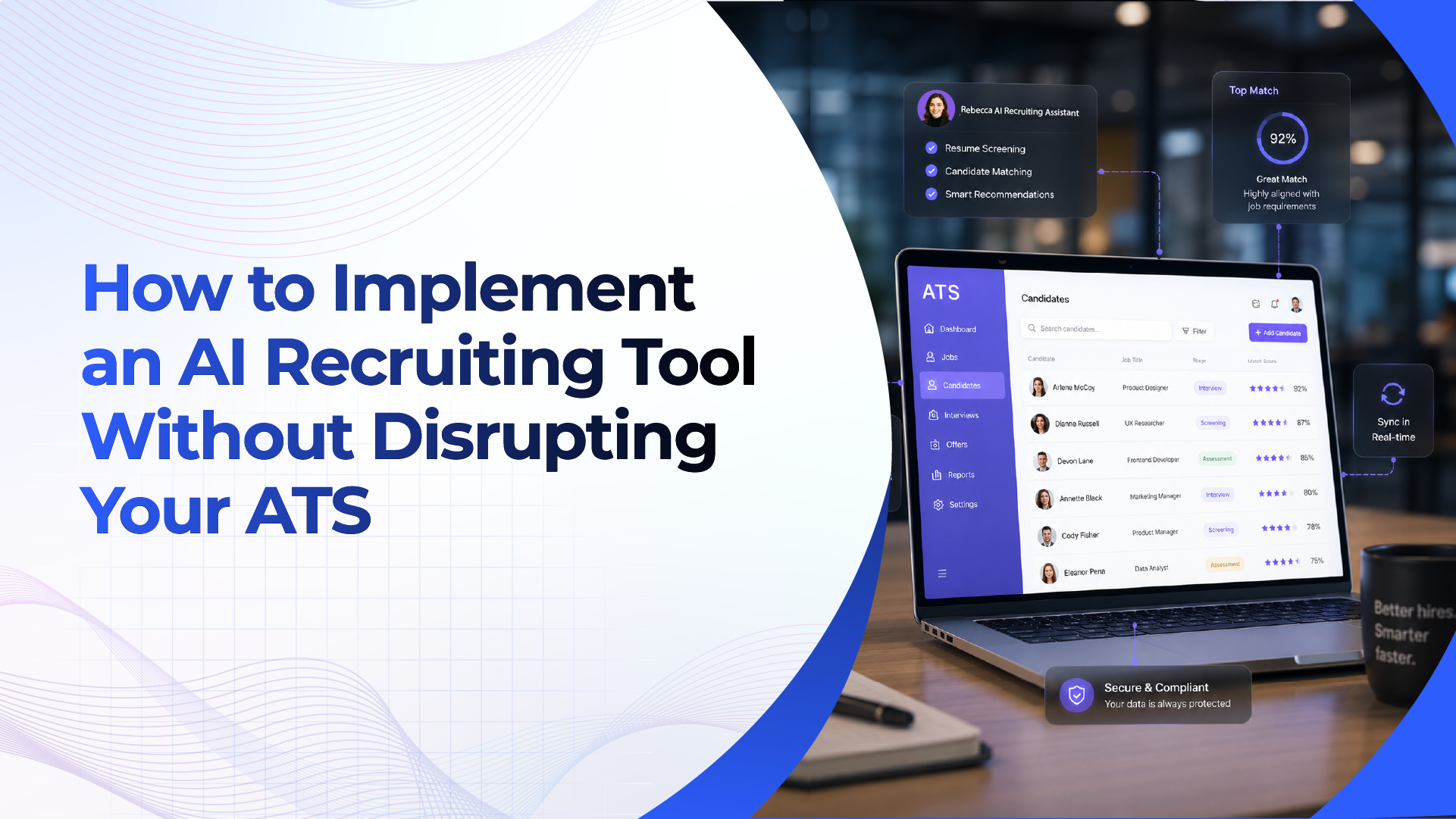
Your ATS is the backbone of your recruiting operation. Years of candidate data, structured pipelines, compliance records, hiring manager access, and integration with your HRIS all live inside it. So, when someone pitches an AI recruiting tool, the first real concern is not whether it works. It is whether plugging something new into that infrastructure will break something that already does.
That concern is legitimate. And it is exactly what most AI vendor demos gloss over.
This guide is not about whether AI improves hiring. That case is largely settled. IBM has documented measurable gains in time-to-hire, candidate quality, and recruiter productivity across AI-assisted talent acquisition programs. The World Economic Forum has reported that AI-powered recruitment, when deployed responsibly, can strengthen both inclusion and process transparency. The harder question is how you get from where you are now to where you want to be, without a six-month implementation, a data migration nightmare, or a pipeline that goes dark for three weeks while IT works out the API.
Here is a practical approach for talent leaders who need better hiring outcomes without breaking the systems already in place.
Start with an honest audit of your ATS
Before evaluating a single vendor, spend time inside your current system. Most teams skip this and discover problems with mid-implementation when the cost of fixing them is much higher.
Going in, you need to know three things:
• What data fields are structured versus free text: Structured fields integrate cleanly. Free-text recruiter notes, unformatted resume data, and inconsistent job titles are messy and often require transformation before an AI can use them reliably.
• Whether your ATS supports open API access: Platforms like Greenhouse, Lever, iCIMS, and Workday offer API access, but the depth varies. Some allow full bidirectional data sync. Others will let you read candidate records but not write back without additional configuration.
• What your candidate flow looks like, stage by stage: Map every stage from application received through offer extended. The AI tool needs to slot into that existing flow, not create a parallel one running alongside it.
This audit typically takes a day or two for a team that knows their ATS reasonably well. It saves weeks later.
Understand the four integration patterns
There is no single way to connect an AI recruiting tool to an ATS. Knowing which pattern fits your situation determines how complex and risky the integration actually is.
1. Native Marketplace Integration
Many modern ATS platforms have a certified partner marketplace. If your AI tool is listed there, setup usually involves granting OAuth permissions and toggling an integration on. Data flows automatically. This is the lowest friction option. Check the marketplace before doing anything custom.
2. API or Webhook Connection
For tools not natively listed, a direct API connection is often possible. The AI vendor sends data such as interview scores, candidate summaries, and qualification flags to a webhook endpoint in your ATS. This requires some IT involvement but is generally stable. Lever published guidance in 2024 specifically recommending accurate data field mapping as the critical success factor here.
3. iPaaS Middleware
Platforms like Zapier, Make, or Workato sit between the AI tool and the ATS, translating data fields and automating sync without custom development. This works well for teams without dedicated engineering resources. The tradeoff is an additional monthly cost and a third system to maintain.
4. Browser Extension Overlay
Some tools operate as a lightweight layer over your ATS, reading and writing through the browser interface rather than a backend API. It is the easiest path to get started. It is also the least robust. Extension-based integrations tend to break when ATS vendors update their UI, and they rarely support reliable bidirectional sync at the data level.
For most mid-to-large recruiting operations, the native marketplace route or a direct API connection is the right answer. Extensions are fine for proof of concept, not a production workflow.
Test Before You Touch Live Data
• Ask your ATS vendor whether a sandbox or test environment is available before any API work begins.
• Running the initial integration in sandbox mode lets you stress-test data field mappings without touching live candidate records.
• Most enterprise ATS platforms offer this. You must ask specifically.
Run a pilot before you commit
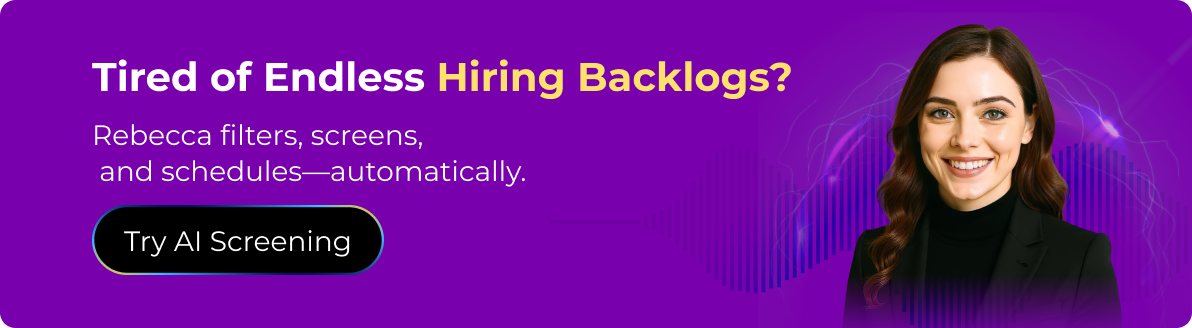
The most consistent mistake recruiting teams make when adopting AI tools is going too broad too fast. They select a vendor, complete the integration, and immediately activate the system across every open role. When something does not work as expected, it is hard to isolate whether the problem is the AI logic, the data mapping, the ATS configuration, or recruiter adoption. The better path is a deliberate pilot.
Pick one role type. The requisition where manual screening volume is highest, where recruiters are most stretched, and where complaints about shortlist quality are loudest. Configure the AI tool for that role only. Define scoring criteria, set escalation rules for edge cases, and run one complete hiring cycle.
Measure three things against your manual starting point: time-to-shortlist, candidate drop-off rate between application and first contact, and hiring manager satisfaction with the quality of candidates arriving for second-round review. These three metrics tell you whether the AI is adding signal or adding noise.
Only after that cycle do you expand. One role type at a time, not across the board simultaneously.
Where Rebecca AI by Pete & Gabi Fits into This
Most AI recruiting tools present a binary choice: replace your ATS entirely or settle for a surface-level chatbot that does not meaningfully change what recruiters spend their time on.
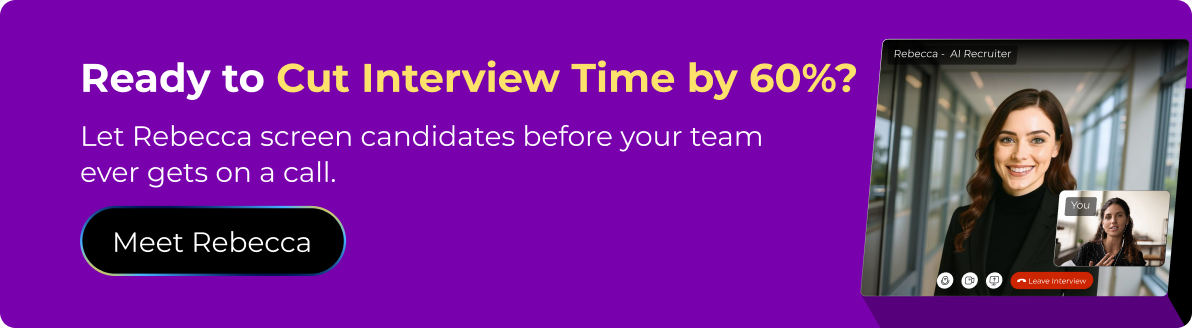
Rebecca AI by Pete & Gabi Take a different approach. She is a specialized AI recruiting agent built exclusively for talent acquisition, not a general-purpose AI that happens to have a recruiting module. Her scope is deliberately narrow: engage candidates immediately after application, conduct live conversational screening, run adaptive structured interviews, score against your role criteria, and push scored shortlists with full transcripts directly into your existing ATS.
The integration works through a direct connection to your ATS or CRM. There is no parallel platform to manage, or a separate login for recruiters, hence, the data does not operate in siloes. Interview notes, qualification scores, candidate interaction summaries, and next-step recommendations appear inside your existing candidate records. Recruiters open the system they have always used and find a complete, evaluated shortlist of waiting.
Setup is measured in days, not months. Rebecca AI connects to existing ATS and CRM systems and begins delivering shortlists within the same week, with no long-term contract required. For teams hiring at volume across healthcare, logistics, customer service, or technical roles, the practical shift is significant. Instead of a recruiter spending three or four hours a day on initial screening calls, Rebecca AI handles that volume at any hour, scores every candidate against the same structured criteria, and flags the top tier for human follow-up.
Rebecca AI is built with enterprise-grade security: encrypted communications, GDPR and CCPA compliance, and secure data storage. Adding her to an already-compliant HR infrastructure does not change your compliance posture.
Data Integrity: The Problem Nobody Addresses Early Enough
AI recruiting tools are only as useful as the data they receive and the data they send back. Two failure modes show consistently in underperforming implementations.
The first is bad input data. If your ATS candidate records are inconsistent, if job titles vary wildly across requisitions, if location data appears in five different formats, if required experience is sometimes a number and sometimes a phrase like ‘several years,’ the AI is working from a compromised foundation. Its matching and scoring will reflect those inconsistencies back at you. Data standardization before go-live is not optional.
The second failure mode is write-back confusion. When the AI pushes candidate data back to the ATS, you need clear rules about which fields to get updated, which fields the recruiter owns exclusively, and what happens when there is a conflict. Without those rules, you end up with duplicated notes, overwritten recruiter comments, and candidate records that tell contradictory stories about the same applicant.
Map every field the AI will touch. Define who owns what. Document the sync rules in writing and share them with both IT and the recruiting team before the integration goes live. This step is unglamorous and pays off consistently.
Bias, Compliance, and the Regulatory Landscape
Regulators are paying close attention to AI in hiring. The EEOC’s ongoing AI and Algorithmic Fairness initiative explicitly addresses AI selection tools and their potential for disparate impact. The Department of Labor joined other federal agencies in April 2024 with additional AI hiring guidance. In the European Union, the AI Act classifies employment-related AI as high-risk, requiring transparency and human oversight.
The World Economic Forum has reported that AI in recruitment can strengthen inclusion and transparency when the right governance structures are in place. The operative phrase is when the right governance structures are in place. Without them, AI tools can amplify existing bias in historical hiring data just as readily as they can reduce it.
Practically, this means running a bias audit on your historical ATS data before configuring any AI system against it. If your last five years of hires skew heavily toward candidates from specific schools, geographies, or backgrounds, the AI will learn to replicate that pattern unless you correct it explicitly.
Final hiring decisions must stay with humans. No AI tool should result in a hire or a rejection without human review. Build that requirement into your process as a hard rule.
Compliance Checklist Before Go-Live
• Run disparate impact analysis on historical ATS data before configuring AI scoring criteria
• Confirm the vendor’s EEOC and OFCCP alignment documentation
• Establish clear human-in-the-loop rules for all final hiring decisions
• Document AI decision logic and maintain tamper-evident audit logs
• Confirm GDPR and CCPA data handling protocols with the vendor in writing
Change Management Is Half the Work
Technical integration is often the easier half. Getting recruiters to trust and use the AI consistently is where many implementations quietly fail.
Recruiters who have spent years developing screening instincts often view AI scoring with skepticism. That skepticism is not irrational. They have seen tools overpromise before. The right response is transparency, not enthusiasm.
Show your recruiting team exactly how the AI scores candidates. Walk through the criteria. Run a calibration session where recruiters review AI shortlists alongside the candidates they would have selected manually and discuss where the two differ. When the AI misses someone obvious, understand why and adjust the scoring criteria. When the AI surfaces with someone, the recruiter has overlooked, note that too.
The goal is not to argue that the AI is always right. It is not. The goal is enough to share understanding that recruiters know when to trust its outputs, when to question them, and how to give feedback that improves the system over time. That calibration phase takes a few weeks, not months. Skipping means your AI tool becomes shelf software that everyone quietly works around.
Measuring Success: Metrics That Actually Matter
The most common evaluation mistake is tracking inputs rather than outcomes. How many candidates the AI screened is less useful than whether those candidates were better qualified than before.
Four metrics give a clear picture:
• Time-to-shortlist: From application received to a qualified shortlist in the hiring manager’s hands. The most direct measure of top-of-funnel efficiency.
• Candidate drop-off rate: The percentage of candidates who start a screening step and do not complete it. AI tools that engage candidates immediately after application significantly reduce this figure.
• Offer acceptance rate: A lagging indicator, but meaningful. If AI-qualified candidates accept offers at a higher rate than historically, matching quality is improving.
• Recruiter time allocation: How many hours per week recruiters spend on administrative screening versus relationship-building and closing. The shift in that ratio is where real productivity gain lives.
Review these metrics at the end of your pilot cycle before expanding. If two of the four are moving in the right direction after one full hiring cycle, you have a strong signal to proceed.
The Implementation Is a Process, Not an Event
No AI recruiting tool goes from signed contract to full production overnight. The organizations that get the most from AI in talent acquisition treat it as an ongoing calibration project rather than a one-time deployment.
That means revisiting scoring criteria when the market shifts. It means updating your bias audit when hiring patterns change. It means listening to recruiter feedback and adjusting the AI configuration accordingly. It means expanding to new role types only when the previous phase has demonstrated stable, measurable improvement.
Done this way, implementing an AI recruiting tool does not disrupt your ATS. It makes your ATS more valuable. The candidate records inside it become richer. The shortlists generated from it have become more reliable. And recruiters spend their time on work that actually requires human judgment.
That is the outcome worth building toward.
Frequently Asked Questions
Will adding an AI recruiting tool break my existing ATS workflows?
Not if the integration is set up correctly. The key is choosing a tool that pushes data into your existing ATS fields rather than creating a separate system of record. Tools like Rebecca AI by Pete & Gabi are built to sync with platforms like Greenhouse, Lever, iCIMS, and Bullhorn without requiring recruiters to change how they navigate their system. Start with a native marketplace integration or direct API connection and test in a sandbox environment before touching live candidate records.
How long does ATS integration with an AI tool typically take?
It depends on your ATS and the integration method. Native marketplace connections can be configured in hours. API integrations with field mapping typically take one to two weeks of IT collaboration. Full custom builds take longer. Rebecca AI specifically supports same-week go-live for teams using standard ATS platforms, with no long-term contract required. For most mid-market recruiting operations, a properly scoped integration should not take more than two to three weeks from contract to pilot.
What happens to candidate data collected during AI screening?
It should be treated with the same compliance standards as any other channel. Reputable tools maintain GDPR and CCPA compliance, encrypt communications, and store data securely. Before selecting a vendor, ask specifically how candidate’s conversation data is stored, how long it is retained, whether it is used to train the model, and who has access to it. Any vendor worth working with will have clear documentation on all four points.
Can AI recruiting tools reduce bias, or do they make it worse?
Both outcomes are possible, which is why configuration and auditing matter. AI tools that score candidates against structured, skills-based criteria without demographic weighting can reduce the pattern-recognition bias that affects manual resume screening. But AI trained historically biased hiring data will replicate those patterns unless corrected before deployment. The WEF recommends governance structures that include transparency about how decisions are made and regular audits for disparate impact. Running a bias audit on your historical ATS data before go-live is not optional.
Do recruiters lose control over hiring decisions when AI is involved?
No, and any implementation suggesting otherwise should raise flags. AI recruiting tools are designed to handle volume work: initial engagement, screening, first-round interviews, and qualification scoring. Final hiring decisions remain with human recruiters and managers. This is both industry’s best practice and increasingly a regulatory expectation. EEOC and DOL guidance emphasizes human oversight in AI-assisted selection. The practical benefit is that recruiters are freed from administrative screening calls, not removed from the decision.
What is the difference between an AI-enhanced ATS and a standalone AI recruiting tool?
An AI-enhanced ATS has AI features built natively into the platform, typically resume ranking, suggested matches, or automated email sequences. A standalone AI recruiting tool is a separate product that connects to your ATS to add capabilities the platform lacks. Most enterprise ATS platforms still lack robust conversational screening, live AI interviewing, and real-time scoring. Tools like Rebecca AI by Pete & Gabi fill those specific gaps by plugging into your existing ATS rather than replacing it.
How do I integrate AI recruiting tools with my ATS?
How do I integrate an AI recruiting agent with my ATS?
Does an AI recruiting platform update ATS data automatically?
Can AI tools log recruiter calls and update the ATS automatically?
How do I build the business case for AI recruiting investment?
Lead with time-to-hire and cost-per-hire data from your current process. Calculate the hourly cost of recruiter time spent on manual screening calls. Estimate the cost of extended vacancies in your highest-volume roles. Then model what a 40 to 60 percent reduction in time-to-shortlist would mean across your annual hiring volume. The ROI case is typically strong for organizations hiring more than a few hundred people per year. For smaller teams, the argument shifts toward enabling a lean recruiting function to compete for talent at a speed it otherwise could not maintain.
Sources :
World Economic Forum: AI-Powered Recruitment, Inclusion & Transparency (2025)
IBM Think: AI in Recruitment (2025)
Pete & Gabi: Rebecca AI documentation and case studies (2025-2026)
EEOC AI and Algorithmic Fairness Initiative | DOL AI Hiring Guidance (April 2024)
Lever: ATS Integration Best Practices Report (July 2024)