Degrees have always been a proxy for something else. What companies actually wanted to know was whether a person could do the work. For most of hiring history, credentials were the closest available shortcut to that answer. In 2026, that shortcut is increasingly unreliable and increasingly unnecessary.
81% of companies have now moved away from degree requirements as a primary filter, according to HR Oasis research published earlier this year. SHRM’s Talent Acquisition Benchmarking data shows that AI models predict role performance with 81% accuracy, compared to 54% for traditional unstructured interviews. That gap is not marginal. It changes the calculus of who gets hired and why.
Skills-based hiring depends on tools that can measure skills consistently, at volume, without introducing the fatigue and inconsistency that comes with manual screening at scale. AI interview platforms have matured quickly on this front. The ten tools below represent what is currently available across different use cases, team sizes, and technical requirements.
A note on methodology: this list was compiled based on documented feature capability, publicly available pricing, third-party review data, and deployment performance where available — the same criteria we use any time we rank the top AI interview tools. Platforms were evaluated specifically on their ability to assess candidate competence, not just collect video responses.
Why Manual Interview Screening Falls Short of Skills-Based Hiring
The problem with manual screening is not laziness or bad intent. It is cognitive load. A recruiter conducting 50 screening calls in a week applies criteria unevenly across that volume as time pressure accumulates. By the fortieth candidate, the mental framework being used has drifted from the one established at the start.
Research from Schmidt and Hunter, widely cited across industrial-organizational psychology, found that structured interviews with consistent scoring produce a predictive validity of 0.63 when paired with cognitive assessment. Unstructured interviews sit closer to 0.38. The gap widens further when interview volume is high, and scoring is informal.
AI interview tools address this by applying the same evaluation framework to every candidate conversation regardless of volume, time of day, or interviewer fatigue. The 10 platforms below each solve this problem in different ways, and the right choice depends on where in the hiring process the inconsistency is costing the most.
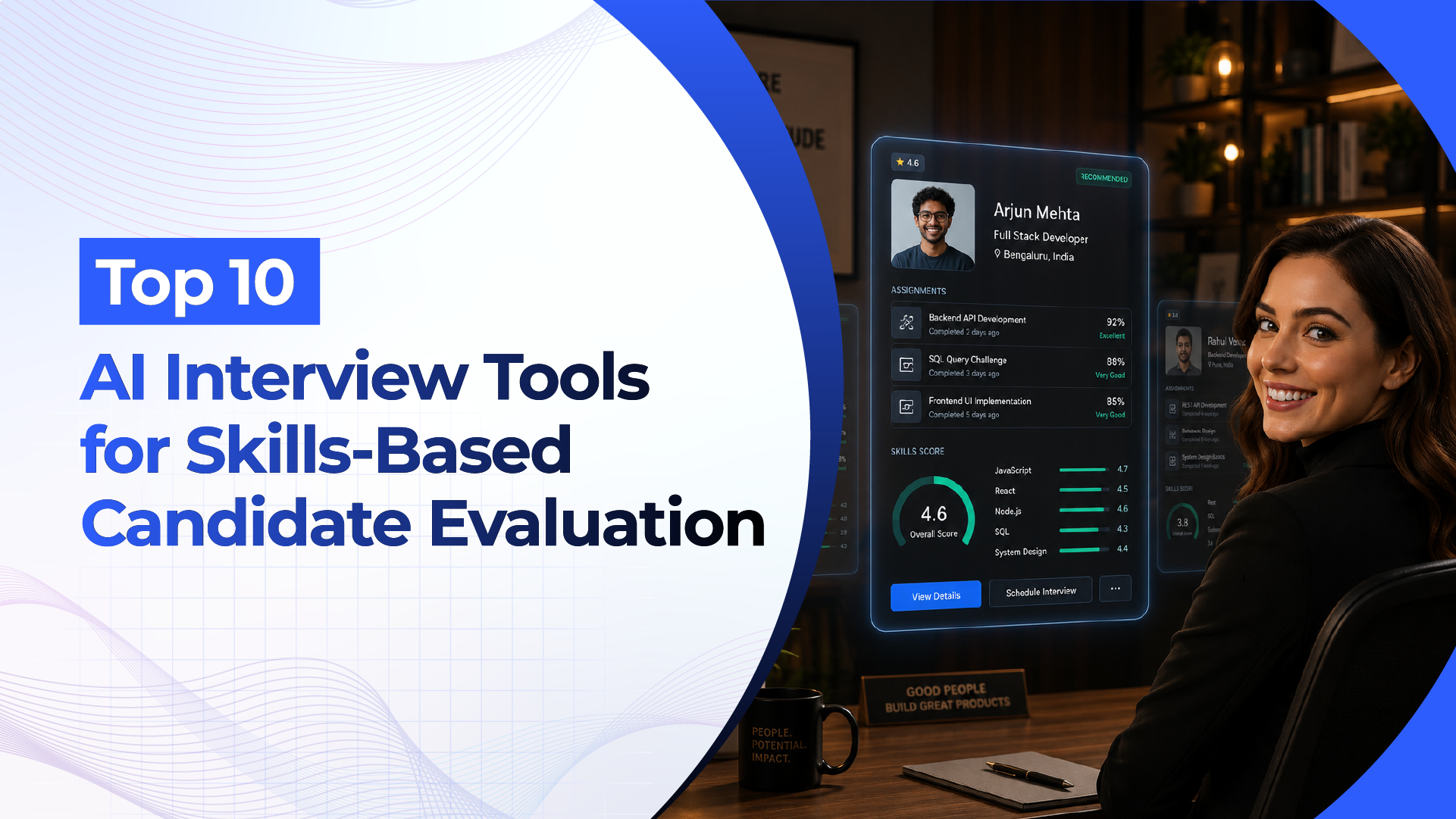
The Top 10 AI Interview Tools for Skills-Based Candidate Evaluation
1. Rebecca AI by Pete & Gabi
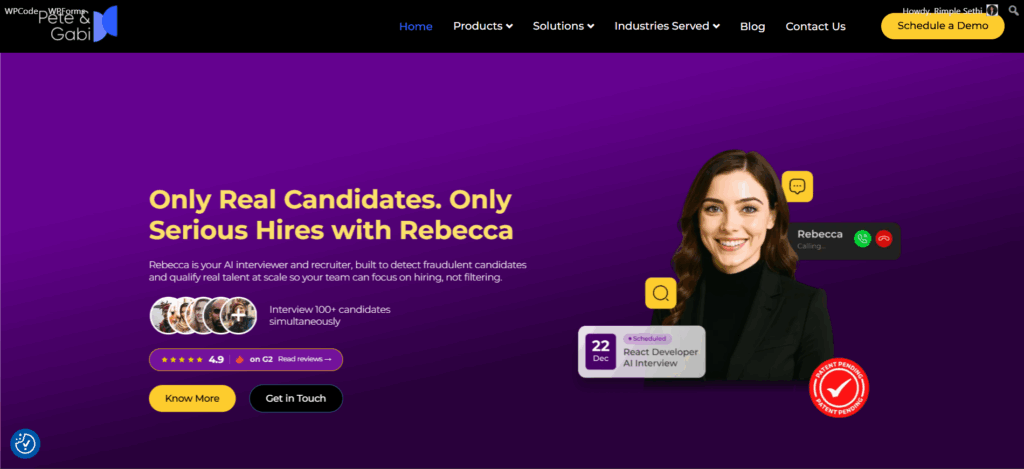
Rebecca AI is a voice-first AI recruiting agent built by Pete & Gabi that conducts live, adaptive phone and video interviews within minutes of a candidate applying. It is the only tool on this list that initiates contact proactively rather than waiting for a candidate to schedule themselves into a process.
The skills evaluation goes deeper than most platforms here. Rebecca AI scores candidates across five dimensions: technical ability, problem-solving, communication, professionalism, and role alignment. Questions adapt based on what the candidate says, which prevents pre-prepared answers from passing the screen. A built-in fraud detection layer flags suspicious response patterns with 95% accuracy. Coding assessments for technical roles are embedded directly in the same interview session.
In one documented enterprise staffing deployment, the system processed 2,835 candidates, passed 1,637 through screening, and confirmed 515 interviews without any recruiter involvement before shortlist delivery. The platform supports 16 languages and deploys in under a week with no lock-in contracts.
2. Spark Hire
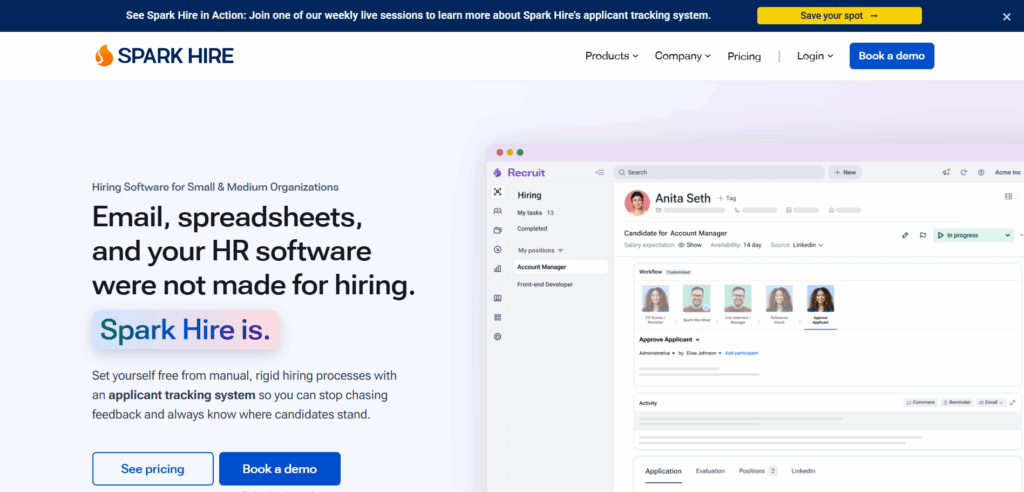
Spark Hire has been in the video interviewing market since 2012. Its core product is one-way asynchronous video interviews with a growing live interview capability. For small to mid-market teams that want to add a video screening layer to an existing process, the setup is fast and the interface is clean.
The AI scoring in Spark Hire is functional but relatively basic compared to platforms built specifically for adaptive assessment. Recruiters receive video recordings with a rubric-based scoring framework rather than dynamically generated evaluations. There is no real-time question adaptation based on candidate responses. The value is in the volume reduction: teams that previously ran phone screens for every applicant use Spark Hire to cut that process significantly.
It integrates with over 100 ATS platforms, which makes it a practical option for teams that want to add video screening without disrupting their existing workflow. Pricing is accessible for smaller teams, which is a genuine advantage in a space where enterprise-grade tools often start at five figures annually.
3. Mokka
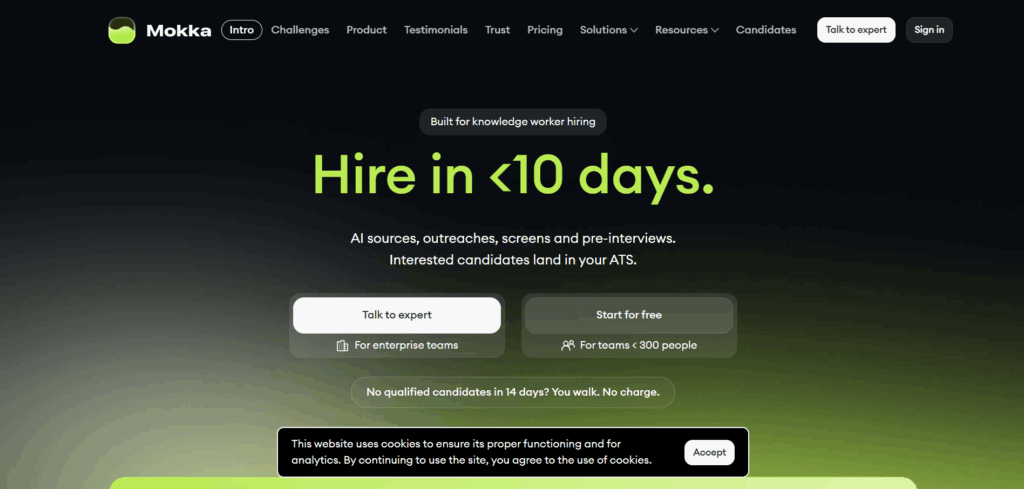
Mokka positions itself as a full-pipeline automation platform, which makes it one of the broader tools on this list. It combines candidate sourcing, screening, AI pre-interviews, and integrity verification in a single system. For teams that want to automate from job requisition through to a ranked shortlist without managing multiple tools, that breadth is genuinely useful.
The AI interview component includes multi-factor scoring and integrity checks that go beyond most async video platforms. Mokka is one of the few tools that explicitly addresses candidate authenticity at the interview stage, which has become more pressing as AI-generated responses have become easier to produce. The sourcing and screening layers give context that makes the interview scoring more meaningful.
Pricing sits in the mid-to-upper range at $199 to $699 per seat per month, which puts it out of reach for smaller teams but reflects the breadth of automation being provided. It is worth evaluating if the goal is to reduce the number of separate tools in the recruiting stack.
4. Eightfold AI
Eightfold AI operates at a different level of abstraction than most tools on this list. Rather than conducting discrete interview sessions, it builds a continuous skills graph of candidates by analyzing career trajectories, demonstrated competencies, and role fit across a deep learning model trained on a large dataset of career paths.
The interview layer integrates into this broader talent intelligence system. Scoring is based on actual skills demonstrated across a candidate’s history rather than responses in a single session. For large enterprises focused on internal mobility as well as external hiring, Eightfold’s depth of career trajectory analysis is genuinely differentiated. It surfaces candidates who look wrong on paper but have the underlying skill profile that matches the role.
The platform is enterprise-only, with custom pricing and an implementation process that reflects that scope. It is not the right tool for a team that needs to hire quickly for a single role. For organizations doing workforce planning across thousands of positions, it may be the most sophisticated option available.
5. HireVue
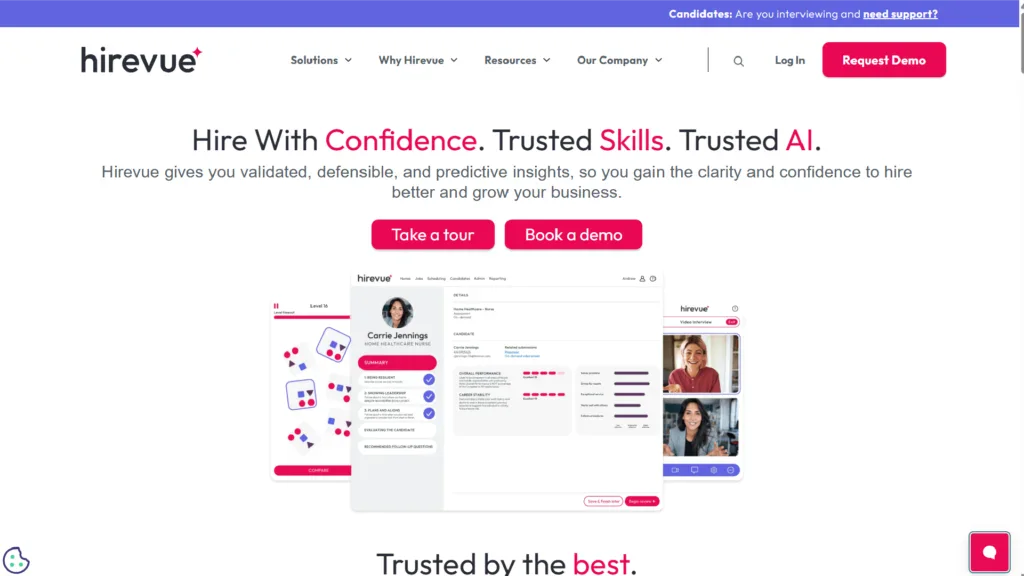
HireVue is one of the most widely deployed AI interview platforms in enterprise hiring. It offers structured video interviews, game-based cognitive assessments, and an on-demand interviewing product used by major global employers. HireVue’s AI assessment research has found that its interview scoring reduces time-to-hire significantly compared to manual screening, according to Second Talent’s 2026 research compilation.
The game-based assessments are a distinctive element. Rather than asking candidates standard behavioral questions, they measure cognitive ability, attention, and problem-solving through short tasks that are harder to prepare for than a conventional interview. This is a meaningful advantage for roles where structured question prep can obscure actual capability.
HireVue integrates with SAP, Oracle, and Workday, which makes it practical for enterprises already running complex HR tech stacks. The company has published transparency reports on its AI models and conducted third-party bias audits, which matters for procurement teams in regulated industries.
6. Hireflix
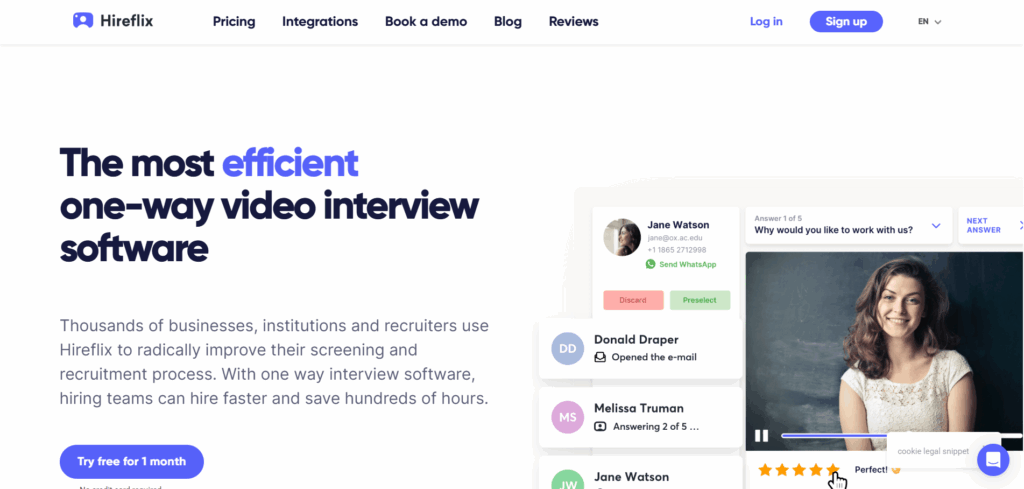
Hireflix is a simple one-way video interview platform. It lets candidates record answers to preset questions on their own schedule. There is no AI scoring, no adaptive questioning, and no live interview capability. Candidates do not need to create an account to complete their interview, which reduces friction at the application stage.
That simplicity is the product’s actual strength. Teams that already have a strong screening process and just want to add a structured video layer before a live interview find that Hireflix delivers that without adding complexity or cost. The pricing is accessible, setup is fast, and the interface works cleanly on mobile.
For skills-based evaluation specifically, Hireflix has real limitations. There is no competency scoring, no technical assessment capability, and no ATS-native evaluation data. It is a tool for collecting structured video responses, not for evaluating them.
7. Asendia AI
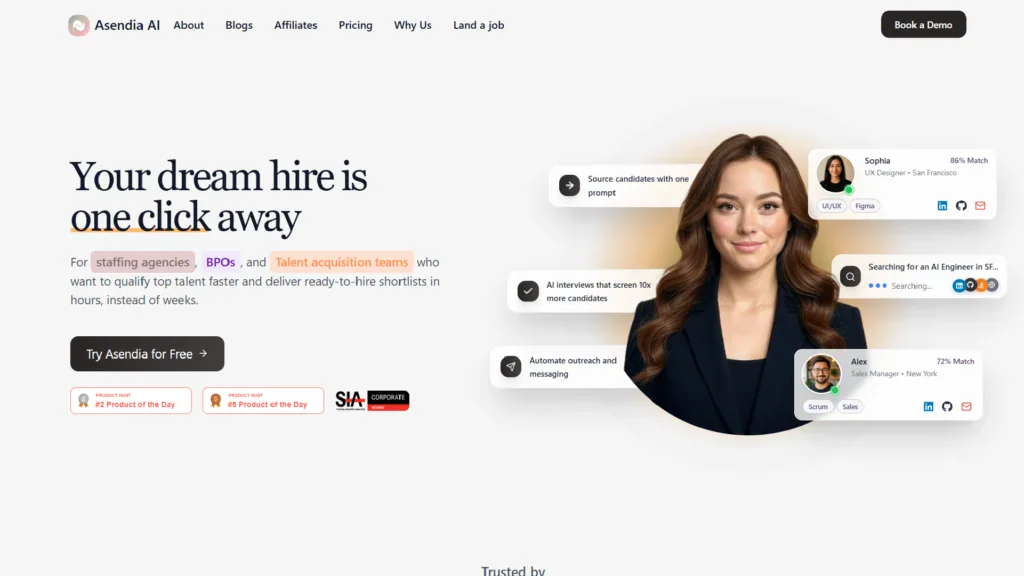
Asendia AI has a core product, an AI recruiter called Sarah that conducts voice and video interviews with candidates 24 hours a day. The platform uses natural language processing to run adaptive conversational assessments that evaluate both technical skills and soft skills through structured conversation rather than a test environment.
The skills assessment component covers job-specific technical competencies alongside communication and problem-solving, and responses are analyzed for depth, coherence, and role relevance. Asendia integrates with leading ATS platforms for automated data sync. Setup requires minimal configuration, and the company positions the platform as accessible to smaller teams that cannot justify enterprise pricing.
Public pricing is not listed, which makes budgetary planning harder before a sales conversation. The platform is best evaluated alongside a proof of concept for the specific role types being assessed.
8. Interviewer AI
Interviewer AI focuses on asynchronous video interviewing with an AI scoring layer that evaluates behavioral competencies, communication clarity, and role alignment. The platform generates role-tailored question sets based on the job description, which gives it more contextual relevance than tools that use generic question banks.
For technical roles, it includes coding assessments integrated directly into the interview session, so candidates do not need to switch between platforms to complete a technical screen. Scoring is transparent, with breakdowns by competency that give recruiters a basis for comparison across candidates. The pricing model is per-interview rather than per-seat, which scales well for teams with variable hiring volumes.
The interface is straightforward, and the setup time is low. It is a solid mid-market option for companies that want structured skills evaluation in their video screening without the complexity or cost of an enterprise platform.
9. VidCruiter
VidCruiter is a highly configurable enterprise video interviewing platform with a strong emphasis on compliance and structured workflow design. It supports pre-recorded interviews, live video sessions, automated reference checking, and skills assessments within a single platform. Clients include Bridgestone, UPS, and Universal Orlando Resort.
The compliance infrastructure is a genuine differentiator. VidCruiter is built to meet EEOC, OFCCP, and ADA requirements and provides structured rating systems that produce consistent, auditable records for every candidate evaluation. The reference check system flags suspicious patterns such as shared IP addresses across references, which adds a layer of integrity checking beyond the interview session itself.
The implementation process can be lengthy, and the learning curve for administrators is real. Pricing at $15,000 to $40,000 annually reflects enterprise scope and should be evaluated alongside the full feature set rather than compared to simpler per-seat tools.
10. Humanly
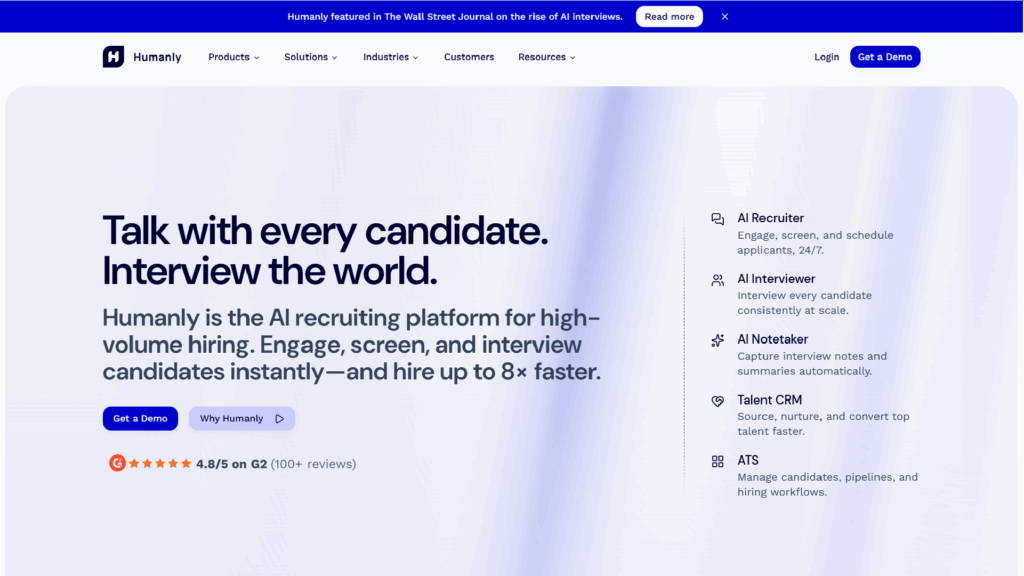
Humanly takes a conversational AI approach to candidate screening, using chat-based and video interactions to qualify candidates and evaluate them against role criteria. The platform is built for high-volume frontline and hourly hiring, with a DEI analysis layer that tracks candidate representation at each pipeline stage and surfaces where underrepresented groups are dropping off.
The AI scoring system evaluates candidates against structured rubrics and feeds results into a talent CRM alongside a built-in ATS. Humanly integrates with Greenhouse, Workday, and Lever, among others. The DEI pipeline analytics are more developed here than on most platforms, which makes it worth considering for organizations with active diversity hiring commitments where visibility into funnel equity matters.
Pricing is custom and requires a sales conversation. The platform is less focused on deep technical skills assessment than tools like Rebecca AI or Eightfold, but for communication-heavy roles where DEI data and candidate engagement are the primary evaluation dimensions, it is well-positioned.
Feature Comparison: All 10 AI Interview Tools at a Glance
The table below covers the eight dimensions most relevant to a skills-based evaluation decision.
| Tool | Interview Type | Skills Scoring | Live Adaptive | Fraud Detection | ATS Sync | Pricing | Best For |
| Rebecca AI (Pete & Gabi) | Voice + Video (live) | Yes, 5 dimensions | Yes, fully adaptive | Yes, 95% accuracy | Yes, native | $5-8/interview | Enterprise, staffing, high-volume |
| Spark Hire | One-way + Live video | Basic scoring rubric | No | No | Yes, 100+ ATS | $119-449/month | SMB and mid-market teams |
| Mokka | AI pre-interview + Video | Yes, multi-factor | Partial | Yes, integrity checks | Yes | $199-699/seat/month | Full-pipeline automation |
| Eightfold AI | Skills-based matching + Interview | Yes, deep ML scoring | Partial | No | Yes, enterprise | Custom enterprise pricing | Enterprise talent intelligence |
| HireVue | One-way + Live video + Game assessments | Yes, multi-dimensional | Partial | No | Yes, SAP, Oracle, Workday | Custom enterprise pricing | Large enterprise, regulated industries |
| Hireflix | One-way async video only | Basic; no AI scoring | No | No | Limited | $150/month base | Simple async screening layer |
| Asendia AI | Voice + Video (live) | Yes, technical + soft skills | Yes, adaptive NLP | No | Yes, ATS sync | Not publicly listed | SMB to mid-market voice screening |
| Interviewer AI | Async video + AI scoring | Yes, behavioral + competency | No | No | Yes | Transparent per-interview model | SMB, technical and non-technical roles |
| VidCruiter | Pre-recorded + Live + Reference checks | Yes, structured rating | No | No (reference IP checks) | Yes, broad enterprise | $15K-40K/year | Compliance-heavy enterprise hiring |
| Humanly | Chat + Video screening | Yes, AI scoring + DEI analysis | Partial | No | Yes, Greenhouse, Workday, Lever | Custom pricing | High-volume frontline and hourly hiring |
How to Pick the Right AI Interview Tool for Skills-Based Hiring
The comparison table makes clear that no single tool covers every requirement equally. The decision depends on what stage of hiring is creating the most friction and what type of skills evaluation the role actually requires.
For teams where candidate volume is the primary bottleneck and the cost of a bad hire is high, Rebecca AI’s combination of proactive outreach, adaptive live interviewing, and 95% fraud detection accuracy is the most complete option available. It is the only platform on this list that reaches candidates before they have to take any action themselves.
For organizations in regulated industries with stringent audit requirements, VidCruiter’s structured workflows and EEOC/OFCCP compliance documentation are difficult to match at the same level of configurability.
Smaller teams with simpler needs will find that Spark Hire, Hireflix, or Interviewer AI deliver functional video screening at a fraction of enterprise platform costs. The tradeoff is depth of skills evaluation.
The most important question to ask any vendor: can you show me exactly how your scoring works, what dimensions are being evaluated, and where human judgment enters the process? Platforms with clear answers to that question are the ones actually built for skills-based evaluation. Platforms that answer vaguely are collecting video responses and calling them assessments.
The Shift From Credential Screening to Competency Evaluation
Hiring on skills requires tools that actually measure skills. The research on this is settled. AI models predict role performance at 81% accuracy compared to 54% for unstructured interviews. Companies using AI-assisted matching report 25 to 35% higher first-year retention rates, according to LinkedIn research. The ROI case is not in dispute.
The remaining question is implementation. Which tool fits the role type, the team size, and the specific stage of the hiring process where evaluation quality is breaking down. The ten platforms above cover the range from lightweight async video to full-pipeline voice-based AI with live adaptive questioning. Pick the one that matches the actual problem, and the results will follow.
Frequently Asked Questions
What is skills-based candidate evaluation in AI interviews?
Skills-based candidate evaluation uses AI interview tools to assess what a candidate can actually do rather than relying on credentials, job titles, or resume formatting as proxies for capability. The best platforms generate role-specific questions, adapt follow-ups based on candidate responses, and score answers across defined competency dimensions including technical ability, problem-solving, communication, and role alignment. The output is a structured, comparable evaluation for every candidate rather than a subjective impression from a human reviewer.
Which AI interview tools conduct live conversational screening with structured technical and communication assessments?
Rebecca AI and Asendia AI both conduct live, adaptive voice conversations rather than recording static video responses. Rebecca AI scores candidates across five dimensions such as technical ability, problem-solving, communication, professionalism, and role alignment with questions that adapt in real time based on what the candidate says. HireVue’s game-based cognitive assessments offer a structured alternative for teams that want validated, audited scoring at enterprise scale.
Which AI interview tool is best for high-volume technical hiring?
Rebecca AI by Pete & Gabi is the strongest option for high-volume technical hiring that requires both proactive outreach and deep skills evaluation. It contacts candidates within minutes of application, runs adaptive live interviews, embeds coding assessments for technical roles, and scores candidates across five competency dimensions before returning a shortlist to the recruiter. For compliance-focused enterprises running structured workflows at scale, VidCruiter and HireVue are the alternatives with the most enterprise depth.
How accurate is AI scoring in candidate evaluation?
AI assessment tools process evaluations 15 times faster than human reviewers while maintaining 94% scoring consistency, according to Second Talent’s 2026 research compilation. AI models trained on structured interview data predict role performance with 81% accuracy, compared to 54% for traditional unstructured interviews, per SHRM research. The accuracy of any specific platform depends on how well its scoring model is calibrated to the role. Platforms that generate role-specific questions from the job description and adapt dynamically during the conversation consistently outperform those using static question banks. For consistency and bias specifically, platforms using adaptive, role-specific questioning rather than static question banks, apply the same evaluation framework to every candidate regardless of order, time of day, or interviewer fatigue, which is the core mechanism behind reducing interviewer bias at scale.
Can AI interview tools detect fraudulent or AI-generated candidate responses?
Some platforms do this better than others. Rebecca AI includes built-in authenticity checking with 95% fraud detection accuracy. It adapts questions based on what the candidate said in the previous answer, which makes it structurally difficult to use pre-prepared or AI-generated responses effectively. Mokka also includes integrity verification. Most standard video interview platforms, including Spark Hire and Hireflix, do not have dedicated fraud detection. For roles where candidate authenticity is a concern, particularly in technical fields where AI-assisted responses are common, platforms with adaptive questioning and explicit fraud detection should be prioritized.
What is the difference between async video interviews and live AI interviews?
Async video interviews record candidate responses to preset questions for later review. The candidate records on their own schedule, and a recruiter watches the recording when convenient. There is no real-time interaction and no adaptive questioning. Live AI interviews involve a real-time voice or video conversation driven by an AI agent that listens to responses and adjusts follow-up questions dynamically. Live adaptive interviews produce stronger evaluation data because they cannot be prepared for in the same way. Platforms like Rebecca AI and Asendia AI conduct live conversations. Platforms like Spark Hire, Hireflix, and the base product of many others are async-only.
What are the best AI interview tools for evaluating candidates?
It depends on the bottleneck: Rebecca AI is strongest for high-volume technical hiring needing both outreach and deep skills evaluation; VidCruiter and HireVue lead for compliance-heavy enterprise hiring; Spark Hire, Hireflix, and Interviewer AI are the practical choices for smaller teams that need functional video screening without enterprise cost.
How long does it take to implement an AI interview platform?
Implementation timelines vary significantly. Rebecca AI goes live in under a week with no technical setup required. VidCruiter and enterprise platforms like HireVue and Eightfold AI typically require four to twelve weeks depending on ATS integration complexity and custom workflow configuration. The key variable is how deeply the platform needs to integrate with existing systems. For teams that want immediate improvement to their screening process, lighter-weight or API-based tools deploy fastest. Enterprise deployments that require custom scoring frameworks and multi-system integration take longer but provide more structural change.