In the upcoming years, the global AI recruitment market is projected to exceed $890 million dollars in 2028. The companies that close their deals quickly and select the appropriate tools will gain tremendous advantages over all other firms within that time frame.
In addition to this, the forecast of AI usage in talent acquisition from LinkedIn 2026 Future of Recruiting report shows that 93% of talent acquisition experts say they are planning on using more AI in 2026, including 66% of respondents who say they will be using AI-powered pre-screening interviews. Many companies that incorporate AI recruiting tools through a strategic process are experiencing hiring costs being reduced by as much as 30-40%.
When implementing AI recruiting software, it can accelerate both the hiring process and improve the overall results of finding quality candidates alternatively, using an inappropriate AI recruiting software solution may result in wasting resources and create a negative candidate experience.
Before formally placing your new contract for an AI recruiting software or onboarding your recruiters on to it, you should ask the right questions, not just those provided on the vendor demo script, but also provide insight into how that particular product performs in real life circumstances.
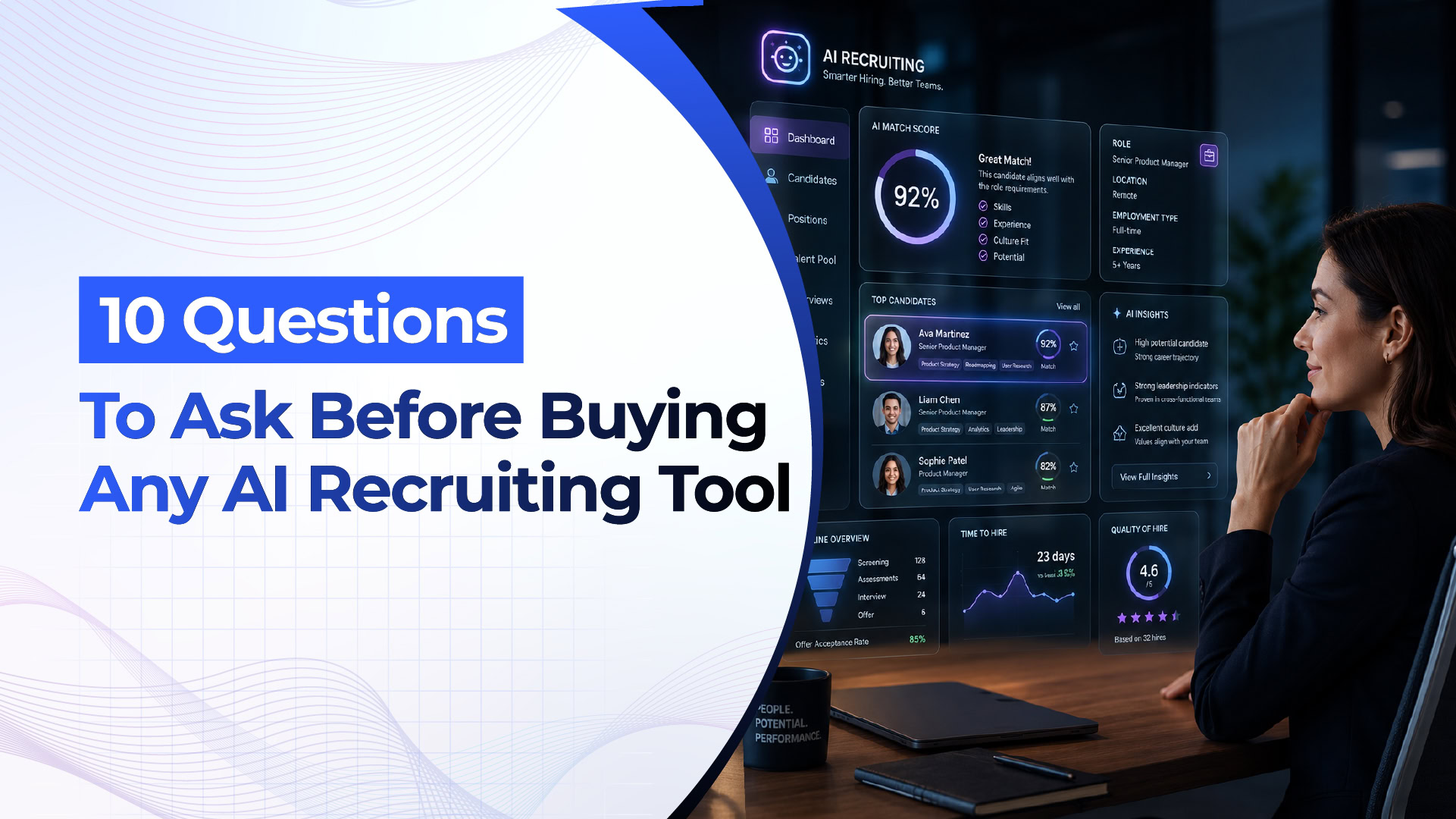
To simplify this step, in this guide there are 10 specific and tangible questions you can ask any vendor providing AI recruiting software before making a purchase decision.
Why Most Buyers Skip the Hard Questions?
To evaluate AI hiring solutions, most teams watch demo videos, look at the price of tier comparisons, and ask if the software will integrate with their ATS. These are basic-level questions; however, the more substantive questions about bias, accuracy, candidate experience, and what happens if/when something goes wrong are typically not asked until after the contract is signed.
As a result, companies are investing dollars into the wrong areas of recruitment automation software by purchasing programs that automate and streamline the wrong processes, purchase AI sourcing systems that only produce poor-quality candidates, or purchase video interviewing software that results in candidates dropping out due to the experience feeling cold and broken.
Key Evaluation Criteria for AI Recruiting Tools
| Criteria | What to Look For | Why It Matters | Red Flags |
| Decision Transparency | Clear explanation of how candidates are scored and ranked | You must be able to defend hiring decisions legally and ethically | Vague answers about “proprietary algorithms” with no detail |
| Bias Auditing | Third-party audits, demographic outcome reports, EEOC compliance | AI recruiting software trained on biased data replicates bias at scale | Vendor deflects to “our AI doesn’t see race or gender” |
| Candidate Experience | Smooth, mobile-friendly flow; adaptive AI interviewer; low drop-off rate | A broken or cold experience damages your employer brand | No way to preview the candidate-facing experience before buying |
| Role Customization | Interview questions adapt to job descriptions, not a generic question bank | One-size-fits-all screening role-specific signals | Only a fixed question library with no customization options |
| ATS & Stack Integration | Native integrations, bidirectional sync, open API | Disconnected tools create duplicate work and data gaps | Integration list is short, outdated, or requires paid add-ons |
| Reporting & ROI | Dashboard tracking time-to-screen, completion rates, quality-of-hire | You need data to prove value and improve over time | Only surface-level metrics; no downstream hire quality tracking |
| Human Override | Clear recruiter escalation path; candidate appeal mechanism | No AI is perfect, human judgment must remain in the loop | No override option; AI decisions are treated as final |
| Pricing Scalability | Transparent per-volume pricing at multiple growth stages | Affordable pilots can become expensive at enterprise scale | Pricing only revealed after multiple sales calls |
| Data Ownership | Candidate data belongs to you; no model training without consent | Sensitive personal and interview data carries serious legal risk | Vendor retains rights to use candidate data for model improvement |
| Security & Compliance | SOC 2, GDPR, CCPA compliance; documented data residency | Non-compliance exposes you and your candidates to real harm | No documentation available; compliance mentioned verbally only |
The 10 questions below are designed to cut through the marketing and get to what matters.
Question 1: How Does Your AI Make Hiring Decisions?
Every trustworthy AI recruitment software company should be able to provide a plain language explanation of what signals their models use to score or rank a candidate. Are they using keyword matching? Behavioral tests? Predictive scoring? Tone analysis during your AI interview?
If they provide generalized or obfuscated information, it’s a red flag. You’ll want to know exactly what your AI recruiting platform is optimizing for because it will do that at scale to thousands of candidates.
Specifically, you should ask them for the scoring, i.e., how a candidate’s score was created, and what analyzed factors went into the scoring. If they cannot easily provide you that information, then you do not have an AI recruiting tool; you have a ‘black box’
Question 2: What Data Was the Model Trained On?
Most providers don’t like to answer this question, but you should really be asking this of them.
If an AI is going to be used in the hiring process, it is up to the data that was built to provide a fair hiring outcome. For example, if the model used data from an organization that has historically hired fewer women, more minority candidates or from those with non-traditional educational backgrounds then the model will have learned that history and be able to continue this history more often than not without you even knowing about it.
Examples of questions you could ask include: “Was the data you used to train your AI tested for demographic bias? Did you remove any core characteristics from the data prior to using it to build the model?” A supplier who has nothing to hide will have a clear answer while a supplier who tries to change the subject to their accuracy rating is giving you a very important message.
Question 3: How Does the Platform Handle Bias Auditing?
Eliminating bias from AI recruiting tools should not be treated as a onetime event but as an ongoing process. The top AI enabled recruiting platforms employ constant auditing techniques and will keep track of results broken down by demographics, identifying any irregularities and alerting your team to such issues prior to them potentially being compliance issues.
Inquire whether regular reporting of bias audits is provided from the platform, and whether these reports will be accessible to you rather than just the vendor. Verify if the platform has undergone an independent audit by a third party, and whether it adheres to guidelines established by the EEOC or equivalent international regulations.
Question 4: What Does the Candidate Experience Actually Look Like?
AI assistance technologies can influence more than your team’s ability to hire; they can have a significant impact on the candidates who use them. A large number of candidates are likely to stop using a clumsy, non-engaging or unreliable AI tool for their interviews and turn to another source for their search for jobs before a human interviewer even gets to meet them.
Try using a candidate-facing application from start to finish by yourself to see what it is like to be a candidate. The candidate experience is the primary design focus of systems designed with consideration for how users will use them throughout their entire hiring journey. Rebecca AI by Pete & Gabi utilize voice AI Interviewing systems to create adaptive, natural conversations that candidates will be less inclined to stop completing.
Question 5: How Does Your AI Interviewer Adapt to Different Roles?
A good interview tool powered by strong AI must adapt itself according to each position and not use a one-size-fits-all approach to candidate screening. Using information from either an individual or group interviewee screening process in an automated fashion creates a negative experience for the applicants, while producing results that do not correlate with the applicant’s ability to be successful at that position.
The best AI recruiters are constantly changing their approach to recruiting, as opposed to remaining stale like traditional recruiters do. The best AI recruiters will actively listen to an applicant and ask open-ended questions to gain a deeper understanding of their ability to fit within a company’s culture as well as with the technical aspects of that job and will be able to constantly adjust their line of questioning while providing timely follow-up in order to keep the interview progressing at an appropriate pace.
Question 6: What Integrations Does the Platform Support?
If you choose to implement new AI recruiting software without connecting to your current technology stack, expect to create extra work for yourself and your staff instead of reducing it. Before you choose an AI recruiting software, evaluate what your current technology stack looks like, so you know how to go about connecting to it. These include your Applicant Tracking System (ATS), Human Resources Information System (HRIS), job board accounts, communication tools, and background check vendor.
Ask the vendor for all of their native integrations and be sure to confirm whether the integration has a bidirectional sync so that candidate data will flow back and forth between the AI platform and your respective systems.
The most effective AI hiring software will seamlessly integrate into your existing workflow without requiring you or your team to adjust how they currently do their jobs.
Question 7: How Is Performance Measured and Reported?
To facilitate improvement, measurement is essential. You should use an AI recruiting system that provides you with easy access to the following data: your time-to-screen; interview completion rates; your score distribution; how much time was saved by the recruiter; and how the hired candidates performed after they were hired.
Ask whether the platform provides a method for tracking quality of hire over time and not just during the screening process, but after 90 days to see if the candidates the AI ranked high have actually performed as expected when on the job?
The best vendors are those that provide you with evidence of their client success (not just their product metrics) because they truly believe in what they are regarding their product.
Question 8: What Happens When the AI Gets It Wrong?
There is no such thing as a perfect AI tool when hiring employees. The important point for you to consider is what happens when your hiring software does make an error?
You may want to ask how recruiters can override AI decisions. You will also want to ask candidates if there is a method for flagging or appealing to the judgement made by AI and that they will receive a response from a human recruiter. Additionally, you should inquire how the AI software handles edge cases – such as candidates who have a nonstandard or international background and/or an unusual looking resume.
The best AI recruiting platforms incorporate human judgement into the recruitment process, as opposed to using it as an alternative to technology. They support recruiters rather than replace them and allow human intervention whenever necessary.
Question 9: How Does Pricing Scale as Your Hiring Volume Grows?
A recruitment platform that may seem relatively inexpensive at 20 hires per month can quickly go from low cost to excessive cost at the higher end of the scale (200) and their pricing methodologies can vary by vendor; some charge on a per interview basis, some charge on a per seat basis, while others charge on a per active job basis and what works for your initial pilot programs will likely not work on an enterprise scale basis either.
Request a total cost of ownership estimate for three hiring volume levels such as actual current hiring volume and twice your current hiring volume and 5 times your current hiring volume.
The vendors who provide pricing transparency demonstrate their confidence in themselves. If a vendor is unable to provide you with definitive numbers until you have gotten to call 5, then they are simply using this as part of their negotiating strategy rather than a part of their available product offering.
Question 10: Who Owns the Data, and How Is It Protected?
Candidate data is often confidential and may include a person’s name, phone number, educational history, and other background information. In the case of AI interview platforms, it would also include audio or video recordings of actual candidates talking. Therefore, before you deliver or transfer the information you have collected on candidates to a third-party platform, you must fully understand where your data will go and how it will be used.
Important Questions to Consider:
1. Who has ownership of the data? Is it you, or the platform you are using?
2. Do they use candidate data in any capacity to improve the way they deliver their services
3. Is the data stored in accordance with each applicable country’s laws?
4. Are there options available for the platform to provide data security such as SOC 2 compliance, or compliance with all relevant legislation governing the handling of personal data, such as the General Data Protection Regulation (GDPR) in the European Union, and the California Consumer Privacy Act (CCPA) for California-based candidates?
Additionally, data ownership and security are not simply compliance with boxes; they are critical to developing candidates’ trust in your hiring practices. When asking vendors questions, make sure to request written support for your understanding; don’t rely solely on verbal conversations.
Final Thoughts
When deciding on an AI recruitment platform, you are making much more than just a software selection; these questions will define how you hire, how productive your recruiters are and what candidates will experience.
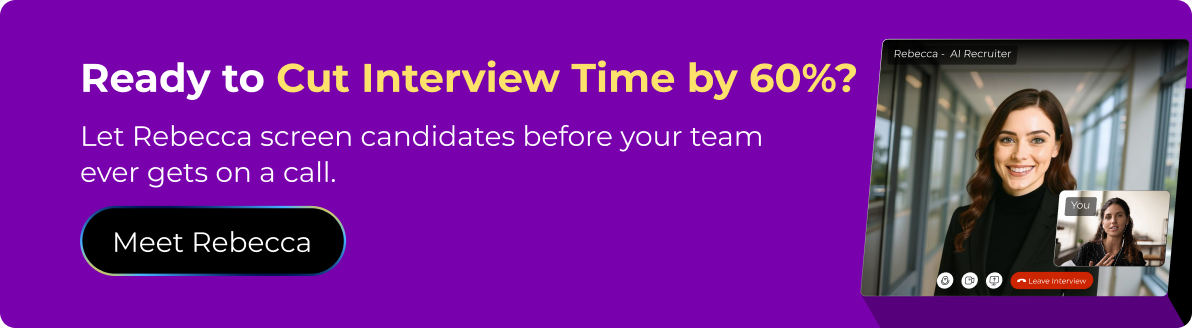
Rebecca AI by Pete & Gabi will answer all these questions and stand out as an excellent choice. It has a real time AI interviewer to conduct automated first stage interviews, integrates with your ATS, and provides scored candidate reports the same day. Teams using Rebecca AI report time-to-hire reductions of up to 80% while conducting 100+ continuous simultaneous interviews, 24/7.
Use these questions in every product demo that you evaluate to make sure that you have selected the right vendor that will provide you with clear and confident responses.
FAQs
Which AI recruiting tools are best suited for high-volume hiring?
AI recruiting tools must have automated screening along with AI-Interviewing, all in the same system. If you’re looking for software that works inside of your ATS, is able to manage hundreds of interviews simultaneously, and can create ranked candidate reports, then an example of this is Rebecca AI which is designed for high-volume staffing.
How do AI recruiting agents differ from standard recruitment automation software?
Staffing automation software helps with repetitive tasks that occur in recruitment, such as sending emails and updating workflows. AI Recruiting Agents do even more by having conversations, asking relevant follow-up questions, evaluating candidate responses, and providing insight about candidates. The best AI hiring solutions utilize both approaches.
What should I look for in a video interview platform that uses AI?
It is best to select an AI Interviewing technology that allows for natural conversations and has structured candidate report capabilities, has proven capable of achieving consistent performance across all devices, has provided excellent candidate experience, is able to manage rescheduling, incomplete interviews and different accent/vocal characteristics thus creating an equitable Interviewing process.
How can I determine whether an AI hiring platform is reducing bias or just claiming to?
Instead of simply showing you their marketing materials, request to see any independent audit reports and any evidence of having done bias testing. You can expect a trustworthy AI Hiring system to have a documented Formal testing procedure, comply with current hiring standards and have conducted a regular schedule of independent bias assessment.
How can AI hiring improve diversity and reduce time-to-hire?
Standardized assessments and broadened candidate search through AI recruitment agents can decrease your hiring time by as much as 75%, and reduce your risk of unconscious bias, when configured correctly.
Which video interview software or AI interview platform should I choose?
Choose a video interview product that provides an authentic AI interview conversation, structured candidates report, reporting and analytics, full integration into your applicant tracking system (ATS), and candidate-friendliness. Rebecca AI offers automated interviewing solutions that combine both AI interview service and automated candidate screening, making them extremely well qualified to support organizations that hire at scale.