There is a moment every recruiter knows. You open your inbox on Monday morning, and there are 340 unread applications, all submitted since Friday afternoon. The role has been open for eleven days. Your first-round calls are booked by the end of next week. Somewhere in that pile is the person you are looking for, and you have no efficient way to find them before they accept something else.
That is precisely when recruiters look seriously at what AI recruiting tools are doing in 2026 and whether the claims hold up.
When managing high volumes of hiring, AI recruiting tools help staffing teams and hiring managers to screen candidates, run first-round interviews, and generate shortlists faster. They are most useful in high-volume hiring, where manual screening slows down response times and causes strong candidates to drop out. AI recruiting tools is built for that kind of workflow, with automated outreach, interviewing, scoring, and ATS sync. The real question is not whether AI belongs to recruiting. It is where it saves time without lowering the hiring quality.
What AI tools do in a recruiting workflow
The term gets used loosely enough to be almost meaningless. Resume parsers that sort applications by keyword are technically AI. So are fully autonomous hiring agents that conduct live voice interviews, score candidates across five dimensions, and sync everything to your ATS before a recruiter has touched the pipeline. These are not remotely the same thing and treating them as equivalent is how organizations end up purchasing tools that solve a problem; they do not actually have.
For most recruiting teams, the bottleneck is not sourcing. Job boards generate applications. The real problem is everything that happens after the screening calls, the scheduling coordination, the candidates who applied on Tuesday and heard nothing until the following week, by which point they had already accepted something else.
That is where the evidence is strong enough to take it seriously. A study conducted through Chicago Booth and PSG Global Solutions screened over 70,000 applicants across healthcare, IT, and industrial roles using both human-led and AI-led interviews. The AI interviews produced 12% more job offers, 18% more job starters, and 16% higher 30-day retention rates than the human baseline. Perhaps more telling was when candidates were given the choice between interview paths; 78% chose the AI agent. Not because they had to. Because it was faster, less intimidating, and more consistent.
The last finding indicates that candidates are not suffering through AI interviews. Many of them prefer it.
Start with your data, not with the tool
Before selecting any platform, pull three months of application data from your ATS. Where do candidates actually drop off? If 40% of applicants never receive a first-round call, the problem is screening capacity. If completion rates are fine, but time-to-offer runs past thirty days; the bottleneck is somewhere else entirely.
This matters because AI recruiting tools are not interchangeable. Platforms built for sourcing passive candidates to solve a different problem than platforms built for automated interview delivery. Matching the tool to the actual failure point in your workflow is the only way to get a meaningful return.
How to set up the role before you launch anything
Generic screening produces generic shortlists. The best platforms generate interview questions from the actual job description and the candidate’s resume, then adjust follow-up questions in real time based on what the candidate says. To get that kind of output, the job description needs to be specific.
A role described as “strong communicator with relevant experience” gives an AI interviewer almost nothing to work with. A role that specifies communication requirements by context, client presentations versus internal documentation versus technical briefings, gives the system enough structure to evaluate candidates meaningfully.
This is not a new problem. Human recruiters face the same thing. AI just makes the consequences of a vague job description more visible, faster.
Configure the scoring framework before the first interview runs. Decide what strong looks like across technical ability, problem-solving, communication, professionalism, and role fit. Setting criteria in advance keeps evaluation consistent and gives your team a defensible record of how shortlisting decisions were made. In regulated industries, audit trail matters.
Where automation should sit in the funnel
Most teams apply automation to the wrong part of the funnel. They use it for resume filtering, which saves some time, but leave outreach and scheduling coordination to recruiters, which is where the hours actually go.
Platforms offering AI candidate screening contact candidates within minutes of application across SMS, phone, and web. Pre-qualification runs in the same conversation. Interviews are scheduled in the same flow. The candidate moves from application to booked interview without a coordinator touching it. The recruiter receives a shortlist with transcripts, scores, and summaries, not a to-do list.
The shift sounds straightforward. In practice, it requires trusting a system to handle conversations that recruiters have historically owned. That trust is earned incrementally. Run AI outreach on one requisition type first. Measure drop-off and conversion rates against your manual baseline. Expand from there.
How AI agents help solve the technical hiring problem in 2026
Screening for technical roles using traditional methods is slow and inconsistent. A recruiter without an engineering background cannot reliably evaluate a developer’s coding ability from a resume. Passing every candidate to a technical panel interview is expensive and does not scale.
The better AI platforms solve this by embedding coding assessments and problem-solving questions directly inside the interview. Candidates work through real-world challenges in context rather than disconnected algorithmic tests. Results are scored automatically and delivered with transcripts and evaluation summaries.
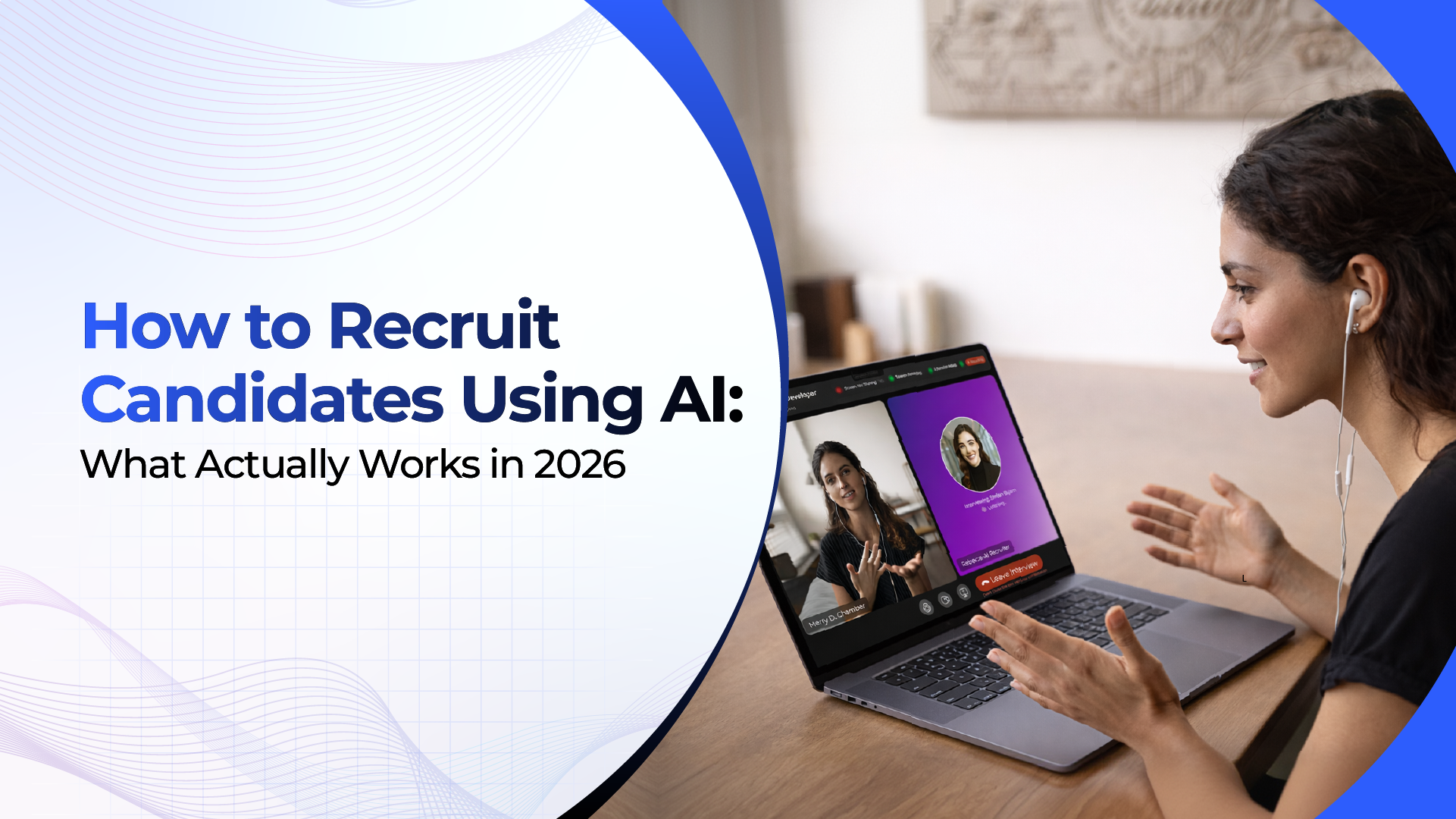
Rebecca AI supports this natively. Dedicated coding assessments run inside the live interview, not as a separate step. Outreach, pre-qualification, technical assessment, and scoring complete in a single flow. The recruiter receives a shortlist of scores.
How is compliance becoming part of the baseline
As these tools become more widely adopted, the regulatory environment is developing quickly. The EU AI Act classifies recruitment as a high-risk use case. Several US states have introduced or passed legislation governing automated hiring decisions. The practical requirements vary by jurisdiction, but the direction is consistent.
Candidates must know when AI is involved in their evaluation. They must have access to their data. Human review must be available. Platforms that treat compliance as an afterthought create risk for the organizations using them.
Rebecca AI operates with consent-first interviews, 30-day data deletion, access and copy rights, human review options, and alignment with SOC 2, HIPAA, and GDPR. These are not feature additions. They are the minimum for operating responsibly in this space.
What the results with AI hiring tool look like in 2026
Organizations using Rebecca AI have reduced time-to-hire by up to 80% and cost-per-hire by up to 60% within the first hiring cycle. In one large-scale staffing deployment, 2,835 candidates were processed, 1,637 passed screening, 515 interviews were scheduled, and zero recruiter involvement was required before the shortlist arrived.
These are Pete & Gabi’s internal deployment figures. They reflect what happens when outreach, screening, interviewing, and scoring run in one automated workflow rather than as sequential manual tasks with handoffs between each stage.
The cost case is straightforward. Recruiter hours spent on first-round screening are hours not spent on candidate relationships, client management, or offer negotiation. Automating the former frees capacity for the latter.
Where human judgment still belongs
None of this is an argument for removing recruiters from the process. It is an argument for moving them further into it.
The early-stage work that consumes most of a recruiter’s week, responding to applications, running first screens, chasing scheduling confirmations, logging notes after calls, is where AI performs most reliably. The later-stage work, reading how a candidate shows up, deciding between two finalists who scored identically, navigating a disagreement with a hiring manager, that work still needs a person.
Organizations that understand this distinction tend to get more from AI recruiting tools than those approaching it as a headcount reduction exercise. The goal is not fewer recruiters. It is recruiters doing better work.
How to get started with AI hiring software
Rebecca AI connects to existing ATS and CRM systems and can begin delivering shortlists within the same week, with no long-term contract and no implementation of the project. The practical starting point is one role type. Pick the requisition where screening volume is highest. Configure job criteria and scoring frameworks. Let the system run one full cycle. Measure time-to-shortlist, candidate drop-off rate, and hiring manager satisfaction against your manual baseline.
Your own data from that first cycle will be more persuasive than any external case study. It is your numbers, on your roles, in your pipeline. That is where the decision usually becomes obvious.
FAQs
What does AI recruiting software actually do?
It automates the repetitive parts of early-stage hiring: reaching out to candidates, screening resumes against role requirements, running structured interviews, scoring responses, and building a shortlist for the recruiter to review. Instead of a recruiter reading hundreds of resumes and scheduling first-round calls one by one, the software handles that first pass and hands off a smaller, ranked group of candidates. Recruiters get more time for judgment calls instead of admin work.
Is AI recruiting only useful for high-volume hiring?
No. High-volume hiring is where the time savings show up most clearly, since the software can screen hundreds or thousands of applicants at once. But smaller teams still benefit: AI tools apply the same scoring criteria to every candidate, which cuts down on inconsistent judgment between interviewers. They also respond to candidates faster, which matters in competitive job markets where slow follow-up costs good candidates. The value scales down even if it’s most visible at scale.
Does AI replace recruiters in 2026?
No. AI handles the repetitive, early-stage work: outreach, first-pass screening, initial interviews. It doesn’t make hiring decisions. Recruiters still own final evaluation, alignment with hiring managers on what the team actually needs, and the judgment calls around culture fit, compensation, and offers. The goal is to remove the manual bottleneck at the top of the funnel, not the recruiter from the process.
What are the best practices for using AI in candidate screening in 2025-2026?
How is candidate quality measured?
Most platforms score candidates against criteria set before the hiring process starts: technical or role-specific skills, communication ability, fit for the role’s actual responsibilities, and the quality of their interview responses. After each interview, the system generates a transcript along with a summary, so recruiters and hiring managers can review the reasoning behind a score, not just the number, and check it themselves.
Is AI interviewing compliant?
It can be, but that depends on how the platform is built and configured. It needs clear candidate consent before an AI interview happens, a human reviewing decisions rather than the AI acting alone, candidates having access to their own data, defined retention rules for interview data and recordings, and configuration that matches the requirements of the jurisdiction where the hiring happens. A platform without these controls isn’t compliant by default, no matter what it claims.