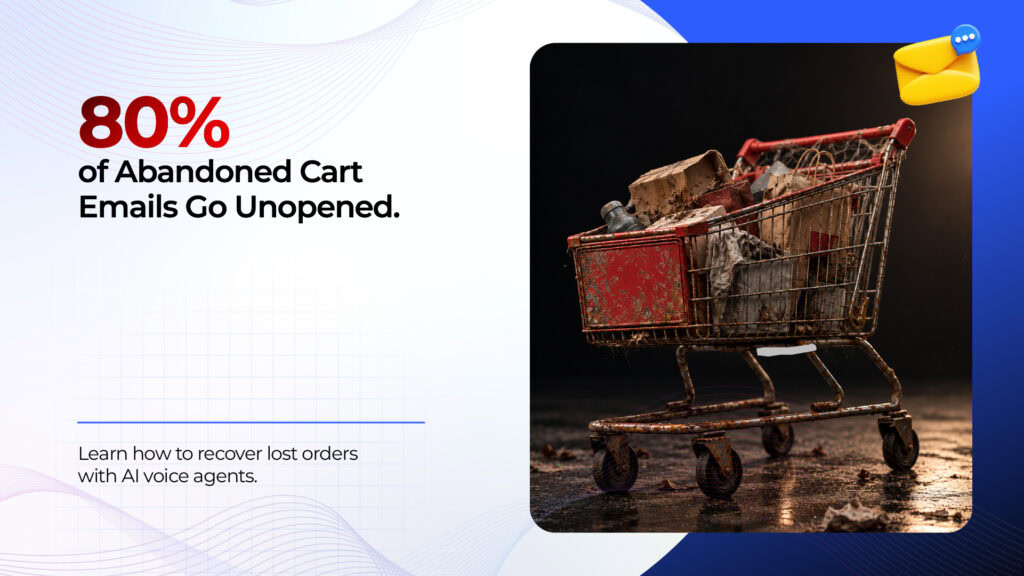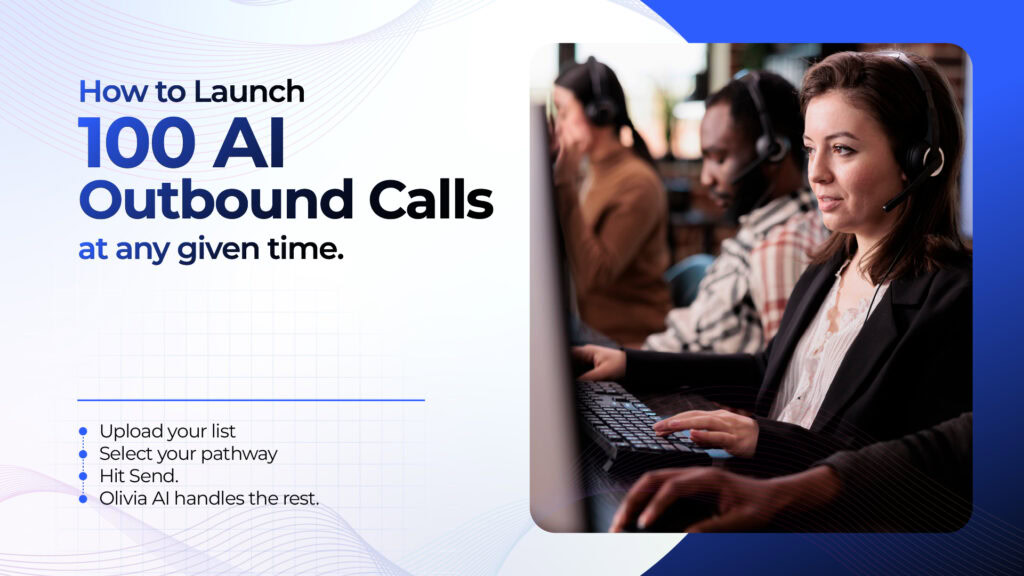

Most of the time spent by sales teams is taken up by administration activities, following up on previous contacts, returning missed calls, and updating CRM. According to Salesforce, 70% of sales representatives’ time is spent on non-sales activities. Therefore, many companies are now looking to utilize AI sales agent software, sales automation software, and AI sales assistants’ tools to pre-qualify, route and re-engage prospects without increasing staff numbers.
While B2B buyers tend to be very fast, sales teams are often slow. AI sales agent assists the buyers by quickly responding, qualifying, updating the CRM, and providing full context of the lead to a human representative. Thus, the value of an AI sales agent software application is not only based on its automation or ability to qualify leads but also provides the ability to respond rapidly and consistently to prospects while effectively using the time of the sales team.
Why does launch speed matter?
Longer times deploying a sales automation software means more potential disruption because of internal review processes, different types of technical dependencies between systems, or ambiguous ownership on behalf of your team. If your team must spend weeks discussing system architecture before making the first call, you are losing the benefits of using AI to provide your sales organization with a competitive advantage.
Expedited deployment also increases how quickly teams will adopt the sales automation software provided by the AI vendor. When teams can see how the software is being used in real time with real conversations booked, and the outcomes successfully entered their CRM, their confidence levels in the use of this type of software will quickly increase as well. The optimal approach is typically a one-use case, one integration method, one short pilot, and then the expansion of the use of the new system to additional functions.
Start with one use case
One way to expedite your go-live process is to determine which single task the AI can be most effective on. Instead of attempting to automate the entire funnel on the first day, concentrate on one Process Flow with a defined goal. Possible workflows to automate include leads that have been cold in the last 3 months, booked appointments with no-shows, or expired or non-active customers who will likely want to renew their contracts with you via phone. Having a single focus for your AI deployment allows you to write scripts more easily, means less set up time before starting to use the AI technology, and establishes the basis for ROI to provide to stakeholders. Additionally, by using a single process workflow, you can quickly develop data and determine how well the AI is performing since the data set will have a smaller sample size.
What to prepare before launch?
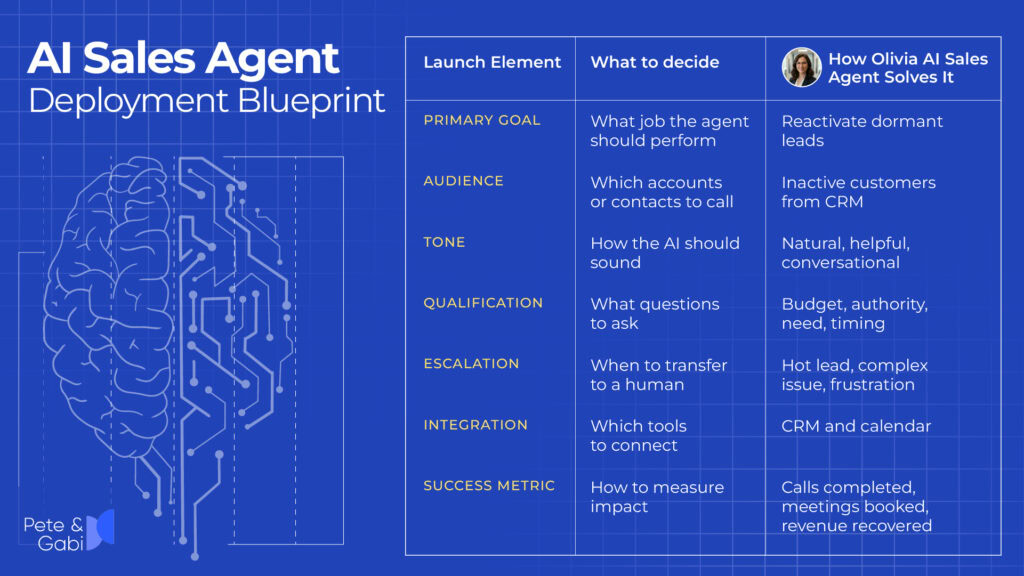
To accomplish this for your sales AI assistant, you will also need to determine if your goal will be qualification, meeting bookings, reactivating customers, upselling or routing leads. These preparation steps take time; therefore, it is important to think about what CRM fields and escalation rules you need to put in place.
AI sales assistant’s workflow demonstrates what these will do for you: give an agent access to scan through CRM data, create a more personalized outreach based on previous account history, ask questions related to the context of the conversation, and hand over qualified leads with full notes included in the record. Your team can continue ongoing conversations without needing to start over with their discovery process; therefore, your handoff will appear much more seamless and allow your sales cycle to be shorter. The more organized you are in terms of your data structure/relationships, the quicker you will launch your project
Typical launch roadmap
Below is an example of how to sequentially roll out an AI sales agent for sales automation as part of an organization’s rollout strategy.
| Phase | What to do | Why it matters |
| Define the use case | Choose one job, such as reactivation, qualification, or follow-up | Keeps the rollout focused and fast |
| Prepare the data | Clean the CRM list, fields, tags, and status values | Prevents bad inputs from slowing the agent |
| Build the conversation | Add questions, objection handling, and escalation rules | Helps the agent sound natural and useful |
| Connect systems | Integrate CRM, calendar, and notifications | Makes handoffs and scheduling automatic |
| Run a pilot | Test with a small segment before full rollout | Surfaces issues early without risk |
| Optimize | Review transcripts, outcomes, and conversion data | Improves performance after launch |
This type of rollout strategy works because initially, the system remains simple, whilst the AI can demonstrate value quickly. Since teams that use Olivia AI are looking for more than just automation, this rollout sequence creates an accelerated pathway to live calling, real-time CRM updates and qualified lead handoffs; that’s why the teams that have adopted Olivia AI quickly tend to show early momentum.
What makes Olivia AI fast to deploy?
Olivia AI is an AI-powered voice-based product that automates conversation sales processes and can help reactivate customers. It does this by engaging in natural conversations with people by performing cold outreach, follow-up, upsell, win back, and qualification of leads. B2B AI sales agent uses data from your company’s CRM to personalize messages, answer objections, classify leads, create meetings, and pass to the sales team where they are at the time of customer interaction.
Since Olivia AI has pre-defined sales workflows, CRM integration, qualifications, and scheduling capabilities built into its platform, any company should be able to deploy the system in less time than it takes to build a system from scratch that would be able to do these functions.
Key Takeaway
To implement a B2B AI sales agent quickly, it is best to look at one specific business issue, one workflow, and one measurable outcome first. Rather than trying to automate the entire sales process at once, there are specific use cases that are common among successful teams such as customer reactivation, lead qualification, and follow-up automation that can be focused on.
State-of-the-art AI Sales Agents can have natural conversations with customers, qualify prospects for their ability to buy, update CRM databases in real-time and do outreach at massive scale. Companies can shorten implementation time, eliminate lengthy development cycles, and get pipelines generated, and revenue recovered much sooner by taking advantage of platforms that come with pre-built sales workflows and integrations.
FAQs
What exactly is an AI sales agent and how does it differ from a chatbot?
A sales AI is an artificial intelligence sales representative that can do all sales tasks such as qualifying leads, following up with leads, booking appointments, and updating the CRM records. Olivia AI takes it to the next level by conducting true sales conversations (i.e., human-like), managing objections, and transferring qualified leads to human representatives with the context around the opportunity.
How long does it take to deploy an AI sales rep?
The time frame for a successful implementation varies greatly due to the complexity of the CRM, work scripts, and the need for internal sign-off. The quickest way to get rolling with the software is to first roll out one narrow process as a pilot project, then build upon the value of it over time to implement additional processes.
Will an AI sales assistant replace my human sales team?
The most likely to be successful will be using Olivia AI as an augmentation tool rather than as a replacement for people performing repetitive tasks, allowing them to focus on closing deals, creating relationships, and negotiating complex business transactions. This type of division of labor typically results in more productivity overall instead of removing people from the workforce entirely.
What does AI sales agent software typically cost?
Pricing is based on the features you want to use, how often you plan to use them, and the number of calls you expect to make. Companies such as Vodex.ai have plans starting at approximately $100 per month, while Voiceflow has paid plans that begin around $60 each month for each editor, and SalesAPE.ai has reported their pricing terms as beginning at close to $999. Olivia AI will provide custom pricing based on your company’s requirements, the complexity of the workflow, and the size of your company.
How do conversational AI sales tools handle GDPR compliance?
GDPR compliance has been aided by the implementation of multiple features, including consent tracking, opt-out management, access controls on personal data, secure data storage, and logging activity. Among the most effective methods of achieving compliance include accurately documenting consent receipts, honoring customer opt-outs, controlling how often a potential customer is contacted, and making sure that you have thoroughly checked the compliance and security features of your platform before it is used.
How do I measure success from an AI sales agent?
In addition to analyzing whether operational metrics such as the number of completed calls, response rates, lead qualification rates, number of meetings scheduled and CRM updates have all been successfully recorded, you should connect all these metrics to revenue impacts as well. Some of the measured operational metrics were rapid call volume, improved transfer quality, and the ability to recover lost revenue through reactivation workflows.