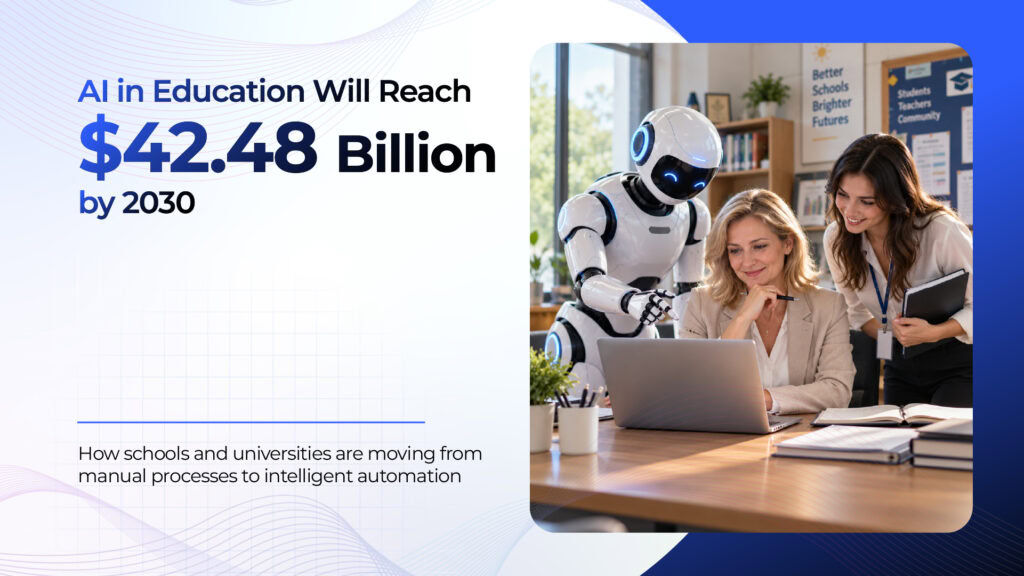
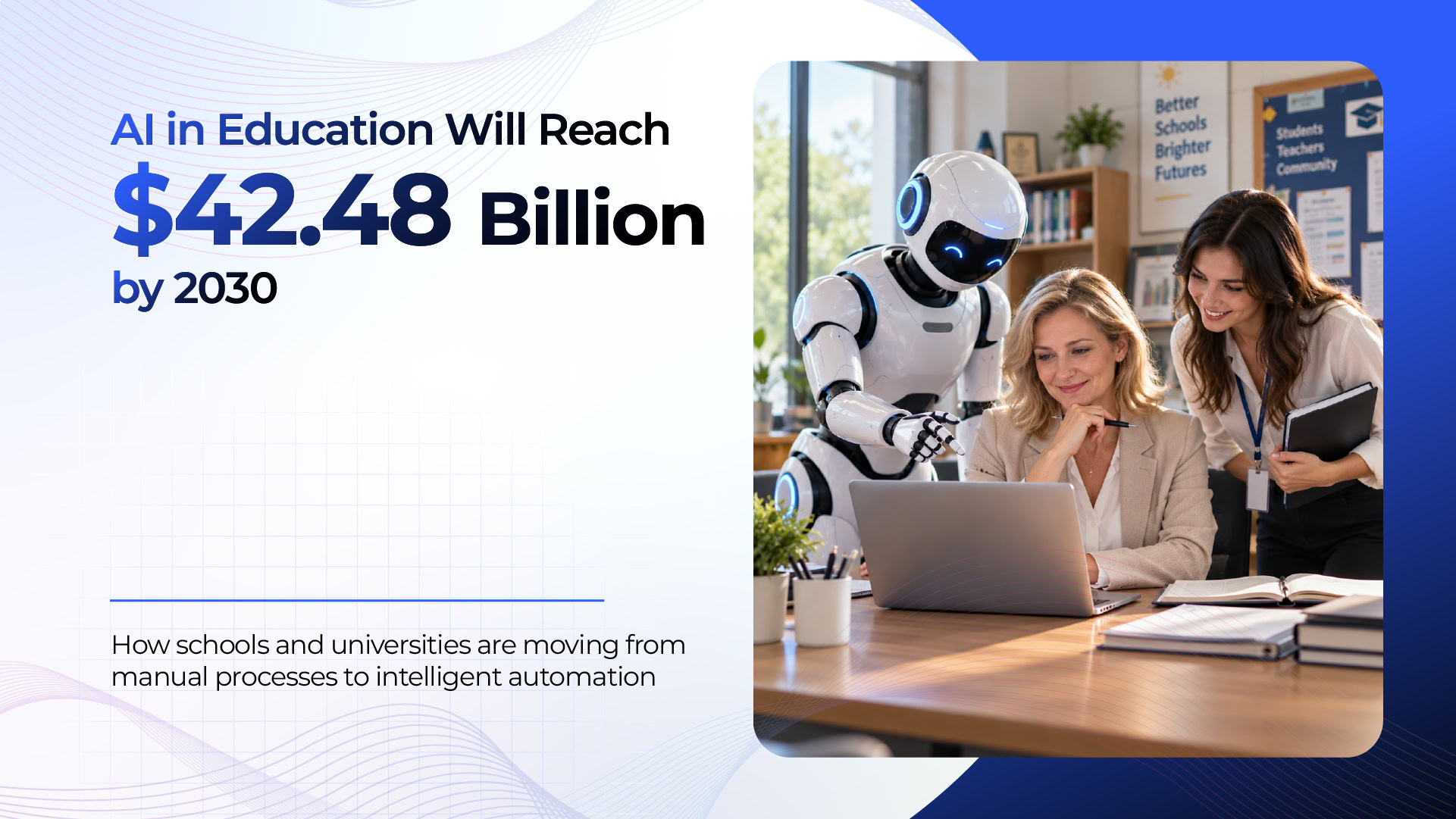
Educational administration is undergoing a significant transformation as schools and colleges increasingly adopt artificial intelligence to streamline operations. With the AI in education market projected to reach $42.48 billion by 2030, institutions are recognizing the growing role of AI in managing administrative tasks, from admissions processing and student inquiries to scheduling and record management. This shift reflects a broader move toward intelligent automation, helping educational institutions reduce manual workloads, improve efficiency, and make better use of their resources.
The integration of AI in education plays a crucial role in the optimization of the processes that have long been considered cumbersome and inefficient in educational institutions. Educational managers want to keep up with the changing number of students and limited resources and try to apply artificial intelligence in education to their management and administration systems.
The benefits of AI and education are extending well beyond the classroom, creating more agile, cost-effective, and responsive institutions.
The Administrative Challenge
The complexity of educational institutions means that they usually have to deal with large numbers of students, faculty, and numerous operational facts. Dependence on old systems based on paper and siloed digital technologies leads to various performance issues. Manual data entry takes time and is prone to mistakes while paper documents are difficult to use in data analysis. The result of these outdated processes is an increase in labor costs, and even more importantly, a slowdown in response time affecting the level of student satisfaction and enrollment.
The solution to these problems lies in the application of education AI. The fundamental idea behind it is that the use of intelligent automation will facilitate the integration of this type of technology into daily operations within schools and universities to achieve a decrease in administrative costs and improvement of data quality.
Automating Core Administrative Workflows
The applications of AI for administrative automation are extensive, touching almost every functional area of a campus.
1. Admissions and Enrollment Management
The admissions procedure has one of the highest resource demands in educational institutions. With admissions teams confronted with a flood of applications that include academic records, standardized test scores, letters of recommendation, and essays, it is always a challenge for them to deal with applications in an efficient manner. With AI for educators, it is possible to equip the admissions department with very effective tools that can automatically sort the incoming requests, gather essential data, and confirm all required documents.
NLP is a great technology that helps them screen application essays and personal statements for various themes or sentiments, offering admissions staff an opportunity to receive helpful evaluations. In addition to that, AI-based chatbots handle a huge number of applicants’ queries about the deadlines, necessary documentation, and other aspects of campus life that enable the staff to focus on cases that require more thorough analysis.
2. Marketing and Financial Aid
The introduction of AI makes it possible for organizations to optimize their marketing strategies and precisely define the potential applicants. By the analysis of historical data concerning the applicants’ genders, interests, and engagement, companies can quickly adjust to marketing strategies. Accordingly, such a high level of customization in terms of marketing messages helps to increase enrollment rates.
Built on AI technologies, companies can be innovative in processing huge volumes of financial data, thus identifying potential applicants and issuing funds. Such automation facilitates the application of rules and helps to make fund usage much safer with fewer chances for frauds and mistakes.
3. Curriculum and Scheduling Operations
Course scheduling is one of the challenging jobs of every registrar. Using AI, these systems anticipate what students will want, faculty available, and what demand will be for facility resources to create perfect schedules. It saves time, cuts down on scheduling errors, and saves much-needed administrative resources.
In addition to this, education AI can help institutions see emerging trends in course demands, that puts them in a position to predict their faculty and resource needs for the future. This results in overall better utilization of resources, making life easier for students and professors, as well.
AI and Education: The Operational Comparison
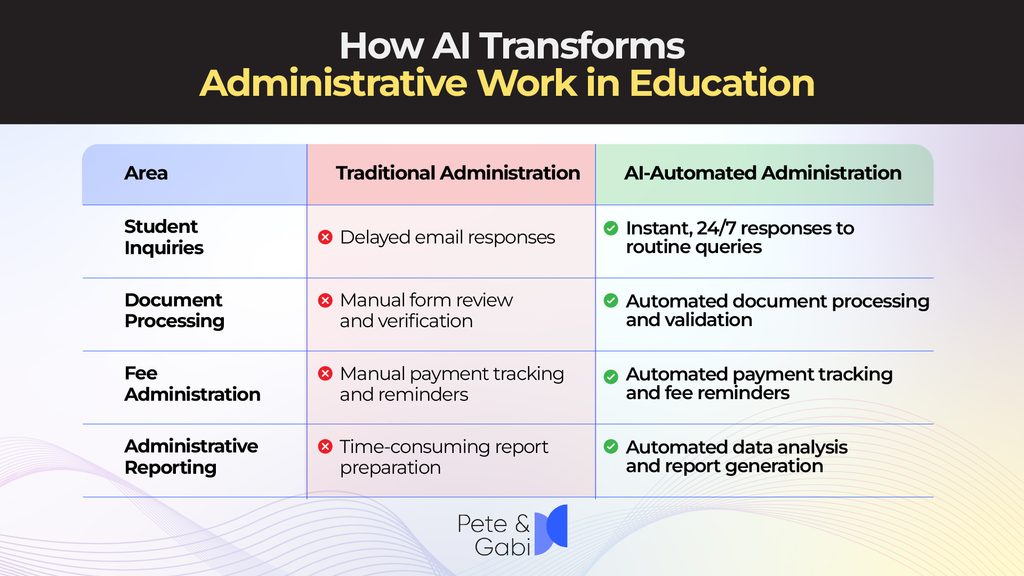
Switching from manual administration to automatic AI administration helps educational institutions cut down on administrative workload, speed up response time to inquiries, and streamline operations. The schedule below compares traditional approaches with the AI methods of administration by the following important aspects, such as student data processing, inquiry processing, and entrance data processing, to demonstrate how AI can help institutions with their work.
The Future of Education Administration Is Automated
Using AI in education for administration is no longer a luxury but an operational imperative. Indeed, the substantial expected investment in 2026 shows that organizations today understand the importance of the focus on AI and education for their operational stability and financial viability. AI for educators allows taking care of tedious and repetitive tasks, enabling them to concentrate on other more demanding tasks such as student counseling and strategic planning.
The time of manual, paper-based administration has come to an end. Colleges and universities now utilizing education AI are able to become lean, flexible, and student-oriented educational institutions. Thus, there is no ambiguity about the future, and educational management should now shift from a rear process to agile, intelligent, and scalable digital processes.
Frequently Asked Questions
1. Is AI meant to replace human administrators or educators?
Certainly not. Education-focused AI systems aim at increasing efficiency, as well as performing automating and enhancing activities. Education systems pursue automation of tedious tasks such as data entry, scheduling, and typical correspondence. The main objective of AI for educators is to exploit it to support the already existing personnel rather than get rid of them.
2. How will AI impact the faculty experience?
The essence of such technology is to make back-office support easier and help faculty members by lowering their workload. Tasks like complex scheduling or resource allocation become uncomplicated and thus less frustrating. AI and educational technology systems give professors better data and predictive analytics about educational requirements of students that help higher education personnel modify their curriculum or plan their resources beforehand.
3. What about data privacy and security when using artificial intelligence in education for sensitive student records?
The importance of data privacy cannot be overstated. As a result, responsible education ai solutions are implemented with strict security practices such as advanced encryption, multi-factors authentication, and strict controls on access. In addition, any widely acknowledged AI education solution company must comply strictly with strict regulations on the protection of privacy such as FERPA in the USA or GDPR in Europe in the processing of student data and information.
4. How long does a typical implementation of AI administrative automation take?
As regards timelines, these may differ based on the complexity of any institution, but little pilots such as sorting of admissions or implementation of AI-powered chatbots may take as little as 3-6 months maximum. Comprehensive implementation of AI across the systems in a big institution may take as long as 1-2 years. The best way to start is to work in this field on areas that have little complexity but promise maximum results of engagement.
5. How will students directly notice a difference with AI-automated administrative work?
Education-enabled AI will make it possible for students to be able to have their queries resolved much faster, process requests more accurately, and have all the information they need at any time. Institutions with AI tools are much more student-oriented, that gets rid of the need to wait days or even weeks to get answers to the often-asked questions of students.