A few years ago, the notion of “developing an AI calling agent“ was that of a simple project to be completed in a weekend: simply connect a language model to a phone line, enter the appropriate prompts, and let the agent interact with clients. However, in reality, companies that attempted this have realized the hard way how wrong they were: while creating the agent that knows certain phrases was easy part, making sure the agent is operational every time it is needed and properly connected to the existing systems is what complicates the process.
This disparity is exactly the reason why organizations are moving away from developing and commissioning their own AI agents and are opting for managed AI agents that allow for workflow design and deployment, as well as content improvement and integration done by experts rather than performing all the tasks in-house.
1. Building an AI Calling Agent Is Only the Beginning
If you talk to any organization that made an AI calling system from ground zero, you will hear the same thing: the agent is not the difficult part of the process, but everything surrounding it.
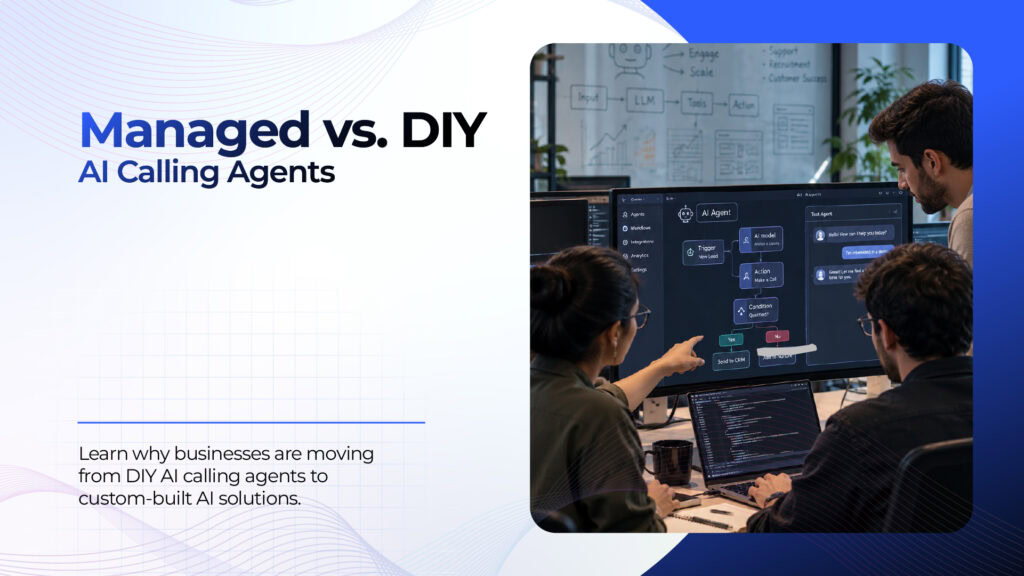
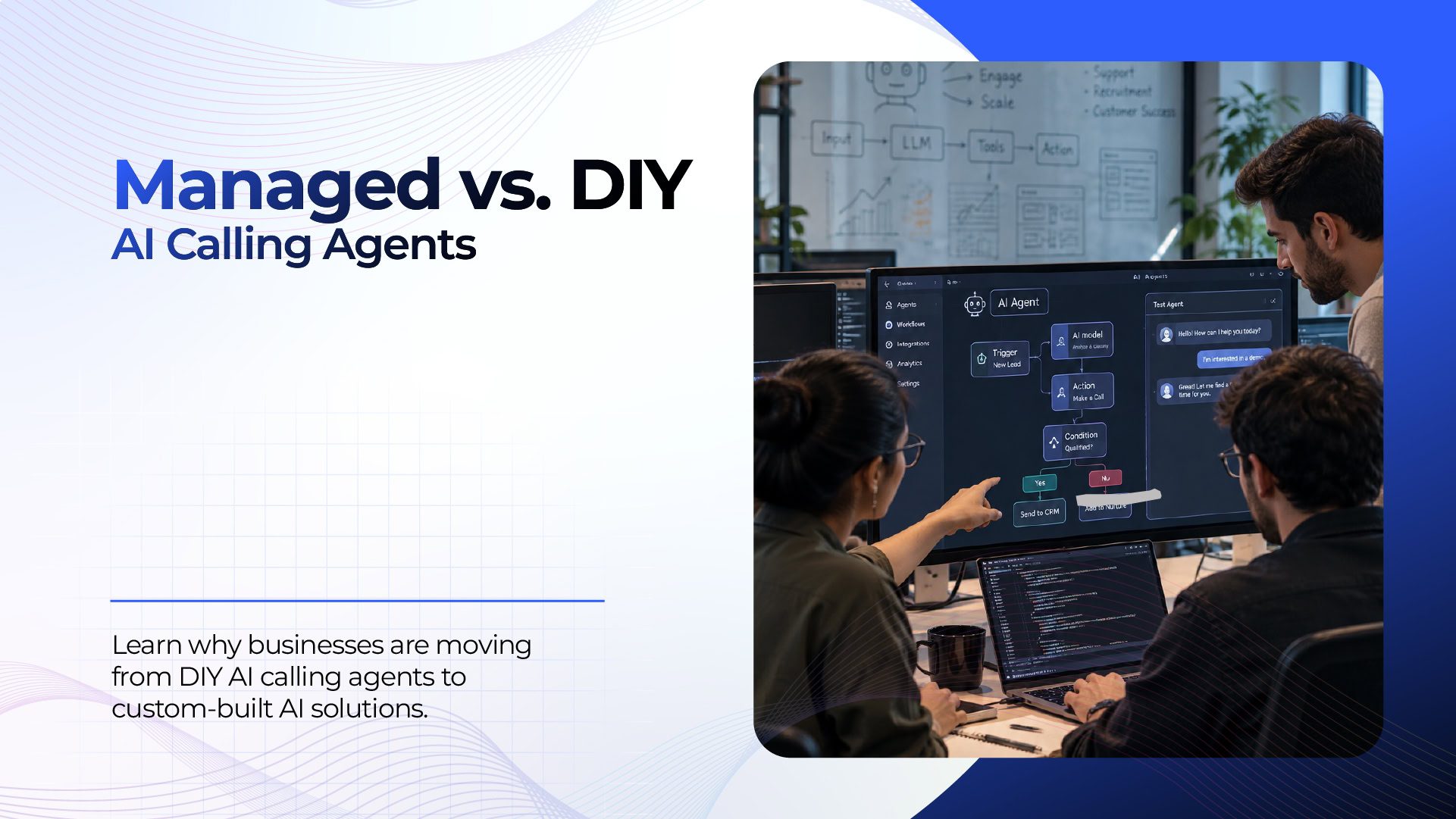
Just an AI calling agent will not make it work properly. The AI calling workflow needs to be able to hold conversations that include different types of real-life conversation: interruptions, unexpected replies, silence, objections, and non-scripte `d requests. In addition to that, proper integrations with CRM software are necessary if you want the outcomes of the calls to be saved so that the sales or support team members can know about it. Moreover, it is important to create means for routing calls, logging information, waiting for follow-ups, and/or transferring calls to the human agent.
After that, it becomes necessary to move to testing, more like dozens of different types of tests carried out with different customers in mind, to confirm customer satisfaction. From testing, the process follows monitoring activities and proceeds with a regular review of results of customer calls, identifying the most typical failure points, and checking instances when agents gave wrong answers to questions of clients. Last comes maintenance, that involves adjustments to existing scripts with the introduction of new prices, newly launched products, changes in compliance policy, and other improvements.
To sum up, the creation of the agent does not mean completion of all the work. It explains the fact that AI-based process automation is being perceived in most successful companies as a never-ending initiative instead of one-time work.
2. DIY AI Calling: When Does It Make Sense?
In many cases, DIY AI calling agents can be a good solution for different companies. In respectful companies with professional developers, expertise in machine learning, and ability to maintain a system in the long term, it can be a great idea for building custom-made AI agents. In addition, it will be good when companies have specific tasks which cannot be resolved with off-the-shelf products.
However, even in this best scenario, time and technological efforts are considerable and underestimated. As a result, the development of a good AI calling agent includes such things as:
- Developing logic of conversations for all possible flows in the call
- Connecting the technologies of speech-to-text, text-to-speech and language model together into a common system
- Constructing and supporting CRM and telephony integrations
- Creating monitoring dashboards to warn company about failures before clients notice it
- Conducting ongoing quality check if the company becomes bigger
- Appointing someone to support system all the time and not just during the launch
When a team is required to assign a couple of developers to the task for several months, with the expectation of continuing spending time on maintenance to adjust the program whenever required, everything turns into a continuous engineering process. Such an agreement can be considered quite justified for a big hi-tech company, but for most companies, it’s a much more serious issue than it may seem.
3. What If You Don’t Have the Right Technical Team?
Here’s the more common situation: a business knows exactly what it wants an AI calling agent to do. It can clearly stipulate what it wants the agent to do: “qualify a certain type of lead,” “follow up the clients that have abandoned a quote,” “set up appointments and confirm them.” What the business cannot do is to find a developer who would implement this process and create an AI calling agent.
This is where the real gap in the domain of DIY lies. It is not about ambition or vision, for most businesses know their ideal workflow inside and out. It is about implementation – do you have to hire a developer to create the AI calling agent? Well, the answer is yes, not only to create it but also to continuously update it when anything goes wrong or when the call flow changes.
Finding a skilled employee in this domain is not an easy task, and it often overlaps with something else. Projects are abandoned, tools that do not fit the specific company requirements are purchased and attempts to create a solution from scratch are made.

4. What Does a Managed AI Agent Handle?
Instead of a company developing and managing every piece of the system, a managed AI agent company does all the heavy lifting while the company specifies its requirements. The company’s processes (steps taken to qualify for the leads, appointment logic, follow-up schedule) are translated into a conversational flow suitable for the AI agent to follow.
A managed approach typically covers:
Workflow design: Steps taken to qualify the leads, appointment logic, follow-up schedule are translated into a conversational flow suitable for the AI agent to follow.
CRM and other integrations: Connected with the existing technology (CRM, calendars, scheduling, support tools) to ensure automated transfer of data.
Deployment and testing: Launched, tested in real life, and all bugs are identified before they reach the customer.
Monitoring and optimization. The data about the calls is processed, issues are detected, and the scripts are revised based on the performance of the agent.
Ongoing workflow changes: Updated in case of any changes in pricing, offers, compliance rules, or the possibilities of the business without requiring it to deal with programming.
In essence, a managed AI agent makes “create an AI calling system” into “explain your wishes and allow us to make it a success.” The client can handle the strategy and the process, while the service provider is responsible for the technical implementation and maintenance.
5. Managed AI Calling Without Enterprise-Level Complexity
It is often thought that managed AI services are only accessible to big companies with huge budgets; however, this is no longer true because they free small and middle-sized companies from the necessity to hire their own tech team and make a large investment into infrastructure at the very beginning.
Compare the two paths side by side:
DIY AI Calling: Whether you hire or relocate developers, create and test up the pipeline, install integrations, keep track of operations, or manage any updates to come afterward may take a good deal of money in terms of salaries, time, and missed opportunities long before the agent gets its first real call.
Managed AI Agent: Only need to define the use case, analyze the process provided, launch it, and let the vendor take care of everything else. It combines testing, monitoring, and upgrades, as the costs will be based on the use of the service and not on the number of employees or infrastructure costs.
For the majority of businesses, this option enables them to obtain an effective AI calling agent faster and for less money. Complexity doesn’t disappear; it is simply passed to a group assigned to take care of it.
6. Olivia AI: When You Know What You Want the Agent to Do
Olivia AI is specifically designed for companies that understand their processes but have no interest in becoming AI developers.
Olivia AI eliminates the need for companies to create conversation flows, coordinate and maintain integrations, or handle the technical platform. Instead, it starts off by considering the company’s processes and performing the required technical tasks.
In practice, that looks like:
- Lead qualification: Olivia AI calls new leads, asks the right screening questions, and routes qualified prospects to the sales team.
- Customer reactivation: Reaching out to dormant customers with a natural, on-brand conversation designed to re-engage them.
- Appointment booking: Scheduling, confirming, and rescheduling appointments directly against a connected calendar.
- Follow-ups: Checking in after a quote, a missed call, or an initial conversation, without relying on someone remembering to make the call.
- CRM updates: Logging call outcomes and next steps automatically, so sales and support teams always have accurate, up-to-date records.
Hence, companies are responsible for telling Olivia AI what they need in their voice, tone, and goal. Olivia AI is responsible for figuring out how to perform these tasks.
7. Build It Yourself or Let a Managed AI Team Handle It?
Boiled down, the decision comes down to five factors:
| Factor | DIY AI Agents | Managed AI Agents |
| Technical expertise required | High, in-house developers’/AI skills needed | Low, business defines the process, provider builds it |
| Time to launch | Weeks to months | Typically, much faster |
| Cost structure | Upfront plus ongoing engineering cost | Usage/service-based, no infrastructure investment |
| Complexity handled by | Your team, indefinitely | The managed provider’s team |
| Ongoing management | Falls on internal staff | Included as part of the service |
There is not always one path that is better than the other. Companies with well-developed internal AI skillset may choose to create AI agents from scratch in case they have specific complicated tasks. But most companies which know what they want AI agents to do, have no possibility to create this technology sphere on their own; the choice of managed AI agents is more beneficial.
That’s the real reason for the shift. It’s not that DIY is impossible. On the contrary, managed AI agents are the best solution to get the results businesses need.
FAQs
1. Is a managed AI calling agent more expensive than building one myself?
Generally no. The costs of doing it yourself include programmer wages or contracting fees, as well as recurring expenses for updates and testing. Managed AI agents normally charge on the basis of usage, and no infrastructure and development costs are involved.
2. Do I need technical knowledge to use a managed AI agent like Olivia AI?
No. You supply the business process and objectives. The provider deals with the creation of workflows, as well as various issues, such as integrations, setups, testing, and optimization.
3. Can a managed AI agent connect to my existing CRM?
Yes. Normally, the integration of the CRM and various tools is part of the managed service, which means that all your customer information and results from calls will be sent automatically without the need to be entered.
4. What happens if I need to change how the agent works later?
If you have a managed AI agent service, your scripts, workflows, and logic will be updated by the provider’s specialists as part of the service you receive, so there is no need to have your own developers.
Related Sources