The Problem
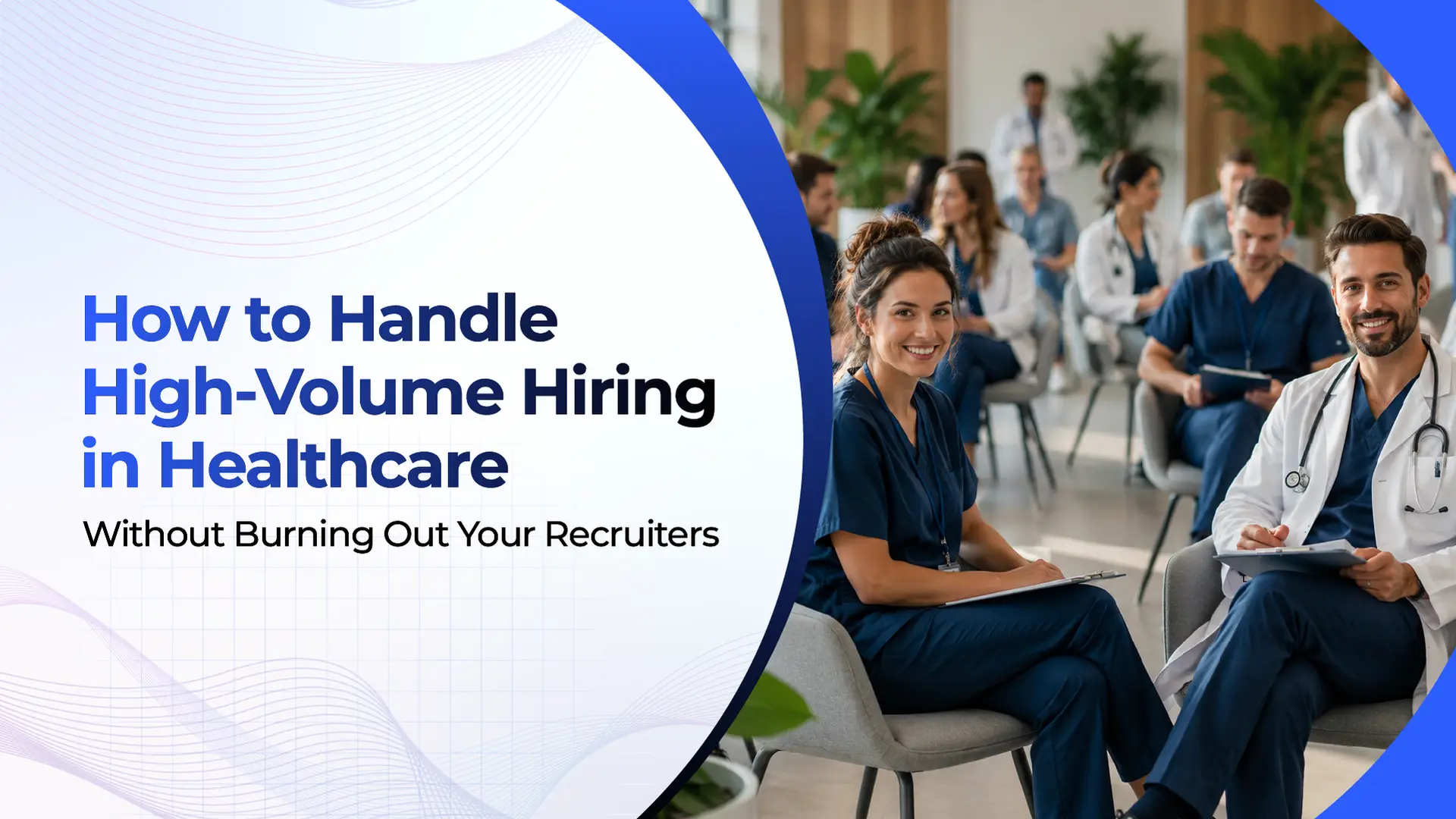
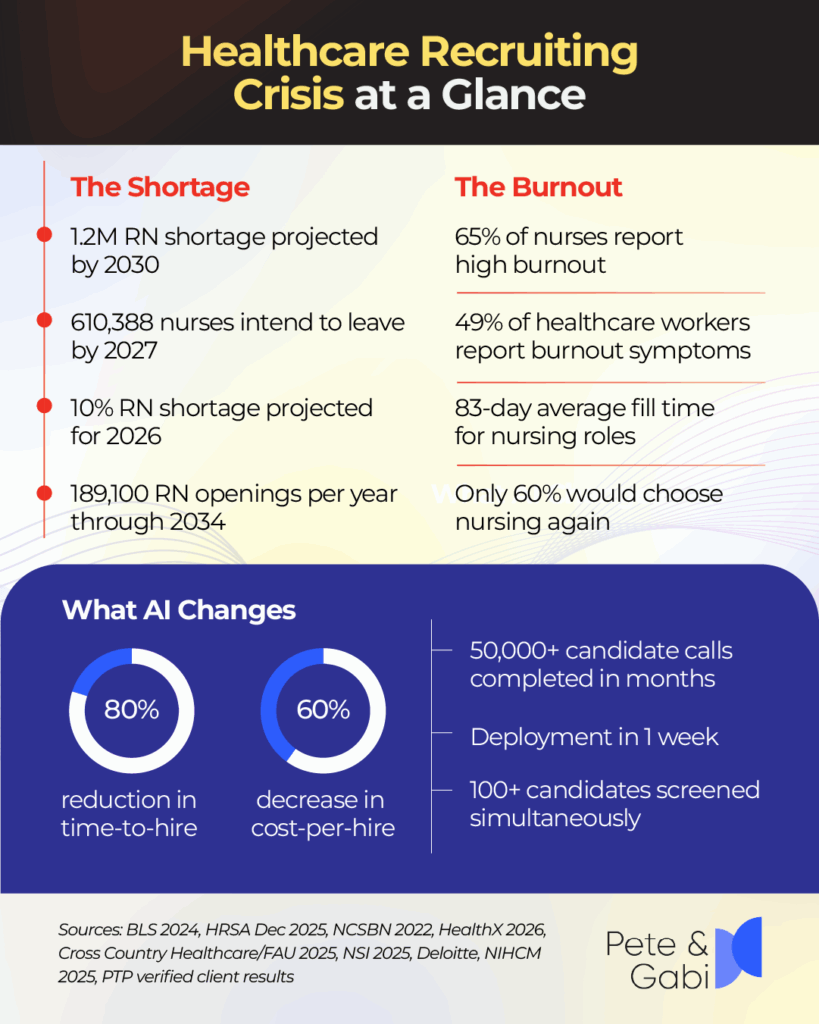
Healthcare recruiting teams are running empty. The Bureau of Labor Statistics projects 189,100 registered nurse (RN) job openings per year through 2034. HRSA’s December 2025 analysis confirms a 10 percent RN shortage and a 20 percent LPN shortage are already here. Over 610,000 nurses have signaled their intention to leave the profession by 2027, according to NCSBN, while Mercer projects that 6.5 million healthcare professionals across all roles will exit the workforce by 2026 with only 1.9 million replacements entering. A recruiter managing 30 to 50 open requisitions fills her day with outreach calls, credential checks, interview scheduling, ATS data entry, and hiring manager follow-ups, and still watches qualified candidates go cold because nobody got back to them in time. The National Institute for Health Care Management found that 49 percent of healthcare workers reported burnout symptoms in 2025. The recruiting teams responsible for replacing them are running the same race.
How AI Automation Is Changing Healthcare Recruiting
The AHA’s 2026 Health Care Workforce Scan names AI-driven platforms among the most effective interventions available for automating candidate screening in specialized healthcare roles. HireQuest’s 2026 healthcare workforce analysis describes AI as genuinely effective at identifying the best fit for clinical roles at a volume human recruiters cannot match on their own.
The 83-day average fill time for nursing roles documented in the HealthX 2026 Healthcare Hiring Report is not a sourcing problem. Candidates are applying. The lag lives between application and qualified shortlist, in the manual steps that eat recruiter hours without producing a hire. AI automation compresses that window at every stage.
Faster first contact changes for those who get hired.
HealthX data shows healthcare employers who attend career fairs fill nursing positions 40 percent faster than those relying on job boards alone. The variable is the response speed. A nurse who submits an application and receives a call within minutes, rather than days, stays in the conversation. A AI recruiter fires outbound SMS or voice outreach the moment a candidate enters the pipeline, regardless of the time of day or how many other candidates are being contacted simultaneously. Sixty-five percent of nurses report high burnout, and only 60 percent would choose the profession again, according to the Cross-Country Healthcare and FAU 2025 survey of 2,600 nurses. The ones considering a move are not waiting for a callback that arrives 72 hours later.
Automated prequalification removes the threshold work from recruiter calendars.
A first-round screen for a nursing role covers the same ground every time: license status and issuing state, specialty and years of experience, shift availability, compensation range, relocation. These are threshold questions, not judgment calls. An AI voice interviewer handles every one of them at scale, scores the responses in real time, and filters unqualified candidates before a human recruiter spends a single minute on the conversation. The recruiter’s expertise belongs in the second conversation, when the candidate is qualified, and the relationship determines whether the offer is accepted.
Structured AI interviews catch credential problems before they reach the clinical team.
Healthcare placements fail at the credential verification stage more often than hiring managers realize. An expired license or a lapsed certification discovered after two interview rounds represents weeks of effort and a still-open role. Credential questions embedded in an automated prequalification call surface these issues before a human screen ever happens. Fraud detection built into the AI interview layer catches misrepresented credentials and inconsistent candidate responses before they reach a hiring manager with a compliance obligation.
Consistent scoring removes the drift that degrades shortlist quality.
A recruiter who runs 12 phone screens before noon does not evaluate the 12th candidate in the same way she evaluated the first. Fatigue introduces inconsistency, and inconsistency in healthcare hiring has direct patient care implications. An AI interviewer applies the same rubric to every candidate with no variation in tone, pacing, or rigor. Clinical competency, soft skills, and communication quality are scored uniformly. The shortlist that emerges reflects the criteria, not the condition of the person doing the screening.
Around-the-clock availability captures candidates that a 9-to-5 process loses.
Travel nurses, night shift RNs, and per diem staff look at job postings after their shifts end. A nurse finishing a 7pm to 7am rotation who sees an opening at 8am is not available for a recruiter callback at 2pm. An AI hiring system that contacts her within minutes of application, while the role is still top of mind, captures intent that a standard business-hours outreach model cannot reach. Contract labor costs surged from 2 percent to 11 percent of total hospital labor expenses between 2019 and 2022, per Deloitte. Every qualified candidate lost to slow follow-up is a travel contract that shows up on the operating budget.
Freed recruiter time goes to work that requires a human.
When the manual volume layer moves to AI, recruiters stop triaging and start recruiting. They spend their time on second-round interviews with pre-scored, pre-verified candidates. On relationships with clinical hiring managers who trust them because the shortlists are good. On offer negotiations that require reading a candidate’s motivations accurately. On retention conversations that do not happen at all when the team is buried in first-round screens. The NSI National Health Care Retention and RN Staffing Report found 16 percent national RN turnover in 2024, with hospitals hiring roughly 385,000 RNs to backfill exits. The cost of a recruiter who burns out and leaves is layered on top of that.
Where Rebecca AI Fits
Pete & Gabi built Rebecca AI hiring agent for exactly this environment. She is a full-conversation AI recruiter that covers the pipeline from first outreach to ranked shortlist.
When a candidate enters your CRM, Rebecca sends an SMS within minutes. She follows up with a prequalifying voice call that assesses license status, specialty, shift availability, compensation, and relocation. Candidates who meet the role criteria are automatically scheduled for a structured video interview. Rebecca AI hiring tool conducts the interview, scores each candidate in real time across clinical knowledge, soft skills, and communication clarity, and flags fraudulent or inconsistent credentials before the shortlist is built. Your team receives the top five to ten candidates, with full transcripts and scoring breakdowns, ready for a hiring manager’s conversation.
Rebecca AI hiring software tells every candidate from the first word that she is an AI. Candidate Rimple Sethi described the experience this way: it felt more like a conversation than a screening. She never interrupted, let me finish my thoughts, and asked questions just like a real recruiter would.
A medical staffing company needed to build a nursing candidate database at a volume their internal team had no realistic path to reaching. Rebecca AI video interviewer completed over 50,000 candidate calls across a period of months. Their advanced practice department, previously the weakest unit in the company, became the strongest.
Clients have reported an 80 percent reduction in time-to-hire and a 60 percent decrease in cost-per-hire within 90 days. Rebecca integrates with Workday, Bullhorn, and all major ATS platforms via secure API. No manual data entry. No implementation fees. No lock-in contracts. Deployment takes one week.
See Rebecca AI handle your healthcare pipeline.
Over 50,000 candidates call in months. 80% faster time-to-hire. A recruiting team that spends its time on decisions, not data entry. Rebecca AI is living in one week.
Schedule a demo https://www.petegabi.com/schedule-a-demo/
Frequently Asked Questions
What is the average fill time for nursing roles in 2026?
HealthX 2026 Healthcare Hiring Report data puts the average at 83 days. Most of that time sits in the manual steps between application and qualified interview, not in the interview-to-offer stage. AI automation of outreach, prequalification, and first-round screening removes the largest time sinks from that window.
Does AI recruiting work for specialized clinical roles or just high-volume generalist positions?
Rebecca AI is configured with role-specific interview questions and scoring criteria per position. A CCRN placement uses different rubrics than a CNA placement. The system adapts to what the role requires, not to a generic screen applied uniformly across clinical levels.
How does an AI hire assistant handle credential verification for healthcare candidates?
Rebecca AI asks about license type, issuing state, and expiration during the prequalification call. Candidates with expired or inactive credentials are flagged before reaching the human recruiting team. Her patent-pending fraud detection system additionally identifies misrepresented credentials and inconsistent interview responses, which is a growing exposure to high-volume healthcare hiring.
How does AI-assisted recruitment reduce bias in healthcare hiring?
A recruiter running 12 screens before noon does not evaluate the 12th candidate in the same way she evaluated the first. Rebecca AI applies the same rubric, the same tone, and the same scoring criteria to every candidate with no variation. The shortlist that results reflect the role requirements rather than the condition of the person doing the screening at that moment in the day.
What results have healthcare organizations reported with AI automation?
Clients report an 80 percent reduction in time-to-hire and a 60 percent decrease in cost-per-hire within 90 days of deployment. A medical staffing company completed over 50,000 candidate calls across a period of months using Rebecca, a volume that would have taken six months or more of manual recruiting. Their advanced practice department became the highest-performing unit in the company.
Is 24/7 availability relevant in healthcare recruiting?
More than in most other industries. Travel nurses and night shift RNs have their most available time outside standard business hours. A nurse finishing a 12-hour overnight shift who sees an opening at 8am is not reachable at 2pm. Rebecca contacts candidates within minutes of application regardless of when that application arrives, which is where the 40 percent faster fill time advantage documented by HealthX actually comes from: response speed, not sourcing volume.
How long does AI automation take to deploy?
One week. Rebecca integrates with Workday, Bullhorn, and all major ATS platforms via secure API. No coding is required. No implementation fee applies. Most healthcare recruiting teams begin screening candidates within days of going live.
Sources
- Bureau of Labor Statistics, Registered Nurse Occupational Outlook 2024 to 2034
- HRSA National Center for Health Workforce Analysis, December 2025
- NCSBN 2022 National Nursing Workforce Study
- Cross Country Healthcare and FAU Beyond the Bedside Survey 2025, 2,600 nurses surveyed
- National Institute for Health Care Management 2025
- NSI National Health Care Retention and RN Staffing Report 2025
- Mercer workforce projection, cited in 3B Healthcare 2025 analysis
- Deloitte hospital labor cost analysis 2019 to 2022
- HealthX 2026 Healthcare Hiring Report
- American Hospital Association 2026 Health Care Workforce Scan
- HireQuest Healthcare Workforce Trends 2026