
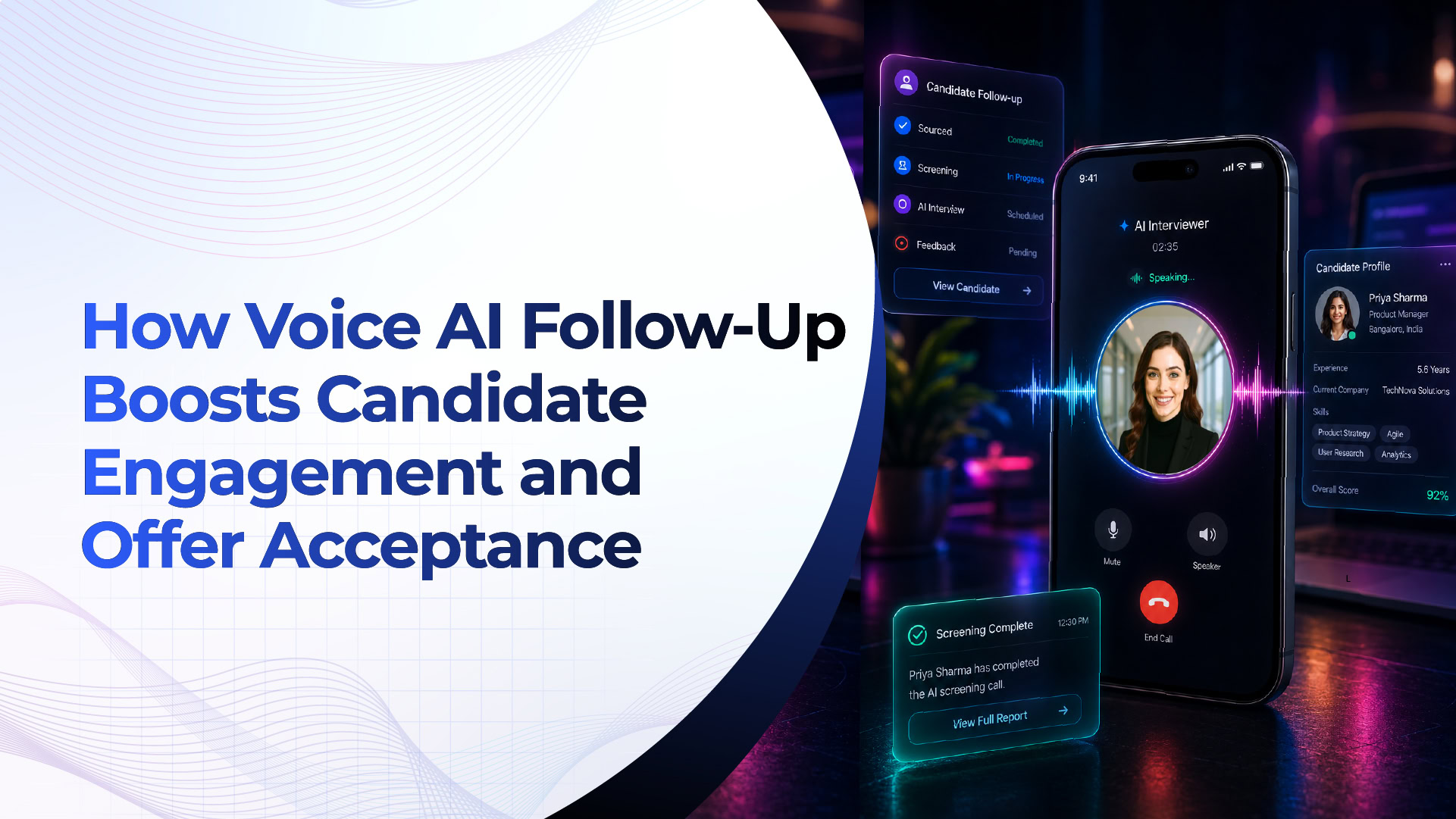
Within the vast majority of recruiting pipelines, a quiet disaster is taking place that often goes unnoticed. Employers have invested thousands of dollars into sourcing quality candidates, creating a job description, and developing an employer brand but somewhere between applying for the job and receiving the job offer letter, a top candidate goes unfulfilled. What causes this?
Silence, delayed follow-up, and inconsistent communication create friction between the candidate experience and the employer brand creating a scenario where the great candidate accepts another offer before the company even calls them.
Voice AI has the ability to change all of this. And it has a surprising level of humanity.
The Engagement Gap Nobody Talks About
For a long time, recruitment teams have recognized the fact that speed is important when it comes to attracting talent. In today’s fast-moving employment market, however, the importance of speed is no longer something that can be negotiated. Numerous studies indicate that candidates who have an interview will become engaged with an organization if they hear from the recruiter within 24 hours of completing the interview and ultimately accept offers at a much higher rate than those that do not hear back within that same time period.
As a result of these circumstances, there are many warm talent candidates who fall out of the candidate pipeline at a very slow pace simply because the recruiter didn’t respond to them quickly enough.
Why Voice Beats Text When It Comes to Candidates
Before we explore what, AI can accomplish, let’s talk a little about the compelling reasons why candidates are more engaged through voice than they are through text during the recruiting process. Clearly, a candidate will feel that their time was appreciated when they receive an immediate follow-up after an interview in the form of a voice telephone call versus an email or an automated SMS. There’s simply no substitute for the emotional connection that a voice follow-up represents. Consequently, a candidate will feel appreciated and engaged with the overall process, which will likely lead to an increased level of response, as well as a greater degree of attachment to the recruiting process.
What Voice AI Actually Does in the Follow-Up Stage
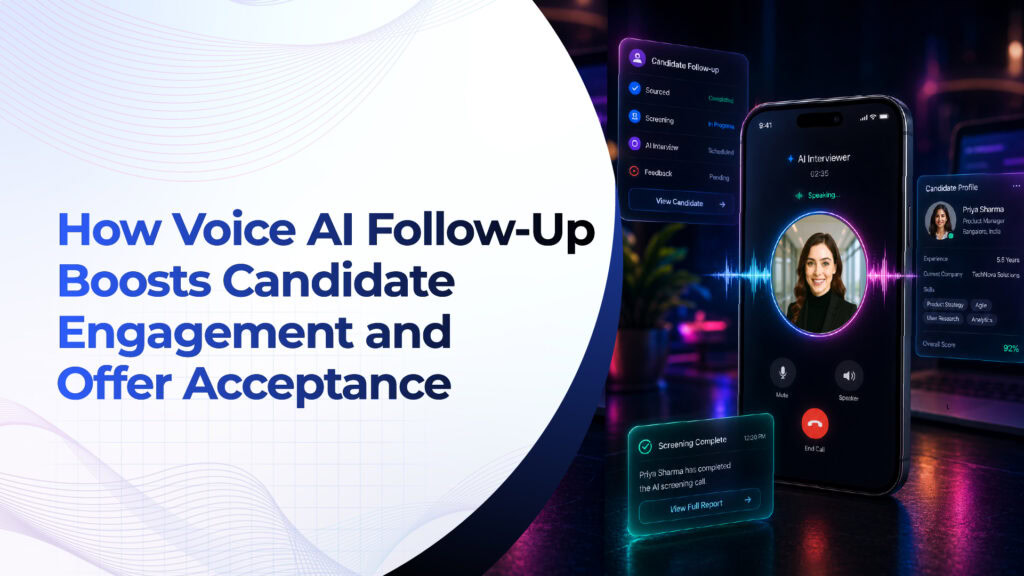
In recent years, evolution in Voice AI technology have allowed recruitment to automate many of the follow-up activities formerly requiring direct recruiter involvement, including immediate post-interview acknowledgement calls, screening clarification calls, next steps briefing calls, availability confirmation calls and even preliminary offer stage check-in calls.
The primary distinction between legacy automated systems and newer generation of voice AI is the incorporation of conversational definition into the voice AI user interface. In contrast to older automated voice systems, where the only function of the telephone interface is to read a script, newer voice AI systems can actively listen to, adjust to and provide context around exactly what the candidate says during their interaction with the voice AI system. For instance, if the candidate asks about the timing of a follow up call, the voice AI can provide the candidate with a tangible expected date rather than a vague “we’ll be in touch.”
The Follow-Up Timeline: Why Hours Matter More Than Days
Candidate excitement is short-lived, according to one of the key insights of recruiting today. A candidate can lose their excitement within 48 hours of having completed a first-round interview if they do not hear from someone about what to expect next. By the fifth day, a large majority of candidates have moved mentally.
Voice AI significantly reduces the delay in following up with candidates. With a voice AI solution, the interviewer can follow up with the candidate only a few hours after the interview to reaffirm the positive experience of the interview, to maintain a warm connection and to request any additional information needed to expedite their decision-making process.
The Consistency Factor: Same Experience, Every Candidate
One of the less acknowledged benefits offered by using voice AI to conduct follow-up is that results are provided to all candidates in a consistent manner. Unlike traditional recruiters who will treat each candidate differently depending on who is currently performing the follow-up based on how busy they are and/or how their day has gone, all candidates will receive equally useful reach-outs (updates).
This makes two potential issues, one being an inconsistency in the way each candidate feels about their overall interaction with the company and therefore create a more objective and fairer recruitment process, and second that the ability to optimize follow-ups for your company will not exist because the quality of a company’s follow-up will essentially be random.
With the use of voice AI, both of these issues can be resolved. All candidates will receive a follow-up of equal quality every time within the same period, and each of the follow-ups will include the same key pieces of information.
How Rebecca AI Does This at Scale
When Rebecca AI, an AI voice recruiter built by Pete & Gabi finishes conducting a first round interview, recruiters have their follow-up ready to go. Reports, including fit ratings, transcripts and scoring data are created on the day of the interview itself so that recruiters can conduct their follow-up conversations with candidates quickly and with context that would have otherwise needed to be reconstructed from notes or recollection.
Candidates who have interviewed with Rebecca AI have found it to be a noteworthy experience because, as one candidate put it, “she didn’t interrupt me, she let me finish my thoughts and she asked me questions as a real person would when being interviewed for a job.” The fact that candidates experience voice AI follow-up as a genuine listening experience (rather than just an automatic process) helps to explain why it is effective. It is not only quick; it also has a feeling of being thought through.
Because Rebecca AI operates 24 hours a day, 7 days a week, across all time zones and regions of the world, candidates with different time zones or unconventional work hours like finishing an interview at 10 p.m. on Tuesday vs. finishing at 2 p.m. on Wednesday, receive equal levels of service.
Voice AI (Rebecca AI) Follow-Up vs. Traditional Follow-Up: A Comparison
| Factor | Traditional Follow-Up | Rebecca AI Follow-Up |
| Response Time | 1–5 business days | Same day or within hours |
| Availability | Business hours only | 24/7, any time zone |
| Consistency | Varies by recruiter | Standardized every time |
| Personalization | Dependent on recruiter knowledge | Role- and resume-aware responses |
| Scale | Limited by team size | Unlimited parallel conversations |
| Candidate Experience Score | Inconsistent | Reliably high (9.8/10 in Rebecca AI deployments) |
| Bias Risk | Present (tired Friday effect) | Reduced through structured scoring |
| Cost per Interaction | High (recruiter time) | Significantly lower |
| Data Capture | Manual notes | Auto transcribed and synced to ATS |
The Candidate Experience Is Now a Competitive Advantage
With so much competition in the job market today, more than ever, candidates are looking for companies with quality recruitment processes as part of their total experience with a company. When companies treat candidates respectfully, communicate consistently, follow through quickly, and place intentionality behind their engagement with candidates, they generate a favorable reputation that will lead to larger numbers of higher quality candidates attracted to the company over time.
AI recruiting automation tools can provide the experience level of an enterprise employer with a solid hiring process and recruitment system across all their locations, using an automation platform that leverages knowledge from its database.
The cumulative benefit derived from improved candidate experience results in increased acceptance rates by candidates. Increased acceptance rates lead to improved workforce quality, which produces improved business results. Improved business results will drive higher-quality candidates to apply for positions during the next hiring cycle.
Improving Offer Acceptance Rates
The line between candidate engagement and offer acceptance is shorter than most recruiting leaders realize. Candidates who feel consistently engaged throughout a hiring process are more likely to accept an offer for three compounding reasons.
First, they’ve built a positive emotional association with the company. Every follow-up that felt timely and thoughtful added to that impression. Second, they’re less likely to have kept aggressively pursuing alternatives, because they believed this process was moving. Third, when the offer arrives, it doesn’t feel like the end of a long, uncertain journey; it feels like the natural conclusion of a process they were already invested in.
Frequently Asked Questions
How does voice AI follow-up actually improve offer acceptance rates?
Voice AI helps to ensure candidates feel emotionally connected with the organization during the application process by providing personalized and timely voice follow-up after each phase of the interview process .This helps to establish a positive association with the organization, and reduces their chances of exploring alternative employment, thus upon receipt of the offer it feels like a natural conclusion of an already established connection rather than a completely random phone call after multiple weeks of no contact.
Which types of roles benefit most from voice AI follow-up in the recruiting process?
Voice AI follow-ups have the greatest impact on positions with high levels of applications and very competitive labor markets. The technology fields, engineering, finance, healthcare, and logistics have many of the same characteristics of high application rates and equal competition among potential candidate pools. This is especially true for positions in which the speed of hiring is of utmost importance, because some of the best candidates in the disciplines have numerous simultaneous conversations regarding job opportunities.
How does a voice AI system handle follow-up without losing the personal touch candidates expect?
Voice AI systems utilizes conversational intelligence, not scripted automation, in providing interviews for candidates. It reads the resume of each candidate prior to the initial meeting to provide meaningful and role-specific questions. By acting on the candidate’s response in real-time, Rebecca AI provides a much-enhanced conversational experience for each candidate.
What happens to the recruiter’s role when voice AI takes over follow-up and first-round screening?
Instead of wasting time performing the same repetitive tasks every day as a recruiter, you will now have more time to spend on the more complex, strategic work that helps close candidates to hire. In other words, where a recruiter used to spend 3-4 hours a day doing first-round screenings (phone interview), this time will be spent on reviewing the reports generated by the AI, having discussions with hiring managers regarding overall strategy, negotiating offers with candidates, and developing meaningful relationships with the candidates that result in them accepting offers from your company.
How quickly can a team implement voice AI follow-up and see a measurable impact on candidate engagement?
The timing for implementing a specific recruiting platform can vary greatly; however, there are many recruiting platforms that were developed specifically for recruitment and designed for a quick setup/implementation phase, e.g., Rebecca AI. Based on feedback from current customers, many recruiting teams can go from having a platform set up to screening candidates within a week. Most recruiters do see a measurable improvement in candidate engagement during their first hiring cycle because of the significant decrease in time it takes to respond to candidates.