

Eventually, every growing business needs to hire new staff for an expanding team or to fill a vacant role. Without a clear strategy for finding the right candidate, this can be a messy and time-consuming process.
A recruitment process is a systematic approach used by an organization to recruit, assess and hire new employees. A clear process helps hiring managers and recruiters to maintain a consistent candidate hiring experience, save time and stay aligned.
This guide covers the main steps of a standard recruitment pipeline, the key operating principles, and the selection of the most appropriate sourcing methods for your company.
What is recruitment process?
Recruitment process is the systematic process that a company uses to find, recruit, evaluate and employ new staff.
Think of it as the fuel for your recruitment engine. Instead of messy email threads or guessing what the next steps are, recruiters and hiring managers have a clear recruitment process with a shared roadmap.
To make things easier, it’s helpful to know the difference between recruitment and staffing:
-
- Recruitment vs. Hiring: Recruitment is the Top of the Funnel. The aim is to post job ads, communicate with potential candidates and collect applications, answering a simple question: Who wants a job in this company? The applicants are hired as soon as they arrive. It includes the following: interviews, skills assessment, best candidate and offer.
-
- Recruitment vs. Staffing: Staffing is the more comprehensive element. It is responsible for the overall planning of the team, the annual budget and the retention of current employees. Recruiting is only one part of the overall staffing strategy.
You organize these steps in a clear way, which can reduce costs, save time and lead to better long-term hires.

What are the 7 main stages of the recruitment process?
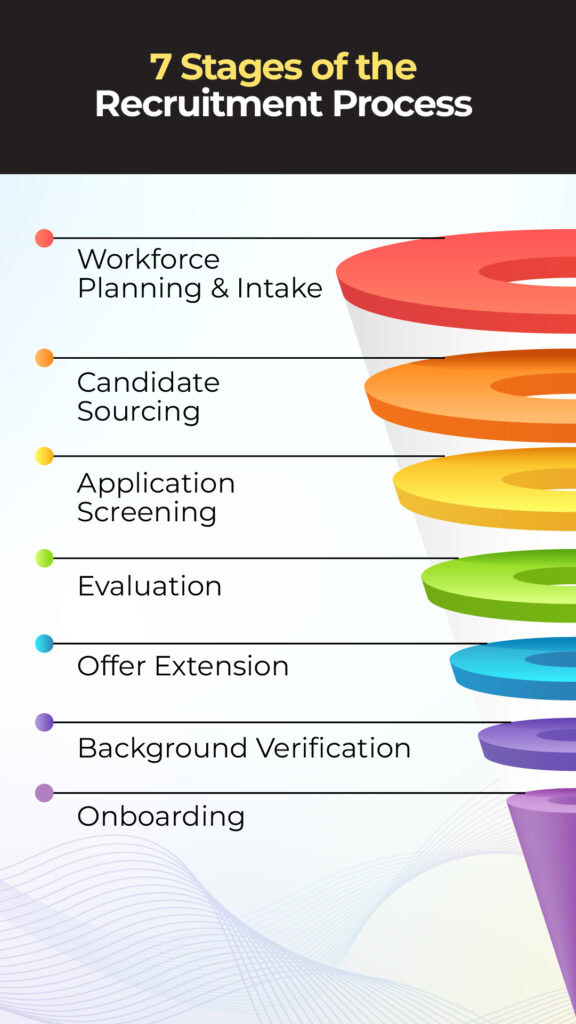
The seven main stages of a recruitment process are intake planning, candidate sourcing, screening, evaluation, selection, background checks, and onboarding.
These recruitment process steps guide a job seeker from an initial applicant to a settled, productive team member:
-
- Workforce Planning & Intake
A manager realizes they need help and submits a request for a new team member. Before posting anything online, the manager and recruiter sit down for an intake call. They agree on the required skills, set a realistic salary, and define what success looks like in the first 90 days.
-
- Candidate Sourcing & Outreach
After defining the job criteria, the position is posted on career pages and job boards. Recruiters also tap into their own database of candidates, ask current employees for referrals and reach out to passive talent on professional networks.
-
- Application Screening
The first resumes are in. As an initial step, recruiters will eliminate unqualified candidates by reviewing applications quickly, followed by short 15-minute phone calls or online screens. This confirms basic information such as expected salary, location and start dates.
-
- Technical & Behavioral Evaluation
Qualified applicants advance to formal interviews during the core recruitment process phases. This step usually combines behavioral interview questions with a practical skill test or work sample to see how the candidate handles real tasks.
-
- Final Selection & Offer Extension
The interview panel reviews their scoring sheets and agrees on the best candidate. The recruiter makes a verbal offer to discuss compensation, then follows up with an official written offer letter.
-
- Reference Checking and Background Verification
Once the candidate accepts the offer, the company does a background check on the candidate. This includes standard background checks, verification of work history and contacting professional references to confirm compliance.
-
- Onboarding and Integration
The recruitment process concludes with the official start of the new employee. IT sends out their computer, HR makes out the paperwork, and the manager oversees them for their first weeks of training.
Is there any other process involved in recruitment?
Yes, companies often add extra steps like internal talent searches, psychometric tests, or panel alignment meetings to reduce hiring risks.
Depending on the industry or position level, teams can include:
-
- Internal Talent Audits: Looking inside the company first to see if any current team members want a promotion or lateral move before spending money on external job ads.
-
- Psychometric & Skill Testing: Administering standard personality or problem-solving tests to leadership candidates to gauge their decision-making under stress.
-
- Compliance Checks : Mandating drug tests or security clearances for regulated industries like finance, defense, or healthcare.
-
- Scorecard Debriefs: A brief meeting in which interviewers compare notes before making a final decision, so that a hiring decision is not influenced by the personal bias of a single individual.
For roles that get hundreds of applicants, companies often use an AI interviewer right after intake. It handles preliminary candidate conversations automatically, clearing resume backlogs without slowing down your HR team.
What is the 70/30 rule in hiring?
The 70/30 rule in hiring means recruiters should spend 70% of their time finding passive candidates and candidates should own 70% of the conversation in an interview.
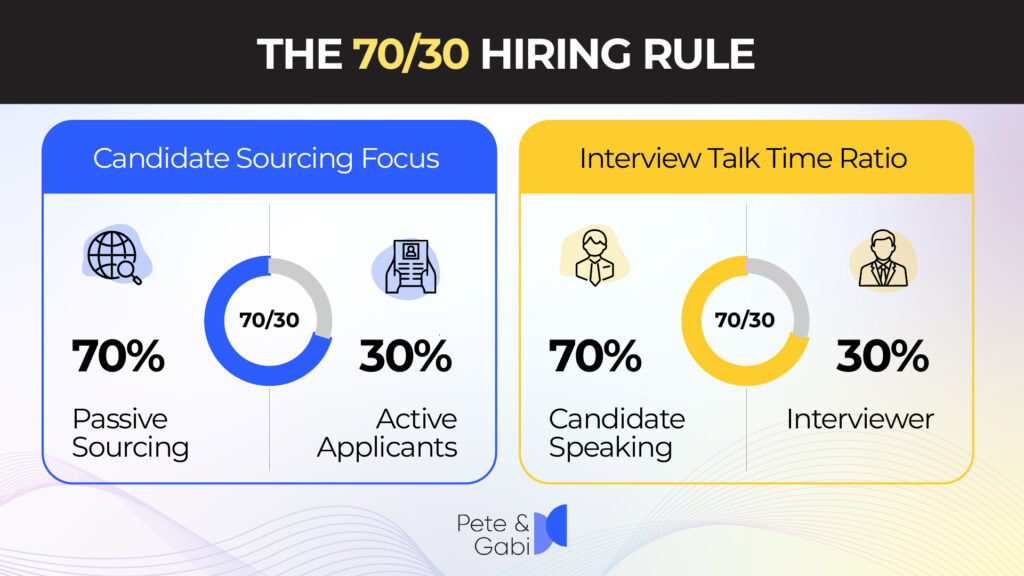
Sourcing Ratio: Dedicated recruiters spend 70% of their effort reaching out to passive candidates (people who are currently employed and not actively looking at job boards). The remaining 30% goes to reviewing active applicants who submitted resumes. Reaching out to passive talent takes more work, but it often yields higher-quality long-term hires.
Interview Conversation Ratio: During the interview, the interviewer should be speaking 30% of the time and the candidate should be speaking 70% of the time. The interviewer uses their minority time to introduce the position, ask short questions and answer candidate questions later. If the interviewer dominating the conversion might leave without giving enough information to make an informed hiring decision.
What are the different ways of recruitment?
Main recruitment methods are internal promotion, direct inbound application, employee referral, agency headhunting, campus hiring and AI-assisted screening.
-
- Internal mobility: moving current employees into open positions through promotion or transfer. This approch is usually cheap and quick fix, but at some point the employee’s old position will need to be back-filled.
-
- Direct Inbound Sourcing : An approach where applications are collected via job boards, career pages, and social media posts.
-
- Employee Referrals: Asking current employees to refer trusted contacts. Employees who are referred generally are more adaptable and have a tendency to stay with the organization longer.
-
- Recruitment Agencies: Using external agencies or executive headhunters to find candidates for leadership roles or difficult roles.
-
- Campus Recruitment: The practice of recruiting fresh graduates and interns directly from their schools by visiting universities.
-
- AI-Assisted Sourcing : Automated software used to conduct preliminary candidate interviews, rank candidates, and conduct screenings on a large scale
How do the different recruitment methods differ from each other?
Recruitment methods differ primarily by speed, cost per hire, applicant volume, and how much work they require from your internal team.
| Recruitment Method | Primary Use Case | Average Cost | Time-to-Fill | Best Advantage | Core Limitation |
| Internal Hiring | Promotions and lateral team moves | Low | 10–20 Days | Almost zero onboarding lag | Leaves an open gap in old role |
| Employee Referrals | General team expansion | Low to Moderate | 15–30 Days | Higher retention and job fit | Can limit team diversity over time |
| Direct Inbound | Standard mid-level job openings | Low | 30–45 Days | Large volume of applicants | Requires sorting through bad resumes |
| Recruitment Agencies | Executive or rare specialized roles | High (15–30% fee) | 30–60 Days | Access to hard-to-find networks | Expensive per hire |
| Campus Hiring | Entry-level roles and internships | Moderate | Seasonal | Great for bulk junior hiring | Requires training time for new grads |
| AI-Assisted Sourcing | High-volume or continuous hiring | Low (Scalable) | 5–15 Days | Instant 24/7 candidate screening | Needs clear evaluation criteria |
Smart organizations don’t put all their eggs in one basket. They use automated screening to keep high-volume pipelines moving quickly, they mix employee referrals and direct job postings for day-to-day hiring and they use executive search agencies.

What are the methods by which top-performing teams maximize their recruitment pipeline metrics?
The best teams track four metrics to maximize their pipeline: time-to-fill, candidate pass-through rates, offer acceptance rates and long-term retention.
The time-to-fill metric is the number of days it takes from the opening of a job to the acceptance of an offer. Too many interview rounds, poorly defined job requirements, or slow manager feedback can all be reasons for prolonged delays. And interview loops should not be more than three or four rounds at the most so that the best talent rises to the top.
Pass-through rates are simply the number of candidates moving from one step in the process to the next. If half of your candidates are falling out after the first round of interviews, then you likely need to change up your job description or salary range.
What are the typical chokepoints in today’s recruitment pipelines?
The most common recruiting bottlenecks are: generic job descriptions, subjective scoring, over-engineered interview loops and slow interviewer feedback.
-
- Generic Job Descriptions: Old job descriptions without clear requirements are being repeated. This confuses candidates and results in the wrong applicants.
-
- Delayed feedback: Interviewers take days to complete scorecards, which can slow down decision-making and cause candidates to lose interest.
-
- Too many interview rounds: Candidates get tired of doing five or six different interviews and drop out for faster offers.
-
- Unstructured scoring is assessing people on gut feelings instead of clear rubrics, and it leads to bias and poor hiring decisions.
As recruitment processes become more complex, many companies are beginning to use AI to support repetitive and time-consuming tasks across the hiring pipeline. Therefore, AI can help teams source candidates, review applications, conduct initial screenings, and organize candidate information before recruiters make the final decision. To understand how these technologies can be applied in practice, read this guide on how to recruit candidates using AI in 2026.