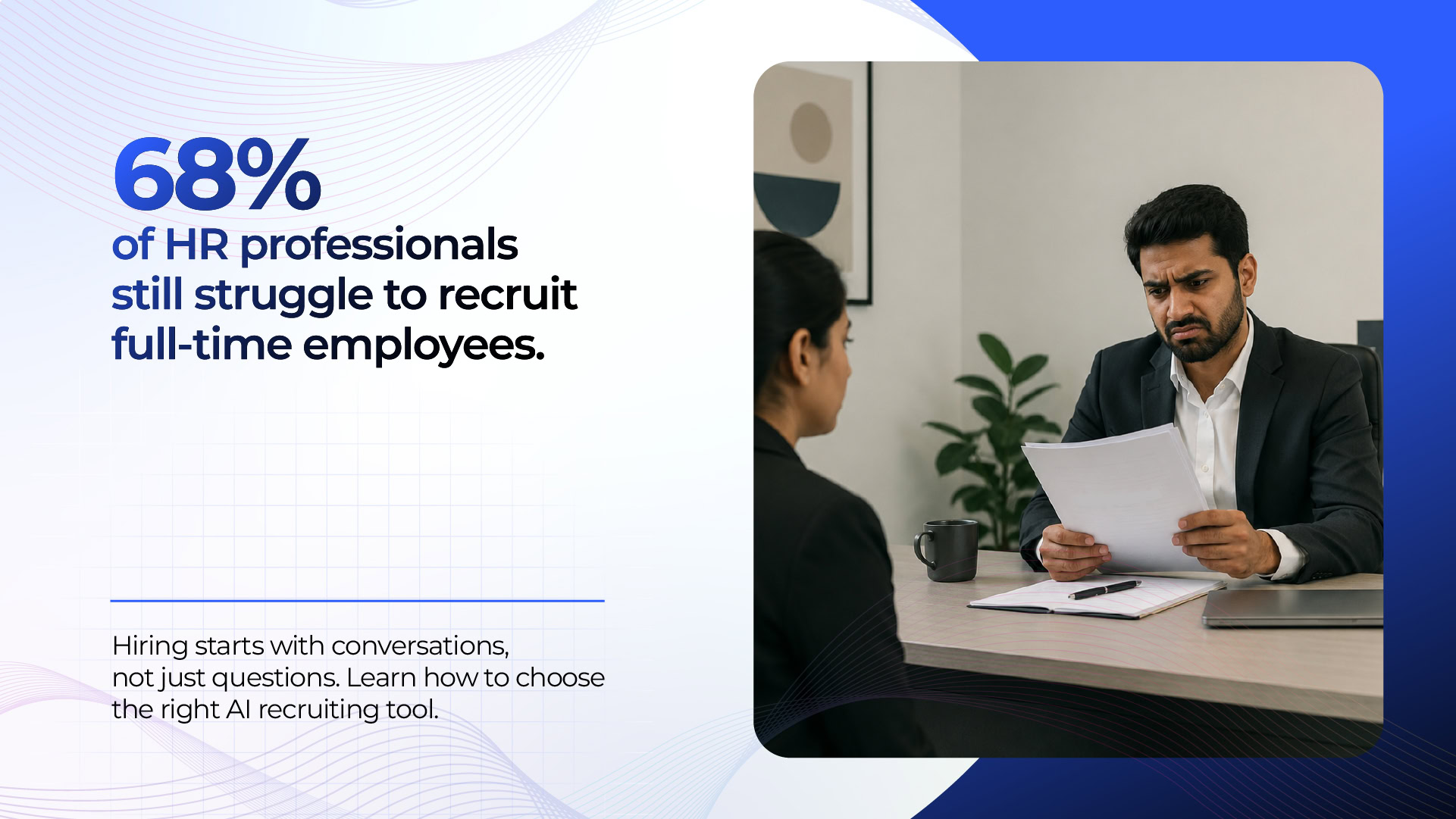
The recruitment process has a numerical issue. One open position can receive hundreds of applications, yet the number of hours in the day remains the same, and recruiters still spend valuable time scheduling interviews and reviewing resumes. In fact, 68% of HR professionals still struggle to recruit full-time employees, highlighting how difficult it has become to keep up with hiring demand. As a result, much of the hiring process is consumed by repetitive, low-value screening instead of meaningful candidate engagement.
AI interview screening software helps eliminate this bottleneck. It conducts interviews on behalf of recruiters, evaluates every candidate against the same criteria, and delivers comprehensive interview reports, allowing hiring teams to review qualified candidates instead of sorting through piles of resumes. When done properly, AI interview screening can reduce the time spent on interviews from a few weeks to just one day.
Before deciding whether to invest in AI recruitment platform, it is important to understand how to choose a system that works effectively as opposed to a program that only provides scoring for the candidates. This guide covers the features that define a high-performing AI recruiting platform, and the standards Rebecca AI by Pete & Gabi is built to meet.
Why Buyers Are Turning to AI Screening in the First Place
Three common issues are bound to crop up while talking about this field of recruitment.
- Volume: High-growth positions mean numerous candidates for each position, so it is hard to check for each candidate effectively.
- Consistency: The HR managers ask different questions on different days and in different states of mind on why some bias might be introduced in an unintentional way.
- Speed: Great candidates won’t wait. If it takes three weeks to go through the recruitment process, the best candidates have already been hired elsewhere.
AI screening tools claim to deal with all three issues simultaneously, but the ways of implementation vary significantly between providers.
The Core Feature Checklist
1. Real Conversational Interviewing, Not Just Form-Filling
The weakest solutions in this area resemble chatbots that are simply read from a pre-prepared script. The best of them, on the contrary, behave more like a live interviewer by analyzing the information contained in the resume and job description first and adjusting their questions depending on the answers of the candidate.
In this regard, Pete & Gabi’s Rebecca AI stands out as a good point of reference. It creates an individualized interview for less than one minute and performs it in a voice conversation manner, making it able to adjust follow-up questions based on candidate’s responses. Many testimonials on the service mention the mentioned flexibility, that distinguishes this service from a standardized screening interview.
What to check: Request a live demo interview from any vendor instead of a pre-recorded one. Does the AI ask about ambiguous answers or proceed to the next question as if nothing has happened?
2. Built-In Technical Assessment
In the case of technical professions, just talking to someone does not indicate that he or she is qualified. Find services providing real-time tests involving coding solutions during the interview.
This matters because it measures the candidate’s claim of “having five years of Python experience” before a recruiter starts searching for information.
3. Cheat Detection and Interview Integrity
As AI technologies advanced, candidates using such technologies started to cheat as well, asking a friend to help. Serious services need to implement integrity measures that include monitoring tab-switching, blocking pasting actions in a coding editor, enforcing fullscreen mode, and ideally running a local check for AI assistant apps running on the candidate’s computer.
4. Structured, Auditable Scoring
Perhaps the most significant aspect of the matter and hence the one that is often overlooked by buyers is the introduction of a formal scoring system that evaluates each candidate based on one set of criteria and in the same sequence. However, it needs to be borne in mind that it is the systematic nature of the scoring that helps eliminate distortion and bias.
Some of the important aspects to look for are the presence of:
- A transparent scoring system including the clarity of communication, technical proficiency, quality of answers, etc.
- A unified score or recommendation (for instance, Good Fit/Fair Fit/Poor Fit)
- An auditable record log in in which your legal or diversity teams will be able to check in case of any disputes regarding the hiring decision.
5. Bias Auditing and Compliance Credentials
Manufactured by the emergence of various rules, AI hiring tools are now subject to a serious regulation framework. In this regard, companies should actively ask vendors questions before choosing a tool.
The company should inquire about:
- The adverse-impact testing which may involve the application of the EEOC four-fifths rule in different groups.
- The data handling certifications (SOC 2, GDPR, CCPA, ISO 27001) which are expected to be valid in 2026.
- Candidates’ transparency and whether applicants know beforehand about the use of AI tools.
The last point is crucial as, in most countries, disclosure can’t be avoided because it makes the process transparent and trustworthy.
6. ATS Integration
AI screening tool that operates independently from the existing ATS will result in the creation of another system that recruiters need to integrate manually, instead of serving the very purpose for which the AI screening tool was bought, i.e. saving time. All scored reports, transcripts, code results, and recordings must be sent to many platforms such as Workday, Greenhouse, iCIMS, or Ashby automatically without the need for manual exports.
7. Turnaround Speed
One of the major selling points of these platforms is giving you the ability to compress a month-long first round of interviews into just one day. Of course, that is possible only when the service offers the feature to hold interviews whenever a candidate becomes available, regardless of their time zone, without any recruiter required to be present on the call or schedule appointments with a candidate.
8. Transparent, Usage-Based Pricing
The pricing models in this business vary greatly, so it is very important to know the unit economics before signing up. Some platforms charge for a seat, while others charge for interview credits that increase proportionally to the number of interviews. In any case, it is worth asking about the rollover policy, differences in costs of the basic interview and the interview with the coding test, and how much time the plan allows you to use.
Feature Comparison Table
| Feature | Why It Matters | What “Good” Looks Like |
| Adaptive voice/video interviewing | Static scripts miss follow-up context | AI adjusts questions in real time based on candidate answers |
| Live coding/technical challenges | Claims on a resume aren’t proof of skill | Timed, auto-graded, difficulty adjustable by role level |
| Cheat detection | AI-assisted cheating is a growing risk | Configurable tab-switch detection, paste blocking, full screen lock |
| Structured scoring rubric | Reduces recruiter-to-recruiter bias | Same criteria, same order, for every candidate |
| Bias auditing | Legal and ethical exposure | Regular adverse-impact checks (e.g., four-fifths rule) |
| Compliance certifications | Data protection and legal defensibility | SOC 2, GDPR, CCPA, ISO 27001 |
| ATS integration | Avoids duplicate manual data entry | Automatic sync of reports, transcripts, recordings |
| 24/7 availability | Speeds up time-to-hire | Interviews run the moment a candidate is ready, no scheduling |
| Candidate transparency | Trust and, in many regions, legal requirement | Candidates are clearly told they’re speaking with an AI |
| Usage-based pricing | Predictable costs at scale | Interview-credit model with rollover and clear tier limits |
What to Ask Vendors During a Demo
A feature list does not reveal everything about the service. When you start the actual demo session, he suggestions:
- “Can you show me a case in which the candidate answers are unclear or irrelevant?”
- “What will happen to our data if we stop using the service?”
- “Is it possible to disable separate check-up for easy-to-hire candidates?”
- “How frequently do you audit for biased behavior, and can you provide us with a record of such auditing?”
- “What is the difference in the cost between text interview and a coding interview?”
Usually, those who provide clear and detailed answers are also the ones who have developed the service. In other words, if the provider starts being vague or defensive, it means something
Final Thoughts
AI interview screening tools are no longer something out of science fiction as businesses can use the systems to make important hiring decisions that impact what candidates undergo. When thinking about the providers of such systems for use in 2026, one must not get swayed by the good presentation of a product and instead pay attention to whether the vendor provides features like adaptive interviewing, accurate technical assessment, auditable scoring, and compliance, as those tools should easily integrate with the ATS already used within the company.
When selecting a vendor, one should use the same approach as one would take in an interview, meaning one must check if the company shows that they really can deliver on what they promise instead of just making claims about being a good vendor.
FAQs
What is the difference between AI recruiting tools and a traditional applicant tracking system?
Traditional ATS functions merely as a database that lists applications, monitors stages of the hiring process, and handles job ads. The most advanced solutions in AI recruiting take one step further by performing recruiting processes such as finding candidates, interviewing them, and assessing their answers. In most cases, AI recruiting software is used along with an existing ATS to add an additional layer of intelligence to the recruitment process.
Which features separate a strong AI recruiting platform from a basic one?
The best platforms for AI recruiting bring together several functionalities rather than just one. For example, such platforms provide adaptive interviews, structured scoring systems that make the assessment impartial and objective, as well as integration with other systems.
How does recruitment automation software actually save recruiters time?
Recruitment automation solutions eliminate repetitive tasks from hiring processes such as scheduling calls, asking the same basic questions to all candidates, and collating interview notes. With automated recruitment solutions in place, recruiters can switch from their tasks until the candidates are screened according to the set rubric.
What is the role of AI recruiting agents versus AI sourcing tools?
Tools that utilize artificial intelligence allow for locating candidates through the searching of databases, job boards, and talent pools. AI recruiting agents help candidates progress through the recruiting funnel by carrying out interviews, answering questions from candidates, and even doing screenings. These two tools can work hand in hand and fully automate recruitment processes in companies.
Which is better for screening: an interviewer or traditional video interview software?
Video interviewing technology of the traditional kind enables recording candidates’ answers in video format for review later in contrast to traditional video interviewing platforms, which focus on the recording of responses, an AI interview platform performs live interviews and monitors candidate responses in real time.
How do I evaluate AI recruitment software before signing a contract?
Inquire about a live demo of the software rather than a pre-recorded video, ensuring to file a test regarding the handling of an unclear candidate’s reply. Seek to find information on bias checks (and not compliance claims); ask for certifications; check whether the system is compatible with your existing processes.