Someone in your leadership team has asked about the AI rollout. The answer was probably something like “still in the pilot phase” or “we’re working on the integration.” Maybe “it’s delivering value in certain areas.”
Meanwhile, a competitor is filling roles faster, converting leads quicker, and responding to customers in seconds instead of days.
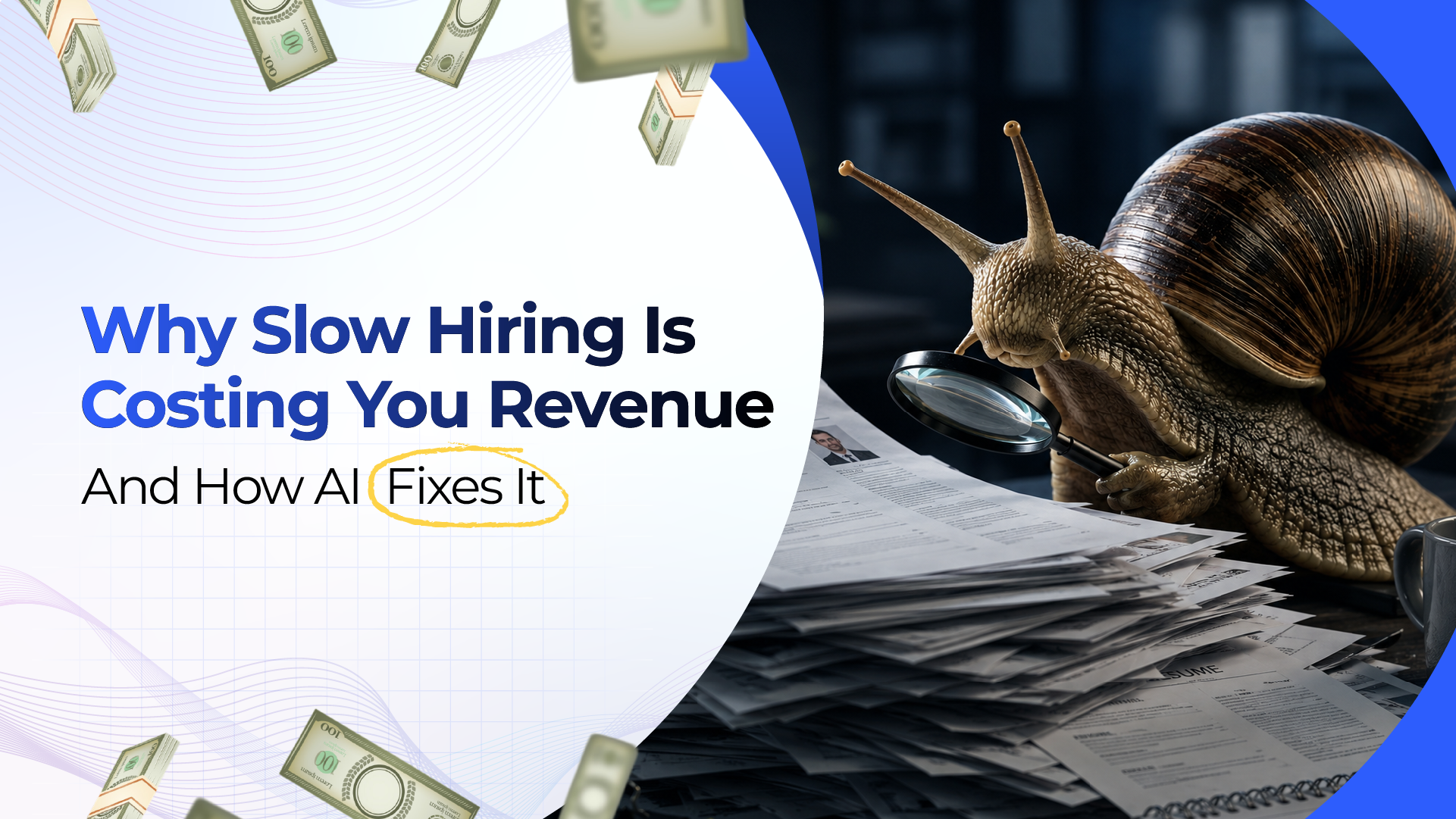
Slow AI is not the same as no AI. In fact, it is worse. When AI is stuck in pilot mode or pointed at the wrong problems, you are paying for the infrastructure, managing the organizational change, dealing with the internal politics around it, and getting none of the upside. Most businesses are not accounting for that expense correctly.
Source: NVIDIA State of AI 2026
The Real Revenue Cost of Getting AI Wrong
The framing most executives use AI ROI is what did we spent versus what did we got back. That misses the more important question, which is what you lost while you were waiting.
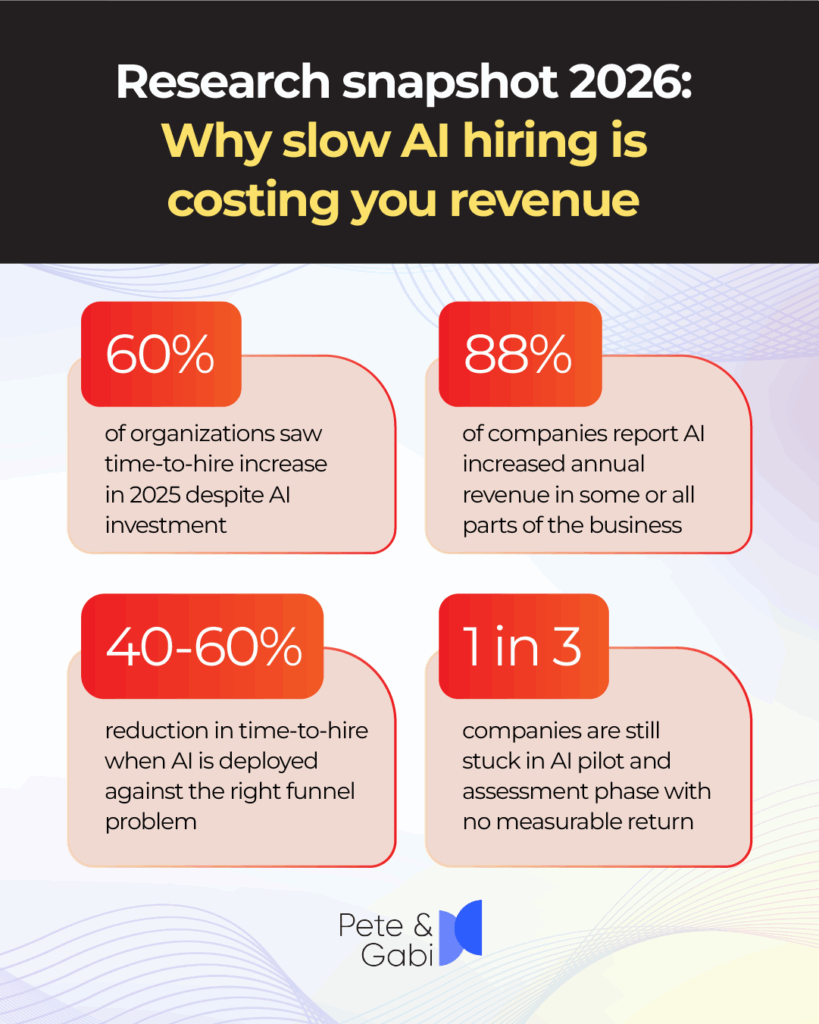
NVIDIA’s 2026 State of AI report found that 88% of organizations said AI had a measurable impact on increasing annual revenue, with nearly a third reporting increase of more than 10%. That is the upside picture. The same data, however, reveals that a third of respondents have not moved past pilot and assessment stages. They are carrying the cost without capturing the return.
According to Forrester’s analysis, about half of organizations in their client base are putting off planned AI deployments this year, not because the technology failed, but because early implementations did not deliver results fast enough. As one CEO put it: “We’ve been in the vision-selling era for too long and need to move to the outcomes era.”
In talent acquisition, specifically, numbers are hard to ignore. NVIDIA’s 2026 Hiring Insights Report found that 60% of organizations saw time-to-hire actually increase in 2025. Despite more tools and more AI investment, the hiring cycles were longer. That is what happens when automation gets layered on top of broken processes rather than used to fix them.
The World Economic Forum also published a sharp piece on this recently. Organizations that do not build genuine AI culture, meaning a shared understanding across departments of what the AI tools are for, end up with “pockets of fragmented experiments and siloed data.” They have AI on paper, not in practice.
And in practice, every week a role sits open is revenue that role was hired to generate but isn’t. Every candidate that goes uncontacted is the role your competitor closes. Every candidate who does not hear back within a reasonable time accepts a different offer.
What Fixing Slow Hiring Looks Like
The companies getting tangible results in 2026 share one pattern. They did not buy AI to “transform operations” or “reimagine the hiring journey.” They identified specific places where time and money were bleeding out and deployed AI recruiting tools against exactly those points.
In talent acquisition, the bottleneck almost always sits at the same place: the front of the hiring funnel. Applications come in; recruiters get buried, qualified candidates wait days without hearing anything, and drop-off starts compounding. By the time a recruiter surfaces a strong candidate, that person has already accepted another offer or stopped responding.
This is the exact problem Rebecca AI, built by Pete & Gabi, was designed to solve.
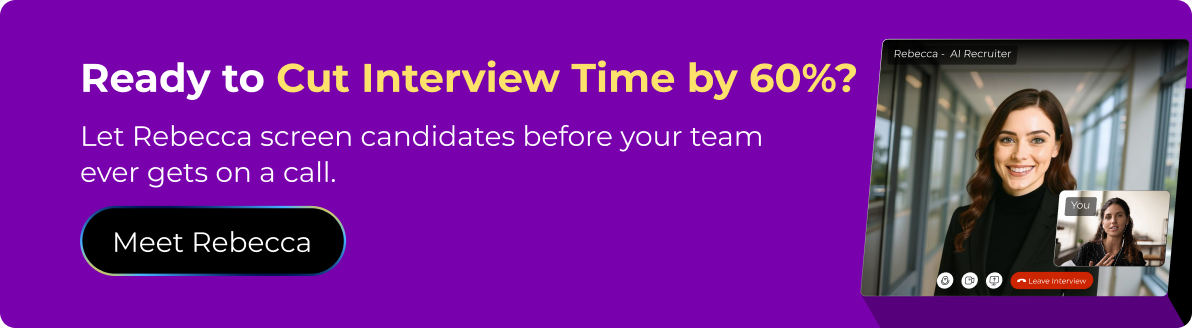
Rebecca AI is a conversational hiring assistant that engages candidates at the moment they apply. The AI hiring assistant runs screening conversations autonomously, asking role-specific qualification questions in a tone that reads a human exchange rather than an automated filter. Candidates who might abandon a standard application form complete the process because they are getting real responses, human-like communication, and a process that does not make them feel like they are shouting into a void.
Such conversational AI screening changes the economics, especially for high-volume hiring. Recruiters stop spending their days managing screening logistics and start spending them on the work that requires genuine human judgment such as evaluating culture fit, negotiating offers, and building relationships with hiring managers. Rebecca AI recruiting agent handles the front-of-funnel qualification that would otherwise consume hours and compresses it into minutes.
Every qualified candidate who moves forward is one the business did not lose to a slow process. Every recruiter hour recovered from administrative tasks is an hour that goes toward strategic hiring work that moves the needle. Rebecca AI removes the operational drag that prevents good hiring decisions from happening, rather than trying to make those decisions herself. That is the difference between AI hiring that stalls in pilot mode and AI recruitment that delivers ROI within weeks.
The Benefits That Stack When AI Is Pointed at the Right Problem
When AI has a clear mandate and a specific problem to solve, the results show up fast and build over time. Hiring cycles shrink without quality taking a hit. AI enterprise recruitment automation can cut time-to-hire by 40 to 60% on volume roles, leading to a massive competitive advantage. The best candidates do not wait for slow processes. They take the first credible offer that arrives. Every day removed from your hiring cycle is a day you retain candidates who would otherwise have moved on.
Cost-per-hire drops at scale. IQTalent’s 2026 research found that organizations using AI with defined, specific objectives see 30 to 40% reductions in cost-per-hire. The variable is not the AI technology itself. It is the clarity of purpose behind the deployment. Vague goals produce vague returns.
Diversity hiring improves in measurable ways. The same research showed up to 48% improvements in diversity hiring effectiveness when AI screening tools are intentionally configured for that outcome. More diverse leadership pipelines outperform less diverse ones by metrics that have been consistent across McKinsey for research for over a decade.
Candidate experience becomes a business metric. Career Plug’s 2025 Candidate Experience Report found that 66% of candidates say a positive hiring experience directly influences whether they accept an offer. On the other side, 26% rejected an offer specifically because of poor communication during the process. The hiring process is the first real interaction a candidate has with your organization as an employer. How it feels shapes whether they say yes when the offer comes.
Recruiter output multiplies without headcount increases. A single recruiter equipped with effective AI tooling can carry the workload that previously required two or three people working manually. That helps in cost savings as well as structural expansion of what the talent function can accomplish without proportional budget increases.
The Compounding Problem with Staying Slow
Slow AI hiring creates a compounding problem because the damage accumulates across quarters.
Every role that takes weeks to fill instead of days is two additional months where the output that role was meant to generate is not happening. Every recruiter hour spent on scheduling and screening logistics rather than strategic work is an hour not invested in employer brands, pipeline development, or the hiring manager relationships that make every future hire faster and easier.
The World Economic Forum report on AI hiring culture scaling makes this point from a different angle. The organizations that come ahead in the AI transition are not necessarily the ones with the most advanced tools. They are the ones who built the right culture and clarity before the technology arrived, giving them “the agility to iterate and face whatever comes next.” That culture starts with honest answers to specific questions: where are we losing time, where is that costing us money, and what is the right tool to fix it.
In talent acquisition, those answers are not hard to find. When the front of the hiring funnel is slow, candidates drop off and recruiters are stretched thin. The fix is deploying a conversational AI tool against the specific problem of candidate engagement, letting it run, and measuring what changes.
Slow AI Hiring is a Choice
Slow AI-assisted recruitment happens when organizations buy tools before defining the problem, deploy automation broadly without measuring specific outcomes, or keep extending the pilot phase because “we need more data.”
The businesses generating real returns from AI right now are not necessarily the ones with the biggest budgets or the most sophisticated platforms. They are the ones who identified where time, money, and talent were leaking out and deployed the right tools against exactly those points.
In hiring, the revenue cost of a slow process is quantifiable. Candidates lost to competing offers, recruiter hours spent on tasks that should be automated, roles sitting open for weeks longer than necessary cause revenue problems with a hefty price tag attached.
The right AI, pointed at the right problem, fixes them. That outcomes era is already underway for the teams who made the call.
Frequently Asked Questions
Why is slow AI adoption a revenue problem and not just an efficiency problem?
Every operational delay has a revenue cost attached to it. An unfilled role means the output that role was meant to generate is not happening. A slow hiring process means qualified candidates accept competing offers first. A candidate response that takes 24 hours instead of two minutes means conversions drop. AI-assisted recruitment does not just speed things up. It prevents the revenue loss that slow processes cause. However, when AI hiring stays stuck in pilot mode or is not matched to the right problem, that revenue loss continues regardless of how much has been spent on the technology.
What does “slow AI” actually mean in practice?
Slow AI is any deployment that creates more overhead than it removes. It shows up as tools that need constant manual supervision to produce useful outputs, platforms that promised transformation but delivered dashboards full of data nobody acts on, or automation that handles the wrong tasks while the real bottlenecks stay untouched. Forrester’s finding that half of organizations are delaying AI investments because early deployments did not deliver fast enough is a direct measurement of slow AI-led automation in practice.
How is a conversational AI screening agent different from standard ATS or a basic chatbot?
Rebecca AI runs as a conversational screening assistant. The AI screening agent engages candidates in real-time dialogue that reads like a genuine interaction rather than a form. The distinction from a standard ATS is that Rebecca AI handles candidate qualification autonomously, in natural conversation, based on role-specific criteria your team defines. The difference from a generic chatbot is that it is purpose-built for hiring workflows, with screening logic, qualification, and scheduling all integrated. The practical result is that candidates actually complete the process rather than abandoning it halfway through.
What types of companies benefit most from AI hiring tools?
Companies dealing with high application volume relative to recruiter capacity see the fastest returns. That includes fast-growing startups, companies in high-turnover industries like retail, logistics, healthcare, and hospitality, and any organization running multiple parallel hiring pipelines. The benefit scales proportionally with how much front-of-funnel work is currently consuming recruiter time. The higher that volume, the faster the ROI becomes visible.
How do you measure whether AI is actually delivering ROI in hiring?
You can start with three numbers: time-to-hire, candidate drop-off rate by stage, and recruiter hours spent on administrative tasks. These are the metrics most directly affected by front-of-funnel automation. Beyond that, track offers acceptance rates and quality-of-hire at 90 days (about 3 months). This tells you whether hiring faster is also better than hiring. If time-to-hire drops but 90-day retention falls with it, the AI is optimizing the wrong variable. The goal is faster and better, and the data will show you which side needs attention.
Is AI hiring legally compliant?
Yes, when deployed responsibly, the specifics vary by jurisdiction. The EU AI Act now classifies recruitment AI as high-risk, with enforcement active as of August 2026. In the US, the EEOC has established that employers are liable for algorithmic disparate impact under Title VII, even when the bias originates from a third-party vendor tool. In practical terms, any AI hiring tool you deploy should come with documentation of bias testing, clear audit trails, and human oversight at final hiring stages. Vendor transparency on this is a legal and reputational floor. Rebecca AI recruiter offers 24/7 availability and full compliance with global data privacy regulations, alongside a dedicated, round-the-clock support team to ensure secure and uninterrupted hiring at scale.
Why do most AI-assisted hiring implementations fail to deliver measurable results?
Organizations deploy AI with broad goals like “improve efficiency” or “enhance the candidate experience” rather than specific, measurable ones like “reduce time-to-first screen from 72 hours to 4 hours” or “increase candidate completion rate from 40% to 70%.” Without specific targets, there is no feedback loop and no way to course correct. IQTalent’s 2026 research makes this explicit: organizations that align AI tools with clear objectives report substantially better outcomes than those that do not.