
Top 10 AI Calling Software Replacing Traditional Call Centers in 2026
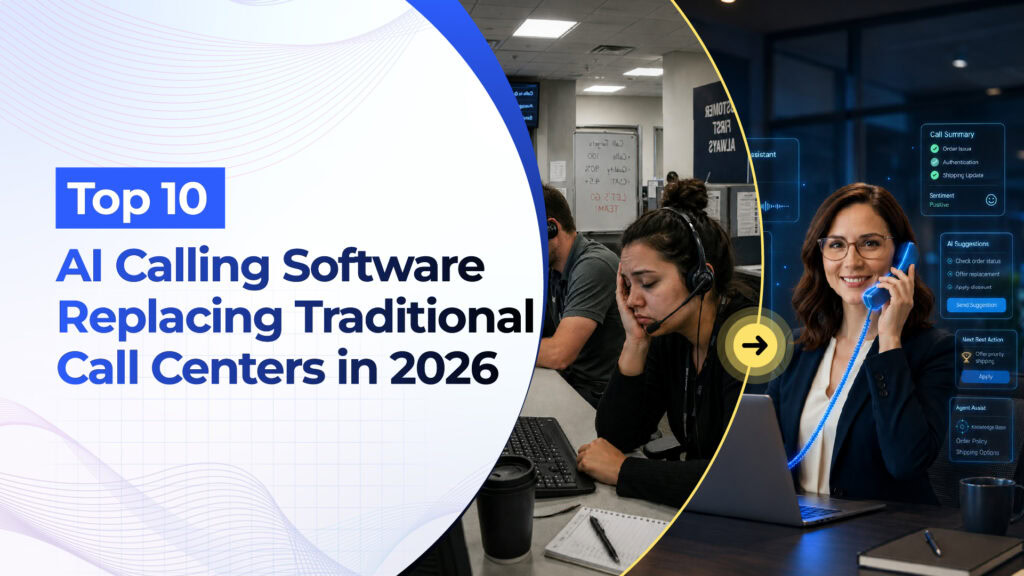
The traditional call center is collapsing under the weight of: high agent turnover rates; costs that are no longer sustainable; the inability of call centers to operate nearly around the clock or on every time zone; and a CRM bulging with cold leads that many are simply too busy to follow up on by making the math simply doesn’t work anymore. Replacing the traditional call center is the next generation of autonomous AI calling applications. New, advanced voice agents that are capable of conducting true sales conversations as genuine agents would do; as well as being able to qualify leads, handle slight objections, make CRM updates with more accuracy, and hand off warm leads to human sales representatives seamlessly at all times, regardless of company size. This is not about chatbots or phone trees. Today’s leading AI-enabled sales agent platforms are designed to sound natural and human; they can react to intent-based responses, and they can also personalize outreach that used to require a full sales development team (SDR). Below are the top 10 best AI calling software platforms that we predict will continue to replace the traditional call center in 2026. 1. Olivia AI by Pete & Gabi Olivia AI is the best AI sales agent available to help recover revenue lost from inactive customers. Many other AI calling tools work on generating new leads, while Olivia AI is designed specifically for reactivating customers and recovering much-needed revenue from the many records sitting in your CRM and going unused or inactive. Olivia AI examines your CRM for inactive customers, stalled deals and cold leads, and will contact them with personalized conversations based on their account history and behavior with your company. Each call will change automatically as the prospect shows signs of intent to buy, and if they raise any issues related to price, timing or previous disappointment, Olivia AI will convert the prospect to your sales teams by either referring them with all information or booking an appointment. Best for: Customer win-backs, lead reactivation, reduction of churn, upselling to inactive customers, and after-hours reach. 2. Bland AI Bland AI provides AI sales agent software targeting enterprises that have high volume outbound sales operations and hold strict data governance requirements. The system is designed to facilitate the completion of thousands of concurrent calls using voice samples from your brand (representing your brand’s voice) to train the agents to appropriately represent your brand’s tone. If your operations require compliance and tight controls around infrastructure, then this is the solution for you, provided you have engineering resources to deploy it. Best for: Large outbound sales organizations, data-sensitive industries, and development resources. 3. Retell AI Retell AI ranks 1st for response time, which is essential for live sales. Callers who took part in independent testing could only differentiate Retell’s AI sales representative from a human SDR 74% of the time due to a first response latency of ~620ms. Retell provides a drag and drop flow builder that allows you to get a working qualification agent to live within a matter of hours. Retell also provides visibility after the call, with sentiment scores, handoff flags and issue triage available immediately once the call has ended, thus providing sales managers with real-time data on the state of their pipeline. Best used for: Rapid deployment, low latency interaction, teams needing strong after-call analytics. 4. Synthflow AI Synthflow is, by far, the easiest to use all sales automation solutions available today. You won’t have to write any code at all. Synthflow has designed its product using a no-code BELL Framework, which provides an end-to-end solution for all agents from beginning to end. If you don’t have an engineering team but need to launch and operate your automation quickly and efficiently with little overhead cost, then your best solution could be Synthflow. Best For: Non-technical teams; small and medium-sized businesses; appointment-driven businesses; follow-up sequences. 5. Vapi Vapi provides complete control over every layer of an engineering-led team’s voice automated AI system. With features such as interruption detection, stage recognition and custom voice options via ElevenLabs and PlayHT, Vapi creates an ideal platform for integrating webhooks with n8n, Make, and/or Zapier. Vapi is easily one of the most technically capable software platforms for AI sales agents, but all teams will incur significant costs associated with the use of Vapi, and teams using Vapi require considerable amounts of developer time. Best For: Custom call workflows; complex CRM integration; engineering-driven sales teams. 6. 11x AI (Julian) Julian, the autonomous AI phone agent from 11x, takes care of outgoing prospecting calls in 30+ different languages, and connects structured qualification data directly into your CRM. Julian works with Alice, 11x’s AI e-mail SDR, which creates a compelling ability to serve as one of the best AI sales agents to handle outbound workforce for enterprises needing unified, autonomous outbound workforce using both voice and e-mail. Julian is geared towards larger organizations with existing outbound processes and their ideal customer profiles (ICPs). Best For: Enterprises doing outbound prospecting and using an enterprise solution with an extensive requirement for onboarding and largest structured sales team in their best prospecting campaigns. 7. Artisan (Ava) The Artisan Ava combines: B2B data, e-mail infrastructure, campaign management, and conversational AI for sales, into one integrated platform. Through the Artisan platform, sales teams receive an AI sales assistant able to locate and conduct research on leads using both technographic and intent data; produce personalized messaging; and utilize sentiment analysis to automatically indicate the best qualified prospects and ensure qualified candidates are routed correctly. For sales teams desiring an integrated sales automation solution that can do the entire top of the funnel workflow without needing to bring together additional tools, Artisan represents one of the strongest options available to accomplish this. Best For: Artisan will be outbound sales teams that want to integrate their data, sequencing, and AI-based calls into one platform. 8. Lindy AI With it’s AI sales assistant, Lindy AI enables businesses to be successful by supporting them with the ability to do outbound phone calls, and automating the lead qualification process and capturing their CRM information, while also providing them with the ability to chain multiple post-call activities together, such as CRMupdates, follow-up emails and task creation, with no need for manual documentation or tracking. The platform has the ability to communicate to other systems based on an action taken
How to Automate Follow-Ups for Every Lead Using AI Sales Agents
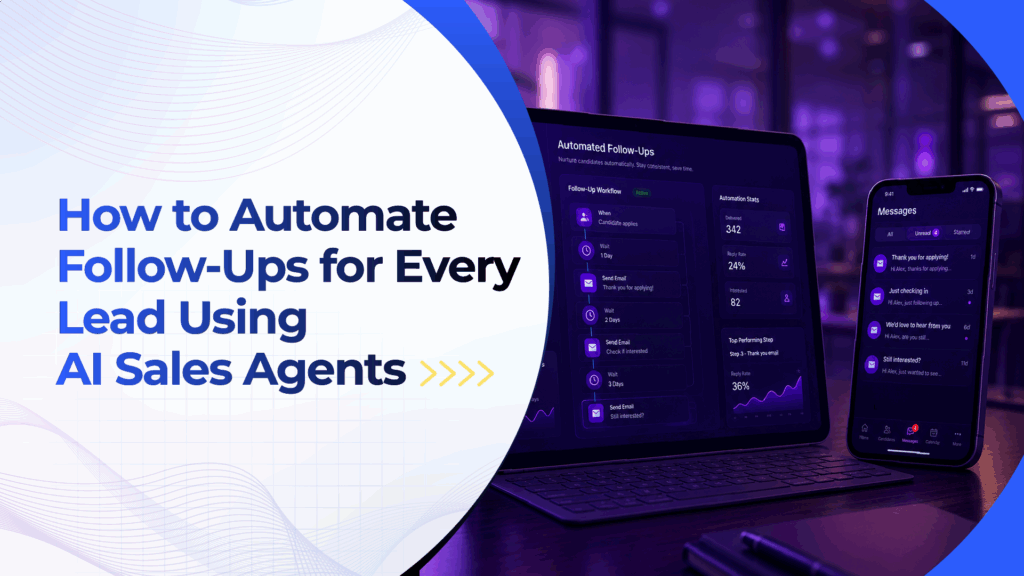
Sales teams experience the frustration of missed leads. A sales rep obtains a lead, becomes occupied with other tasks, never contacts the lead, and ultimately loses revenue due to timing issues. New sales automation solutions utilizing AI sales assistants will eliminate this issue. Why Manual Follow-Up Is Killing Your Pipeline The Salesforce website states that 70% of sales reps spend their time on non-revenue-generating activities such as administrative tasks, logging calls, updating the CRM, and chasing unqualified leads, thus reducing time spent selling. Buyers today expect immediate responses from their sales representatives; consequently, the introduction of an AI assistant for sales has completely changed how we look at the sales process. Using the right sales automation tools, your reps will be able to reach all leads all of the time without increasing their payroll. What an AI Sales Agent Actually Does An AI sales assistant does not simply provide a series of pre-scripted email responses via a chatbot but rather provides conversational agents. Conversational agents provide humanized, real-time sales conversations, present objection handling and determination of lead qualification in one continuous application process, automatically updating the designated CRM application with each contact, thus allowing for the real-time routing of qualified leads to a human sales rep. Follow-Up Automation: Manual vs. AI Sales Agent Follow-Up Stage Manual Process AI Sales Agent Initial Outreach Rep dials when they get around to it often hours or days later Calls within minutes of lead capture, 24/7 Lead Qualification Scripted questions, quality varies by rep Adaptive conversation with real-time lead scoring Objection Handling Fully rep-dependent, inconsistent across the team Intelligent, pre-trained response library that adjusts in real time CRM Update Manual entry, often delayed or skipped Automatic post-call sync, no rep input needed Hot Lead Handoff Scheduled callback, sometimes missed Instant live transfer to a human rep while interest is high Dormant Lead Reactivation Rarely prioritized, falls through the cracks Automated campaigns working through thousands of accounts at scale The Follow-Up Gap Is Where Revenue Gets Lost AI outbound sales solutions typically focus on finding new leads. However, a lot of recoverable revenues are inside of leads that have gone cold. These include the prospects that expressed some level of interest in your product/service but had not converted. By using an AI sales call agent, it is possible to cover thousands of dormant accounts in one week, something you can’t do on a great scale with your human team. Pete & Gabi’s AI sales agent, Olivia AI, was built specifically for CRM, finds inactive contacts, performs personalized approaches, manages objections, and gives full conversation context back to your sales team. What to Look for in the Best AI Sales Agent When assessing the best AI sales assistants and automation platforms, here are the must-have capabilities: AI Sales Follow-Up: B2B Use Cases That Drive Results Many advantages come with using an AI sales agent for B2B businesses. B2B sales cycles last much longer than before; buyers are looking for ways to buy faster than before, and if you miss an opportunity to contact a customer, it can be expensive! Using AI sales assistants does allow B2B businesses to: Ready to Stop Losing Leads to Slow Follow-Up? If your team is spending too much time on calls that could be automated or leaving potential customers to become cold without reaching out to them at all, don’t hire more sales representatives; think about how you can use smarter technologies to solve these problems. An example of smart technology that will help with this problem is Olivia AI. It is a AI sales agent created by Pete & Gabi to use artificial intelligence as a sales agent specifically designed to facilitate follow-ups at scale. Through the use of your CRM system Olivia AI acts as a 24/7 representative communicating with qualified leads using natural language; managing objections intelligently (providing full context for the conversation to all human agents), & giving your human agents everything they need in order to close more deals when the lead hands off to them. FAQs 1. Which follow-up tasks can an AI sales agent fully handle without any human involvement? An AI salesperson will take care of all initial follow up tasks such as making outreach calls, qualifying leads, answering questions about limitations/conditions, and creating or updating records in your company’s customer relationship management database. Human involvement occurs only if there is no longer a good chance of obtaining an order from a prospect. That’s where Olivia AI by Pete & Gabi comes into play. Once the lead has been qualified and determined to have an interest, Olivia AI will transfer the call to your representative while providing complete context on the previous interaction. 2. How does an AI sales rep handle a prospect who is frustrated or wants to speak to a human immediately? An effective conversational AI uses real-time sentiment analysis to detect when a conversation is getting off track or when a prospect is feeling frustrated and ready to quit communicating with your company. The AI agent will respond to this by promptly transferring the conversation to a live representative with the lead’s complete history so that the representative can quickly assist with the prospect issue. 3. What happens to lead the AI qualifies, but the sales team does not follow up quickly enough? An excellent sales automation system manages this whole process automatically by transferring a qualified lead to a sales rep. If the rep fails to engage with that lead within a predetermined timeframe, the sales automation system uses AI to initiate a re-engagement workflow; for example, the AI could create a new call, create a task to follow up, or set a flag within the company’s CRM system. This way, when an AI warms up a lead, no lead can go cold due to the AI’s inability to physically connect with the lead. 4. How does an AI sales assistant manage a complex product with nuanced qualification criteria? For an AI sales assistant system to be able to successfully assist salespeople with their sales process, it must be built around your specific qualification criteria, typical objections, and product-specific detail even before it calls a lead. An AI sales assistant system is designed to resolve the conversation prior to an enterprise-level relationship being established, therefore it is not
Top 10 AI Voice Agents Replacing Traditional IVR Systems in 2026
According to a Vonage report, 51% of surveyed consumers reported abandoning an entire company, not just a call, due to poor IVR interaction. IVRs typically have an average abandonment rate of 15%, and in telecom and utilities where there are typically heavier usages of IVRs, the rate goes up even more. The question is no longer whether businesses should ditch their existing IVRs and replace them with AI IVRs, but rather what AI IVR solutions should they start using first. The answer lies in conversational AI, that uses natural language processing to qualify callers in real time, manage their objections, and route them to the correct person without the use of any menu prompts at all. We have compiled a list of AI voice agents that are alternatives to traditional IVR solutions, ranked from best to strong alternatives. Why Traditional IVR Can No Longer Compete? Traditional IVR was developed for routing calls, however; it cannot resolve issues. It makes customers pass through fixed decision trees when they call and provides no opportunity to modify the process while they are still on the line. This leads to frustration for customers, abandoned calls, and customers moving their business elsewhere without saying a word about it. Alternatives to IVR are with the AI technology that provides an entirely different experience for customers. Intelligent routing will allow a caller to be routed according to an intended purpose rather than selecting from a menu of options. Inbound call automation can handle qualifying, scheduling and following up on callers without adding any additional staff. Rank 1: Olivia AI by Pete & Gabi Developed by Pete & Gabi, Olivia AI functions as a fully autonomous AI sales agent that provides complete inbound qualification, objection handling, appointment scheduling, CRM data syncing, and live transferring while providing complete context to the recipient. Olivia AI is currently the top AI voice assistant agent, not only for responding to calls but also converting inbound leads and re-engaging dormant customers. Key features include real-time CRM integration, natural human-like conversations, voice/SMS/engagement analytics, automated lead qualification, deployable in 1 – 2 weeks with no technical installation required. Rank 2: Kore.ai Kore.ai provides an enterprise-level conversational AI platform, which includes various capabilities such as intelligent call distribution, multilingual NLU, and deep integration with CRM, ERP, and ticketing systems. The infrastructure is well-suited for large organizations that want to upgrade their contact center operations on a grand scale as the current technology continues to evolve. While Kore.ai has powerful functionality across the board, revenue recovery and quick deployment have proven to be less important for mid-sized companies than developing high-quality contact center solutions. Rank 3: Vodex Vodex is a specialist in high-volume, compliance-driven outbound communications focused on debt collection, financial services, and the healthcare industry. Vodex has achieved the appropriate certifications such as; SOC 2, ISO 27001, and HIPAA. It automates outbound calls at Tier 1 level, allows for live warm transfers and has integrated with various CRMs using; API and Webhook. However, Vodex does not have the focus on reactivating customers through sales as well as having full-funnel revenue recovery. Rank 4: Retell AI Developer platforms have been created with the intent of giving organizations the ability to build and deploy AI voice agents that conduct calls with low latency while integrating with an organization’s own machine learning model (MLM). The general flexibility of Retell AI allows engineering teams to work on what they want as well as providing companies with complete control over the technologies used in their call center operations. Rank 5: Bland AI Using the Bland.ai developer platform allows developers to execute outbound calls at warp speed using their API. Bland.ai could be an ideal choice for various customer notice events such as an appointment reminder or follow-up to lead. Additionally, while Bland.ai can execute personalized messages, the level of sophistication is significantly below those found within solutions that are purpose-built for the intended application. Rank 6: Synthflow AI Synthflow gives developers a way to build no-code AI voice agents. While Synthflow’s AI voice agents can execute appointment scheduling, lead qualification and basic inbound call handling, they are designed primarily for healthcare providers. Synthflow is HIPAA compliant, can be integrated with common customer relationship management software (CRM) systems and can be used by teams without technical capability. Rank 7: Air AI Air.ai conducts fully autonomous conversations over the telephone for both sales and customer support. Air.ai supports multi-turn inbound and outbound telephone calls and has been adopted by businesses as an alternative to using basic IVRs. Air.ai was designed to provide broad capability as opposed to deep specialization, making it a poor fit for teams who need complex reactivation processes or revenue recovery. Rank 8: Nooks AI Nooks, an AI-supported sales dialer, boosts outbound SDR efficiency through multi-channel calling, AI forced-feedback, and access to advanced call data. Rather than replacing IVR systems or replacing autonomous inbound call automation systems, Nooks is designed to augment existing internal sales teams. Rank 9: Thoughtly Thoughtly is a no-code visual tool that allows you to create AI voice agents for use in supporting customers, scheduling appointments, or performing additional sales-related tasks. It serves as an intermediary between a full development platform and a solution managed by someone else, enabling non-technical personnel to use Thoughtly’s capabilities. Rank 10: Voiceflow Voiceflow is a design and production platform for the creation of conversation-based IVR flows within voice, web, and other messaging channels. Voiceflow is very flexible and intended primarily for developers to use and gives developers full control over the development of their virtual receptionist systems; as such, it requires extensive customization to deliver the desired conversion rates that purpose-built platforms can offer as standard. Top 10 AI Voice Agents: Feature Comparison Table Company Conversational AI / NLU CRM Integration Inbound Call Automation Outbound & Reactivation Compliance & Security Olivia AI by Pete & Gabi Full human-like, adaptive tone + objection handling Native sync Salesforce, HubSpot, Pipedrive, Zoho; real-time updates Yes. 24/7 instant answer, live lead qualification, meeting booking Yes. Purpose-built customer reactivation, win-back campaigns at scale TCPA, GDPR compliant Kore.ai Enterprise-grade NLU, multilingual, multi-intent Deep CRM, ERP, ticketing integration Yes, Enterprise contact center automation Yes, omnichannel outbound across voice and digital SOC 2, GDPR, enterprise security Vodex Generative AI, human-like, accent-matched voices CRM, dialer, marketing automation via API/webhook Yes, inbound with warm transfer to human agents Yes, high-volume outbound, collections-focused SOC 2, ISO 27001, HIPAA, FDCPA, TCPA Retell AI Custom LLM integration, developer-configurable Custom
How to Get a B2B AI Sales Agent Live Faster Than You Think
Most of the time spent by sales teams is taken up by administration activities, following up on previous contacts, returning missed calls, and updating CRM. According to Salesforce, 70% of sales representatives’ time is spent on non-sales activities. Therefore, many companies are now looking to utilize AI sales agent software, sales automation software, and AI sales assistants’ tools to pre-qualify, route and re-engage prospects without increasing staff numbers. While B2B buyers tend to be very fast, sales teams are often slow. AI sales agent assists the buyers by quickly responding, qualifying, updating the CRM, and providing full context of the lead to a human representative. Thus, the value of an AI sales agent software application is not only based on its automation or ability to qualify leads but also provides the ability to respond rapidly and consistently to prospects while effectively using the time of the sales team. Why does launch speed matter? Longer times deploying a sales automation software means more potential disruption because of internal review processes, different types of technical dependencies between systems, or ambiguous ownership on behalf of your team. If your team must spend weeks discussing system architecture before making the first call, you are losing the benefits of using AI to provide your sales organization with a competitive advantage. Expedited deployment also increases how quickly teams will adopt the sales automation software provided by the AI vendor. When teams can see how the software is being used in real time with real conversations booked, and the outcomes successfully entered their CRM, their confidence levels in the use of this type of software will quickly increase as well. The optimal approach is typically a one-use case, one integration method, one short pilot, and then the expansion of the use of the new system to additional functions. Start with one use case One way to expedite your go-live process is to determine which single task the AI can be most effective on. Instead of attempting to automate the entire funnel on the first day, concentrate on one Process Flow with a defined goal. Possible workflows to automate include leads that have been cold in the last 3 months, booked appointments with no-shows, or expired or non-active customers who will likely want to renew their contracts with you via phone. Having a single focus for your AI deployment allows you to write scripts more easily, means less set up time before starting to use the AI technology, and establishes the basis for ROI to provide to stakeholders. Additionally, by using a single process workflow, you can quickly develop data and determine how well the AI is performing since the data set will have a smaller sample size. What to prepare before launch? To accomplish this for your sales AI assistant, you will also need to determine if your goal will be qualification, meeting bookings, reactivating customers, upselling or routing leads. These preparation steps take time; therefore, it is important to think about what CRM fields and escalation rules you need to put in place. AI sales assistant’s workflow demonstrates what these will do for you: give an agent access to scan through CRM data, create a more personalized outreach based on previous account history, ask questions related to the context of the conversation, and hand over qualified leads with full notes included in the record. Your team can continue ongoing conversations without needing to start over with their discovery process; therefore, your handoff will appear much more seamless and allow your sales cycle to be shorter. The more organized you are in terms of your data structure/relationships, the quicker you will launch your project Typical launch roadmap Below is an example of how to sequentially roll out an AI sales agent for sales automation as part of an organization’s rollout strategy. Phase What to do Why it matters Define the use case Choose one job, such as reactivation, qualification, or follow-up Keeps the rollout focused and fast Prepare the data Clean the CRM list, fields, tags, and status values Prevents bad inputs from slowing the agent Build the conversation Add questions, objection handling, and escalation rules Helps the agent sound natural and useful Connect systems Integrate CRM, calendar, and notifications Makes handoffs and scheduling automatic Run a pilot Test with a small segment before full rollout Surfaces issues early without risk Optimize Review transcripts, outcomes, and conversion data Improves performance after launch This type of rollout strategy works because initially, the system remains simple, whilst the AI can demonstrate value quickly. Since teams that use Olivia AI are looking for more than just automation, this rollout sequence creates an accelerated pathway to live calling, real-time CRM updates and qualified lead handoffs; that’s why the teams that have adopted Olivia AI quickly tend to show early momentum. What makes Olivia AI fast to deploy? Olivia AI is an AI-powered voice-based product that automates conversation sales processes and can help reactivate customers. It does this by engaging in natural conversations with people by performing cold outreach, follow-up, upsell, win back, and qualification of leads. B2B AI sales agent uses data from your company’s CRM to personalize messages, answer objections, classify leads, create meetings, and pass to the sales team where they are at the time of customer interaction. Since Olivia AI has pre-defined sales workflows, CRM integration, qualifications, and scheduling capabilities built into its platform, any company should be able to deploy the system in less time than it takes to build a system from scratch that would be able to do these functions. Key Takeaway To implement a B2B AI sales agent quickly, it is best to look at one specific business issue, one workflow, and one measurable outcome first. Rather than trying to automate the entire sales process at once, there are specific use cases that are common among successful teams such as customer reactivation, lead qualification, and follow-up automation that can be focused on. State-of-the-art AI Sales Agents can have natural conversations with customers, qualify prospects for their ability to buy, update CRM databases in real-time and do outreach at massive scale. Companies can shorten implementation time, eliminate lengthy development cycles, and get pipelines generated, and revenue recovered much sooner by taking advantage of platforms that come with pre-built sales workflows and integrations. FAQs What exactly is an AI sales agent and how does it differ from a chatbot? A sales AI is an artificial intelligence sales representative that can do all sales tasks such
Top 10 Conversational AI Tools for Sales Automation in 2026
Out of the best sales agent platforms, we considered 3 key workflows: outbound cold calls, incoming lead calls, and customer reactivation campaigns targeting old leads and at-risk customers. Each was assessed on the following criteria: conversation quality, CRM integration, depth of reactivation, total cost of sales agents at a high volume. If your sales pipeline is dependent on SDRs working through large cold call lists with hundreds of qualified leads stored away in your CRM, there is a misalignment in your sales automation process. The top-rated AI sales agents within this list can automate the entire calling, qualifying, reactivating, and logging process without needing any human input. Comparison Table: Top 10 Conversational AI for Sales and Reactivation (2026) Best For Pricing Reactivation Depth No-Code Builder Free Trial Olivia AI Reactivation & win-back Custom (enterprise) Specialist Yes Demo only Vodex.ai Fast outbound campaigns Custom Basic Yes Demo only Voiceflow Custom conversation design Free + paid tiers Custom-built Yes (visual) Free tier YourGPT Support, sales & operations automation $39–$349/month General purpose Yes 7 days CallAgent AI SMB inbound/outbound Custom Basic Yes Demo only NL Pearl Complex NLP sales calls Custom Moderate No Demo only Synthflow AI No-code automation From $450/mo Moderate Yes 14-day trial Retell AI Developer voice infra From $0.07/min Custom-built Partial $10 credit SoundHound Enterprise speech accuracy Enterprise Limited No No Air AI Long-form trust-based calls $25K+ license Strong No No CRM Integration Compliance Objection Handling Multi-language Live Call Transfer Olivia AI Yes SOC 2, GDPR Advanced Yes Yes Vodex.ai Yes Not disclosed Basic Limited Yes Voiceflow Via API SOC 2 Custom Yes Custom YourGPT Yes ISO 27001, SOC II, GDPR Advanced Yes Yes CallAgent AI Yes Not disclosed Basic Limited Yes NL Pearl Yes SOC 2 Advanced Yes Yes Synthflow AI Yes SOC 2, HIPAA Moderate 30+ Yes Retell AI Yes SOC 2, HIPAA Advanced (custom) 31+ Yes SoundHound Yes SOC 2 Moderate Yes Yes Air AI Yes Not disclosed Advanced Limited Yes How We Evaluated Each Platform We evaluated all platforms against six criteria, where you’ll find the actual results of real-world performance.
Top 10 AI sales agents for customer retention services
Every lost customer is lost revenue. Discover the top AI Sales Agent software that helps you reconnect with dormant leads, recover missed revenue, and keep your customers engaged. The economics of maintaining a customer today has never been stronger. It costs between 5 and 7 times as much to acquire a new customer than it does to retain one; additionally, the average ecommerce retailer loses between 70% and 77% of their customers each year. At the same time, AI customer service solutions are beginning to rewrite this narrative as businesses that use AI-based sales representative software are experiencing improvements in retention figures between 10% and 15%, as well as increases in revenue by between 7% and 25%. If you are looking for an excellent AI sales assistant, an effective sales automation system, or an advanced AI SDR (sales development representative) that never sleeps, this guide provides the top 10 tools that are changing the game for businesses and helping them keep their highest-value customers. 10 BEST AI SALES AGENTS FOR CUSTOMER RETENTION (2026) #01 Olivia AI by Pete & Gabi Use Case: Customer reactivation and win-back outbound telephone calls are the use case for this tech requirement, no-code auto-calling. Custom pricing starts from $1,200/month. The only AI that truly minimizes customer churn and increases customer retention is Olivia AI by Pete & Gabi. A live conversational AI designed for high volume autodialing; Olivia AI looks at your CRM to find dormant prospects and customizes each phone call based on the customer’s account history and handles live objections while talking to customers in real-time. When she finds hot leads, she passes them directly to your human salespeople with detailed contextual information about each customer. Best for: Businesses with large dormant CRM databases that require a fully automated customer reactivation engine and have no technical barriers to entry. #02 | Vodex.ai Use Case: Voice based automated lead outreach and follow up tech requirements. No code pricing, usage Based Vodex.ai is an impressive AI Sales Assistant that allows users to do voice first outreach via thousands of simultaneous and personalized calls through a natural-sounding verbatim conversational AI to qualify leads and collect data prior to handing the conversation off to a human representative. For teams that want to minimize the possibility of losing customers through proactive re-engagement, Vodex is a great option for bulk-calling workflows pre-integrated with their CRM in their tech stack of sales automation tools. Best for: SMB’s and Mid-Market teams who want to scale voice prospecting but do not have development resources. #03 | VoiceSpin Use Case: Inbound and outbound contact center automation with low code pricing from $49 per user, per month. VoiceSpin is an all-in-one solution for contact centers offering ai agent capabilities for sales as well as complete cx (customer experience) contact center infrastructure; ai agent’s automated predictive dialer, real time speech analytics and sentiment analysis allows for at-risk customers to be identified before the customer ever leaves. VoiceSpin’s AI agent capability allows for both proactive and reactive support to be conducted all through one system, a first in contact center solution. Best For: Companies with contact centers looking to combine outbound sales automation with inbound retention capabilities. #04 | Voiceflow Use case: Building and deploying Custom AI Agents. Low Code/Developer-Friendly Pricing: Starting at $50/month (team plans). Voiceflow is the best AI sales assistant software available for teams that want to have complete control over how their AI agents will converse with customers. It has a drag-and-drop builder to build complex conversations and create bots who can innovate around retention, execute cancellation prevention, generate revenue through loyalty program upselling, and reduce churn risk conversations. Best for: Product & CX teams who want total control over Retention conversation Logic but do not have full engineering resources to support their work. #05 | SoundHound AI Use Case: Enterprise voice AI technology for customer service & sales. Customized pricing. SoundHound’s voice AI platform is built on its own Speech-to-Meaning engine that provides in real-time process of spoken intent and eliminates the need for an intermediate transcription step. The way Signature Voice Products provides brand and client experience will help enterprise customer retention provide conversations with almost no delay but sound very realistic. It will also provide the best sales agent capabilities for enterprise brands and sales in the automotive, hotel, and financial service sectors, for which consistent & precise brand voice(s) are an absolute necessity. Best for: Enterprise branded companies that require ultra-low latency, consistent branded voice AI capability to assist with high stakes customer interactions. #06 | SalesAPE.ai Use Case: AI sales development representative for inbound lead response and qualification. No technical requirements or coding required. Monthly Cost: $500 SalesAPE.ai offers AI SDR software that is available 24/7 and will respond to any incoming lead within seconds, qualify them through conversation, and automatically book their meeting with you. It can send and receive text messages, emails, or phone calls making it a great ai salesperson for businesses that rely on speed of service and need to keep customers from leaving. And it learns from your most successful sales conversations, so it can be more accurate in qualifying leads as you continue to use it. Best for: Any sales team that is overwhelmed with inbound leads that requires an instant, intelligent follow-up without having to increase their staffing needs. #07 | CallAgent AI Use Case: Automate outbound calling. Nurture leads through the phone. Tech Requirements: No-code and usage-based pricing. CallAgent AI is a rapidly growing AI sales agent software used by small-to-medium sized businesses to do automated outbound calling. There are pre-built templates available that cover typical retention situations (win-back campaigns, renewal reminders, re-engagement sequences), therefore it is one of the fastest platforms to easily set up a team that is new to sales automation software. In addition, CallAgent AI has natural sounding AI voices and provides real-time call analytics, thus equipping small sales teams with the resources needed to function at the level of a large company. Best for: SMB’s that need to implement an outbound AI calling solution quickly and want pre-built templates for proven retention campaigns. #08 | NL Pearl Use case: Global sales teams using AI-powered multilingual agents. Low-code requirement. Monthly subscription; use-based pricing. NL Pearl is one of the top-rated AI sales assistants due to its multilingual capabilities which support over 50 different languages with authentic regional accents. The AI agents will be able to carry on detailed discussions with customers over many interactions and remember what has already been talked about. This makes them extremely effective for having
AI Sales Agents vs Human SDRs: What Actually Works Better?
The sales industry is currently experiencing the most major upheaval of any period in history since the CRM was developed. For a number of years now, the SDR has been the main driver of business growth for our frontline sellers who are forced to continually grind their way through prospecting, emailing, and setting appointments on behalf of others. Now, with the emergence of Agentic AI, we have asked ourselves: Will an AI sales agent perform better than a human salesperson? Leaders are stuck between the proven empathetic qualities of the human sales representative and the superhuman efficiency of a sales automation platform. To find out how an AI-based salesperson will compare, we need to examine factual data, scalability, and the latest technologies of today’s leading AI sales assistants. The SDR Bottleneck: Why the Traditional Model Is Breaking Down To comprehend why businesses are pivoting towards AI SDR software, we need to take a first step of understanding the limitations of the traditional human model of sales development representative (SDR). Speed-to-Lead Gap: Studies show us time and time again that responding to a Lead within 5 minutes of them becoming available has a 9x greater opportunity for the Lead to turn into a sale. There is also no human SDR no matter how great they may be that can work around such limitations as sleeping, eating, or taking breaks. Personalization Paradox: Buyers are tired of “Spray and Pray” automation but to develop true personalized emails to 50 prospects a day it would be impossible for any human SDR to do without running out of hours. High Burnout: The SDR Position is plagued with high employee turnover rates and high employee burnout rates. When an SDR becomes proficient within their position, more times than none, they either kick off into an Account Executive Position or will simply leave the company, forcing leadership back into a very high turnover hiring/training cycle. Now let’s see how far Sales Automation Software has come from its earlier implementation of Simple “If/THEN” Sequence Models to now use advanced AI for Customer Service and Customer Sales Agents. Rise of the AI Sales Agent: What’s Behind the Shift? Unlike traditional chatbots that follow rigid scripts, AI agents for sales adapt in real time to every conversation. Bots of the past would only follow strict predetermined scripts whereas today’s agents, using LLMs, can comprehend context, intent, and meaning behind words. An advanced AI sales representative doesn’t just send out emails but will also do research about your prospect on LinkedIn, check out their last few annual reports, and create a humanized value proposition for that prospect. Conversational AI for sales allows businesses to deliver a “white glove” level of service that used to be possible only via a manual approach with hundreds of pieces of equipment. Where Humans Still Shine It is irrelevant to claim that humans have become obsolete. The high-end Enterprise sales sector still relies on the personal connection that a human being can provide, which remains a key differentiating factor. Humans excel at: However, in practice, only 20% of the day-to-day activities of a Sales Development Representative will depend on the application of any or all the skill sets mentioned above. Beyond the Meeting: Customer Retention and Churn Conversations about “top of funnel” growth have frequently been at the forefront of discussions, but to ignore the critical importance an AI sales assistant suite has in increasing sales at the bottom of a customer lifecycle would be detrimental. AI-powered customer retention services allow companies to reduce customer churn by identifying “at-risk” behaviors, and insight before the customer is even aware of their dissatisfaction. AI for customer service can proactively contact your customer using usage data and his/her support ticket sentiment analysis to provide personal services that would normally be done by a dedicated account manager yielding a much higher level of customer satisfaction. Comparing the Cost-to-Performance Ratio Once you evaluate the ROI in your search for a good AI sales assistant solution, the numbers quickly add up. Human SDR: Salaries, bonuses, benefits, cubicles, and management overhead will total over $100,000/year for a mid-sized market rep. Sales AI Assistant: Costs only a small fraction of the above-listed expenses, requires no benefits and handling the workload of minimum 10 humans working at the same time. Which Approach Sets the New Hybrid Standard? Most successful sales organizations in 2026 are now being established through the “Centaur” framework. The program is utilized to collect lead information and conduct the majority of lead quality checks with new prospects. After an individual has expressed true interest in potentially purchasing a product or service, or asks a high-level technical question, the sales AI agent will efficiently transfer the sales process to a human salesperson. The process enables the sales reps to work with “warm” leads and will ultimately have the most sales potential. The Verdict: What Works in Modern Sales Speed and accuracy reign supreme in the ongoing dispute amongst humankind and robots. You want an ecosystem to facilitate the transformation of your pipeline, not simply a tool. Olivia AI, developed by Pete & Gabi, is an advanced but highly functional AI Sales agent that acts as an entire team member, conducting research on your prospects as if they were a professional analyst whilst engaging with the same conversational fluency of a top-performing SDR. Integrating Olivia AI into your workflow closes the gap between human instinct and machine capability. She takes care of constant follow-up tasks, handles any objections from prospective buyers, and makes sure you have a calendar full of meetings with prospective clients who have expressed intent to purchase. Stop weighing human vs automated. Choose intelligence that combines both with Olivia AI. FAQs What differentiates an autonomous agent from standard email sequences? AI sales automation software uses instant reasoning to make sense of prospect intent by creating a unique, one-to-one response based upon current behavior, instead of using a static template. While tools such as Voiceflow and SalesAPE.ai have strong conversational frameworks, Olivia AI focuses more on in-depth integration with CRM systems as well as implementing lead reactivation logic to ensure that no contact becomes cold. Which features are essential for reducing customer churn? The key to retaining customers is becoming predictive on their sentiment and effectively engaging them proactively. Platforms like NL Pearl and Soundhound concentrate mainly on high-quality voice interactions, but Olivia AI brings together
Beyond Generic Dialers: Why AI Calling Agent Excels at Real-Time Personalization
Imagine you are on the phone with a potential customer and hear your name mentioned within the first three seconds of the call, along with a reference to the biggest pain point in your industry. The call is not filled with awkward scripted pauses or “let me connect you to someone else who will help you.” This isn’t the future; this is how an AI sales agent is operating today. Open-minded revenue teams are swiftly and silently switching from traditional auto-dialers to using AI-powered sales agents. In this blog post, how AI-powered calling agents are fundamentally different from a traditional auto-dialer, how real-time personalization can change the course of your sales pipeline, and lastly, provide guidance on choosing the best sales automation software for your team. What is an AI Sales Agent, and how is it different? An AI agent for sales is a true autonomous conversation system that does not simply dial a phone; it will listen, interpret what the prospect says, respond, and make real-time adjustments based on the way the prospect responds. Moreover, an AI sales agent can handle all of your prospects objection, qualify the prospect, make real-time updates to your CRM database, schedule follow-up calls, make high-intent transfers to live agents while talking to your prospects, and do all of this without ever reaching the end of a script. The difference in capabilities and functionality is architectural in nature, where an auto-dialer is simply an amplification device (megaphone); an AI voice agent is a highly skilled communicator. Below you will find a side-by-side comparison of the differences between the two and how they stack up according to the metrics that are most important to your team. The statistics found in that table are no coincidence, as they are a product of the real-time interaction between conversational AI for sales processes and live data. Here is a look at how it works behind the scenes. What powers real-time personalization in AI sales call agents? When a call is connected, best AI sales call agent accesses multiple data sources at the same time: CRM data: Company size, number and industry; history of previous interactions, current stage in the deal Intent signals: Pages that have been looked at; content that has been downloaded by the prospect Firmographic data: Revenue; number of employees; technology that is being used by the company Live analysis: Detecting tone; keyword identification; identifying any patterns of objections The system creates a conversational path in milliseconds that is uniquely created for every prospect. When a prospect raises a concern about budget, the AI will steer the conversation to ROI. The key difference between true conversational AI sales and scripted chatbots is the ability to respond dynamically instead of statically. Why do generic dialers fail at personalization? Let’s be frank about what generic dialers are actually costing your organization besides just the monthly fee. Prospects will get fatigued and reject calls: There is very little chance of successfully connecting with someone via ‘cold-call’ telephone because this type of call (that feels impersonal) will only be able to connect you with approximately 6% of those you have ‘called.’ Reps burnout and make repetitive calls: Expecting your human reps to make low-impact calls that require a high volume of calls is a waste of money because they will ultimately leave. Also, those representatives that continue to stay (those that have been burning out) will not be good representatives. Dialers do not register unqualified prospects: A generic dialing system will never physically hear what the prospect verbally expressed (expressed as hesitation), and therefore cannot ascertain that the prospect has just expressed a willingness to purchase something, thus, the system will wait for an actual sales person to figure it out after the transaction has occurred (if at all). AI will pick up those signals. Inaccurate follow up to new leads: If your organization does not have a means in which your sales processes automatically have follow-ups built into them, you will allow all prospective new leads to go cold. Follow-ups typically occur within 24 hours of initial contact; dialers will not follow up; AI will. Which industries benefit most from a B2B AI sales agent? Any industry that employs a large number of outbound calls and has consistent qualifications can benefit from using AI agents for sales. Certain industries, however, will see more disproportionate benefits than others. For B2B SaaS and technology solutions, AI sales agents perform consistent discovery on all conversations, identify key pain points, and provide multiple touches to their prospective customers. In the financial services industry, compliance-related regulations associated with high volume of outreach require that AI agents work within a precise regulatory framework to mitigate risk associated with non-compliance per regulation. In Healthcare and Insurance industries, AI agents for sales qualify for consultations, appointments and explanations of benefits before a recruiter engages with the candidate. Whereas in real estate, AI agents will be able to respond to property inquiries within minutes of receipt including after the normal business hours to provide the agent an advantage over any other agents in the same marketplace. In recruitment and staffing industries AI agents will automate the screening process of candidates and could do so on a much larger scale than any human recruiter through the qualification and pre-qualification of candidates before the recruiter contacts a candidate. How does AI sales automation software handle objections? AI sales automation tools use a pre-trained machine learning model based on thousands of actual conversations to do this and therefore create a full response immediately and with about the same tone as the conversation. Here are just a few of the most common types of objections and how best AI sales automation software reacts to them: “We are not interested in anything today”. The model will ask questions about the subject like when do you think you are likely to be ready? And suggest ways to keep in touch until they are ready. “We currently use another vendor”. A good AI sales automation tool can identify problems the customer has with their current vendor and gain better information on how satisfied they are with their vendor and if there are any renewal dates in their contract. “Send me something in the mail”. The software confirmed the customer was going to be sent something, ensured it would have the correct addresses and sent an automated email sequence to the customer’s account immediately following the call. You don’t need a human to respond to these objections! How do AI sales reps improve over time? There is a key advantage that
How AI sales agents use real-time intent signals for optimal outreach?
Effective sales outreach isn’t guesswork; it’s built on proven methods. Sales reps cannot generate leads by sending out 500 emails hoping someone will respond or reach out with a drip email three days after losing the deal to a competitor. A lead is most likely to convert when you contact them right as they’re thinking about the problem your product solves, almost by perfect timing. With the challenge in sales outreach today, companies are using AI sales agents as the basis for implementing a sales outreach program through the identification and response to real-time behavioral signals of interest from prospects. This allows sales reps to change what was once serendipity into an established scalable process for achieving success with outreach. This article explains how that’s possible through a better understanding of what intent signals are, how AI phone agents identify and react to intent signals, and why companies that are engaged in this approach can recover sales revenue that previously disappeared into a CRM. What Are Real-Time Intent Signals? Intent signals are behavioral data points that show when a prospect or dormant customer is actively considering a problem or purchase. The different types of intent signals can indicate where a prospect or customer is in their decision-making process if acted promptly. Intent signals monitored by AI sales agents fall into four categories: The main idea is: By the time a sales rep manually identifies these signals and takes action, the opportunity has typically passed. For instance, a prospect who viewed your pricing page at 2:00 pm and received a call the next day at 9:00 am is a different type of prospect than the one who viewed your pricing page at 2:00 pm. AI agents can operate at all times. The Timing Problem That’s Costing You Revenue Research from Harvard Business Review and InsideSales.com shows that if you do not respond within 5 minutes of the initial intent signal, the chances of successfully qualifying that lead are reduced by 400%. The same holds true for re-engaging dormant accounts; they must be acted upon in real-time as soon as the prospect expresses intent. The challenge Manual re-engagement is time-based, resulting in missed opportunities due to batch processing. Emails are sent out in batches, quick follow-ups are not completed and calls take too much time to complete, causing the lost window of opportunity to occur in virtually all re-engagement attempts Outreach Speed: Manual vs. AI Sales Agent Qualification odds drop 400% after 5 minutes (HBR, 2011). The compounding effect is clear. In a month, a sales team could only fulfill its maximum productivity by reaching 200-300 dormant accounts or less using manual processes. With an AI Agent, it will be possible to reach every 5,000 dormant accounts simultaneously within hours of that account exhibiting interest (intent where indicated). The difference between this and using a manual process is not marginal, it creates an entirely new way for an organization to operate. How AI Sales Agents Actually Read and Act on Intent The process isn’t magic, it’s a tightly orchestrated workflow that connects data intelligence to real-time conversation. Here’s how an AI sales agent operates from signal detection to closed loop: Step 1 CRM Scan: Pulls dormancy flags, engagement history, and account data to identify candidates. Step 2 Signal Score: Ranks accounts by intent strength and recency of signal, prioritizing who to call first. Step 3 Auto-Dial: Launches a personalized outbound call within minutes of the signal firing. Step 4 Live Conversation: Adapts in real time based on the customer’s tone, objections, and responses. Step 5 Warm Handoff: Routes hot leads to reps with full context that is ready to close, no cold transfers. Personalization at the Conversation Level Reactivation calls vary between generic and conversion calls because they have different contexts. AI Agents understand customer data such as last activity, product usage and objections preventing reactivation by using it for context. Since they are integrated with a CRM system, messages can be personalized in real-time as opposed to being sent from a static list of contacts. Every message that is sent is customized based on the customer’s intent. For example, Pete & Gabi utilized AI voice agents to reach out to 1,000 inactive accounts. The outcome of this was 413 actual conversations with 12 deals closed and generated $21,116 in revenue with all transactions being managed using AI. Why Manual Reactivation Keeps Failing (And Will Keep Failing) Salespeople are not unsuccessful at competing with the competition to reactivate customers because they do not want to. They do not; however, reactivating customers is structurally deprioritized every time a pipeline with new potential sales appears. When an account executive must choose between calling a brand-new lead immediately or calling a customer that has become inactive for an extended period (e.g., 6 months), the account executive will most often contact the new lead. Account executives are not unsuccessful at making reactivation calls because of a lack of motivation but rather because of a lack of incentives. The numbers don’t lie. AI-based reactivation does not replace the sales team; it picks up some of the work that they cannot reasonably allocate time to complete. When the AI has created “warm”, qualified conversations for them, the sales representative can allocate time to these conversations. Getting Started: What You Actually Need to Deploy This A lot of people believe that deploying an AI Sales Agent requires a long-time frame, often months, and therefore extensive engineering; it doesn’t. You can have an Olivia AI agent up and running in less than a week. All you need is good CRM data, a clearly defined target, and a well-defined conversation flow. Once the Agent is in place, it will learn and enhance itself on its own. The teams that are successful are not overbuilding; they are executing rapidly and learning through that execution rather than trying to figure out what they’re doing before they start executing. Frequently Asked Questions What are real-time intent signals in sales? Behavioral signals that indicate the level of readiness of a potential customer or a current customer to make a purchase or to re-engage are intent signals. Unlike traditional data sources, these signals are live and therefore provide much more predictive accuracy. Olivia AI continuously scans your CRM in search of the signals mentioned above and will begin making contact to prospects (via email and/or text) within minutes of identifying them as warm. How does AI personalize outreach without sounding robotic? AI agents do not follow strict schedules or scripts; they can change and adapt to new information based on the context provided by
How AI Call Agents Are Reshaping Patient Communication in Modern Healthcare
Healthcare providers are facing a strange reality. Demand for care has never been higher, yet growing administrative burdens mean clinicians spend much of their time on phone calls, paperwork, and scheduling rather than with patients. This growing gap can be filled by the new generation of AI voice/text-based agents with the ability to conduct natural-oriented conversations that have goals. In comparison to chatbots of the past, modern AI healthcare agents can call patients and answer complicated insurance questions; they collect data from patients; and sort patients concerns in real-time without needing to have a human on the other end of the conversation. The use of AI agents is not in the future; clinics, hospitals, and specialty practices have started deploying them in their patient communication workflows already, with measurable success: a decrease in no-shows, faster patient response times, increased patient satisfaction scores, and reduced staff time required for patient communications are all examples of how successful they have been. The question has shifted for healthcare leaders from whether to implement AI agents within their organization, to choosing workflows they will implement as their priority. For instance, a call reminding a patient about colonoscopy preparation can be handled very differently from a follow-up call after surgery. Modern AI agents can be trained to recognize these scenarios and respond appropriately with remarkable accuracy. Source: PMC How AI Agents Fit into Healthcare Workflows Without Disrupting Them AI agents excel in integration into existing global healthcare systems. Connecting with EHR, schedule, and customer relationship management (CRM) systems allows these agents to leverage the actual data available on patients such as appointment schedule, their medication schedule and how insurance will be billed for those medications to provide a more customized interaction between patients and providers. Patients will not only receive generic reminders for their appointments but will also get calls with context specific to their appointment, including the provider, date/time of appointment and documents needed to prepare for that appointment. The 15 Use Cases: Where AI Call Agents Deliver the Most Impact The use cases relate to every aspect of a patient interaction or ongoing relationship from the time they first make contact with a provider to the long-term retention of that patient, grouped by similar functions. Meet Olivia: OurAI Agent Built to Help Dormant Patients Reconnect With Care All seventeen use cases described in this article become significantly more actionable when powered by a purpose-built AI agent like Olivia, developed by Pete & Gabi. Olivia is a conversational voice AI designed specifically for outbound reactivation and re-engagement she scans your CRM for dormant contacts, places personalized calls using each patient’s history and context, handles objections naturally in real time, and routes warm, qualified leads directly to your team with full conversation context already logged. In a healthcare setting, that means lapsed patients who haven’t visited in over a year receive a call that references their care history and offers a relevant reason to return whether that’s an overdue annual physical, a preventive screening, or a seasonal wellness campaign. Olivia integrates with leading CRMs, operates 24/7 across time zones, and updates records automatically after every interaction, making her a practical starting point for any practice ready to stop leaving reactivation revenue on the table. FAQs Can AI call agents handle sensitive medical information securely? Yes. Most conversational AI companies have incorporated HIPAA compliance into their products to ensure the highest levels of security. How do AI call agents enhance patient experience? AI call agents can help provide patients access 24/7, reduce wait time for responses to questions, offer personalized reminders based on each patient’s health, and ensure there are follow up communications for all patients after their appointments; therefore, helping patients feel better supported and reducing friction associated with obtaining appropriate health care. Will AI call agents replace human employees? No. AI call agents will be used to assist staff with repetitive and administrative tasks like sending appointment reminders, verifying insurance coverage, and taking patient intake information so that medical staff can concentrate on providing complex care to their patients and having relationships with their patients. How do AI call agents connect with current healthcare systems? AI call agents can communicate directly with EHR, scheduling, and CRM databases, allowing them to access real patient information rather than relying on generic messaging. It includes details such as a patient’s appointment date and time, medications, and insurance information before communicating with the patient.