The sales industry is currently experiencing the most major upheaval of any period in history since the CRM was developed. For a number of years now, the SDR has been the main driver of business growth for our frontline sellers who are forced to continually grind their way through prospecting, emailing, and setting appointments on behalf of others.
Now, with the emergence of Agentic AI, we have asked ourselves: Will an AI sales agent perform better than a human salesperson?
Leaders are stuck between the proven empathetic qualities of the human sales representative and the superhuman efficiency of a sales automation platform. To find out how an AI-based salesperson will compare, we need to examine factual data, scalability, and the latest technologies of today’s leading AI sales assistants.
The SDR Bottleneck: Why the Traditional Model Is Breaking Down
To comprehend why businesses are pivoting towards AI SDR software, we need to take a first step of understanding the limitations of the traditional human model of sales development representative (SDR).
Speed-to-Lead Gap: Studies show us time and time again that responding to a Lead within 5 minutes of them becoming available has a 9x greater opportunity for the Lead to turn into a sale. There is also no human SDR no matter how great they may be that can work around such limitations as sleeping, eating, or taking breaks.
Personalization Paradox: Buyers are tired of “Spray and Pray” automation but to develop true personalized emails to 50 prospects a day it would be impossible for any human SDR to do without running out of hours.
High Burnout: The SDR Position is plagued with high employee turnover rates and high employee burnout rates. When an SDR becomes proficient within their position, more times than none, they either kick off into an Account Executive Position or will simply leave the company, forcing leadership back into a very high turnover hiring/training cycle.
Now let’s see how far Sales Automation Software has come from its earlier implementation of Simple “If/THEN” Sequence Models to now use advanced AI for Customer Service and Customer Sales Agents.
Rise of the AI Sales Agent: What’s Behind the Shift?
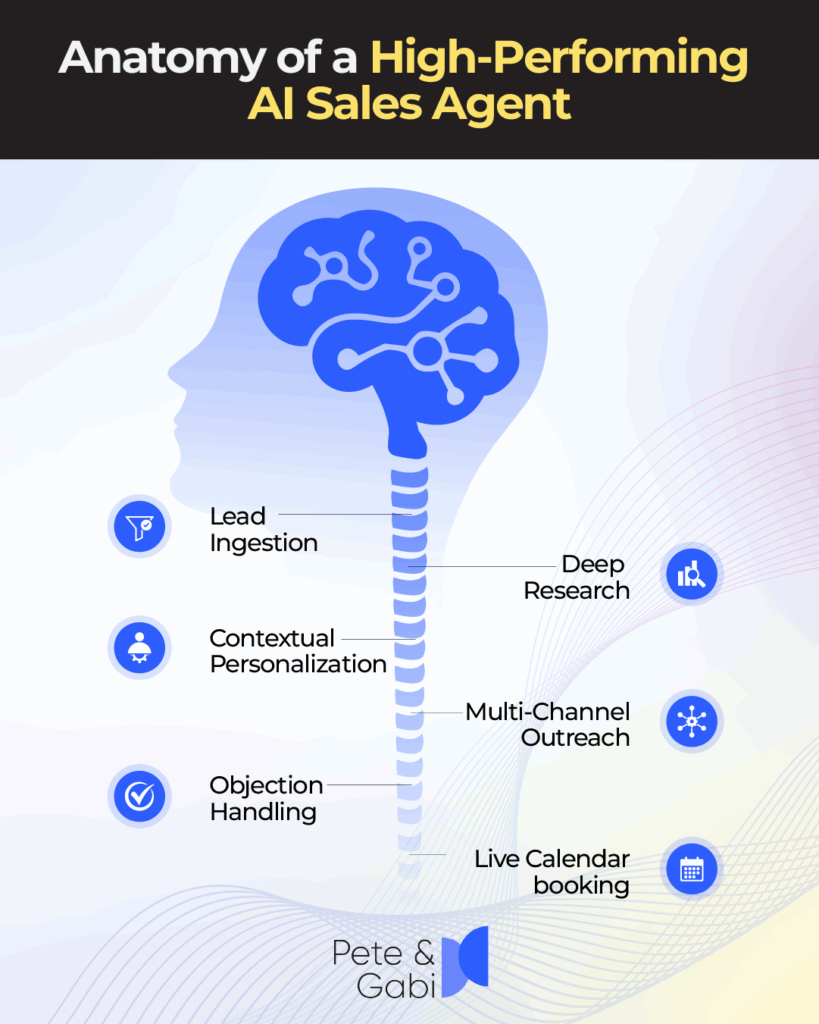
Unlike traditional chatbots that follow rigid scripts, AI agents for sales adapt in real time to every conversation. Bots of the past would only follow strict predetermined scripts whereas today’s agents, using LLMs, can comprehend context, intent, and meaning behind words.
An advanced AI sales representative doesn’t just send out emails but will also do research about your prospect on LinkedIn, check out their last few annual reports, and create a humanized value proposition for that prospect. Conversational AI for sales allows businesses to deliver a “white glove” level of service that used to be possible only via a manual approach with hundreds of pieces of equipment.
Where Humans Still Shine
It is irrelevant to claim that humans have become obsolete. The high-end Enterprise sales sector still relies on the personal connection that a human being can provide, which remains a key differentiating factor. Humans excel at:
- Develop Strong Emotional Relationships: AI can imitate some of the characteristics of allowing empathy with a client, but AI cannot have “feelings” for the client when a significant promotion takes place for them.
- Navigating Complex Internal Politics: AI has not yet reached the level of social intuition required to identify and navigate the often-invisible power structures in the board room of a prospective client.
- Creative Approach to Problem Solving: When a deal goes wrong for reasons that aren’t contained in the data, a veteran salesperson can change directions by following intuition/situational cues.
However, in practice, only 20% of the day-to-day activities of a Sales Development Representative will depend on the application of any or all the skill sets mentioned above.
Beyond the Meeting: Customer Retention and Churn
Conversations about “top of funnel” growth have frequently been at the forefront of discussions, but to ignore the critical importance an AI sales assistant suite has in increasing sales at the bottom of a customer lifecycle would be detrimental.
AI-powered customer retention services allow companies to reduce customer churn by identifying “at-risk” behaviors, and insight before the customer is even aware of their dissatisfaction. AI for customer service can proactively contact your customer using usage data and his/her support ticket sentiment analysis to provide personal services that would normally be done by a dedicated account manager yielding a much higher level of customer satisfaction.
Comparing the Cost-to-Performance Ratio
Once you evaluate the ROI in your search for a good AI sales assistant solution, the numbers quickly add up.
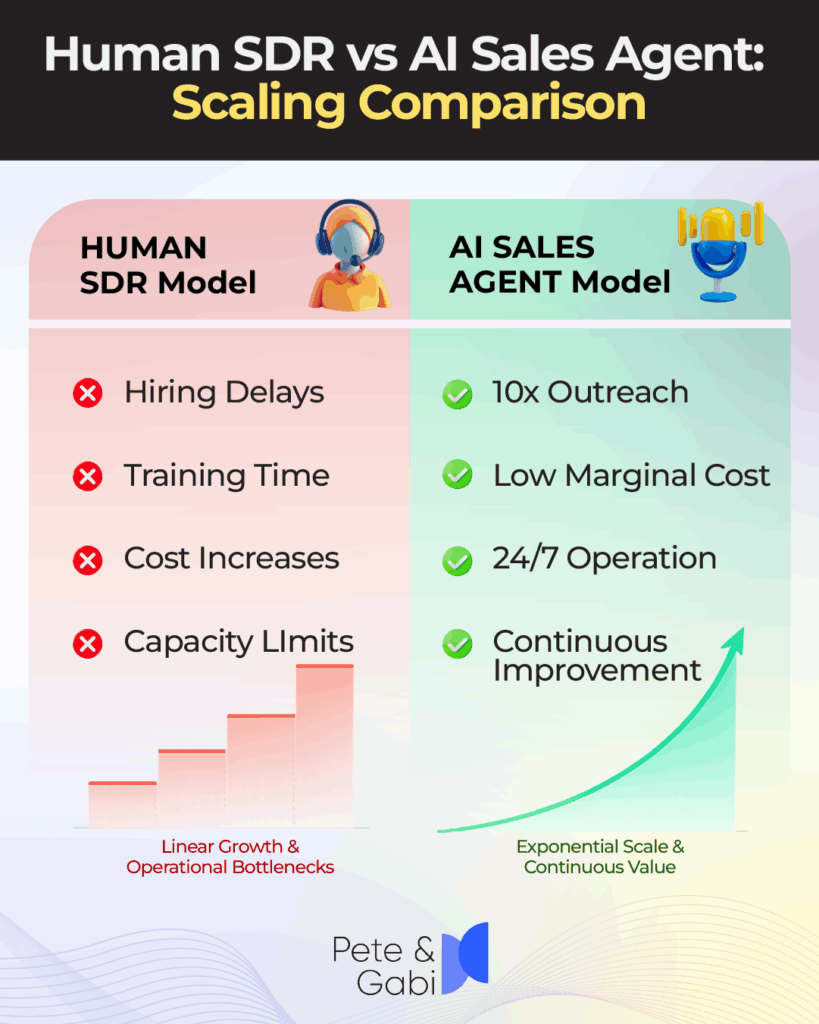
Human SDR: Salaries, bonuses, benefits, cubicles, and management overhead will total over $100,000/year for a mid-sized market rep.
Sales AI Assistant: Costs only a small fraction of the above-listed expenses, requires no benefits and handling the workload of minimum 10 humans working at the same time.
Which Approach Sets the New Hybrid Standard?
Most successful sales organizations in 2026 are now being established through the “Centaur” framework. The program is utilized to collect lead information and conduct the majority of lead quality checks with new prospects.
After an individual has expressed true interest in potentially purchasing a product or service, or asks a high-level technical question, the sales AI agent will efficiently transfer the sales process to a human salesperson. The process enables the sales reps to work with “warm” leads and will ultimately have the most sales potential.
The Verdict: What Works in Modern Sales
Speed and accuracy reign supreme in the ongoing dispute amongst humankind and robots. You want an ecosystem to facilitate the transformation of your pipeline, not simply a tool. Olivia AI, developed by Pete & Gabi, is an advanced but highly functional AI Sales agent that acts as an entire team member, conducting research on your prospects as if they were a professional analyst whilst engaging with the same conversational fluency of a top-performing SDR.
Integrating Olivia AI into your workflow closes the gap between human instinct and machine capability. She takes care of constant follow-up tasks, handles any objections from prospective buyers, and makes sure you have a calendar full of meetings with prospective clients who have expressed intent to purchase.
Stop weighing human vs automated. Choose intelligence that combines both with Olivia AI.
FAQs
What differentiates an autonomous agent from standard email sequences?
AI sales automation software uses instant reasoning to make sense of prospect intent by creating a unique, one-to-one response based upon current behavior, instead of using a static template. While tools such as Voiceflow and SalesAPE.ai have strong conversational frameworks, Olivia AI focuses more on in-depth integration with CRM systems as well as implementing lead reactivation logic to ensure that no contact becomes cold.
Which features are essential for reducing customer churn?
The key to retaining customers is becoming predictive on their sentiment and effectively engaging them proactively. Platforms like NL Pearl and Soundhound concentrate mainly on high-quality voice interactions, but Olivia AI brings together the advantages of both voice interactions and data-driven customer retention services to identify accounts that may potentially churn prior to them doing so.
What are the primary cost benefits of using AI sales assistant software?
The main benefit is the removal of substantial overhead costs associated with recruitment, training, and providing benefits for human staff. Vodex.ai and VoiceSpin offer automated calling functionalities, but Olivia AI provides an extensive AI sales agent platform experience that has up to 10 times the potential reach of human staff, without increasing headcount.
Which platforms offer the best integration with existing CRM systems?
The very best platforms employ native, bi-directional synchronization, producing consistent data quality throughout all components of your technology stack. CallAgent AI and Voiceflow provide APIs for developers to make use of, but Olivia AI was designed to work directly with your CRM, automating lead assignment and transitions to human representatives without any manual entry of records.
Which metrics determine the success of an automated outreach campaign?
Success is measured by lead-to-meeting conversion rates and the quality of pipeline generated, rather than just raw volume. While SalesAPE.ai and NL Pearl prioritize engagement rates, Olivia AI focuses on booking qualified meetings that convert to revenue, providing a higher ROI than traditional automation.
What level of technical expertise is required to deploy an AI agent?
Most modern agents are designed for “no-code” deployment, allowing sales leaders to launch campaigns in days. Whereas VoiceSpin and SoundHound often require specific telephony setups, Olivia AI is designed for rapid onboarding, allowing you to go from setup to live outreach almost instantly.