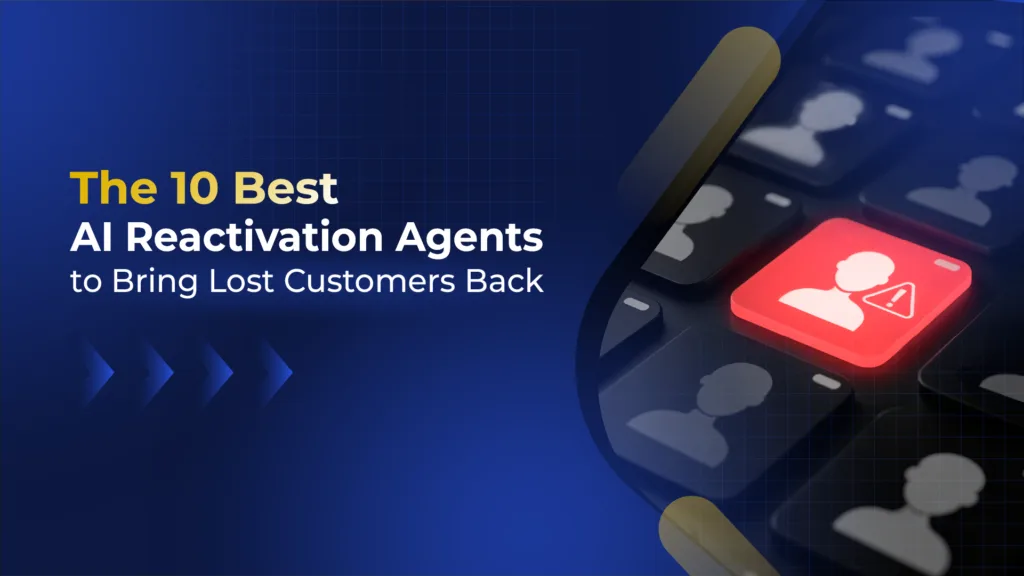
The 10 Best AI Reactivation Agents to Bring Lost Customers Back

It’s a new year. Do you know where your old customers have gone? Almost every company has a CRM full of them: contacts who bought at some point but have since gotten lost in the shuffle. The data’s invariably inconsistent, as are the reasons they’re not still buying. Maybe life got busy, priorities shifted, or a salesperson they loved left the company. Maybe a competitor’s won them over, or maybe they just reached out one time too many and couldn’t get through. Meanwhile, your sales team has bigger fish to fry, leaving them without the time to circle back, check-in, update, and see if the customer’s needs could be met again. With AI, these contacts no longer have to remain lost. AI sales agents built for customer reactivation are helping businesses re-engage dormant accounts at scale. They’re recovering revenue that may be too cost prohibitive by volume for human salespeople, and in the process updating contacts and bringing in new leads. In this blog, we extensively evaluate 10 AI agents that are thriving in this space. You’ll learn each one’s key features, best deployment scenarios, strengths, and potential weaknesses. Why You Should Deploy Customer Reactivation AI Agents in 2026 New leads are expensive. But most businesses kick off the new year primarily chasing fresh demand. Here’s why deploying AI reactivation agents isn’t optional for businesses anymore: It’s a new year. Time to go get that revenue you’re leaving on the table. Best 10 AI Agents for Customer Reactivation So without further ado, here are the top ten AI platforms helping businesses win back revenue right now: 1. Olivia (by Pete & Gabi) First on our list is AI sales agent Olivia. She delivers the most complete blend of scalable customer reactivation execution and real revenue recovery impact. Olivia is an AI sales agent built specifically to bring back lost customers, reduce customer churn, and recover revenue from dormant accounts that manual outreach never has time to reach. She handles high-volume outbound calling, qualifies intent in real time, updates CRMs, and escalates hot conversations directly to sales teams. Unlike generic AI dialers or email automation tools, Olivia holds natural, human-like conversations that adapt to objections, assess customer sentiment, and offer personalized win-back incentives in real time. This solution is also plug-and-play, integrating easily with existing CRMs. Its claim to fame is that it starts generating revenue within days. Key Features Pros Cons Best for Revenue teams focused on customer win-back, churn reduction, and monetizing existing pipelines. 2. ChurnZero Next on the list is ChurnZero. This platform is an AI-powered customer success solution designed to help subscription-based businesses identify churn risk before it’s too late. ChurnZero excels at tracking usage data, health scores, and lifecycle signals, giving teams early warning signs when accounts may be slipping. It’s automated playbooks, in-app messages, and email workflows help CS teams respond at scale. ChurnZero uses predictive analytics and automated workflows to identify at-risk customers, trigger re-engagement campaigns, and guide customer success teams toward proactive retention strategies. Note that it is designed to stop short of execution, telling teams what to do but stopping short of directly contacting customers. Key Features Pros Cons Best for SaaS companies with mature customer success teams focused on churn prevention rather than customer win-back. 3. Salescloser AI Salescloser AI positions itself as an AI sales assistant built to increase customer outreach productivity and follow-up speed. The platform supports AI-driven conversations across voice and text, helping sales teams reach more customers without manual dialing. It assists with outbound engagement and call scheduling to keep pipelines moving. It excels at outreach and qualification, which is the product’s bread-and-butter. Note that complex win-back scenarios, objection-heavy calls, and CRM-driven recovery workflows may require significant customization or human intervention. Key Features Pros Cons Best for Sales teams looking to boost outbound efficiency and customer engagement volume. 4. Scratchpad We include Scratchpad on this list, though strictly speaking it’s not a customer reactivation tool by design. This platform offers teams a sales execution and productivity layer designed to make reps faster at driving repeat business from customers. Scratchpad does surface inactive opportunities, flags accounts that need attention, and makes it easier overall for reps to execute manual reactivation outreach by reducing the friction of CRM data entry. This means better customer segmentation and more focused targeting of at-risk or churned customers. The platform’s AI-powered workflow makes it easier to identify which accounts to call and track what happens next. Key Features Pros Cons Best for High activity sales teams that want better CRM hygiene. 5. Relevance AI Relevance AI positions itself as a flexible agent-building and orchestration platform focused on powering internal AI workflows. It enables teams to design custom AI agents for tasks like data enrichment, research, classification, and internal process automation. For technical teams, it offers powerful building blocks to create tailored AI systems. In the arena of customer reactivation, Relevance AI can help identify dormant accounts, generate personalized outreach messaging at scale, and trigger automated workflows based on customer behavior. Note that it’s not designed for live voice-based customer re-engagement or AI phone calls, but rather data enrichment and content generation. It’s built to scale your customer win-back campaigns. Key Features Pros Cons Best for Teams building internal AI systems that want to include customer reactivation workflows. 6. Pipefy Pipefy is a workflow automation platform that helps teams streamline processes across sales and customer success—including customer reactivation workflows. While not primarily an AI phone agent for customer reactivation, Pipefy uses AI-powered process automation to trigger re-engagement workflows when customers become inactive, fail to renew, or exhibit churn signals. The platform automates task assignments, follow-up reminders, and multi-step win-back sequences, routing reactivation efforts to the right team members at the right time. For instance, when a customer goes dormant, Pipefy can automatically notify the account manager, trigger an email sequence, create a follow-up task, and track reactivation progress through completion. Key Features Pros Cons Best for Customer success and sales ops teams that need to automate reactivation workflows, task routing and follow-up reminders. 7. Drift AI Drift AI is a conversational marketing and sales platform that uses AI-powered chatbots and live chat to engage customers and book meetings in real time. While Drift isn’t an AI agent purpose-built for customer reactivation, it does offer automated re-engagement capabilities through chat and email that can achieve many of these objectives. The platform can identify returning visitors (including past customers who churned), trigger personalized chat experiences, and route high-value accounts to sales reps automatically. Drift excels at inbound reactivation—when a lost customer returns to your website, Drift can recognize them, start a conversation, address past objections, and book a meeting on the spot. It’s particularly effective for B2B SaaS and tech companies where customers research online before re-engaging. Key Features Pros Cons Best for B2B sales and marketing teams that want to re-engage lost customers when they return to your website through real-time conversational chat. 8. Braze Braze is a customer engagement platform designed to orchestrate personalized marketing campaigns. It works across email, SMS, push notifications, and in-app messaging. It’s not an AI sales agent, but it does offer AI-powered customer re-engagement features through
Sales Automation: Top 10 AI Call Agents Leading the Charge

Your sales team probably isn’t losing leads because they lack skill. Realistically, there’s only so much any sales team can do. Between missed calls, the time needed for follow-ups, and overbooked calendars, opportunities always slip through. This is why AI call agents exist. With conversational AI, you can get an always-on sales automation engine that instantly engages leads, qualifies them, schedule calls, and keeps deals warm, even when your team is off the clock. But it’s important to note that there are big differences in providers in terms of quality, product offerings, and implementation experience, not to mention your needed outlay in time and money. In this blog, we’ve compiled a comprehensive list of the top 10 AI call agents for sales automation. We profile each one’s capabilities, ideal use cases, perks, and potential downsides to help you make the most informed decision possible. Why Invest in Sales Automation with Conversational AI Speed wins deals, but humans can only move so fast. Conversational AI bridges that gap, handling the repetitive grind that slows sales teams down. Here’s what makes sales automation with AI impossible to ignore: Faster Lead Response = Higher Conversions: AI call agents engage new leads within seconds. This improves your chances of closing before interest wanes. Or before the competition reaches them. 24/7 Availability Without Burnout: AI voice agents keep conversations going while your team is off the clock, ensuring no lead gets left behind. Consistent Qualification at Scale: No more subjective screening or missed details. AI applies your criteria evenly across thousands of leads, so your pipeline stays clean and optimized for conversion. Reduced Operational Costs, Higher ROI: Every automated call saves time, labor, and overhead. AI voice agents also help your sales reps do more without sacrificing quality. Instant Insights, Sharper Strategy: Conversational AI captures call data, intent, and sentiment in real time, giving your team instant insights that drive smarter targeting and stronger close rates. Keep reading as we explore the top ten AI call agents for sales automation on the market today. Best 10 Conversational AI Solutions for Sales Automation Enough theory—here are the platforms actually delivering results. 1. Pete & Gabi First on our list is Pete & Gabi, powerhouse AI voice agents that offer end-to-end sales automation. Built specifically for high-volume outreach and lead qualification, Pete & Gabi conducts natural, human-like conversations in more than 15 languages. They qualify prospects, handle objections, and route hot leads to your closers instantly. The platform is renowned for its easy implementation process and integrates seamlessly with popular CRMs to keep teams synced. The system maintains detailed call logs and delivers comprehensive analytics that show exactly where your revenue is coming from. Pete & Gabi’s natural tone, contextual understanding, and always-on availability make them a must-have for teams aiming to accelerate sales without expanding headcount. Many companies report faster pipeline growth and dramatically lower cost-per-qualified-lead compared to manual prospecting. Key Features Natural conversation AI with intelligent objection handling Real-time lead qualification and scoring Instant CRM integration and data syncing 24/7 outreach across time zones Customizable scripts and conversation flows Automated follow-up sequences Multilingual capabilities Pros Handles 100s of calls simultaneously Seamless handoff to live reps with full context Comprehensive analytics and ROI tracking Support team gets consistently high marks from their broad list of clients Cons Voice-first (limited visual chat capability) Pricing is customized, which can make budgeting harder for smaller companies Best For Sales teams that need human-quality AI conversations for end-to-end automation in high-volume operations. 2. Synthflow This platform positions itself as a no-code AI voice agent builder that enables businesses to create custom voice assistants for sales outreach and customer engagement. With Synthflow’s drag-and-drop interface, you can create AI-powered agents that handle inbound and outbound calls, qualify leads through structured conversations, and integrate with popular CRM systems. The agents also offer multilingual capabilities. Synthflow also prides itself on ease of deployment, allowing teams to build conversational workflows through a visual interface without technical expertise. However, while the platform easily delivers accessibility and customization, its conversation quality can feel more scripted compared to some of these other AI platforms. Key Features No-code visual workflow builder Multilingual voice agent support White-label deployment options CRM and calendar integrations Custom conversation path design Pros Easy setup without technical expertise required Flexible customization for different use cases Cons Conversations can feel more scripted than natural Limited advanced AI capabilities compared to competitors Requires more manual workflow configuration Best For Agencies and businesses that need customizable, white-labeled AI calling solutions with quick deployment. 3. Retell AI Retell AI focuses on hyper-realistic voice synthesis—enabling businesses to build custom voice agents that sound natural, express emotion, and adapt to conversational nuances. The platform uses advanced voice synthesis and real-time emotion modeling to make every sales interaction feel authentically human, whether it’s handling inbound support calls or qualifying leads. Retell AI also supports multiple languages and offers flexible deployment options across phone systems and web-based calling interfaces. Compared to the offerings above, this product requires more technically in-depth setup. Key Features Hyper-realistic voice synthesis and cloning Real-time emotion detection and sentiment modeling Developer-friendly API for custom integrations Multi-language conversation support Flexible deployment across phone and web channels Pros Excellent voice response speed and quality Flexible integration capabilities Scalable infrastructure for high call volumes Cons Requires technical expertise for setup and optimization Steeper learning curve than no-code alternatives Limited pre-built templates for quick deployment Best For Tech-savvy sales teams who need granular control over AI conversation logic and want to build custom integrations with existing sales infrastructure. 4. Call Agent AI Call Agent AI is a dedicated voice automation platform built to handle high call volumes and streamline inbound and outbound communications. With an emphasis on rapid deployment with pre-configured conversation templates tailored to common sales scenarios, Call Agent allows businesses to launch campaigns quickly without extensive setup. The tool also focuses on scalability—enabling teams to deploy multiple AI-powered agents that can handle simultaneous lead qualifications, follow-ups, and call bookings without
AI Voice Agents Are Redefining B2B Client Prospecting in 2025

Prospecting has always been the grind of sales. The endless dialing. The unreturned voicemails. The wasted hours chasing “interested someday” prospects while the hot leads slip through the cracks. Sales leaders know the pain: Your best reps spend too much time qualifying instead of closing. Enter 2025. AI voice agents are flipping the script. No longer gimmicks or “nice-to-have” tools, they’re a core part of the B2B prospecting engine, making calls, qualifying leads, booking meetings, and following up with clockwork precision. And the numbers back it up: That’s not incremental improvement. It’s transformation. Are AI Voice Assistants Really Effective for B2B Cold Outreach? Cold calling isn’t dead, it’s just evolving. Over 50% of B2B leads in the U.S. still come from cold outreach. The problem has never been the channel itself, but the execution. AI voice assistants fix the bottlenecks: And when a prospect signals interest, the agent doesn’t try to “sell,” it warms the lead, captures key info, and routes them to a human rep ready to go deeper. Industries like SaaS, financial services, and business services are leading adopters. Prospects in these spaces are comfortable with AI call automation, provided it’s efficient and respectful of their time. In more trust-heavy sectors (enterprise consulting, legal), AI voice agents work best as the front-end filter, letting humans handle complex conversations. How Voice Agents Reshape the Sales Funnel Think of conversational AI as the engine that keeps momentum alive through every stage of the funnel: Top of Funnel (TOFU): Rapid Qualification AI voice agents hit cold lists and inbound leads with the same energy. Within seconds, they ask structured questions, budget, authority, need, timeline, and sort contacts into qualified versus not ready. No rep wasted on a dead end. Middle of Funnel (MOFU): Nurture Without Neglect Here’s where most pipelines leak. Research shows 44% of reps stop after one follow-up, even though 80% of deals require five or more. Voice agents never forget. They follow up at scheduled intervals, remind prospects of meetings, and handle FAQs with brand-aligned messaging. Bottom of Funnel (BOFU): Keeping Deals Warm Deals stall. Prospects go silent after proposals. AI voice agents keep the line warm, rescheduling no-shows, clarifying next steps, even routing in additional decision-makers. Reps walk into every touchpoint with a prospect who’s informed and engaged. The Metrics That Matter Deploying voice AI without measurement is like flying blind. Here’s what winning teams track: These aren’t vanity metrics. They’re hard proof that AI voice agents aren’t shiny toys, they’re ROI-generating machines. The Realities of Deploying AI Voice Agents in B2B Prospecting AI voice agents are reshaping client prospecting, but they’re not without challenges. Knowing them upfront helps teams avoid missteps and unlock real results. Technical Barriers That Shape Prospecting Outcomes Regulatory Guardrails in the US Prospecting with AI voice agents doesn’t just require tech, it requires compliance discipline. For B2B sales teams, this means building compliance into call flows, not bolting it on later. Teams that ignore it risk lawsuits instead of leads. How Voice AI Becomes a Prospecting Game-Changer (When Done Right) The real transformation happens when companies combine the tech with the right process. Here’s what leading teams in 2025 are doing: Prospecting Trends Shaping 2025 By the end of 2025, AI voice agents won’t just call prospects, they’ll prioritize, personalize, and predict conversions. Closing Thought Prospecting is where most sales pipelines leak. In 2025, AI voice agents patch those leaks, qualifying faster, persisting longer, and surfacing high-intent leads at scale. The sales automation tools that win treat AI voice agents not as a gimmick, but as a core prospecting partner. And while different platforms bring this to life, top AI solutions for outbound sales teams like Pete & Gabi show what’s possible: 24/7 coverage, consistent qualification, and reps freed to close deals. The transformation is here. The only question is: are you ready to keep up? FAQs 1. Can AI voice agents really do cold outreach that sounds human? Yes. Candidates and sales professionals report that AI voice agents pause naturally, handle interruptions, and mimic tone well enough to pass initial screenings. But the closer you get, the more critical nuance—accent, pacing, response timing—becomes. 2. What is the most practical use-cases for voice AI in prospecting? Common real-world use cases include following up with warm leads (e.g. those from ads or forms), qualifying leads via structured questions, booking appointments, and routing leads to human reps when needed. 3. How much cost saving or output improvement can businesses get using voice AI? The gains can be large: some report 20x output vs traditional call centers, major cuts in operational cost, drastically reduced screening workloads. But exact numbers depend on the implementation. 4. How do you ensure voice AI integrates well with existing sales tech (CRM, etc.)? Success depends on syncing call and qualification data automatically into your CRM, having seamless hand-offs to sales reps, and training the voice agent with up-to-date scripts, objections, and flows.
AI Call Agents Are Crushing Sales Outreach: Here’s Why and How You Can Take Advantage

Your star closers are stuck making rejection-filled cold calls instead of building relationships with qualified prospects. Meanwhile, hot leads are cooling because nobody has time to follow up. It’s like using a Ferrari to deliver newspapers. This is the reality for many businesses. And this backwards approach is crushing your revenue potential while burning out your best talent. But there’s good news. Adding the right conversational AI to your outreach workflow can change the game entirely. AI call agents handle the grunt work while your human team does what they do best—build relationships and close deals. In this blog, we cover how AI call agents help smart businesses scale outreach exponentially, transform conversion results, and shift every customer interaction from a time-sucking burden to a revenue-generating opportunity. The Heavy Lifting Problem: What’s Killing Your Sales Team If your sales team is still handling calls manually, they’re likely drowning in busy work. While your metrics may show call volume and activity levels, the reality is your talent is trapped in low-value tasks. Below are some of the bottlenecks costing you thousands of dollars in lost revenue and burning-out sales reps: The Volume vs Quality Trap Manually calling means your sales reps spend a significant amount of time on unproductive outreach—dialing unqualified numbers, leaving voicemails that never get returned, and chasing prospects who lack budget or authority. Instead of having meaningful conversations with buyers, your team plays a numbers game that rewards activity over results and leaves qualified opportunities underserved. The Rejection Grind Did you know that the average success rate of cold calls in 2024 was 4.82%? In other words, wins don’t come often. It also means the entire process can systematically destroy team morale through constant rejection and interruption-based selling. Your top performers could negotiate complex deals and build strategic relationships but instead absorb dozens of daily rejections from prospects who never wanted to be called. This emotional toll increases turnover and kills the confidence needed for high stakes closing. Calling Overload and Missed Follow-Ups Warm leads turn into lost opportunities because your human reps are swarmed with calls. They struggle to maintain consistent follow-ups across their growing prospect databases. And while your team chases new leads, interested buyers slip through the cracks, creating leaky funnels and lost sales. AI call agents eliminate this problem. Let’s look at what makes conversational AI the difference maker for your sales team. Why AI Call Agents Solve the Sales Outreach Problem While traditional sales teams have all pros and cons of being human, AI call agents never tire, never have bad days, and never miss opportunities. Here’s a look at the critical features of conversational AI that can transform sales outreach: The Impact of AI Call Agents on Sales Outreach AI call agents are helping business leaders reimagine what’s possible. Below we explore how conversational AI improves results at every stage of your sales funnel—from initial prospect identification through final deal closure. Cold Calling at Machine Scale One of the key ways AI call agents help you transform your sales outreach workflow is by conducting hundreds of simultaneous conversations while your human team concentrates on closing. These voice AI systems engage prospects through intelligent conversation that sounds natural rather than scripted and builds genuine rapport and interest from the first interaction. They identify resistance patterns and address common concerns intelligently while monitoring engagement levels and looking out for buying signals throughout every conversation. AI agents also carry out automatic lead scoring and qualification during initial conversations. They assess factors like budget capacity, decision-making authority, and genuine need to determine if prospects are ready. This way, every lead that reaches your sales team has been thoroughly pre-vetted and you don’t waste time prequalifying them. Warm Lead Nurturing on Autopilot Warm lead management becomes effortless with AI call agents providing instant follow-up on inbound leads. Conversational AI solutions engage leads within minutes of their inquiry, ensuring no opportunity cools through long response times. And with real-time access to your CRM, voice AI can reference past interactions to build on rapport and continue from previous touchpoints to create seamless experiences. AI call agents help you execute personalized re-engagement strategies by leveraging prospect behavior and demonstrated interests. They craft targeted conversations that feel relevant and not generic or pushy. Effective conversational AI systems also identify optimal moments for your sales reps based on engagement levels and qualification completeness. Personalization at Scale Integrating AI call agents into your sales outreach workflow means hyper-personalized messaging. Conversational AI considers the industry verticals of prospects, their unique company parameters, and specific pain points, all to steer conversations and offer dynamic value propositions. Manufacturing companies hear about operational efficiency benefits while tech startups get scalability and growth messaging that resonates with their priorities. Voice AI agents are available 24/7 regardless of your hours or time zones, which ensures prospects are called at the best time for them, depending on factors like location or personal preferences. This all improves metrics like call success rates, engagement quality, conversion rates, and even customer lifetime value. The Perfect Division of Labor AI call agents create optimal workflow divisions that maximize efficiency and effectiveness across the entire sales operation. Effective teams let automated AI-powered systems handle all initial contact, comprehensive qualification, ongoing nurturing, and scheduling activities that can eat into your rep bandwidth. The sales professionals focus exclusively on relationship building, complex negotiations, and deal closing that requires emotional intelligence, strategic thinking, and personal connection. Imagine a work week where: The result: continuous pipeline feeding without human bottlenecks, and your people focused on driving revenue. The Competitive Reality: AI Agents Supercharge Sales Outreach Traditional sales teams can’t compete on volume, consistency, or cost-effectiveness against AI-powered operations. Competitors using AI call agents are capturing outreach advantages that translate directly into pipeline dominance. More leads are reached, engaged, qualified, and closed daily because their AI agents work around the clock. Every day you delay, early adopters strengthen their market position with tech that transforms sales from a resource-constrained
Voice AI for Sales Call Optimization: How It Works

Summary: Voice AI in sales is here to stay. With its capacity for having human-like, effective conversations with both existing customers and prospects, it’s already transformed the sales landscape. And with improvements to speech recognition and sentiment analysis, these systems are better than ever at reading intent, having personalized dialog, and adapting conversations on-the-fly. They naturally convert conversations into revenue. And by integrating seamlessly into CRMs and sales workflows, voice AI automates prospecting, lead qualification, upselling and cross-selling with reduced churn. Introduction: Did you know the vast majority of sales (80% per recent stats from Invesp CRO) require five or more contacts from reps? That’s a lot of calling. Reaching out. Checking-in. Updating. Yet, in the real world, nearly half (48%) of salespeople never follow up, and 44% give up after a single try. We all know that in sales, quality relationships are critical. But it’s only part of the equation. There’s also effective listening, impeccable product knowledge, providing quality service, and the ability to understand when to offer personalized and relevant offers. AI systems are already giving companies most of these benefits right now. Using voice AI for sales calls completely changes the game. With the automation able to handle arduous tasks like follow ups, your team is freed to focus on things that matter most—talking to high value leads and maximizing the revenue value of existing clients. Sound too good to be true? In today’s blog we look at the reality, covering how voice AI actually works for sales calling, the process behind lead qualification, and what all this can mean for your bottom line. A Closer Look: How Voice AI Optimizes the Sales Process First and foremost, Voice AI systems bring the efficiency boosts that sales teams need. With their capacity to dial at the times, and in the ways, you need, no sale need ever be lost for a lack of time. AI sales agents provide: What does this all add up to? Reduced call handling times, exponential drops in cost per call, increased customer satisfaction, and increased sales. Why Voice AI Is Rising Fast in Popularity The benefits to businesses bottom-lines are obvious, and that hasn’t been lost on the market. The Wall Street Journal reports that voice AI surged as a hotspot for venture capitalists between 2023 ($315 million) and 2024 ($2.1 billion), and that investment is already paying big dividends. With more leading companies adopting voice AI systems first, front-runners are pushing even further ahead while companies that lag find the gap only increasing. Voice AI vs Conversational AI for Sales—So What’s the Difference? Whether you’re an AI optimist or doomer, an avid enterprise user or an occasional chatbot dabbler, people love talking to AI. [We’ve covered this before—you can see just how much in this article on how conversational AI works.] That’s because it’s easy, adaptive, and increasingly life-like. And as we talk about the varying systems, there’s a difference between conversational AI and voice AI (though they’re sometimes used interchangeably). Conversational AI refers to AI’s ability to understand and respond to us. Whether that means text, voice, images, or video. Voice AI is more specific. It refers to conversational systems that actually listen to us and can carry on vocal conversations. Conversational AI: The Importance of Sentiment and Call Intelligence Conversational AI can handle most calling needs, detect intent, mood, make conversation more natural, and know when a call needs to be transferred to a human agent. And for sales use, it boasts additional features like sentiment analysis, call scoring, and the ability to get better by experience, using machine learning (ML) for fine-tuning. Systems that can transfer leads directly to sales pros give you the best of both worlds: an AI contact that’s on-time and on-message, and an experienced human closer to seal the deal. Let’s look at these pieces: Seamless AI CRM Integration for Sales Calling Solutions AI voice agents don’t just optimize sales calls. They also make your team more efficient. Using AI calling assistants means less time spent on manual calling and data entry – freeing your salespeople to focus on what they are best at: selling. By integrating seamlessly with your existing tools, AI phone agents automatically log call data, transcriptions, sentiment evaluations, and the next required step into CRMs like Salesforce, Hubspot, Zoho, or even custom-built systems. They can also use other tools like calendars for scheduling, bringing automation throughout the lead-to-close process. This slashes the manual work, further empowering your team to focus on complex interactions and establishing quality relationships. AI-Powered Sales Calls Aren’t the Future—They’re Now the Baseline for Top Sales Teams With all of this humming together smoothly, voice AI solutions help sales teams not only reach customers, but also accelerate their pace and results. They empower a single rep to work like a team, with their own AI assistants helping them get the job done. Check out some of the benefits companies are getting now from voice AI sales solutions: By increasing sales call conversion rates while dropping costs, even small and medium-sized businesses are opening the door to ready scaling and seeing real ROI upon implementation. Pete & Gabi: AI Sales Call Optimization Made Easy Okay, so there’s one voice AI system that brings all this to the table and does it easily: Pete & Gabi. Consider what it does best: Conclusion: Let AI Sales Call Assistants Optimize Your Team Voice AI is here and it’s not going away. For sales teams that are out of time to make contacts or follow up, lack the right information, or fail to effectively track efforts, AI solutions can save the day. AI phone agents take on repetitive work, and they do it effectively, tirelessly, and cost-efficiently. Sound too good to be true? Take a look for yourself. Talk to Gabi right now at +1 224 445 2200 FAQs Can voice AI sales systems replace human sales reps entirely? Nope. In sales, building quality relationships is critical, and AI systems can’t compete