Trust in the hiring process is rapidly deteriorating
Nisos, a cybersecurity company, recently reported on a massive North Korean fraud ring that submitted over 166,000 fake job applications to US companies successfully securing 76 jobs. During an interview with their candidate for a position, an investigator saw the candidate’s eyes moving back and forth on the screen. When Nisos followed up with the candidate, they determined that the candidate was using an AI tool to provide real-time answers to his questions because investigators created a fictitious hurricane to test the candidate. The North Korean applicant had coordinated efforts with other members by submitting large volumes of job applications, sharing references with each other, and exchanging interview schedules with one another as part of a fraud unit. The Nisos investigation is one of the clearest examples to date of how AI interview cheating, Employment Fraud, and organized DPRK candidate fraud are converging inside remote hiring workflows.
This is not an isolated case. In 2024, cybersecurity company KnowBe4 revealed that it had unknowingly hired a North Korean operative position as a remote software engineer using a stolen identity and an AI-enhanced profile photo. The company caught suspicious activity shortly after the employee was onboarded. In another widely reported example, Amazon disclosed in late 2025 that it had blocked more than 1,800 suspected North Korean job applications since April 2024, warning that fake remote applicants were increasingly targeting major employers and that the volume of such attempts was rising rapidly.
Together, these incidents show that AI-enabled hiring fraud is no longer just an interview problem. It is a broader Cybersecurity and Employment Fraud issue that affects enterprise hiring, talent operations, and CSOS teams responsible for risk and trust.
Rise of AI Interview Cheating and AI Hiring Fraud
The rapid rise of AI Interview Assistants has introduced new obstacles for employers trying to protect the integrity of their interviews in remote hiring environments. Remote interviews opened the door for companies to consider candidates from a global talent pool. However, the downside is now that there is a new type of toolkit for candidates to commit fraud where traditional video interview platforms were not designed to support AI-assisted interview detection. That problem becomes even more serious when interview fraud is tied to coordinated Employment Fraud or DPRK candidate fraud operations rather than individual candidates acting alone.
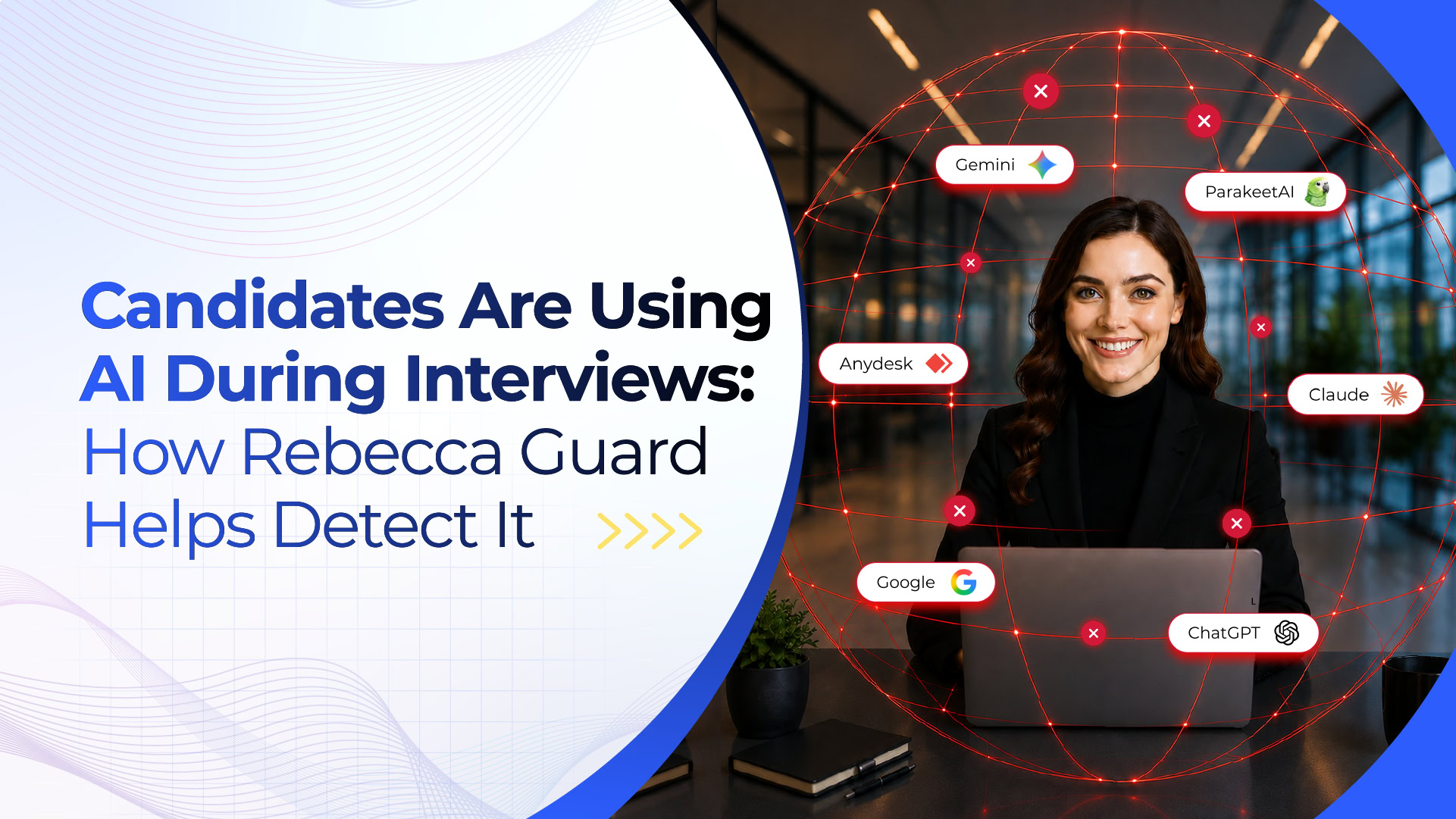
Cheat Sheet: What Candidates Use and What Rebecca Guard Detects
| Tool Type | Examples | How It Cheats | With Rebecca Guard |
| AI Interview Assistants | Cluely, Final Round AI, Parakeet, InterviewsBy | Feeds live scripted answers to the candidate | Flagged and blocked |
| AI Chat Desktop Applications | ChatGPT Desktop, Claude Desktop | Answers technical questions silently in the background | Detected and reported |
| Remote Access & Control Software | TeamViewer, AnyDesk | Let’s a third party conduct the interview remotely | Flagged and reported |
| Live Transcription Tools | Otter, Fireflies | Relays questions to an external coach in real time | Detected and reported |
Candidates can perform well in their interview, but once they start day one, they’ll have issues delivering that performance. It is especially difficult to detect AI during interviews because these frauds are not visible to the interviewer without interview cheating detection software. The video feed of a fraudulently talented candidate will look the same as that of a truly talented candidate because both will appear to present themselves in a competent manner while reading AI-generated responses from a second screen.
Employers do not experience poor performance from hiring frauds. They also incur additional costs through the waste of time for recruiters; job offers that are higher than necessary and therefore reduce team morale. Employers also face potential direct security risks to their organization from hiring frauds, including those identified because of the recent Nisos Investigation into North Korean IT worker fraud and broader Cybersecurity threats tied to fraudulent hiring.
What’s Really Happening on the Candidate’s Screen?
One problem that keeps hiring managers awake at night is that regular video interviews provide no insight into the applicant’s computer. An interviewer can only see a face answering questions confidently and judge an interview without the knowledge that the applicant has an AI assistant providing answers in real-time and/or a remote person helping them by telling them what to say through their conversation.
Rebecca Guard is integrated with the Rebecca AI interview platform the candidate should have installed Rebecca Guard before the start of their interview. While the Rebecca AI session is occurring, Rebecca Guard runs in the background and checks what applications are open on the candidate’s device. If the candidate is using a prohibited tool during their interview, Rebecca Guard helps support AI interview monitoring and AI-assisted interview detection. It is especially important in environments where hiring teams are concerned about organized interview fraud, Employment Fraud, or DPRK candidate fraud attempts using AI assistance.
The design is intentional. Candidates are told upfront about the requirement for Rebecca Guard. They are provided with a full explanation of what Rebecca Guard does. The candidates consent to install Rebecca Guard prior to installing it. Rebecca Guard is a required condition of the interview and communicated clearly to the candidates; it is like an examination hall requiring you to leave your cellphone outside before entering a testing facility.
Which Apps Are on the Blocked List and Why?
The sole purpose of Rebecca Guard is to determine whether a disallowed application is active on a candidate’s device. There are no behavioral assessments, key logging, or any other guessing methods done by Rebecca Guard. An application from the restricted list was checked by the system for activity.
The default restricted list includes many of the tools that are utilized for interview fraud, including AI interview assistants, AI desktop apps, remote desktop apps, and live transcription apps. Examples include applications associated with ChatGPT interview cheating, real-time interview coaching, remote assistance, and other forms of AI interview cheating. However, companies may add applications to their own restricted list, and that list will change as new applications are released.
Equally important is the fact that Rebecca Guard does not access files, capture screen shots, record screen, log keystrokes, look at web browser history, e-mails, text messages, data communications, audio or video files. There are no persistent background services being installed by Rebecca Guard. Rebecca Guard determines the applications that are installed on a device and reports that information solely.
When the Interview Is Over, So Is Rebecca Guard
Most of the monitoring software will persist past the time of the task being accomplished by running an agent, installing a service, and collecting information for an unknown time and results. Rebecca Guard was designed specifically not to do anything mentioned above.
When the interview ends, or when the applicant exits the application, the monitoring will be terminated; there will be no processes remaining to monitor any future activity, and no data will reside in a temporary folder. There will be no check-in for tomorrow or any scheduled actions within the software; rather, the application will expire automatically, approximately 60 minutes after the interview, and will completely erase itself and all temporary files associated with it. Therefore, the applicant’s digital device will be restored to its state prior to the commencement of the interview.
Hence, the privacy and integrity of the interview process can co-exist. Recruiting companies that use Rebecca Guard in their Rebecca AI workflow can hold their applicants accountable by applying a consistent and verifiable standard without having to require the applicant to give up any portion of their privacy beyond the time they are being interviewed through the use of Rebecca Guard software.
Interview Integrity Is a Hiring Infrastructure Problem
Investigators from the Nisos fraud investigation have confirmed that one fraud cell made more than 166,000 fake job applications, used artificial intelligence to gain access to live video interviews, and placed operatives in American businesses. The case demonstrates how large-scale DPRK candidate fraud can operate like a coordinated Employment Fraud network rather than isolated candidate misconduct. As a result, recruiters can no longer see the process of conducting video interviews as a low-risk, good faith transaction.
Until now, employers have not had any method of knowing what applicants are doing on their computer screens during an online interview. With Rebecca Guard, that has changed. It adds an additional level of transparency and privacy-respecting verification to the process, giving organizations a practical way to strengthen Cybersecurity controls in hiring while also supporting reliable interview integrity software and AI hiring fraud prevention.
As remote hiring scales, organizations need a reliable way to verify interview integrity without compromising candidate privacy.
Rebecca AI Guard by Pete & Gabi provides that solution by helping employers establish a more transparent, accountable, and trustworthy hiring process.
Frequently Asked Questions
1. What happens if a candidate is running a prohibited application when the interview begins?
The Rebecca Guard app checks for the activity of any prohibited applications and alerts the Rebecca AI platform of the finding. The recruiting organization determines if the interview is restricted, if a warning is issued, or if the interview will be flagged for review according to their policies. Rebecca Guard only reports and not determines.
2. Can candidates using assistive technologies still participate in interviews?
Yes. The Rebecca AI’s Guard feature was created with the purpose of creating an equal opportunity and accessible interview experience. Accessibility and assistive technology applications will not be restricted, nor will they be flagged, unless the recruiting organization adds them to their list of restricted applications.
3. Can interviewers spot AI cheating on their own without any tool?
Most of the time, and not consistent. There are some signs of fraud, such as the candidates’ eyes tracking the screen eerily, responses sounding overly polished, or answers taking a very slight but consistent time to arrive. However, very skilled fraud operators have learned how to mask these signs. Once the hiring manager suspects something is wrong, the interview has already concluded, and the candidate has advanced to the next round.
4. Does interview integrity software access personal files or private data?
No. Multiple different types of modern interview integrity solutions that can be configured to measure compliance without access to the candidate’s personal files, documents, emails, messages, browser history, or cloud storage. According to the way the interview integrity solution is implemented, there may or may not be recording of screens, monitoring of keystrokes, or capturing of audio or video.
5. Is interview integrity software permanently installed on a candidate’s computer?
Not necessarily. Some interview integrity solutions are designed for temporary use during the interview process and can be removed after the assessment is complete. Organizations should clearly communicate how long any software remains active and what data, if any, is retained after the interview.