Around half of American job seekers (47.7%) believe that the AI recruitment tools are biased and make it more difficult for individuals of certain age, race, gender, or other attributes to be hired. The remaining quarter of respondents disagree. This difference in the opinion of applicants regarding algorithmic recruitment and the confidence that employers have in the use of such systems has become one of the largest obstacles faced by recruiters in 2026.
AI-powered recruitment and interviewing technology has quickly become a norm in many companies. Resume scanning is already present in both recruiting platforms as well as interview automation services, making being one of the most prominent HR technologies. But there are numerous questions related to the fairness of such practices raised by the government, scientists, and candidates.
The article encompasses the concept of automated employment decision systems (AEDTs), reasons for bias in AI recruitment systems, main ideas of responsible disclosure, as well as the way how Rebecca AI, a recruiting agent by Pete & Gabi managed to overcome the existing issues.
The Stakes: Why This Conversation Matters Now
The regulatory framework in AI and research landscape has changed a lot over the course of the last 12 months. Here are a couple of important facts to think about:
- The massive Stanford HAI study which analyzed millions of jobs offers within 150 companies that have used a third-party AI recruitment system discovered the differences in the results for Black and Asian applicants as per the traditional adverse impact studies.
- Around two thirds of companies who use AI in hiring fairly report that their systems may be subject to discrimination (the most common is age discrimination), with the second place occupied by socioeconomic discrimination, and finally, gender discrimination.
- The EU AI Act labelled the use of hiring algorithms as high-risk systems, with severe sanctions for noncompliance. The US states follow its suit, for instance, Colorado AI Act obliges to conduct bias audits on high-risk hiring tools; New York City has employed its own AEDT audit and notification regulations.
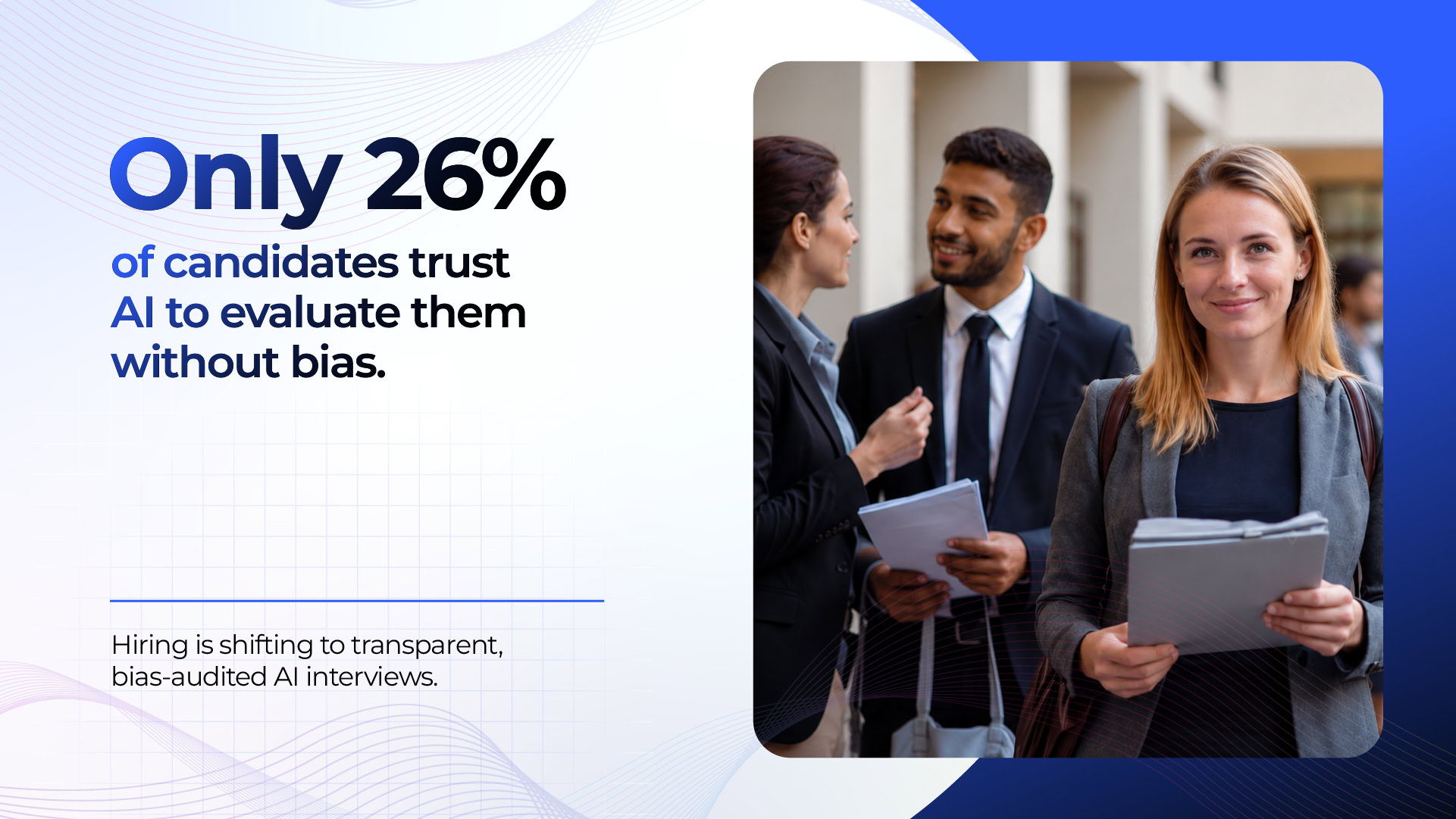
- The trust has not kept pace with the adoption of AI, with only one-fourth of the individuals expressing trust in the AI systems about their evaluation, while most of the population is entirely against the AI playing a major role in the hiring process.
The tools now available have been documented in terms of risks and their regulation has stiffened. Organizations that are implementing AI in the recruitment of candidates, as well as candidates attending interviews with AI, need to understand how everything works and where problems might arise.
What Counts as an “Automated Employment Decision Tool”?
An Automated Employment Decision Tool (AEDT) refers to any AI system that significantly aids or replaces human judgement in hiring, promotions, or other employment-related decisions. Whether a specific tool is determined to be one under law depends on various factors such as: the laws in effect, the way in which the system is implemented by the company, whether the system produces a score or some kind of ranking, and how far the output is taken into the decision-making process.
This is important because the classification entails responsibilities such as providing notices to candidates, conducting bias reviews, providing alternatives to discrimination, and guaranteeing the right to a human review, among others. A well-designed system does not want to convert into such things, so it incorporates this from the beginning.
How These Tools Actually Work
For the exposition of this point, we will use the example of Rebecca AI which has addressed this issue and described its working principle in its AI Bias and Automated Employment Decision Tools Disclosure document. Rebecca AI can be discussed as an AI voice and video interviewer, asking pre-prepared questions and probing questions, creating transcripts, comparing the answers with the job requirements of the employer, and giving scores and comments.
The system works with possible conditions such as resumes, work experience, multiple certificates, IT knowledge, and answers in the interview process. The technical part includes such aspects as transformation of voice into text, organization of speech by themes, and its evaluation according to special evaluation criteria with eventual assessment.
The last point made by the author is where a lot of biases are found, not in overtly biased algorithms, but in things such as speech-recognition errors that impact speakers of different languages or those with speech disabilities or criteria used for scoring, also indirectly punishing the way people communicate rather than the subject of their communication.
Where AI Bias Creeps In
The underlying cause of bias in AI recruitment is usually made up of similar patterns:
- Training or assessment data that doesn’t accurately reflect hiring trends and instead only confirms expectations from the past.
- Proxy indicators such as postal code, name of school, and speech that link with protected characteristics without utilizing any methods to examine race, gender, or age.
- Communication styles cause consequences for candidates because it makes use of accent, dialect, or poor articulation.
- Technical problems and issues with access make it hard for candidates to use the system, including things like bad connectivity and issues related to assistive technology.
- Human dependence on AI score, where professionals consider the score to be infallible rather than just considering it.
None of the audits can guarantee that the system is free of these elements. As a result, expert platforms tend to treat bias elimination as a continuous process rather than one-time action.
What Responsible Disclosure and Bias Auditing Look Like
The relevant disclosures of AEDT and Rebecca AI are quite similar on similar issues like what the technologies can and cannot assess, what data it collects, how it generates scores; and most importantly, what are the characteristics of people that it cannot identify (for example, emotional state, honesty, mental state, or cultural adequacy are not relevant in the context of job evaluation).
Independent bias audits (if instructed by the law) usually analyze the rates of selection, appraisals and impact ratios based on various demographics, and also their own limitations (the relevance of the sample size, the absence of demographic data and the possibility to extrapolate data from one audit of an organization to another organization).
Rebecca AI states that its candidate scoring has been bias audited in accordance with guidelines established by the Equal Employment Opportunity Commission, including verification using the four-fifths adverse impact rule. The platform also aligns with SOC 2 and ISO 27001 compliance standards. Candidates are informed in advance that they are speaking to an AI which, considering the other AI billings issued by various organizations, is not yet a common practice amongst employers.
Human Oversight Is the Non-Negotiable Piece
Whatever a platform’s technical safeguards, the disclosure model that regulators and researchers keep converging on is the same: AI should assist, not replace, human decision-making. It requires:
- A person will check the results produced by AI before the final decision is made.
- In case a candidate wants to be evaluated in another way other than AI, they have the right to ask for another form of evaluation, be it an interview with a person, a written assignment or time lasting longer than usual, and this can be done without revealing any personal details regarding health.
- At the same time, it is allowed to ask for a human review of transcripts as well as scores and recommendations in case they seem to be inaccurate.
- Moreover, a candidate can request changes in personal data in case it is inaccurate.
Rebecca’s AI is positioned very unambiguously in the range of “assist, don’t replace” philosophies: recruiters make hire decisions whereas the platform presents its scores as an assessment subject to human verification.
The Practical Takeaway
For employers, the checklist is pretty straightforward: figure out what AEDT laws apply in your location and the location of the applicant, send notices, have a human involved in the process before any declinations are sent out, provide alternative assessments and accommodations, and don’t automatically assume that the vendor’s audit of their system suffices to address your specific needs.
For job applicants, it is useful to know that you do generally have a right to find out whether AI was involved, demand an alternative method of assessment, and request that the results of an AI assessment that you believe is incorrect be reviewed by a human. You should also know that you should not be retaliated against asking these questions.
AI interviewing tools such as Rebecca are not going anywhere because they deliver important savings in time and efficiency. However, using AI without accountability is the recipe for creating bias. Those organizations that understand this fact will be the ones that adopt proper perspectives toward the issues of transparency, auditing, and human monitoring and make these issues part of the product features of their businesses.
Frequently Asked Questions
1. What makes an AI hiring tool an “automated employment decision tool” (AEDT)?
Typically, a tool qualifies if its output such as a score, ranking, or recommendation significantly complicates or even supersedes choices made by humans regarding recruiting and promotions or other employment-related issues. The precise legal classification is determined by local law, by the employer’s use of the tool, and by the degree of dependence on its output.
2. Can an AI interviewer legally reject me without a human ever reviewing my application?
It depends on the jurisdiction and on the employer’s own rules. It is what many new regulations of AEDT aim at limiting. Resilient computer programs introduce a human check prior to any unfavorable decision, and many legislations are heading in this direction.
3. What should I do if I think an AI interview scored me unfairly?
In most cases, the request for human review should be addressed to the hiring company, and any justification might come in when the request is made (technical difficulties, misunderstanding disability-related factor, wrong interpretation of the answer). Most letters (including that written by Rebecca) should include this as a right and not just a matter of courtesy.
4. Does a bias audit guarantee an AI hiring tool is fair?
Bias audits assess aspects such as selection rates or impact ratios as per data available for a specific point in time but do not imply complete absence of bias or inaccuracies, and it is possible that a platform-level audit is not indicative of how an employer has used the tool. Audits do not provide certainty, but only the starting point for further work.
5. How often should bias audits be repeated once an AI hiring tool is in use?
AI models, their prompts, and the scoring process keep changing over time; a bias assessment only depicts the condition of a system at that point only and is not a guarantee for any period of time. The best option is to recheck the system after major changes in the model or in the scoring system. At least, an audit should be performed according to the laws that govern it (for instance, it must be conducted at least once a year according to many U.S. state and city laws regarding AEDT).