

In today’s talent acquisition landscape, there may be nothing more frustrating than spending hours evaluating, interviewing and nurturing a highly qualified applicant only to have them vanish without a trace. Emails go unopened. Calendar invites are not unlimited. Voicemails are totally ignored.
For years, the power in hiring has been with the employer. Millions of job seekers have been sending resumes into the dreaded “black hole” of applicant tracking systems, only to never hear back (not even a rejection notice). Today the pendulum has swung violently in the opposite direction. Job seekers are walking away from hiring pipelines, forcing recruiters to scramble to fill empty interview slots and explain sudden drop-offs to increasingly impatient hiring managers.
If you’re a talent leader struggling to keep applicants engaged from initial application to final offer letter, you’re not alone. This comprehensive guide breaks down the true scale of the abandonment crisis, explores the systemic friction that causes top talent to walk away, highlights the hidden operational costs of a leaky pipeline, and provides actionable, practitioner-level strategies to keep your candidates locked in and highly responsive.
What is candidate ghosting, and how common is it really?
Candidate ghosting occurs when a job seeker ceases all communication at any point in the active hiring process, often without explanation.

This is so very common in today’s labor market, from rare annoyance to systemic operational crisis. According to recent research from the SHRM Talent Trends Report, 41% of organizations have experienced candidates going “dark” completely during the active interview process. On top of that, 39% of hiring teams have had to deal with a no-show interview in the past year – when an applicant doesn’t log on or turn up for an arranged meeting without giving any notice.
The phenomenon has become deeply mutual. It’s the age of the employer ignoring the applicant, and it’s created a culture where candidates feel perfectly justified in walking away from a process without closing the loop.
| Market Data Point | Research Finding |
| Mid-Process Drop-Off | According to Indeed’s Hiring Lab, 47% of job seekers have abandoned a hiring process mid-way. |
| Interview Disappearance | SHRM reports that 41% of organizations experience candidates disappearing during the interview stage. |
| The No-Show Rate | 39% of hiring teams have dealt with a scheduled interview no-show recently. |
| Reciprocal Disconnect | 44% of candidates now openly admit to ghosting employers, while 53% report being ghosted by employers themselves. |
Why do candidates ghost recruiters mid-process (the real reasons, not just “flaky candidates”)?
The main reasons candidates ghost recruiters mid-process are: the hiring timeline is too slow, communication is poor, or they accepted a faster offer from a more decisive competitor.
If your hiring managers are constantly wondering, “Why do candidates ghost recruiters?” the data indicates systemic friction, not individual applicant flakiness. The truth is that if the employer is silent, then the candidate is silent. Research shows that 34% of candidates think they’re out of the running if after an application or an interview, they get only a week of silence. If candidates feel their time is not respected, they will emotionally check out of the opportunity.
Three operational failures beyond poor communication drive candidates away:
- The Scheduling Black Hole: When it takes five emails over three days to nail down a 15 minute phone screen window, highly sought-after candidates get impatient.
- No Pay Transparency: Candidates drop out of a pipeline late in the process when they discover the salary does not meet their expectations. If you wait until the third interview to talk about compensation, you are setting yourself up for late-stage ghosting.”
- Misaligned Interview Processes: A six-hour unpaid take-home assessment or five separate panel interviews for a mid-level professional signals a bureaucratic, slow-moving corporate culture, causing top talent to bail.

What does ghosting actually cost a hiring team, in time and pipeline?
Ghosting costs a hiring team thousands of dollars in lost operational productivity, longer vacancy periods and wasted administrative hours.
In measuring recruiter ghosting metrics, talent leaders frequently underestimate time wasted on dead-end processes. The financial and time damage from a sudden drop-off of applicants is huge because it is a compounded loss. You lose the candidate, but you also lose the hours you spent reviewing their resume, the time you spent scheduling their calls, the calendar time you blocked out for your senior hiring managers, and the opportunity cost of turning away other viable candidates waiting in the wings.
The “Candidate Time Tax” measures the aggregate hours invested in the sequence of events culminating in the sudden silence and reflects the average loss of 47 hours of total effort from one ghosted application pipeline. When this becomes a pattern, recruiter bandwidth is obliterated, cost-per-hire skyrockets and hiring managers start to lose faith in the talent acquisition team’s ability to provide reliable pipelines.
What are the warning signs a candidate is about to go quiet?
The key red flags that a person is about to ghost you are late email responses, reluctance to give you references, and not asking detailed questions about the position.
Some candidates vanish without a trace, while others leave subtle hints before they disappear completely. Recognizing these red flags allows recruiters to intervene, address any underlying issues or take the hit before the panel interview costs time and money.
Look out for these changes in behavior:
- The “Busy” Reschedule: If a candidate cancels and reschedules an interview more than once, that’s a good sign they’re likely to drop out. Usually it means they are busy with other, more lucrative final round interviews.
- One Word Answers: A candidate who suddenly starts responding to emails with one-word, disinterested responses? They’ve mentally checked out of your process.
- Not Asking Questions: Top talent interviews you as much as you interview them. No questions about team structure, corporate strategy or company culture at the end of an interview means a candidate is no longer picturing themselves in the job.
- Next Steps Hesitation: When a recruiter outlines the next steps (for example, providing professional references or filling out a background check consent form) and the candidate hesitates, it is a huge indicator of pending silence.
What can recruiters do differently to reduce ghosting at each stage?
To reduce candidate abandonment, recruiters should tighten communication SLAs, shorten scheduling timelines, and provide instant post-interview feedback.
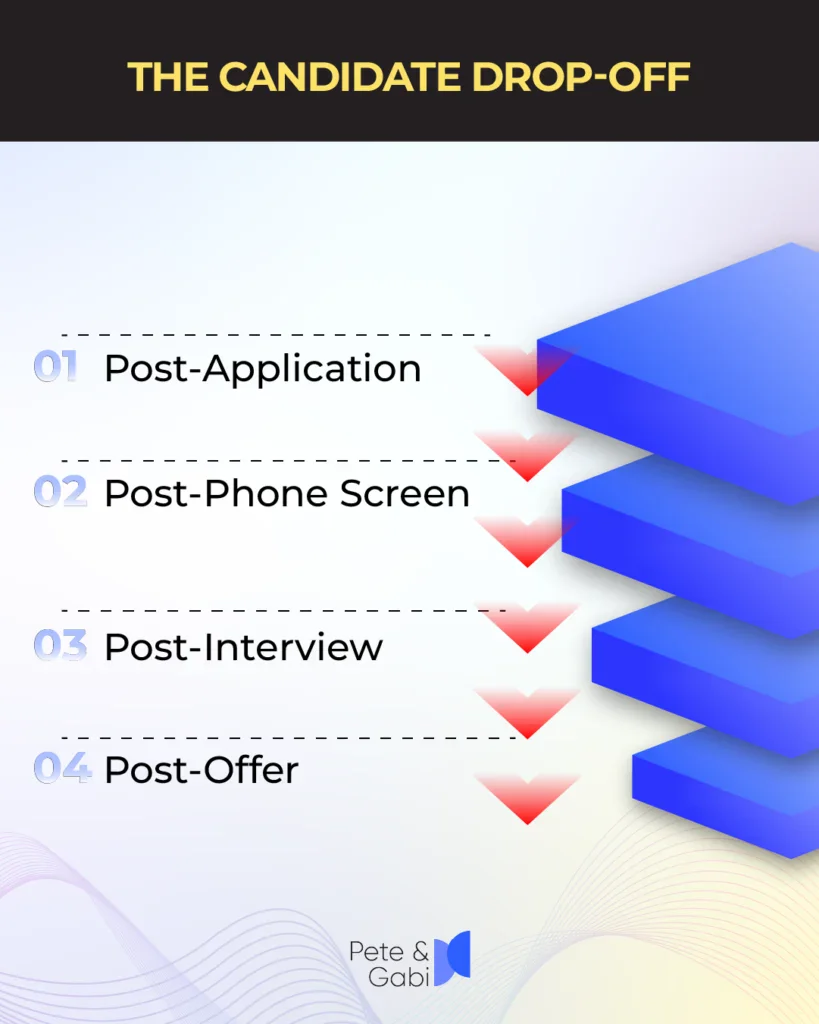
Understanding how to stop candidate ghosting requires mapping the exact moments where applicants fall out of your funnel. It is not enough to just send a generic follow-up email; hiring teams must fundamentally restructure their operations to improve recruiter productivity without sacrificing quality.
By securing the leaks at each major milestone, you can keep talent locked in:
| Hiring Stage | Primary Ghosting Risk Factor | Tactical Solution to Retain Candidates |
| Post-Application | Lengthy forms and lack of initial acknowledgment. | Send automated, immediate confirmation emails detailing the exact next steps and expected review timelines. |
| Screening Phase | Multi-day calendar scheduling delays and phone tag. | Utilize self-service calendar booking links or automated conversational voice screening to bypass scheduling entirely. |
| Post-Interview | The “silent waiting period” while hiring panels deliberate. | Enforce a strict 48-hour feedback SLA. If no decision is made, send a transparent status update explaining the delay. |
| Offer Extension | Uncompetitive salary offers or complex onboarding portals. | Discuss salary expectations transparently in the very first screening round to ensure alignment before the offer stage. |
Does speeding up the process actually reduce ghosting?
Yes, speeding up the hiring process is the single most effective operational change a company can make to drastically reduce candidate abandonment.
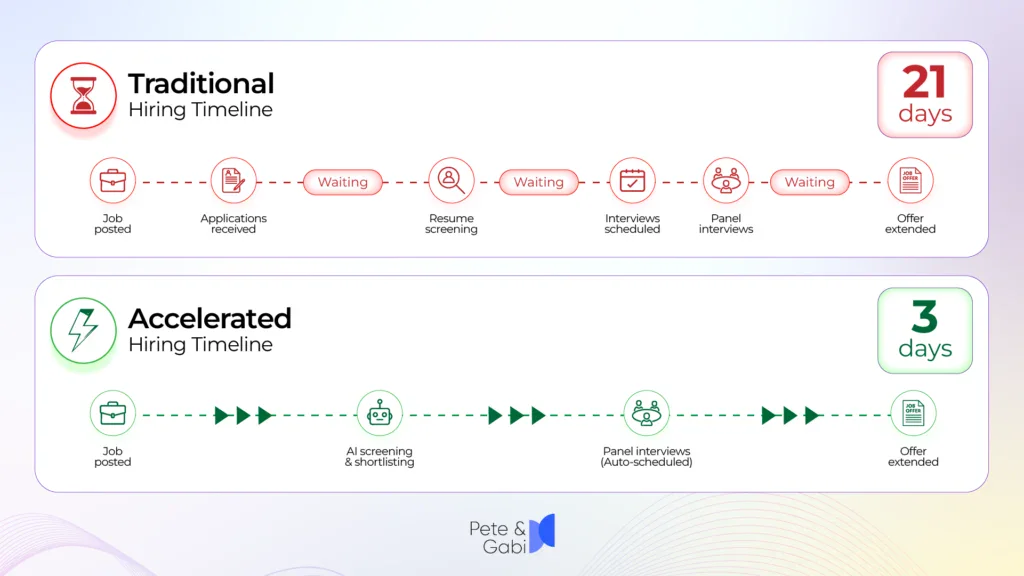
Slow hiring timelines are the biggest killer of talent acquisition. If it takes three or four weeks, candidates have plenty of time to interview other places, lose interest in your brand, or just take a competitor’s offer. Speed-to-hire is a great pricing indicator to candidates that your company is decisive, super-efficient, and respects their time. For tested, practitioner-level tactics to accelerate this timeline, see our comprehensive guide to reducing time-to-hire.
More importantly, fast-tracking the process doesn’t mean skipping important evaluation steps, it means ruthlessly removing the dead space between the steps. It improves the candidate experience, which is what the industry calls it. Urgently handled applicants, treated with respect and transparency are highly engaged. (Discover exactly what candidate experience is, to get a sense of the impact this has on your employer brand and offer acceptance rates.)
Crucially, speeding up the process does not mean skipping vital evaluation steps; it means ruthlessly eliminating the dead space between the steps. It directly enhances what the industry refers to as the candidate experience. When applicants are treated with urgency, respect, and transparency, they remain highly engaged. (To understand how deeply this impacts your employer brand and offer acceptance rates, explore exactly what is candidate experience).
One of the most powerful and immediate ways to accelerate the top of your funnel is by deploying conversational automation. By utilizing an intelligent system like Rebecca AI Interviewer, talent teams can completely eliminate the days wasted on scheduling manual phone screens. Instead of suffering through a multi-week, disjointed communication loop, candidates receive a same-day, fully scored interactive interview. This modern approach keeps top talent locked into your pipeline, delivers immediate feedback, and drastically minimizes the risk of them disappearing to a faster competitor.