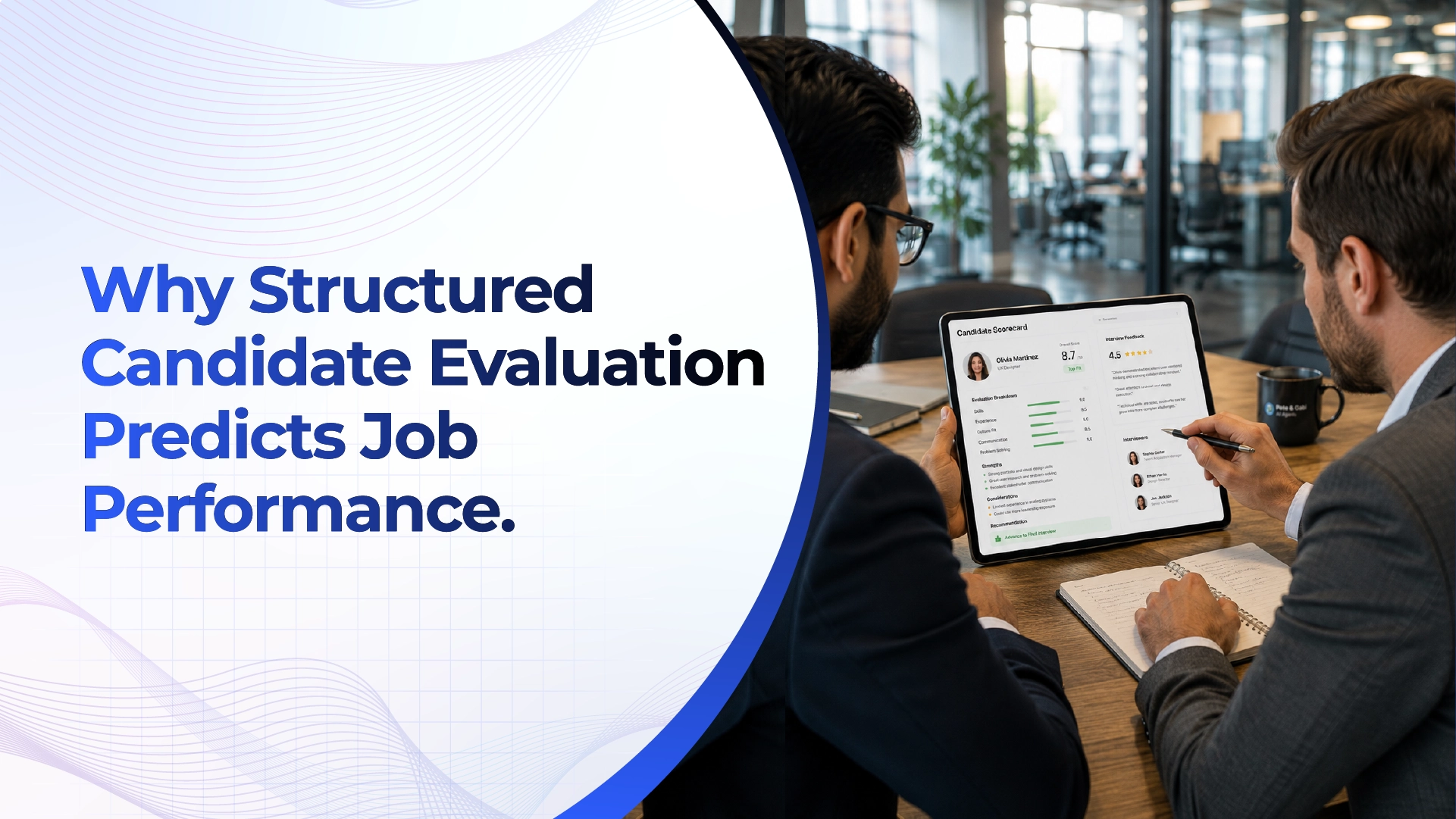
In the high stakes world of talent acquisition, hiring for “gut feeling” is one of the most dangerous and costly mistakes an organization can make. When organizations rely on unstructured conversations, highly charismatic candidates often overshadow competent candidates. To combat this, human resources professionals make heavy use of structured evaluation frameworks to predict how a candidate will actually perform on the job.
The behavioral interview is central to this structured approach. Rather than asking candidates what they might do in the future, this methodology forces candidates to demonstrate their skills by telling us exactly what they have done in the past. But while nearly every modern enterprise has a claim to using this framework, very few do it end-to-end throughout their entire hiring pipeline.
In this guide, talent acquisition leaders, hiring managers and HR pros looking to up their hiring accuracy will get the full scoop on the science that underlies behavior-based evaluation. We’ll break down the framework, break down some common questions, explain why even the best teams struggle with score consistency, and explain how smart tech is finally bringing a standardized approach to human potential evaluation.
What is a behavioral interview, and why do most hiring teams use one?
Behavioral interviews are highly structured interviews based on the psychological assumption that the best predictor of future behavior is past behavior. Interviewers don’t pose opinion or hypothetical questions. They ask candidates to recall specific past experiences, challenges and workplace scenarios.

This is the most common method used by high performing talent acquisition teams because it eliminates a candidate’s ability to provide rehearsed, generic answers. You ask a candidate, “How do you deal with conflict?” and they’ll give you the ideal, textbook answer about communication and compromise. But if you ask, “Tell me about a time you had a fundamental disagreement with a stakeholder and how you resolved it,” the candidate has to rely on real memory and concrete actions.
Hiring managers can actively gage an applicant’s experience depth by requiring candidates to provide specific examples. It separates the people who have just watched a project happen from the people who made the project happen. Additionally, these questions are based on specific job competencies such as leadership, adaptability or analytical thinking, offering objective data points that help organizations make data-driven hiring decisions.
What are the most common behavioral interview questions, and what are they really testing for?
The best behavioral interview questions are never just pulled from a hat. They are reverse-engineered from the core competencies for the open role.
The questions usually start with, “Tell me about a time when…” or “Give me an example of a situation where…” even if the wording is different. They want to see certain soft skills , and how well you work under pressure .
Here’s a breakdown of common behavior-based questions and the qualities they’re meant to evaluate:
| Core Competency | Common Question Phrasing | What the Interviewer is Actually Testing |
| Problem Solving | “Tell me about a time you had to solve a complex problem with incomplete data or limited resources.” | Can the candidate operate in ambiguity? Do they panic, or do they build a logical framework to find a solution? |
| Conflict Resolution | “Describe a situation where you fundamentally disagreed with a manager’s strategic decision. What did you do?” | Does the candidate possess emotional intelligence? Can they disagree professionally without damaging team morale? |
| Adaptability | “Give me an example of a project where the core priorities shifted unexpectedly at the last minute.” | How does the candidate handle stress and pivot their workflow? Do they complain, or do they execute the new strategy? |
| Leadership | “Tell me about a time you had to influence a team or project when you had no formal authority over the group.” | Can the candidate build consensus and drive results through persuasion and respect rather than relying on a job title? |
| Failure & Growth | “Describe a time when a project you led failed. What went wrong, and what did you learn from the experience?” | Does the candidate take extreme ownership of their mistakes, or do they blame external factors and coworkers? |
When interviewers hear these questions being answered, they are not just judging the result. They’re really listening to the candidate’s thot process, their strategic thot process, their personal accountability and their ability to articulate complex situations clearly.
How does the STAR method work for scoring behavioral answers?
Recruiters and hiring managers use the star method interview framework to evaluate these complicated answers fairly. STAR is an acronym for Situation, Task, Action and Result. It is a structural guide for candidates to answer questions and a strict evaluation rubric for interviewers to score them.
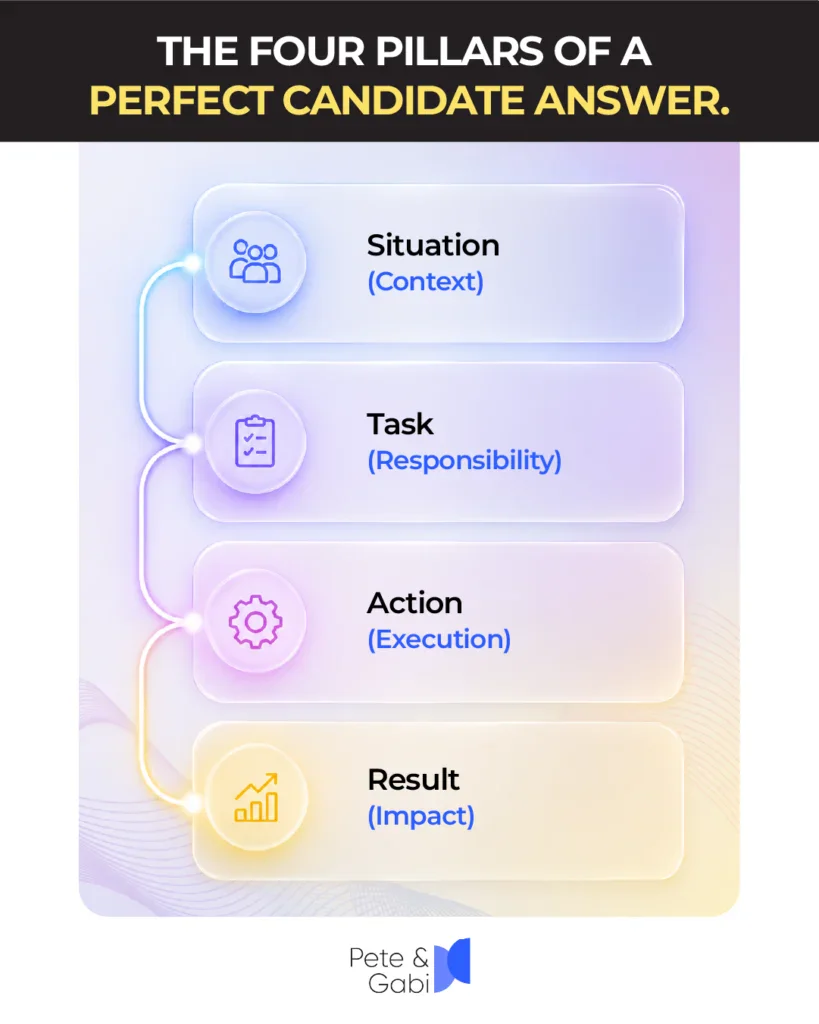
The STAR method is a tool the interviewer uses to assess a candidate’s story and make sure the answer is full and meaningful. When a candidate omits any of the four pillars, the interviewer knows precisely where to probe.
- Was there sufficient context provided by the candidate? The interviewer has to know the background, the stakes, the environment where the event took place.
- Did the candidate clearly describe their role in the scenario? The interviewer needs to find out what the candidate is responsible for by himself and what is the responsibility of the wider team.
- Action: What specific, measurable steps did the candidate take to accomplish the task? This is the most important pillar. Interviewers are listening for “I” statements, not “we” statements, to make sure you are taking credit for your work.
- What was the end result in terms of business impact? A good candidate will offer a quantification of the outcome (e.g. “We saved $50,000” or “We delivered the project two weeks early”) instead of a vague conclusion.
Why do behavioral interviews go inconsistent between interviewers, even with the same question list?
Structured questioning and the STAR framework are widely used, but in reality most organizations conduct these interviews in a notoriously inconsistent fashion. Even if the talent acquisition team requires the same list of questions to be asked of every candidate, the scores that candidates get can vary a lot depending on who is doing the interviewing.
This inconsistency is because there is no standardized behavioral interview scoring rubric . Giving a manager a list of questions is only half the battle, because if you don’t have a clear idea of what a “good” answer looks like versus a “bad” answer, the evaluation immediately defaults back to subjective gut feeling.
| Scoring Methodology | The “Gut-Feel” Unstructured Approach | The Rubric-Based Structured Approach |
| Candidate Answer | “I managed a difficult client by listening to their complaints and eventually calming them down so they renewed their contract.” | “I managed a difficult client by listening to their complaints and eventually calming them down so they renewed their contract.” |
| Interviewer Rating | Score: 5/5 (Excellent). Interviewer reasoning: “The candidate seemed very confident and friendly. I like their communication style.” | Score: 2/5 (Below Expectations). Interviewer reasoning: “Answer lacked specific Action steps and quantifiable Results. Did not meet the rubric standard for conflict resolution.” |
| Impact on Hiring | Highly susceptible to affinity bias; rewards charismatic candidates who lack depth. | Highly objective; rewards candidates who provide concrete evidence of competency. |
Moreover, human interviewers suffer from cognitive fatigue and context drift. The interviewer evaluates a fifth interview on a Friday afternoon differently to the first interview on a Monday morning. Without strict scoring anchors, the standard for a “passing” answer moves imperceptibly throughout the day, destroying the fairness and predictive validity of the hiring process.
Does research actually show behavioral interviews predict job performance?
There is a wealth of empirical data supporting structured evaluation. Industrial-organizational psychologists have studied hiring practices for decades, and the consensus is that structured, behavior-based questioning is much better than conversational interviewing for predicting post-hire job performance.
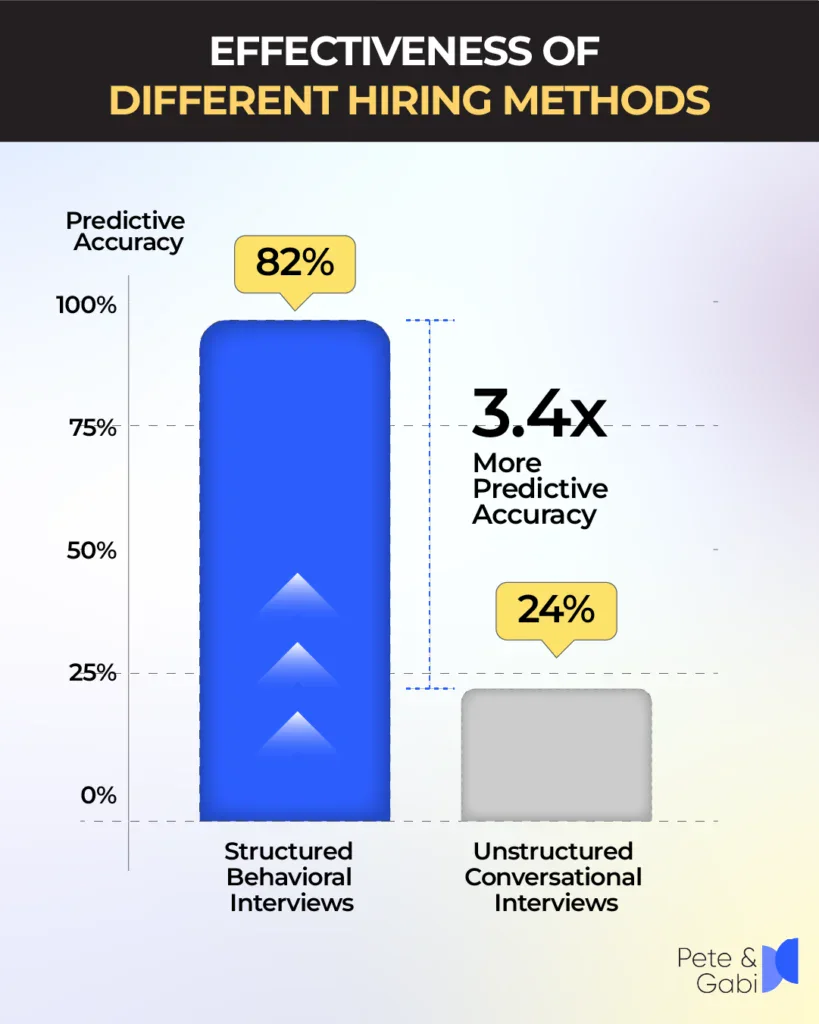
The data reveals a huge performance difference between a structured and an unstructured interview. According to the seminal meta-analysis of personnel selection by Schmidt and Hunter, structured interviews have a predictive validity of .51, with unstructured interviews lagging behind at .38. Thus, structured interviews are roughly 34% more accurate at predicting job performance.
The gap is also confirmed by more recent research. According to a 2023 update by Sackett and colleagues, unstructured interviews scored a significantly lower.19 in the same analysis, while structured interviews scored a.42, making it the best-performing predictor among widely used selection techniques.
Data shows that when every role candidate is asked the same job-relevant questions and scored against the same criteria, organizations are comparing apples to apples instead of relying on subjective intuition. Unstructured interviews, which are essentially open-ended conversations, are very susceptible to confirmation bias, halo effects, and first-impression bias, which greatly diminishes their predictive accuracy.
How can structured scoring, human or AI-assisted, make behavioral interviews fairer?
For organizations to tap into the real predictive power of behavior-based interviewing, they need to eliminate subjective scoring drift. The way to fix this is to ensure that everyone scores on the same standardized rubric, with the same specific anchors for each candidate.
Structured scoring removes the vibe check from the hiring process, whether it’s a tightly disciplined human HR team doing it, or aided by modern artificial intelligence. Even if the candidate is a charmer, even if they went to a great school, a Level 3 answer needs the right evidence, presented in a standardized framework, and a Level 5 answer needs to show quantifiable business impact.
The Role of Technology in Standardization
Training human interviewers to rigidly adhere to a rubric is difficult and resource intensive, but intelligent conversational platforms are solving the consistency problem completely.
For example, structured assessments such as Rebecca AI Interviewer are programd to perform advanced screening without the strain of cognitive fatigue. Rebecca’s interview asks the same baseline questions of each candidate, in the same tone, probes in real time for missing STAR elements, and scores the final response against an unchanging, objective rubric.
There’s no drift in gut-feel from the first interview of the day to the 50th. All candidates are judged in an identical fashion, fair and perfectly consistent. We deploy a digital AI Interviewer tools at the top of the hiring funnel to ensure only candidates with verified, rubric-passing past behaviors reach the final hiring manager round.
For more insights on how to build a highly structured bias-proof hiring funnel, explore our comprehensive guide on the best practices for the candidate screening process and check the definition, stages and rules of recruitment process. By dedicating yourself to structured evaluation, your organization can stop guessing, and start predicting performance with real accuracy.