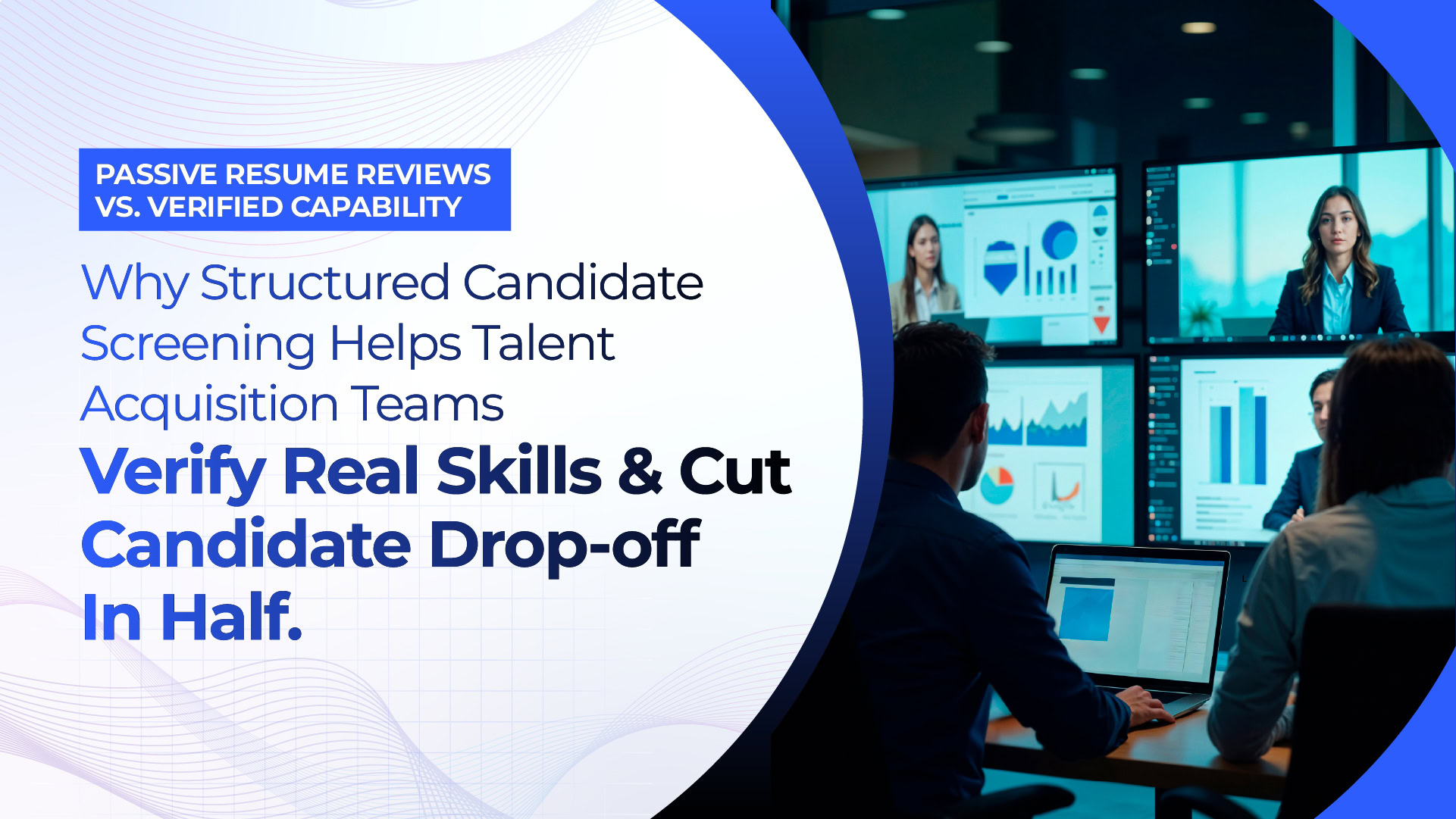
Hiring teams are always faced with the challenge of quickly assessing a high volume of incoming job applications, while at the same time moving the right talent through the hiring pipeline fast enough to prevent top candidates from accepting competing offers. Bottlenecks in hiring can happen quickly when early-stage evaluations rely on manual reading of resumes and broken phone tag.
A structured candidate screening process provides a repeatable way to assess applicant capabilities in the early stages. Modern candidate screening tools combined with clear evaluation stages can help talent acquisition teams weed out unfit candidates, gauge fundamental technical skills and deliver qualified candidate shortlists to hiring managers.
This practical guide outlines the four basic evaluation steps, compares the most important screening tools for recruitment, and explores the impact of AI technology and automated candidate screening on early talent evaluation in 2026.
What is candidate screening and why does it matter?
Candidate screening is the first step in the recruitment process where recruiters and hiring managers review the qualifications, technical skills, work authorization, and salary expectations of job applicants before inviting them to the formal interview rounds.

Screening is the vital link between deep-dive panel assessments and top-of-funnel candidate sourcing, says LinkedIn’s Talent Acquisition Glossary. Candidate screening helps talent acquisition teams quickly identify critical requirements rather than waste valuable team hours interviewing unvetted applicants.
| Operational Objective | Practical Impact on Hiring Pipeline |
| Filter Out Mismatches | Identifies uncalibrated salary specs, work authorization issues, or missing core skills before live interviews. |
| Protect Manager Bandwidth | Ensures hiring leads spend time interviewing vetted, highly qualified candidates rather than reviewing PDF resume piles. |
| Standardize Evaluation | Applies identical qualification criteria across every applicant, reducing personal interviewer bias. |
| Maintain Candidate Speed | Reaches out to qualified applicants quickly, preventing top talent from losing interest during long delays. |
Without a structured screening framework, hiring processes degrade. Managers spend hours reading generic PDF resumes, phone screens turn into unstructured casual chats, and qualified applicants drop out due to slow communication.
What are the steps in a typical candidate screening process?
Candidates undergo four progressive evaluation checkpoints as part of the standard screening. Each stage filters candidate fit, so the final interview panel is only qualified candidates.
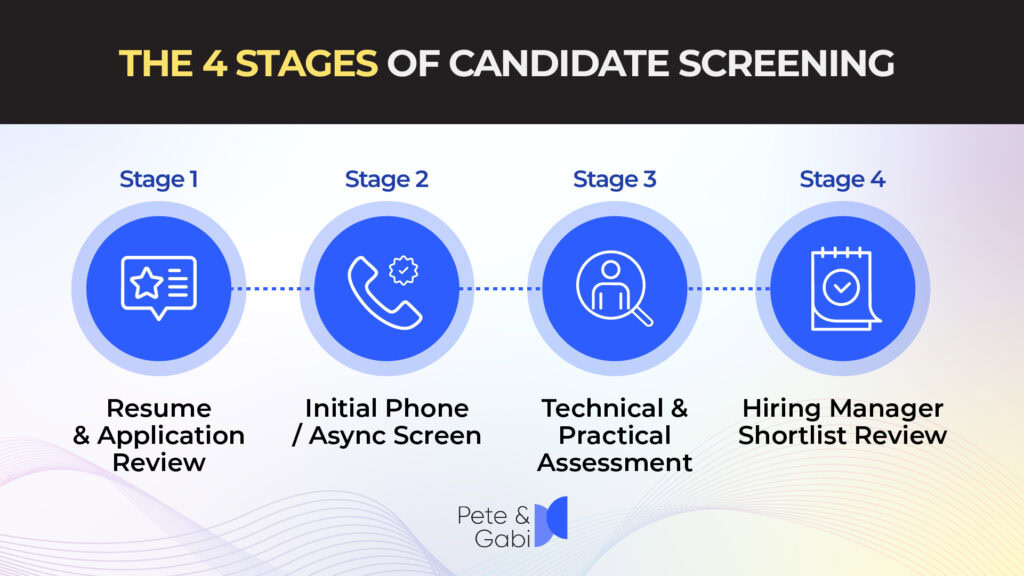
Stage 1: Resume & Application Form Review
The first stage is to assess the responses to incoming resumes and applications against the essential job requirements. Recruiters verify the applicant’s legal authority to work, education requirements, relevant work experience, and necessary credentials.
Stage 2: Initial Qualification Screen (Asynchronous/Telephonic)
Interested candidates are welcome to participate in an initial discussion. This 15- to 20-minute checkpoint confirms foundational operational details:
- Compensation band and salary expectations
- The length of the notice period and the availability of the start date
- Location logistics, work arrangements (onsite/remote/hybrid), travel willingness
- Motivation to the position and basic communication skills
Stage 3: Evaluation of Technical and Practical Skills
Candidates for specialized technical, engineering or analytical positions will be evaluated based on role-specific criteria. To assess hard skills, teams use specific technical screening tools: short coding tasks, practical tests of work samples, or domain-specific scenario tests.
Stage 4: Hiring manager shortlist review
The recruiter produces a candidate profile that includes candidate evaluation scorecards, assessment results, and screening summaries. The hiring manager reviews the pre-qualified shortlist and approves candidates for live panel interviews.
What types of screening tools exist (resume, technical, video, phone)?
Modern talent teams rely on a combination of applicant screening tools designed for specific evaluation touchpoints. Understanding the primary tool categories helps organizations build an efficient recruitment tech stack.
| Category | Primary Function | Ideal Use Case | Key Operational Benefit |
| Resume & ATS Parsing Tools | Parses PDF resumes; extracts skills, job titles, and experience history automatically. | Top-of-funnel inbound application processing. | Organizes candidate records; eliminates manual data entry into ATS. |
| Technical Screening Software | Administers automated coding challenges, practical skill assessments, and logic tests. | Engineering, software development, data science, and technical roles. | Verifies real technical capability; filters out resume exaggerations early. |
| Asynchronous Video Screening Tools | Captures pre-recorded video responses to standardized prompts on candidate schedule. | High-volume hiring (customer support, retail, sales, graduate programs). | Eliminates phone scheduling lag; allows batch review of candidate communication skills. |
| Automated Voice & Conversational Screening | Conducts interactive two-way voice screening conversations; evaluates candidate intent and skills in real time. | High-volume, technical, and mid-level corporate roles. | Replaces manual phone tag; delivers immediate structured candidate scorecards 24/7. |
Deploying the right combination of candidate screening tools ensures that candidates move smoothly from application to evaluation without creating administrative backlogs for HR teams.
How does automated candidate screening save recruiters time?
Automated candidate screening transforms the start of the hiring process by eliminating manual administrative friction, not by cutting corners on evaluation.
To understand how automated systems save time without replicating traditional time-to-fill optimization strategies, it is helpful to compare manual recruiter tasks with automated screening workflows:
| Workflow Stage | Manual Recruiter Screening Process | Automated Candidate Screening Workflow |
| Top-of-Funnel Review | Recruiter manually reads through 200+ PDF resumes, spending 20–30 hours clicking through ATS databases. | Candidate screening software parses applications instantly, surfacing high-fit profiles based on skills and criteria. |
| Screening Outreach | Recruiter sends individual emails to schedule introductory phone calls, waiting days for calendar alignment. | System sends automated screening invites immediately upon application, allowing candidates to screen 24/7. |
| Initial Qualification | Recruiter repeats the same 15-minute introductory questions 30 times a week over live phone calls. | Conversational screening engines conduct structured two-way qualification calls automatically. |
| Scorecard Creation | Recruiter manually types up screening notes, compiles summaries, and emails hiring managers for feedback. | Automated tools generate structured evaluation scorecards and sync notes directly to the ATS profile. |
Real Time Savings for Great Teams
Talent acquisition teams can also reduce manual administrative work by as much as 70% by automating processes like resume filtering and initial qualification calls.
Instead of administrative scheduling coordinators, recruiters will use their bandwidth to actively engage passive candidates, develop talent pipelines and provide guidance to hiring managers on final hiring decisions.
What should you look for in candidate screening software?
When selecting the right candidate screening software, you need to look beyond simple keyword filtering. To ensure compliance, high-performing hiring teams need tools that easily plug into their recruitment tech stack, measure real candidate abilities and stay compliant.
When you assess candidate screening tools, use this feature checklist:
| Essential Feature | What to Verify During Vendor Evaluation |
| Contextual Resume Screening | Does the software evaluate skill depth and experience progression, or does it rely on exact keyword matches? |
| Two-Way Conversational Intelligence | Can the platform conduct interactive, adaptive screens, or is it limited to static multiple-choice forms? |
| Seamless ATS & Stack Integration | Does the tool offer pre-built bi-directional integrations with Greenhouse, Lever, Workday, or custom ATS setups? |
| Synthetic Candidate & Fraud Detection | Can the screening platform verify candidate identity and flag AI-generated deepfake or resume fraud? |
| Explainable AI & Bias Mitigation | Are evaluation scorecards transparent, providing clear, objective competency ratings to support EEOC standards? |
| Mobile-First Candidate Experience | Can candidates complete screening tasks on mobile browsers without downloading third-party software? |
Choosing software that meets these standards ensures that your screening process remains accurate, secure, and candidate-friendly.
How is AI changing candidate screening in 2026?
Candidate screening technology is about to go through a major transformation in 2026. In a world where generative AI is hitting the market hard, old-school screening techniques like static multiple-choice forms and ATS filters that match keywords are no longer enough.
Applicants can also utilize generative AI tools to produce AI-powered resumes and cover letters, tailored to specific job postings. Talent acquisition teams are responding with intelligent, conversational screening technology that measures the true skills of candidates, not slick PDF documents.
Important Trends In AI Screening 2026
- Today’s AI resume scanners are looking at the context of your experience, career path and depth of skills rather than disqualifying qualified candidates who don’t use the exact buzzwords. It’s a shift from keywords to contextual capability.
- Conversational Screening and Interactive Voice Conversational screening engines have natural, two-way voice conversations, probing claims and asking dynamic follow-up questions in real time, instead of having candidates fill out repetitive forms.
- Candidate Fraud Prevention Built-in: Advanced platforms act as a barrier for false candidates. Detecting fake candidate profiles via voice verification and behavioral analysis prior to live interview sessions.
- Automated Technical Evaluation An AI-driven technical screening infrastructure which offers live coding and problem solving evaluations, with instant objective scorecard summaries for hiring leads.
Conversational AI recruiters are the fastest growing category of screening.
As screening technology continues to evolve, conversational AI platforms are becoming the norm for high-speed talent evaluation.
Tools such as Rebecca AI Recruiter represent this next generation of screening platforms. Rebecca AI is the intelligent extension to your talent team that conducts two-way conversational screening calls, verifies technical skills, identifies synthetic candidate profiles and generates structured scorecards directly in your ATS workflow.
Discover how AI screening platforms are revolutionizing hiring operations in our guide to recruiting candidates with AI in 2026 or explore our best picks for the best AI candidate screening tools.