Disclaimer: The following article is provided for general informational purposes only and does not constitute legal advice. Recruitment teams should consult legal counsel regarding specific jurisdictional compliance requirements.
Introduction: The 2027 Compliance Environment
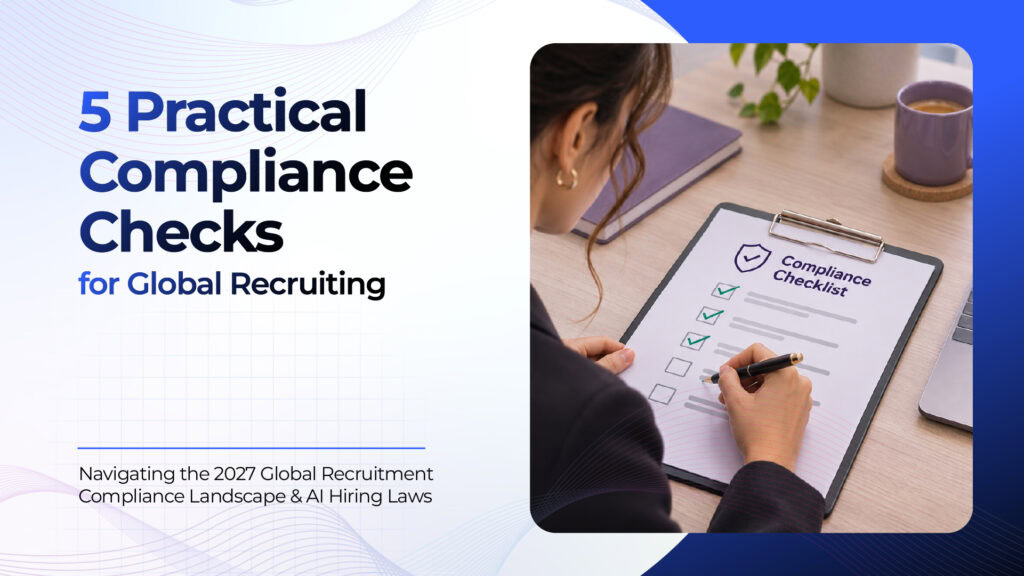
By 2027, talent acquisition and artificial intelligence are no longer subject to a patchwork of experimental local rules. Robust AI recruiting laws, stringent data protection regulations and strong pay transparency criteria have become minimum operational standards in the US, EU, UK and other global markets.
For talent acquisition leaders and recruiters working across borders, the issue is clear: sustaining high-volume hiring velocity while ensuring every touchpoint—from inbound sourcing to screening and scheduling—strictly adheres to regional regulations.
1. Global Regulatory Trends Impacting Recruiting in 2027
Recruitment compliance has moved from an annual HR review to a real-time operational discipline. Three major changes are shaping the regulatory landscape for 2027:
- AI Regulation Encoded: With enforcement mechanisms related to frameworks such as the EU AI Act, NYC Local Law 144, and increasing US state-level regulations, organisations now need to proactively disclose, conduct bias audits, and demonstrate monitoring by humans.
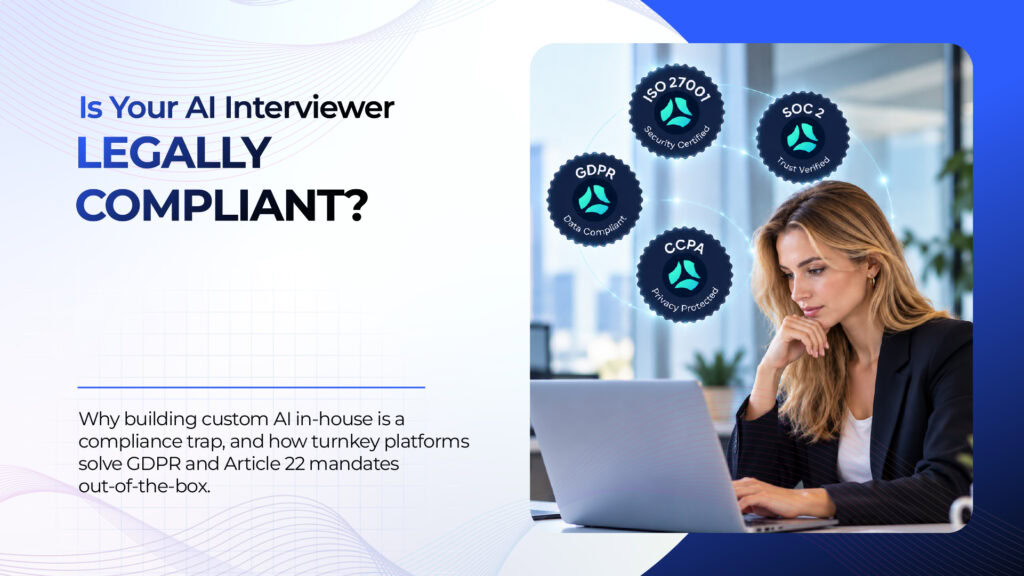
- Candidate data, voice exchanges, and interview transcripts are covered by stringent cross-border data sovereignty rules, such as GDPR, UK GDPR, and CCPA, which restrict their transfer and storage across international borders.
- Total Transparency Requirements: Candidates require clear wage bands, consent to data usage and a human assessment at every point of the funnel.
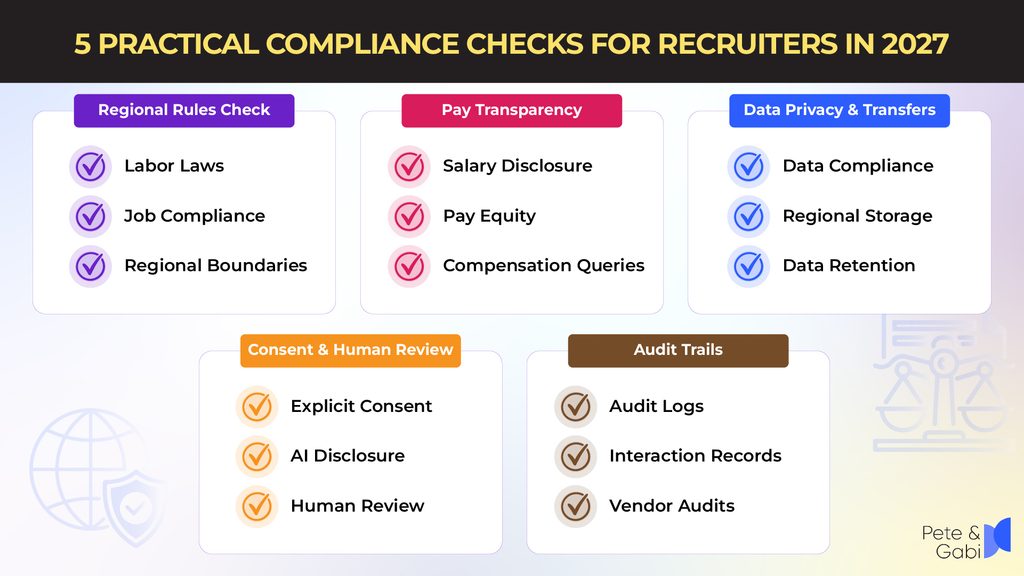
Check 1: Do You Know the AI Hiring Laws That Apply in Each Region You Recruit?
The Reality
Multi-unit and multinational firms infrequently hire in a single jurisdiction. A job listed remotely in London may get applications from across the EU, and a U.S. retail store may be doing business in states with different laws around automated employment decision tools (AEDTs).
What Recruiters Must Check:
- Map your active applicant pools to regional statutory boundaries, not just your corporate headquarters.
- Differentiate between rules for automated sourcing, automated resume filtering and conversational AI screening agents. (For more technical guidance on automated interview agent compliance, check out our guide on 5 Compliance Checks Before Deploying AI Interview Agents in 2027.)
Check 2: Are your job advertisements and offers compliant with pay transparency regulations?
The Reality
Pay transparency is no longer the privilege of select states in the US, with required disclosure of remuneration covering federal and international norms by 2027. Failing to include appropriate wage ranges in job advertising or internal offers results in immediate regulatory penalties and destroys employer brand credibility.
What Recruiters Must Check:
- Ensure that all job descriptions are dynamically populated with localised wage ranges prior to posting to job boards and ATS portals.
- Audit your comp benchmarking workflows for parity across distant remote teams.
Check 3: Candidate Data Transferred Across Borders in a Legal Way (Privacy and Data Transfers)?
The Reality
Conversational screening technologies, video interviews and digital assessment platforms record sensitive personal data, voice biometrics and behavioural transcripts. This data is in violation of international privacy regulations, without explicit legal reasons for storing or processing it, or across non-compliant cloud architectures.
What Recruiters Must Check:
- Make sure your software vendors have strong data processing addendums (DPAs) and clear subprocessor disclosures.
- Confirm that candidate data is separated into secure regional workspaces and not aggregated into public or shared multi-tenant models. Please refer to our corporate Data Processing Addendum and Subprocessor list for security guidelines).
Check 4: Do candidates receive clear notice, consent and an opportunity to request human review?
The Reality
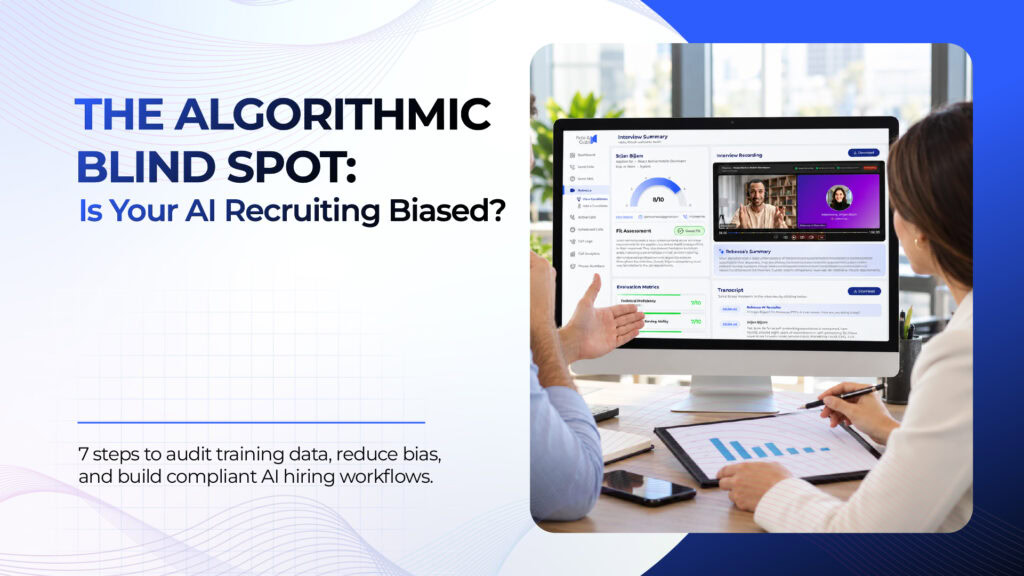
Black-box screening algorithms that reject or advance candidates without transparency are legally outmoded. Under the current rules, candidates must be told whether AI or automated procedures are being used to help assess them, and there must be a clear means for them to request a human review of their case.
What Recruiters Must Check:
- Provide pre-interview disclosure notifications that describe how responses to applicant questions will be scored.
- “Make sure that automated screening workflows have clear consent capture and structured fallback mechanisms for candidates who request human evaluation. (See our AI Bias Disclosure approach).
Check 5: Do you have evidence of documentation, audit trails and vendor records?
The Reality
Regulatory compliance is not simply about policies, it’s about proof. Talent teams must be able to provide immutable logs of scoring criteria, candidate disclosures, consent timestamps, and vendor audit certificates to satisfy an audit or applicant inquiry.
What Recruiters Must Check:
- Keep a central audit trail in your ATS or recruitment system that records all candidate communications and the reasons behind assessment decisions.
- “Only choose technology partners that are regularly audited by third-party security and compliance auditors.

How can a small recruiting team handle changing regulations?
Keeping up with worldwide employment legislation doesn’t mean growing your legal department. Architecture enables modern compliance, not manual overhead. Lean teams can grow hiring velocity without increasing regulatory exposure with compliance-ready recruiting tools that automate permission tracking, secure data isolation and transparent scoring logs.
Conclusion & Next Steps
As 2027 regulatory standards continue to mature, proactive compliance is the ultimate competitive advantage for talent acquisition leaders.
To explore how modern recruitment workflows balance high-volume efficiency with rigorous data privacy and governance, discover our AI Recruiter Solution or review our enterprise Trust & Compliance Center.
Internal Linking & Schema Verification Checklist: