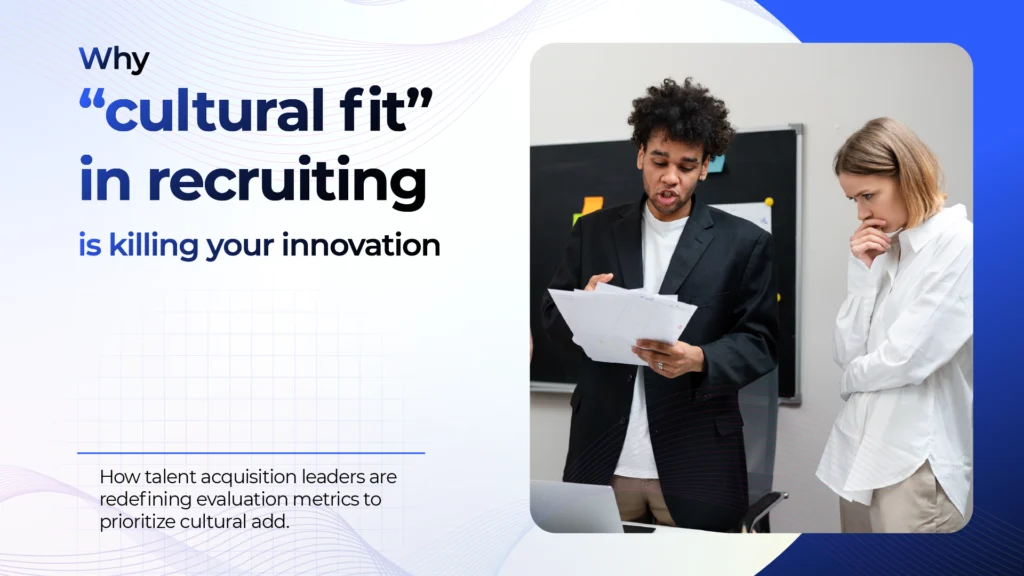
Cultural fit has long been praised as a key component of effective hiring in the changing talent acquisition landscape. In the past, companies relied on this measure to make sure that new personnel fit in with current teams and promote unity and shared values. However, an excessive focus on cultural fit may unintentionally result in stasis when workforce dynamics change toward innovation and flexibility, strengthening unconscious prejudice and limiting team viewpoints.
This raises an important question: Are businesses endangering their long-term success by sticking too closely to the tried-and-true?
Presenting the idea of cultural add, a progressive paradigm that emphasizes the distinctive contributions people make to enhance organizational culture. This approach promotes different origins, different approaches to problem-solving, and new viewpoints as creative catalysts rather than striving for conformity. Moving toward an additive hiring model is now necessary for the expansion of modern businesses, as conversational agents and intelligent automation replace preliminary assessment.
1. How much does employing someone just based on “cultural fit” cost?
Subjective variables are frequently used to assess cultural fit, such as whether a candidate’s communication style, social background, or workplace habits are like those of present employees. Although this can improve short-term team chemistry and expedite initial onboarding, there are serious operational dangers involved.
| Evaluation Approach | Primary Focus & Methodology | Long-Term Organizational Impact |
| Traditional Cultural Fit | Assesses alignment with existing norms, backgrounds, and behaviors. | Risks insular thinking, reinforces hiring bias, and limits team innovation. |
| Modern Cultural Add | Evaluates unique perspectives, varied life experiences, and complementary skills. | Broadens problem-solving capability, increases adaptability, and drives growth. |
Hiring managers sometimes overlook non-traditional applicants and under-represented prospects because they confuse fit with resemblance. Cognitive diversity enhances performance and decision-making, according to numerous studies. Organizations are locked into antiquated patterns when they let subjective fit indicators determine employment decisions.
2. How is team performance affected by the switch to “cultural add”?
Accepting cultural contribution entails seeing each new hire’s unique background as a strength that improves rather than disturbs team chemistry.
Teams become more adaptable when companies assess applicants based on their contributions to the group environment, such as novel technical approaches, different industry experiences, or distinctive collaboration frameworks.
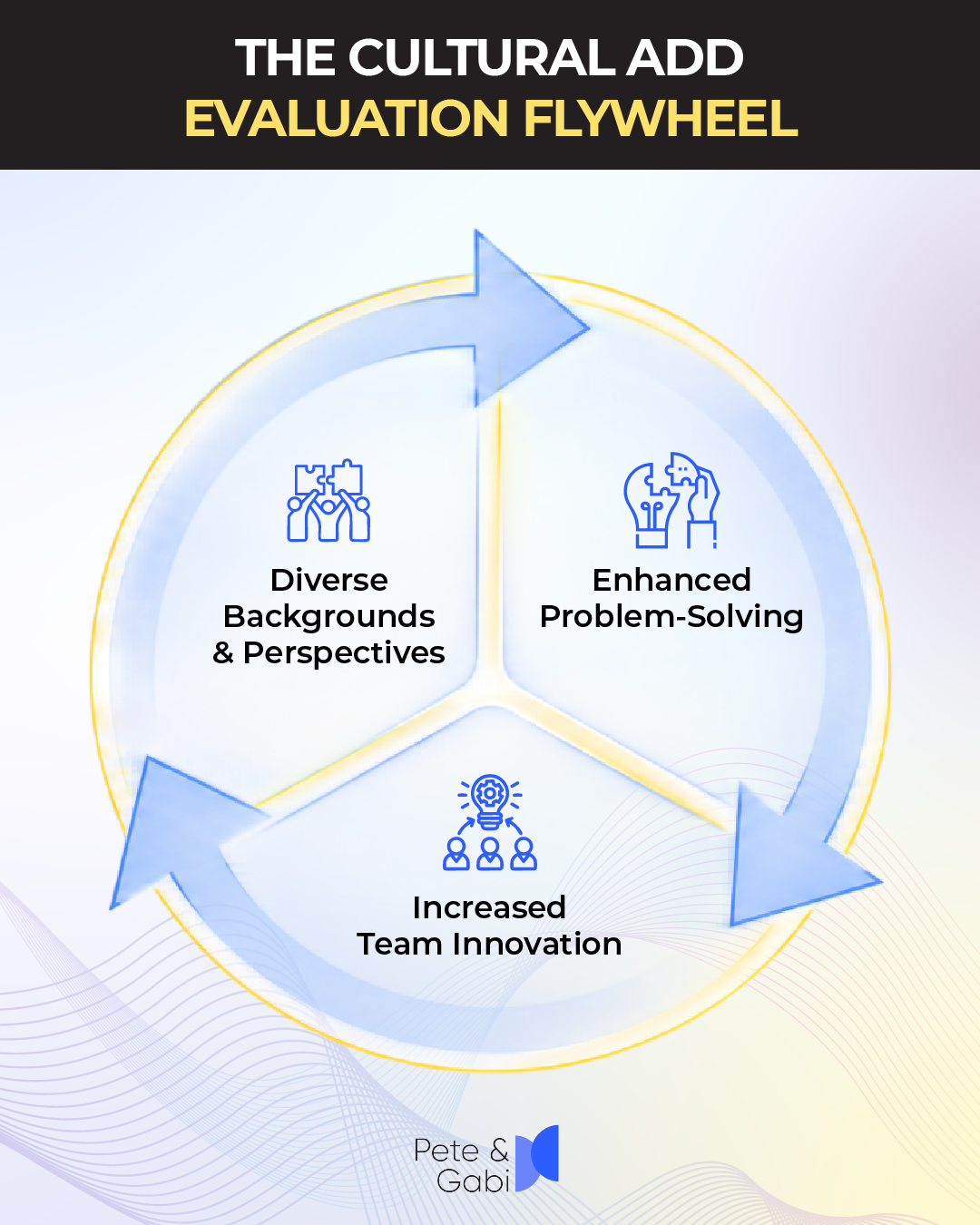
High-performing talent teams create systematic evaluation frameworks that gauge adaptability, empathy, and collaborative intelligence instead of looking for workers that follow a strict mould. See our tutorial on the candidate screening process for a thorough look at how to organize early evaluation processes.
3. Is it possible for AI hiring tools to assess cultural additions objectively?
Talent leaders frequently worry that automation may mimic human bias on a large scale. Legacy algorithms will continue to favor applicants who fit previous employment profiles if they are trained on uniform historical hiring data.
However, contemporary conversational solutions like Rebecca AI Recruiter are designed to do away with human subjectivity caused by weariness. Rebecca rigorously assesses candidates using concrete, job-relevant skill rubrics rather than assigning scores based on nebulous ideas of personality or background.
Intelligent automation guarantees that each applicant is evaluated fairly on merit by standardizing conversational screening questions and concentrating solely on verified skills, problem-solving depth, and job alignment. See our review of the best AI hiring assistants designed to reduce bias to learn more about how automated platforms guard against algorithmic skew.
4. Rebecca AI Recruiter’s large-scale operationalization of cultural add
Every employment request must be executed consistently and methodically to make the shift from subjective cultural fit to objective cultural add. Autonomous conversational agents have a significant impact on this situation.
Above your main applicant tracking system, Rebecca AI Recruiter functions as an intelligent evaluation layer. Rebecca conducts resume-aware, structured voice screens around-the-clock to find out how candidates handle uncertainty, work across teams, and tackle difficult tasks.
| REBECCA AI: EVALUATING COMPETENCY & CULTURAL ADD | |
| Evaluation Dimension | How Rebecca AI Assesses Candidate Potential |
| Objective Rubrics | Scores responses against standardized job requirements rather than subjective “fit”. |
| Behavioral Depth | Asks dynamic, contextual follow-up questions to evaluate collaboration and adaptability. |
| Structured Scorecards | Generates transparent, verifiable evaluation summaries directly within your ATS. |
Rebecca provides your recruiting team with the information they need to support cultural add without slowing down hiring velocity by eliminating administrative screening bottlenecks and implementing uniform evaluation criteria.
To understand how conversational screening connects to your broader hiring infrastructure, check out our whole range of recruitment automation solutions.
Redefining Metrics for the Workforce of the Future
More than just an HR fad, the shift from cultural fit to cultural add is a strategic requirement for businesses navigating challenging, cutthroat industries. Businesses may unlock new levels of creativity, resilience, and problem-solving by changing how talent acquisition teams assess potential.
Diversity of thinking will continue to be at the core of your growth strategy if you equip your hiring process with objective frameworks and clever technology.
- Discover practical frameworks in our guide to the candidate screening process.
- Learn how automated systems support inclusion across our recruiting automation tools.
References & Industry Sources
- Harvard Business Review — Why Diverse Teams Are Smarter: https://hbr.org/2016/11/why-diverse-teams-are-smarter (Source for cognitive diversity metrics, problem-solving performance in multi-background teams, and innovation research)
- SHRM — The Business Case for Workplace Diversity and Inclusion: https://www.shrm.org/topics-tools/news/diversity-equity-inclusion/global-inclusion-insights-2026 (Source for talent acquisition inclusion benchmarks, cultural add hiring frameworks, and retention statistics)
- Pete Gabi Blog — Top 10 AI Hiring Assistants That Reduce Bias: https://www.petegabi.com/blog/top-10-ai-hiring-assistants-reduce-bias/ (Internal Reference: Analysis of objective competency rubrics and algorithmic fairness in conversational screening)