

The recruitment funnel often comes to a halt as candidates’ profiles get handed over to recruiting managers or staffing clients. Recruiters are able to find out about compensation levels, notice periods, and other details during the calls. However, different teams often upload candidates’ profiles along with the PDF of their resumes and a short email saying about them.
While resumes provide candidates’ work history, hiring managers have other questions concerning the candidate they need to be answered: Why did the candidate decide to apply for this job? How does the candidate’s technical skill set fit in with the issues the company is facing? Does the candidate’s hiring need to fit in with the timeline and the budget?
Properly working summaries of the candidates’ profiles transform disorganized conversational information into compelling arguments. The teams achieve rapid feedback, reduced rejection rates, and make the shift from resume vendors to candidates’ consultants.
No matter how advanced the recruitment team you have, this useful article describes how to structure your conversations into compelling candidate presentations.
1. What should be included in a client-ready submission summary?
A client-ready candidate summary is a structured, executive-level overview of an applicant’s competencies, drive, requirements, and suitability for the position, that helps recruiters expediate their hiring decisions.
By using this document, decision-makers will know why the candidate is the right fit and won’t have to sift through pages of a résumé. According to the American Staffing Association (ASA), a hiring manager spends less than two minutes reviewing each application. The speed of this decision-making process can be helped greatly with the presence of a summary document with structured and reliable information.
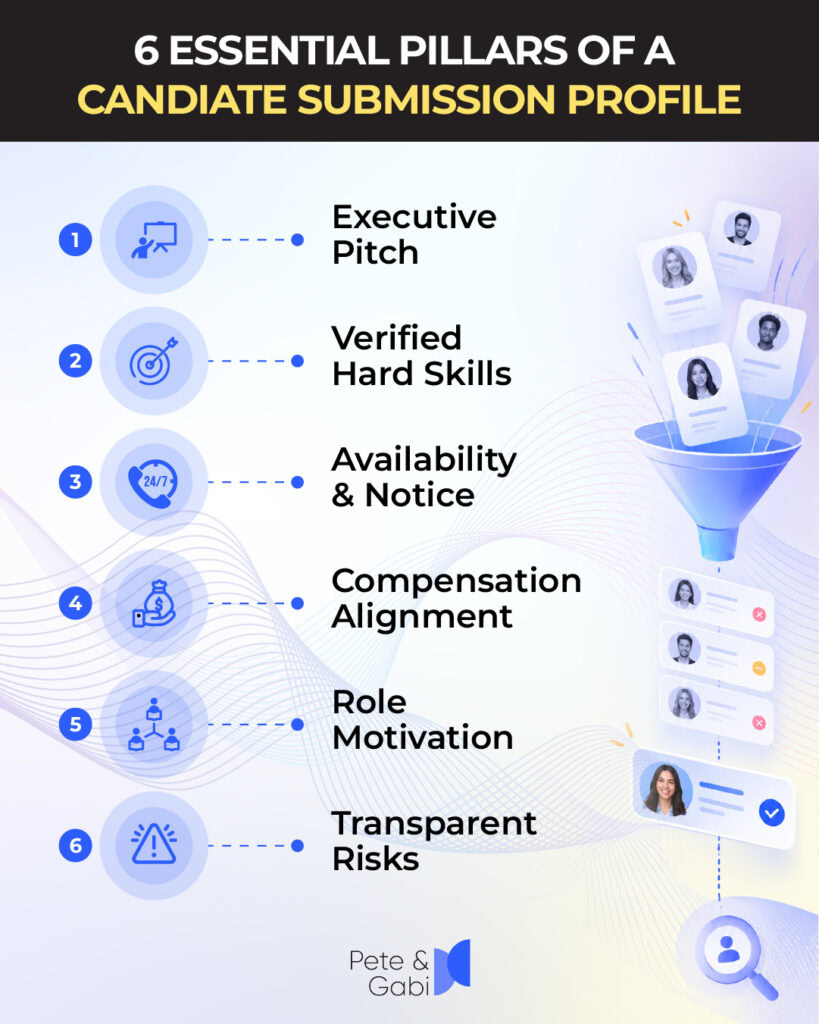
Six fundamental pillars should be included in every candidate brief to ensure instant clarity:
- Pitch for Executive Candidates: A brief overview that describes the most important qualifications of the candidate relevant to their current area of expertise and their career level.
- Verified Key Skills: List of 3-5 bullet points that compare the skills of a candidate with the non-negotiable requirements stated in the job order on a one-to-one basis.
- Availability and Notice Period: Exact availability dates, notice period requirements and the progress concerning interviews with the other companies.
- The compensation parameters include the target salary, the hourly rate range, and opinions regarding the bonuses, and the benefits confirmed during the conversation.
- Motivation and the Search Context: The specific purpose of the job search and the reason why the current role or organization fits their career path.
- Transparent Considerations and Gaps: The specific technical, organizational and/or logistic gaps identified by the recruiter and the explanation of the way in which the candidate tends to fill these gaps.
2. Why are screening call notes so infrequently included in client submissions?
Fragmentation of software tools, untrained and unorganized note-taking methods of recruiters, and continuous lack of time for administrative tasks results in the lack of screening notes in client submissions.
On an initial prospect of AI phone screening call, recruiters must do several things at once: listen actively, ask about technical skills, and take notes. This unstable situation creates workflow disruptions:
| Common Workflow Barrier | Operational Root Cause | Negative Impact on Submissions |
| Shorthand & Fragmentation | Notes are typed in hurried abbreviations (“gd comms, 10y exp, ok w/ 120k”). | Information is indecipherable to hiring managers without extensive rewriting. |
| Urgency & Submission Drag | Recruiters rush to submit profiles before competing agencies deliver resumes. | Recruiters skip writing summaries entirely, sending only raw resumes. |
| Cognitive Memory Fade | Summaries are drafted hours or days after the call concludes. | Critical details, such as candidate project ownership, are forgotten. |
| Data Silos in the ATS | Notes are buried inside private CRM fields or external notebooks. | Account managers and clients never see the context uncovered by the source. |
In the absence of a reliable template for transforming disorderly notes taken during conversations into coherent reports, recruiters will send only resumes in client presentations.
3. To obtain a useful summary, how should recruiters set up a screening call?
Recruitment managers must utilize standard question types when conducting screening interviews, ensuring that they relate to the submission form.
The screening process is effective when having clear objectives as the interviewer knows specifically how the final submission is structured. Standardized questions about competencies help in reducing subjectivity in interviews while providing a possibility to compare candidates’ results.
To make sure that all important elements of presentation are captured, one needs to break down the 20-minute conversation into 4 operational units:
- For Minutes 0–3 you can start with issues including the assessment of the technical history as well as confirming the location, job authorization status, remote or commuting preference in addition to the question regarding what the existing salary criteria and company parameters are.
- Minutes 3–12: Competency and Execution Testing: Do not ask candidates to mention their resume points in chronological order. Instead of that, it is better to ask directed questions regarding the current role of the interviewee, such as “Describe your hands-on experience of creating [the requirement] in the current position”.
- Minutes 12–17: Cultural Fit and Search Triggering: One effective approach to define the apex of courtesy level of the candidate is to ask what they have triggered their job search.
- Minutes 17–20: Transparency of Communication and Closing: Share next steps and update on the interview process with other companies.
4. How do you, step-by-step, transform screening call notes into a summary that is available for clients?
If you’d like to create a refined presentation from casual notes taken during recruiter screening calls, you need to employ some active synthesis techniques.
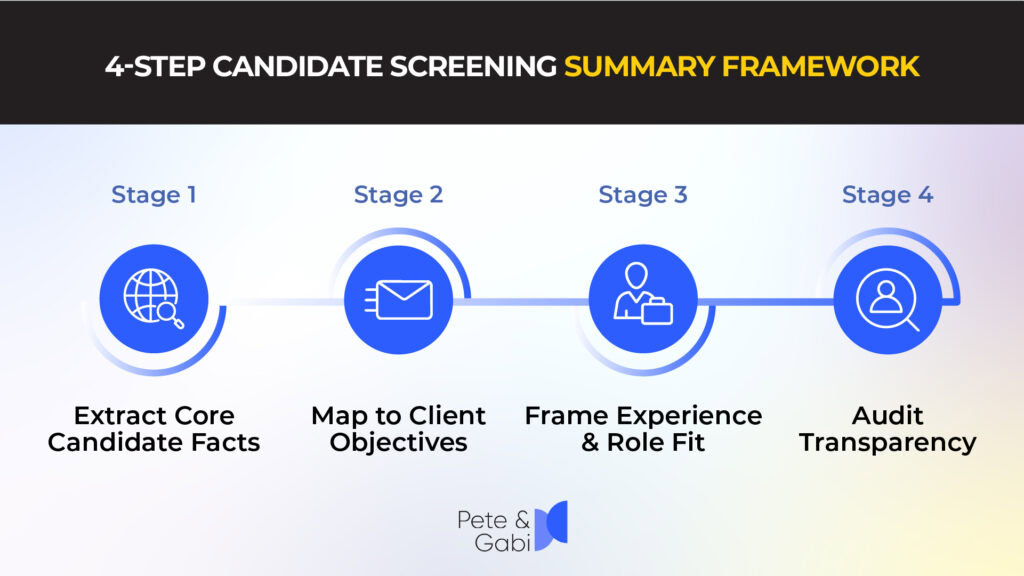
To turn conversational shorthand into an executive candidate profile, follow these four steps:
Step 1: Gather Essential Information
The first group of elements that should be isolated consists of variables like the candidate’s current notice period, expected salary (being a number of components) geographical location as well as his/her right to work in the country. By providing this information at early stages potential delays with the client might be avoided.
Step 2: Directly Link Skills to Requisition Needs
Then from the task brief identify three critical requirements of the employer that cannot be waived. The information collected from the call should prove that the candidate possesses the relevant qualifications as well as be based on the usage of concrete instruments, number of people involved, as measurable outcomes.
Step 3: Identify Engagement Factors and Search Catalysts
Ensure that the reasons for the job search are compatible and correlated with the opportunity provided by the client. The client’s remote flexibility should be emphasized as the main attraction to the candidate.
Step 4: Include Honest Remarks
In addition, insert neutral insights from the recruiters on technical depth, communication clarity, and more. Such an approach will raise the level of confidence of the hiring manager towards the candidate as it will include some mistakes noted by the candidate directly and explain how they were fixed.
Check other articles in our candidate screening process to learn more about timely evaluation touch points.
5. What constitutes a compelling submission summary? (For instance, before and after)
Check out how the same screening notes are presented before and after the process of restructuring:
Prior to: Unsuitable for Clients: Raw Recruiter Notes
John Doe is an accomplished data engineer. Spoke to him today. Good person with some knowledge of Snowflake, Spark, and AWS. He plans to leave his current place of work in the health tech sector because of the company’s restructuring practices.
Currently receiving a salary of 140k, but he hopes to receive an offer of no less than 150k. Two weeks of notice. Excellent communication skills. Claims to have led a migration from a Redshift database to Snowflake, last year.
After: Client-Ready Submission Profile
Candidate Profile: John Doe | Senior Data Engineer
Submission Summary: Possessing over seven years’ experience in data engineering in the niches of cloud data warehousing and real-time streaming pipelines. Recently, he was involved in the production migration from Amazon Redshift to Snowflake with 32% cost efficiency in query expenses.
Core Competencies & Fit:
- Cloud Data Architecture: Over four years of working experience with Snowflake and AWS (Glue, EMR, S3) in architecture and creation of scalable ELT pipelines.
- Big Data Processing: Expert in Apache Spark, having experience with high-volume jobs processing over fifty million records every day.
- Leadership: The person was the technical lead in the cross-functional data group of five engineers in the current job.
Logistics & Search Parameters:
- Salary: $150,000 is desired level of salary.
- Availability: Available in two weeks; open to offers due to company restructuring.
- Interview Status: In the process of undergoing interviews with another company; faster feedback would be appreciated.
The process of converting abbreviated notes into an organized profile for the candidate results in better assessment of their qualifications and quicker approval of the interviews.
6. Is it possible for AI to accurately record, transcribe, and summarize candidate screening calls?
The process of candidate discussion can be recorded using specialized software that allows for accurate transcription and production of written reports.
The main obstacle is the presence of different accents, overlapping discourses, and terminology that could jeopardize the results of traditional general transcription methods. Advanced recruiting conversational engines overcome those difficulties through the use of standardized scoring systems for relevant competencies.
AI voice interview tools can automate candidate screening conversations, transcribe responses, and generate structured summaries that recruiters can use to prepare client-ready submissions.
Implementing AI prospecting platform changes the entire process:
| Operational Dimension | Manual Recruiter Note-Taking | Autonomous AI-Generated Summaries |
| Turnaround Speed | 30–45 minutes of manual writing per candidate | Instant generation immediately following call completion |
| Information Retention | Dependent on recruiter memory and typing speed | 100% transcript fidelity with verifiable quote extraction |
| Standardization | Varies widely across individual recruiters on the team | Consistent formatting and objective rubric alignment |
| Recruiter Bandwidth | Consumes 10–15 administrative hours per recruiter weekly | Recovers administrative time for direct candidate closing |
The use of conversational engines, such as AI-based phone screening systems, can help teams save the trouble of inputting data manually. The solution generates structured, client-ready scorecards within the ATS system, generates detailed transcripts, and performs preliminary technical and logistical qualifications.
Check out our guide on how voice AI helps staffing agencies in communicating with prospects and facilitate the work of the agency.
7. When composing candidate summaries, what are the most frequent errors?
Recruiters often commit simple formatting and wording blunders which undermine the credibility of otherwise capable candidates:
Transcribing the resume verbatim: There is little benefit when bullet points from the resume get copied into an email. The absence of context around the resume means that motivation, scope of operation, and interpersonal skills must all be mentioned in the summary.
Not addressing problems of logistics: Trying to bypass issues of salary differences, visa issues, or work start date postponement in the hope of sorting them out after showing lack of confidence on the client’s part. It is important to outline logistics.
Using less than serious vague terms: Expressions like “rockstar developer,” “nice disposition,” or “cultural fit” do not tell the recruiter anything specific. Instead of subjective praise, a resume should consist of solid qualifications and concrete project figures.
Failing to see the client’s crucial problem: When writing the summary of the vacancy, the recruiter must bear in mind the specific known problem that the client faces. If the client is getting the database work effectively, the first thing to mention should be the experience of the candidate.
8. How can a recruiting team maintain uniformity in submission summaries?
For uniformity of candidates’ presentations in any growing agency, standardized templates and submission criteria are crucial.
Where there are no such presentations, clients may face confusion as recruiters may work with the same accounts. Successful recruitment agencies use four proven methods for ensuring standardization:
Use One Template: Implement a single template in a rich-text or markdown format that all managers should follow when submitting information in the applicant’s tracking system.
Participate In Calibration Reviews: Schedule a monthly meeting for the best recruiters to review their colleagues’ submissions and provide feedback on the quality of their content.
Work Out Accurate Handoffs: Provide recruiters with the same instructions on how to work with accounts to prevent the case of different requirements in submissions from account managers.
Make Reporting Automatic: Make use of advanced technology platforms to help with the process of filling out scorecards.
Check out our specialized AI interview tools for staffing teams or our solutions for staffing and recruitment agencies if you’re a staffing leader looking to maximize your placement infrastructure.
Using Rebecca AI to Simplify Candidate Presentations
Don’t let the clarity of your candidate briefings take all your team time throughout the week.
Rebecca AI Recruiter simplifies the processes of conducting the initial qualification call, accurately transcribing it, and creating the summary for clients, as it can speak and interact with job applicants in a conversational manner, while checking various claims of the candidates and creating scores.
Instead of getting stuck in tedious administrative tasks, you can spend a lot more time chasing the best candidates and meeting your clients’ needs.
References & Industry Sources
- American Staffing Association (ASA) — Staffing Industry Trends & Candidate Presentation Benchmarks: https://americanstaffing.net/research/ (Source for staffing speed metrics, hiring manager submission review velocity, and agency placement standards)
- SHRM (Society for Human Resource Management) — Structured Interviewing Guidelines: https://www.shrm.org/topics-tools/tools/how-to-guides/how-to-conduct-effective-interviews (Source for structured screening methodologies, objective rubric implementation, and cognitive bias mitigation)
- LinkedIn Talent Solutions — Future of Recruiting Report: https://business.linkedin.com/talent-solutions/resources/future-of-recruiting (Source for recruiter administrative burden research, time allocation benchmarks, and automated candidate engagement data)