Generative AI has made it very simple to create an outstanding, customized resume and share it in no time. This is encouraging information for those looking for jobs, but for recruiters, it turns out to be a huge issue as the resumes become less informative when they all look attractive.
Hiring teams need to rethink how they screen applicants, not just find ways to speed up the process. Below you will find a list of eight AI hiring trends that are going to shape 2027, and an explanation of what is responsible for them, as well as where our platform, Rebecca AI recruiter, comes in.
1. Will AI agents take over first-round screening and scheduling?
The answer is mostly yes for a majority of roles with high volume. AI agents have the ability to reach out to job applicants, verify simplicity, and facilitate an interview without any involvement of a recruiter.
What sets such agents apart from traditional chatbots is that the agents are actually conducting the operation instead of merely providing the answers to the queries. A usual first contact sequence is as follows:
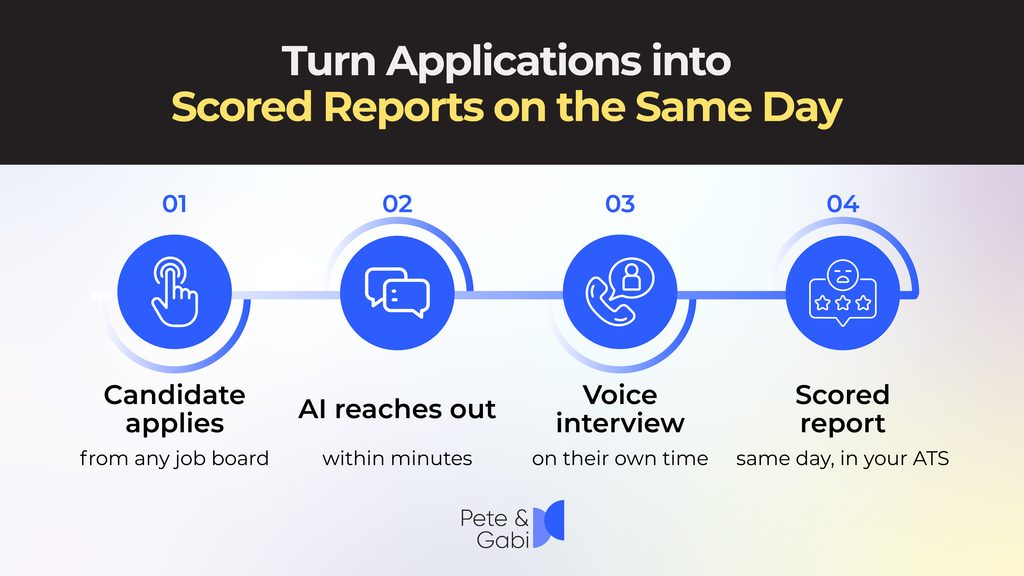
First-round automation workflow · 4 steps
- Application arrives: The agent gets in touch early while the candidate is still keen on the vacancy.
- Basics are confirmed: During the interaction, salary expectations, place of residence, availability, and work authorization are confirmed.
- Short screening conversation: Eligible candidates need to answer some role-specific questions.
- Interview is booked: The applicant chooses the time for the interview from the manager’s calendar.
Rebecca AI is built around this workflow. A candidate receives a link for an interview that they accomplish independently, while the hiring team receives a scored report the same day. In a general case, in all the implementations of Rebecca AI from 2024 to 2026, responses were given in less than 12 hours. However, the real advantage is that every person applying for a job gets the information, not only those who were contacted first by a busy recruiter.
For a deeper look at the mechanics, see how AI hiring software differs from traditional tools.
2. Will voice AI interviews become the default first touch?
In many cases, it should lead to replacing the phone interview that lasts for 15 minutes. The main reason is simple: phone tag does not work when there are double applicants.
Nevertheless, various types of AI interviews exist. For instance, one-way recorded video allows a candidate to answer fixed questions with no chance to ask more questions afterward. Two-way conversational voice listens to the answers and asks further questions as a human would do that shows at once the competence of the person.
Rebecca AI uses the two-way approach. Here is a decent comparison with the replaced phone interview:
| Evaluation Criteria | Human Interviewer | Rebecca AI Interviewer |
| When candidates can take it | Business hours, after scheduling | Any time, on demand |
| Consistency | Varies by recruiter and workload | Same questions and rubric for every applicant |
| Follow-up questions | Yes, and the recruiter can read nuance | Yes, within the role’s question set |
| Time to a scored result | Usually days, once scheduling is included | Same day, once the interview ends |
| Relationship building | Strong: a human makes the first impression | Limited: best paired with a human later |
What candidates need from an AI interview
Candidates are reasonably cautious about being evaluated with the help of algorithms. Firms succeeding with candidate completion typically adopt four strategies:
- Tell candidates that the initial interview is conducted by an AI and outline what the AI is meant to judge
- Describe the forthcoming steps in the process, including information on when a human check will be performed
- Provide alternatives for candidates needing special arrangements, for example, those suffering from speech disorders
- Ensure that the criteria used to evaluate candidates’ performance include a test for accent and dialect equity so that the score reflects only the content of the answer rather than delivery
Rebecca AI has been programmed to fit this approach. It informs candidates that it is an AI interviewer at the beginning of the interview. The applicants agree to the procedure and receive updates about the process as they proceed. The company’s clients report that candidates assign 9.8/10 ratings to the overall experience on average.
See how a two-way interview works on the Rebecca AI platform page.
3. Will skills-based evaluation replace resume keyword screening?
The situation is already unfolding, and generative AI is accelerating it. Once a software is able to recreate any CV according to a job description, the matching of keywords only reflects the utilisation of this software.
The process of skills-based screening requests candidates to demonstrate what they can do instead. Such demonstration of one’s skills can take the form of a situation presented to a candidate (“A customer calls to complain about the delivery. Explain your actions”).
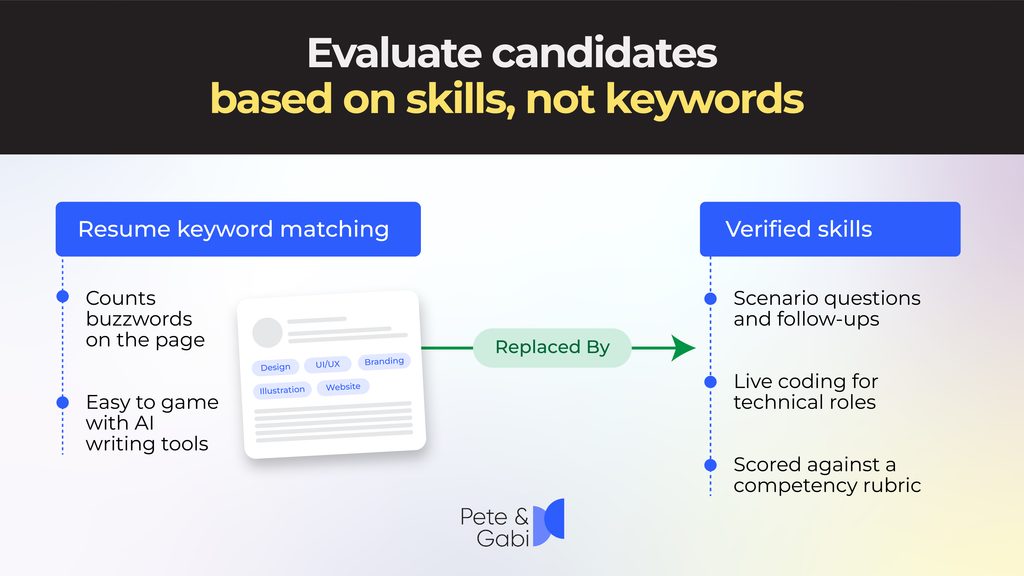
Skills-based qualification: Before and After
Rebecca AI’s voice interview methodology has a very defined approach. The requirements of each position create specific criteria for ROI for every job. During interviews, Rebecca AI assesses responds to inquiries outlined in the rubric. The hiring manager gets to see the score and the evidence behind it.
Specifically, Rebecca AI uses timed coding challenges in multiple programming languages with automated scoring. Integrity checks like tab-switch detection and copy prevention are used to avoid cheating in coding challenges.
Skills hiring is an additional opportunity to reach untapped job candidates since prospects of various professional backgrounds can make a case for their abilities. However, bias is not automatically eliminated in this approach. Rubric content must be well crafted and reviewed regularly that brings us to the next trend.
For a step-by-step framework, read our guide to the candidate screening process.
4. Will bias audits and compliance become a buying requirement?
For corporate buyers, this is a significant concern. When a supplier cannot describe the reason why an algorithm gave a higher rating to one applicant, it is harder for them to proceed with the acquisition of the technology.
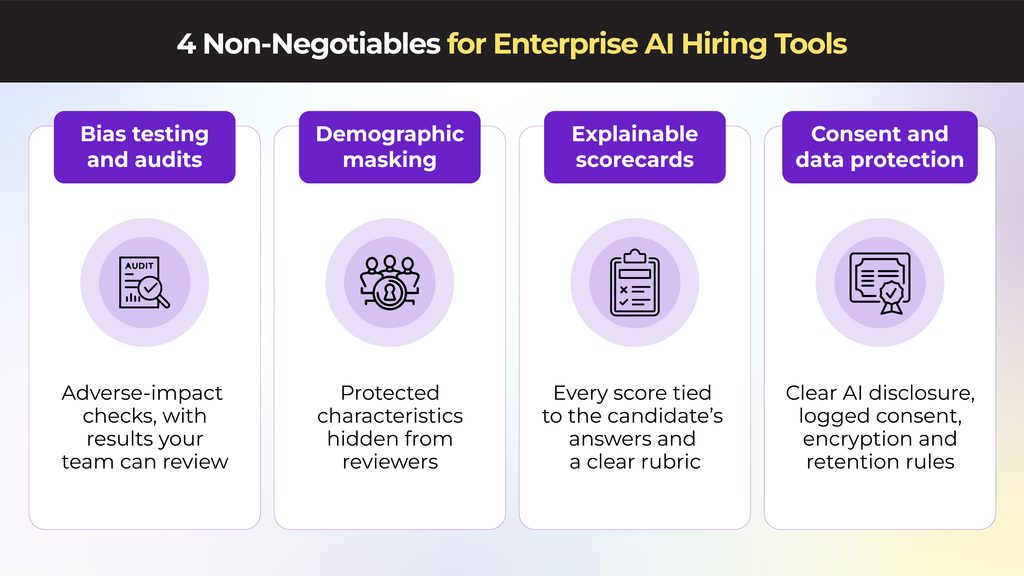
Enterprise AI compliance requirements: 4 areas
The reason for that is mainly the new regulations that have been introduced recently. Here are some of the laws that HR experts should pay attention to:
- According to New York City Local Law 144, third-party audits are required for automated employment decision tools, and information must be communicated to the applicants about the results of the audit.
- Under the EU AI Act, all AI-based recruitment processes are considered high risk, and must comply with the principles of transparency, risk control, and human supervision.
- The Illinois Biometric Information Privacy Act (BIPA) states that voiceprints and all other biometric identifiers cannot be collected without informing people and obtaining their written permission.
- According to the Illinois AI Video Interview Act, companies must inform applicants about using AI for assessment of their video interviews and get explicit permission for that.
The issue that was raised in BIPA is important for systems that work with voice in the identity verification process. While fraud prevention is valuable, it must be supported by clear consent requirements and data-handling policies.
What to ask any AI hiring vendor
- Has an independent third party audited the tool for bias? Can we see the summary?
- Can you show, for any candidate, why they received their score?
- How do candidates give consent, especially for voice or identity checks?
- Can we hide demographic information from reviewers?
- Where is candidate data stored, how is it encrypted, and when is it deleted?
- What alternative is offered to candidates who opt out or need accommodation?
Rebecca AI addresses this challenge. Its scoring is monitored for negative impact by comparing it to the four-fifths rule of the EEOC and checked on a quarterly basis, producing score logs that can be verified. Before each interview, the candidates are informed that they will be talking to AI, and their consent is recorded. Rebecca AI observes the requirements of GDPR and CCPA and is certified according to SOC 2 and ISO 27001 standards, while also making an AI bias disclosure. Reports demonstrate what applicants said and the received score and contain no hidden aspects.
This section contains only general information but not legal counsel. Requirements may differ depending on the location; contact your legal team.
5. Will teams rediscover existing candidates before sourcing new ones?
Indeed, Yes, and Yes! Most ATS stores feature vast amounts of information about former candidates, including highly qualified applicants temporarily outperformed by others.
Recent sourcing technologies identify the profiles so that they can be provided with future openings. The effort of contacting the former candidate who has good knowledge of the employer is cheaper and results in warmer communication compared to traditional job ads or impersonal contact.
However, unfortunately, there is a risk of contracting outdated candidates. People change their skills, may expect different salaries, and may not be job seekers anymore. But a quick AI-led re-screening will allow you to fix this easily.
6. Will AI sit on top of the ATS instead of replacing it?
Certainly. The ATS is here to stay as it still acts as the official system for candidate tracking purposes, compliance records, and job offers. However, the downside is that it lacks the ability to conduct interviews or meetings.
Hence, most companies are going with an AI feature on top of their ATS instead of switching to a new system. The AI will take care of communication with candidates, and the results are recorded in the existing ATS platform only.
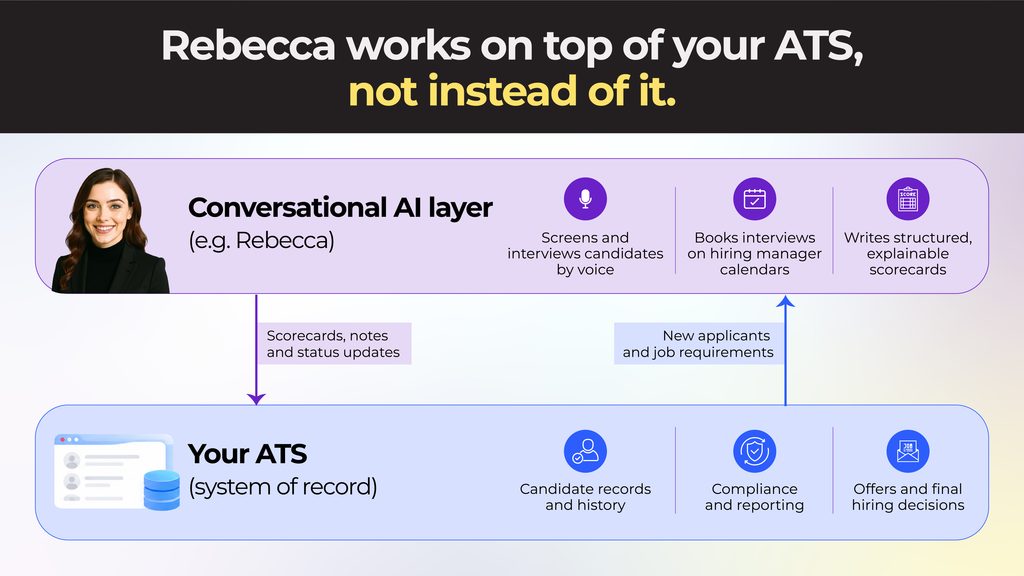
The two systems work well together because of the data exchange: the AI queries the ATS for new job vacancies and candidates and saves the results back into the system. Rebecca AI is compatible with ATSs such as Workday, SAP SuccessFactors, Oracle Taleo, and many others and transmits the requested information automatically.
7. Will recruiter roles and success metrics change in 2027?
Yes, for the better. While technologies are busy with sorting, telephoning, and planning, recruiters are free to work on pieces that should only be performed by people.
| Today, for many teams | Where it’s heading | |
| Where the day goes | Sorting resumes and chasing calendars | Advising hiring managers and closing candidates |
| How success is measured | Activity: calls made, emails sent | Outcomes: quality of hire, retention, hiring manager and candidate satisfaction |
| Relationship with technology | Operating several disconnected tools | Designing and supervising automated workflows |
The last row above matters. It is AI that performs the first pass, but recruiters must continue working with it, examine the results for discrepancies, and make the final decision.
The time saved is significant. At Peterson Technology Partners, the company that developed Rebecca AI, recruiters used to spend three to four hours per day for the initial checks with the help of AI. It takes less than 30 minutes now.
8. How should talent acquisition leaders prepare for 2027?
Start with your own bottlenecks, not the technology. Here’s a practical checklist:
| Area | What to do |
| Pipeline audit | Map every step from application to offer. Note where candidates wait and where recruiters do repetitive work. |
| Skills rubrics | Replace keyword lists in job specs with the 4 to 6 competencies that actually predict success in the role. |
| Vendor compliance | Ask every AI vendor for the six questions in Trend 4. Get the answers in writing. |
| Candidate experience | Write your AI disclosure, explain the next steps, and set up an alternative path for accommodation. |
| ATS integration | Confirm that screening results sync both ways with your ATS, so your system of record stays complete. |
| Team skills | Train recruiters review AI output critically, design workflows, and close candidates. |
You don’t need to do all six at once. Most teams get the fastest results by starting with the pipeline audit, because it shows where automation will help.

Where Rebecca AI Recruiter fits
All the trends previously mentioned indicate that there is a need for an improved version of the first round of hiring that is quicker and simpler.
Rebecca AI Recruiter was created for the first round. Instead of employing a straightforward computer system or asking one-way questions, Rebecca AI engages prospects in a conversation. The system does follow-up questions relating to resumes, offers applicants programming tasks for technical jobs, and guarantees the fairness of both the process and results. After the first round of interview, the results are sent to the customer and can be analyzed in their ATS database.
Reference customers have reported 85% reduction in costs per screen and timely delivery of reports.
Related reading
Sources
- World Economic Forum, The Future of Jobs Report 2025
- Rebecca performance, compliance, and integration figures: Rebecca AI Recruiter platform page (aggregate customer deployment data, 2024 to 2026)