

As the global market of voice AI agents reaches a value of USD 5.10 billion and enterprise teams witness savings of USD 6-12 per call, automated calls have transformed from being an experimental technique into a fundamental revenue driver for efficient sales teams.
The current sales environment has changed a lot from the way it used to be before. In 2027, a revenue generating system does not require building up the work force or simply adding more SDRs who would get in touch with potential customers personally. High growing sales departments are making use of the advanced voice automation systems such as Pete & Gabi`s AI Calling Agent Olivia for high volume outbound and inbound calls along with customer re-engagement.
But the use of voice AI technologies can create new management issues for companies. If you focus on wrong KPIs, there is a risk of misuse of customer relationship management system creating a lot of noise instead of profit generating clients.
To ensure the voice AI systems work, the sales leaders must concentrate on five main indicators.
1. Speed-to-Lead Response Time
Lost revenue opportunities lie in the graveyard where prospects wait for just a call. Response time is the quiet killer of conversion rates in digital sales. The minute prospects submit a demo form, ask for prices or show intent, is the minute their engagement moves closer to a stopover time.
Speed-to-Lead is a KPI that allows tracking if your automated voice technology utilizes maximum interest in your prospects first. Salespeople have some time limitations associated with changes in the work shifts, weekends, or limits in their calendars. However, voice bots provide immediate response to either engage, qualify, or set up an appointment while the team sleeps.
The fact that you measure the metric in seconds instead of hours shows how good or bad your automated calling layer is in making sure your biggest marketing efforts are not going to waste. Prospects expect quick answers in B2B today. Once they get it from your competitors, the game is lost for you.
Analyze Speed-to-Lead by categorizing your information into two categories:
- Inbound Instant Callback Speed: The average time in seconds has passed between the submission of a webform and the initiation of the first automated call.
- Off-Hours Engagement Rate: The percentage of after-hours contacts that were handled successfully and engaged in the qualification process outside of regular operational hours.
2. Conversation-to-Meeting Conversion Rate
In spite of the number of outbound or inbound calls made, the overall outcome of the effort remains irrelevant unless the conversation yields successful sales meetings for the reps. High figures for both calls made and low rates of success illustrate the failure of call scripts, inferior data quality or rigidity of the process with scripts.
AI voice technology, as compared to old-fashioned Interactive Voice Response systems, does incorporate certain advances. Today, AI voice agents are equipped with intelligent intent identification and the ability to change scripts as buyers provide their objections, and they can effectively adapt to the conversation.
Your ability to assess the Conversation-to-Meeting Conversion Rate will allow you to find out whether voice agents can generate the rapport with buyers, overcoming their issues as well as leading them to the next step in the process.
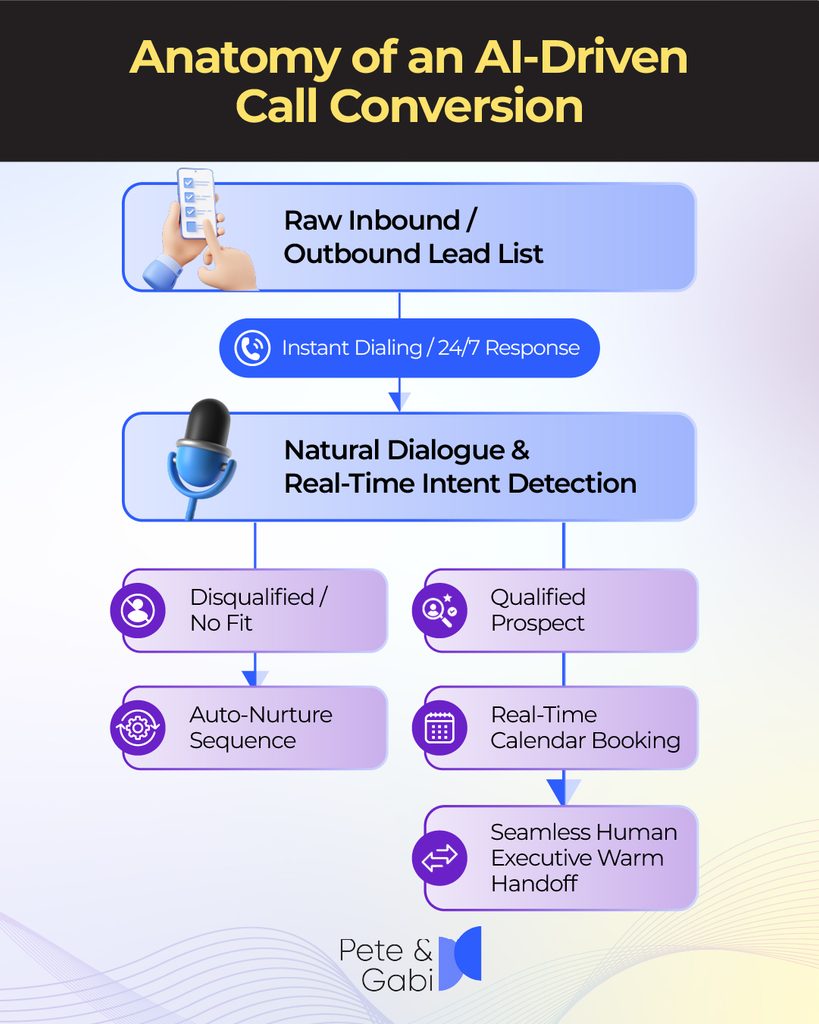
To optimise the sales metric in the future, sales leaders needs to consistently assess the call recording and review various key factors affecting conversions in different kinds of campaigns.
- Cold Outbound Prospecting: Checking the percentage of the first ten seconds of a call: this means how well the caller managed to grab the customer’s attention and secure a meeting.
- Inbound Qualification: Evaluating the number of forms filled out in comparison to the number of scheduled demo meetings with the account executive.
- Dormant Lead Win-Backs: Calculating the number of old leads that did not respond in previous quarters and figuring out whether the number of times they respond today is increasing or decreasing.
3. Human Handoff and Escalation Accuracy Rate
Difficult business negotiations, professional dialogues, and delicate inquiries from clients will necessitate human emotional intelligence. An automated calling strategy should not be designed to replace the job of human closers completely. Moreover, it should serve as an intelligent preliminary filtering system allowing people to concentrate only on closing opportunities that are verified.
The Human Handoff and Escalation Accuracy Rate is the measure of the capability of the voice agent to comprehend its limits of operations. When a lead expresses his irritation or comes up with technical queries that are beyond the database, the agent has to follow a clear escalation process that will allow them to move forward the ongoing talk or lead to an Account Executive with complete context.
Striking the right balance is essential for sales operations:
- High Escalation Rate: If there are too many handoff calls being made, then you should be worried about how efficient your outgoing call system is at automatically filtering prospects and disqualifying them.
- Low Escalation Rate: Conversely, if the number of handoff calls made is too low, then potential clients are not answering, and prospects are frustrated with not having live or human options available for when they need answers.
Periodically optimizing the criteria for triggering an intervention with a human, this helps sales managers receive high value leads that have been sorted out before being passed off for a sales call.
4. CRM Data Hygiene and Transcription Completeness
Manual administrative tasks can be a substantial hindrance to sales efficiency. Traditionally, sales agents would spend hours a week performing such tasks as writing down notes, changing stages of deals, and giving a summary of significant points in a call. As a result, the records in the CRM would more often be inconsistent and some important aspects of customers’ intentions would be lost.
By implementing automated voice callers, the CRM gets the post-call data automatically after every call. The parameters that help measure data hygiene and data completeness in CRM include the way data from post-call notes, qualification scores, custom field tags, and the next-action trigger are transmitted to such systems as Salesforce or HubSpot.
The advantages of automated data logging fall into several categories:
- Accurate Pipeline Forecasting: Business leaders can count on standardized and totally unbiased qualification scores in their decision process.
- Seamless Context Transfer: Sales specialists do not need to spend time typing voice conversation notes.
- Zero Administrative Fatigue: Human salespeople do not need to waste time on typing notes and can focus deeper on selling.
Regularly checking your sync completion rates helps you ensure that no important lead information is lost when scaling calls to multiple locations.
5. Cost Per Acquisition (CPA) and Pipeline ROI
Any technology implemented must prove its worth in terms of the bottom line at the end of the day. Conventional outbound scaling calls for a direct proportional growth in number of employees as well as base salaries, benefit packages, and the expenses necessary for hiring and purchasing any systems required for sales force efficiency.
To evaluate the results in toto, it is up to sales managers to monitor the process of calculating the cost of one acquisition (CPA) and Pipeline ROI. Comparing the operational costs of an autonomic voice system and revenue from re-contacting dormant clients, quickening the processes of incoming calls and setting appointments provides an understanding of one’s revenue technology stack efficiency.
Consider the baseline unit economics of scaling voice operations:
- Lower Cost Per Interaction: The cost of voice AI communication is far below the price of regular phone calls and that greatly decreases the acquisition costs.
- Fixed Overhead Expansion: Increasing the volume of calls processed from a few hundred up to tens of thousands does not require hiring additional managers or hiring extra office space.
- Accelerated Payback Period: Automated qualification processes help speed up sales cycle considerably and shorten payback time significantly.
Returning only some of the leads that have been lost or have been overlapping can pay off the cost of the software within the first few transactions.