Data privacy compliance has evolved from an IT background duty to a major board-level responsibility as organisations increasingly use autonomous conversational agents to scale preliminary screening, outbound outreach, and technical interviews. Candidate data protection is a stringent legal requirement with strong enforcement tools under the General Data Protection Regulation (GDPR) and new international privacy laws.
The operational reality for talent acquisition leaders particularly across the millions of mid-market and SMB organizations managing high application volumes without dedicated enterprise engineering teams is stark. Non-compliance does not merely invite regulatory fines; it permanently damages employer’s trust. When a candidate discovers that their voice recordings, biometric speech patterns, or evaluation transcripts were mishandled or stored insecurely during an automated interview, they rarely keep that experience private. In an era where corporate reputation is shaped across professional networks within moments, ensuring GDPR compliance in AI interviewing is no longer optional. It is a foundational prerequisite for maintaining brand credibility, protecting individual rights, and deploying recruitment automation with absolute legal confidence.
For hiring managers, HR compliance officers, and talent acquisition executives, this comprehensive resource provides a thorough foundation. We explore the true requirements of GDPR compliance in an automated interview setting, dissect data governance regulations, examine limitations on automated decision-making, reveal the legal risks associated with developing custom in-house AI tools, and offer a workable roadmap for the safe deployment of a turnkey, pre-compliant automation platform.
1. What GDPR Really Means for AI Interviewing
A thorough grasp of what personal data is and how legal safeguards apply throughout a talent acquisition lifecycle is necessary to navigate GDPR compliance in AI interviewing. Any information that can be used to identify or identify a real person is considered personal data. This includes everything from basic contact information and résumé materials to audio files, video recordings, and transcripts of conversations. Additionally, AI systems frequently touch upon special category data or produce derived biometric profile datasets when analysing speech patterns, vocal cadence, or behavioural reactions, necessitating an even greater level of security under GDPR. Article 9.
It is easier to understand how these legal principles control day-to-day operational procedures when data flows are mapped over an automated interview process:
| GDPR Compliance Pillar | Regulatory Mandate & Article Reference | Enterprise Operational Implementation |
| Lawful Basis & Consent | Establishing valid processing grounds under Article 6 (Consent, Contract, or Legitimate Interests). | Deploying transparent pre-interview notices, granular opt-in checkboxes, and explicit candidate consent mechanisms. |
| Data Minimization | Restricting data collection strictly to what is necessary for the stated purpose (Article 5(1)(c)). | Limiting AI evaluation models to job-relevant competencies rather than broad, intrusive behavioral profiling. |
| Storage Limitation | Prohibiting the indefinite retention of personal records once hiring decisions conclude (Article 5(1)(e)). | Establishing automated purging schedules and configurable data retention windows to wipe stale records. |
| Candidate Rights (Article 22) | Enforcing protection against solely automated decisions to produce legal or significant effects. | Implementing explainable scoring rubrics, human review loops, and streamlined Data Subject Access Request (DSAR) workflows. |
Talent acquisition teams expose their company to latent compliance liabilities when they use conversational AI without mapping these data flows. By incorporating privacy into architecture, compliance becomes a strategic differentiator rather than a cumbersome administrative obstacle.
2. Getting Around Article 22: Automated Profiling and Decision-Making
Managing Article 22 of the GDPR, which regulates automated individual decision-making, including profiling, is one of the most significant legal obstacles in AI hiring. A general prohibition against making judgements based only on automated processing, such as algorithmic resume screening and automated interview scoring, is established by Article 22. This prohibition applies to decisions that have legal or similarly substantial effects on an individual, such as rejecting a job candidate.
Organisations using conversational screening techniques must set up explicit operational protections in order to be compliant:
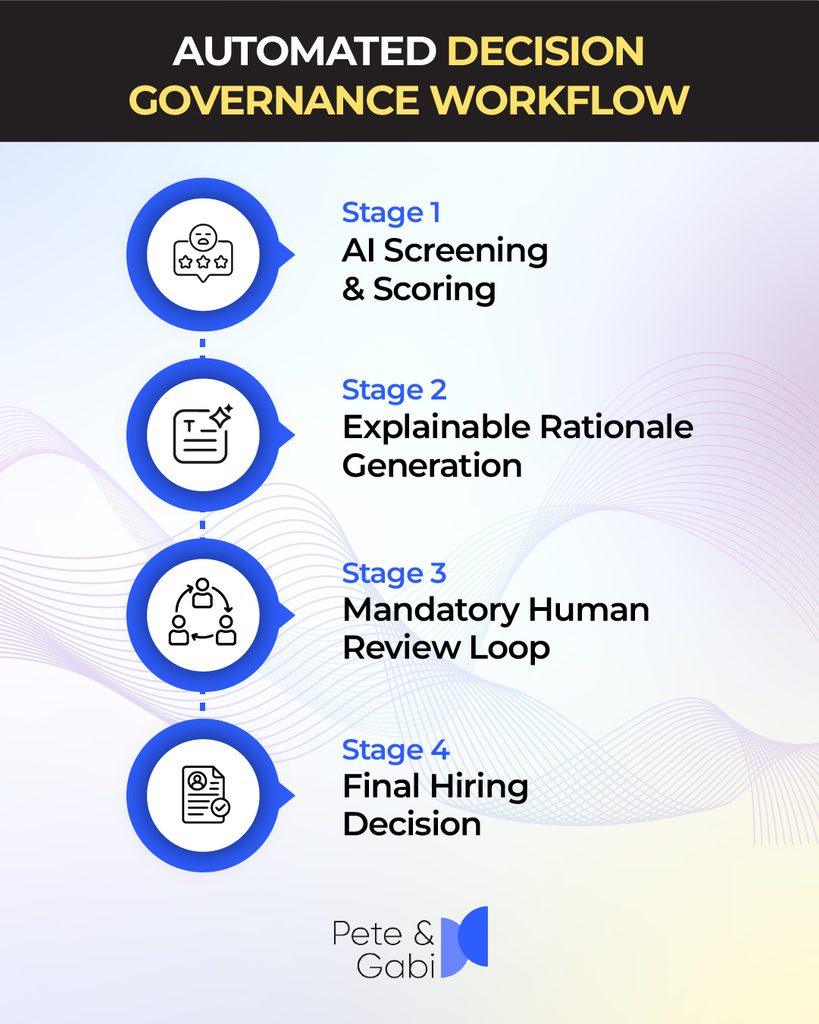
- Meaningful Human Oversight: It is legally insufficient to merely “rubber-stamp” or examine an AI-generated score. In order to override automated recommendations, organisations must make sure that recruiting managers or skilled recruiters check evaluation summaries.
- Articles 13, 14, and 15: Right to Explanation Candidates who undergo computerised assessments are entitled to relevant information regarding analytical reasoning, importance, and anticipated outcomes. Instead than using black-box numerical scores, AI interview technologies must offer clear, human-readable explanations that reference particular competency rubrics.
- Right to Contest (Article 22(3)): Workflows that comply must give applicants an easily accessible way to voice their opinions, contest an automated score, and ask for human assistance.
Your team can fully respect candidate rights under Article 22 while utilising the operational velocity of AI by incorporating these safeguards into your screening architecture.
3. Security, ongoing risk management, and Data Protection Impact Assessments (DPIAs)
Strong organisational and technical security measures are mandated by GDPR and are not just best practices. Article 32 to preserve candidate trust and guarantee data integrity. Strict access controls, thorough audit logs, and stringent encryption standards must be implemented by organisations using AI interview agents.
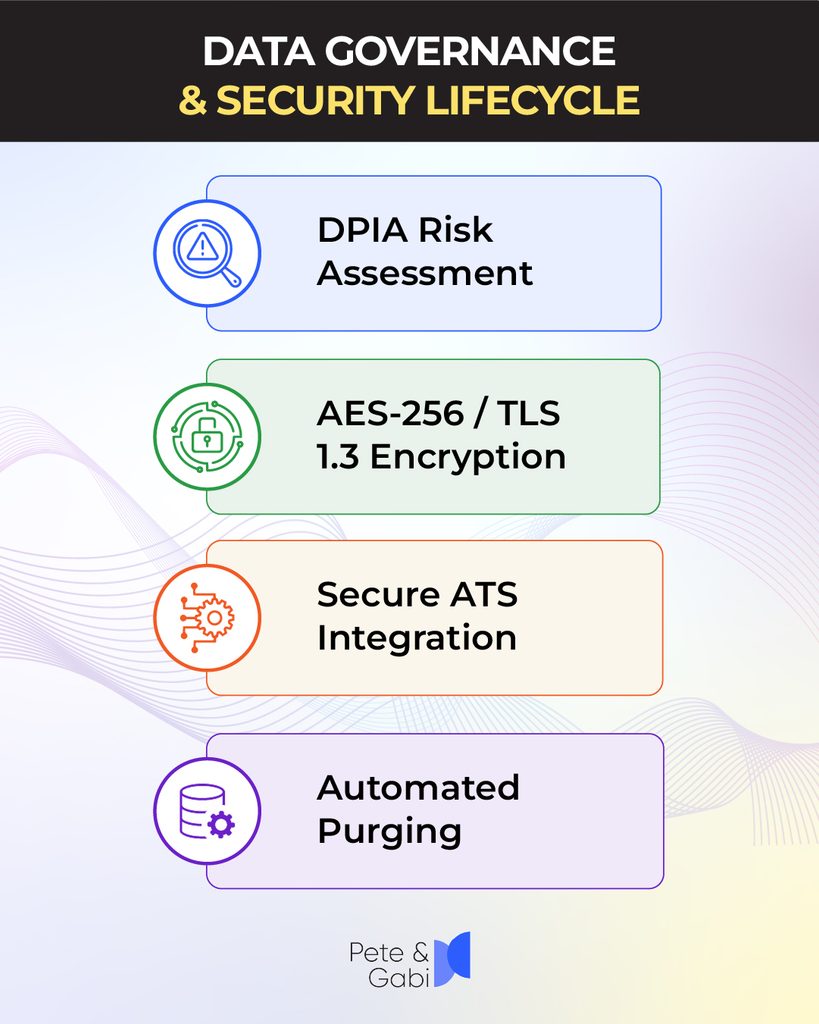
Performing Required DPIAs
Before implementing high-risk processing technologies, such as AI-driven hiring evaluations, a Data Protection Impact Assessment (DPIA) is required under GDPR Article 35. This expressly covers systematic and broad automated profiling of individuals that causes significant consequences. A thorough DPIA needs to assess:
- The Type and Range of Processing: Recording the precise textual, audio, and video information that the AI interviewer gathers.
- Necessity and Proportionality: Determining whether the automated screening actually accomplishes the hiring goal without being unduly invasive.
- Risk Mitigation Strategies: Describe access rights, automated deletion schedules, encryption mechanisms, and pseudonymization techniques to safeguard candidate privacy.
Controls for Enterprise Security
- Encryption at Rest and in Transit: Advanced cryptographic protocols, such as AES-256 for stored data and TLS 1.3 for data transferred across APIs, must be used to safeguard all conversational audio files, video recordings, transcripts, and assessment scorecards.
- Strict Role-Based Access Control (RBAC): Preventing unauthorised internal viewing by limiting access to applicant interview data to authorised recruiting staff only involved in the particular requisition.
- Strict data lifecycle management is enforced through automated retention and erasure protocols. When the recruiting window expires or retention periods expire, outdated applicant recordings and personal transcripts must be automatically deleted or anonymised.
4. Why In-House AI Compliance Fails: The Build vs. Buy Trap
Some leadership teams think about developing custom AI screening technologies internally using open-source voice libraries and raw large language model (LLM) APIs in response to growing applicant volumes and the requirement for quick candidate outreach. This strategy is a risky compliance trap for mid-market and SMB businesses without sizable, specialised engineering teams.
A brittle, uncertified architecture is produced by connecting various voice models, transcript storage databases, and automated data purging routines.
- The Engineering Burden: Rather than developing essential product features, your internal engineers must spend cycles creating biometric consent loggers, Article 22 explainability layers, and DSAR export tools.
- The liabilities Risk: Your company is fully responsible for any legal liabilities and associated costs if your custom-built tool fails an Article 22 audit, improperly handles a candidate’s request to have their data deleted, or leaks audio recordings because of insufficient encryption.
Building in-house is a regulatory dead end for companies that need to handle high application volumes and proactive candidate outreach without an internal technical army. Implementing a turnkey, pre-compliant vendor platform is the only practical option.
5. Rebecca Automation: Complete Hiring with Integrated Compliance
Modern talent acquisition teams rely on Rebecca Automation instead of taking a chance on unique in-house development or managing a disjointed stack of diverse software solutions.
The whole personnel pipeline, including internal talent sourcing, proactive outbound voice outreach, inbound candidate screening, interactive video/voice interviews, and automated compliance reporting, may be managed by Rebecca, a unified, end-to-end recruitment automation engine.
Rebecca Automation: Complete Hiring Process
| Pipeline Stage | How Rebecca Automation Handles Workflow & Compliance |
| Sourcing & Outreach | Proactively reaches out to database leads and cold candidates via natural voice and SMS. |
| Inbound Triage | Engages inbound applicants instantly, verifying logistical prerequisites. |
| Conversational Screening | Conducts interactive voice and video interviews using objective job rubrics. |
| Compliant Reporting | Generates transparent scorecards and syncs encrypted records directly to your ATS. |
Out-of-the-Box Turnkey Compliance
Organisations can transfer regulatory assurance to an enterprise-grade vendor platform by implementing Rebecca Automation:
- Pre-Built GDPR & Article 22 Safeguards: The platform architecture incorporates explainable scoring, automated retention purging, and explicit pre-interview consent protocols.
- Unified Voice & Video Workflows: Remove the hassle of moving between platforms for interviews and calling. In one discussion, Rebecca oversees both inbound screening and outward outreach.
- Smooth ATS Integration: Maintains strict data privacy standards while automatically syncing verified candidate data, transcripts, and scorecards back to your main system of record.
Visit our Trust & Compliance Center or check our Data Processing Addendum to learn about our standardised security terms, compliance certifications, and data governance procedures. See our guidance on compliance checks before deploying AI interview agents for a more comprehensive operational overview of pre-deployment protections.
Conclusion: A Candidate-Centric, Compliant AI Employment Future
It is risky for talent acquisition teams to view GDPR compliance as just an administrative checkbox while they navigate the quick development of conversational AI. True compliance is a continuous, proactive dedication to candidate respect, ethical data stewardship, and governance.
Organisations can use the speed of end-to-end conversational screening from outbound outreach to final interview reporting while protecting individual privacy rights and organisational integrity by avoiding the build-vs-buy trap by implementing turnkey solutions like Rebecca Automation.
- Explore secure, end-to-end automation on the Rebecca AI Recruiter Platform.
- Review enterprise governance standards at the Pete & Gabi Trust & Compliance Center.
- Read our detailed guide on compliance checks before deploying AI interview agents.
References & Industry Sources
- European Union — General Data Protection Regulation (GDPR) Full Text:
(Source for Article 22 automated decision-making restrictions, data minimization principles, and candidate privacy rights)
- European Data Protection Board (EDPB) — Guidelines on Automated Individual Decision-Making:
(Source for regulatory enforcement standards governing AI screening, profiling, and human oversight mandates)
- Pete Gabi Blog — 5 Compliance Checks Before Deploying AI Interview Agents:
https://www.petegabi.com/blog/ai-interview-agent-compliance-checklist
(Internal Reference: Pre-deployment compliance framework covering candidate consent, data security, and audit trails)