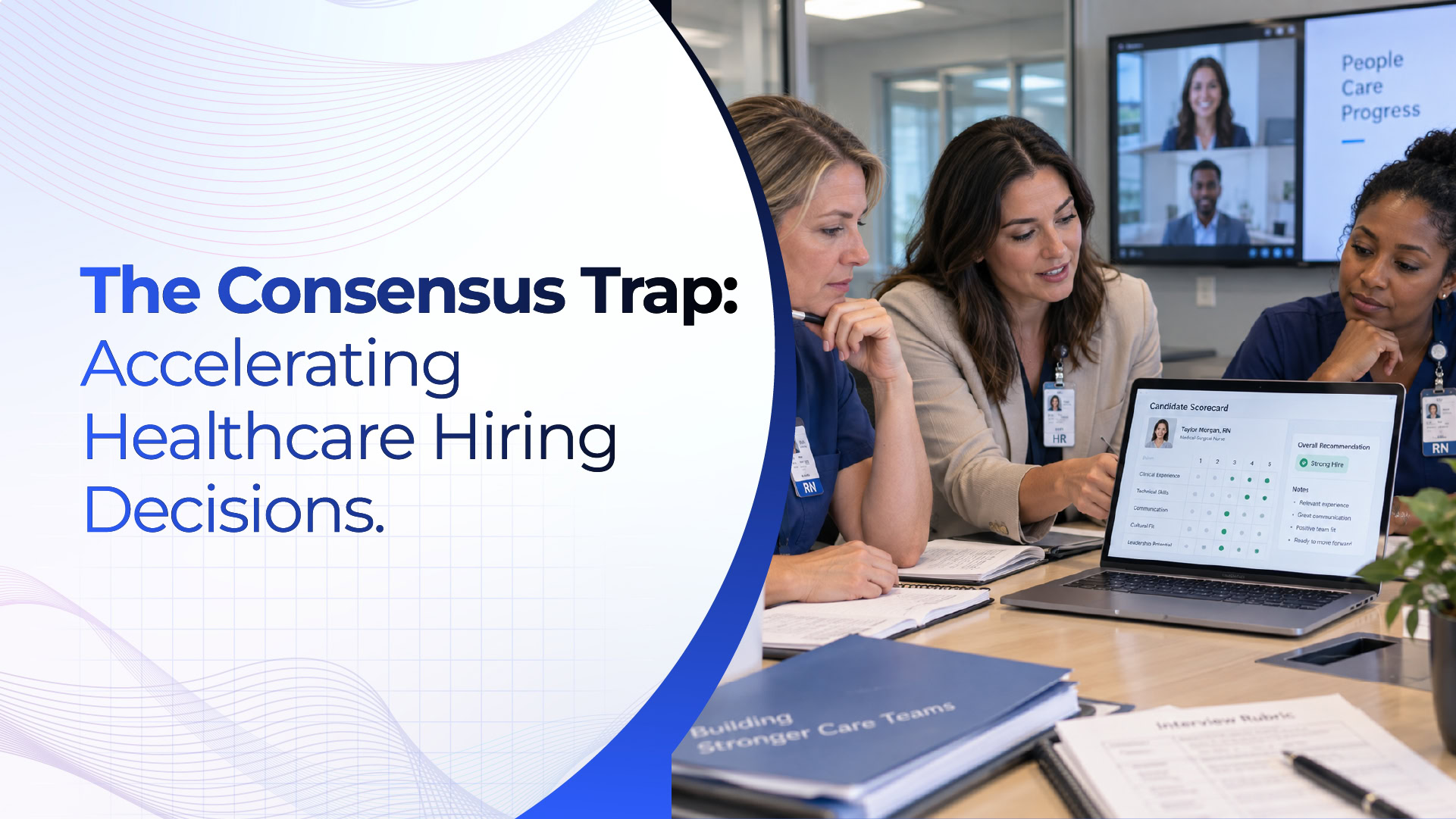
The more people involved in a clinical hiring decision, the lower the probability of successfully securing the candidate. In hospitals, long-term care facilities, and fast-paced clinical environments, hiring is necessarily viewed as a team sport. Assessing a candidate’s clinical competency, bedside manner, ability to handle crisis protocols, and cultural fit requires a diverse set of perspectives. However, when unit managers, HR business partners, and peer interviewers (like charge nurses) all demand an equal say in the final outcome, the operational workflow frequently paralyzes.
Attempting to speed up healthcare hiring decisions is impossible when every stakeholder operates with an implicit veto. The process becomes bogged down in endless debriefs, subjective disagreements, and the constant search for a mythical unanimous consensus. In a candidate-driven market where highly qualified nurses and allied health professionals are off the market in a matter of days, this administrative friction is fatal to your recruitment pipeline.
To secure elite medical talent, healthcare talent acquisition leaders must fundamentally restructure their evaluation process. They must learn to separate valuable clinical input from the final decision-making authority, transforming the committee from a roadblock into a rapid, data-gathering engine.

Why do healthcare hiring decisions take longer the more people are involved?
When evaluating why healthcare decisions stall, the root cause is rarely scheduling friction; it is a structural diffusion of responsibility. General organizational research from HRTalentIQ notes that unstructured hiring committees inherently blur accountability. When no single individual owns the final outcome or bears the immediate consequences of a vacant role, the most common operational failure mode is simply “no decision,” or a perpetual request to bring in “just one more candidate” to mitigate collective risk.
While this research applies across all industries, the effects are devastating in the clinical context due to competing departmental priorities. A healthcare hiring committee typically involves three distinct viewpoints:
- The Unit Manager: Prioritizes immediate shift coverage, baseline clinical competence, and minimizing overtime costs.
- The HR Business Partner: Prioritizes strict regulatory compliance, compensation bands, and long-term retention metrics.
- The Charge Nurse (Peer Interviewer): Prioritizes bedside collaboration, cultural fit, and how the candidate handles high-stress floor dynamics.
When these stakeholders evaluate candidates through unstructured conversations rather than a standardized framework, their competing priorities inevitably clash. The HR partner might flag a candidate for requesting a salary at the top of the band, while the unit manager is desperate to hire them to cover a critical weekend shift. Without a structured way to weigh these concerns, the committee defaults to inaction, waiting for a flawless candidate who satisfies every single priority perfectly.
What is groupthink actually costing your hiring committee?
Beyond competing priorities, unstructured debrief meetings frequently succumb to severe psychological biases. According to hiring research synthesized by Recruiter.daily.dev, committee settings are breeding grounds for groupthink—a phenomenon where the desire for harmony results in irrational decision-making.
In a clinical debrief, this typically manifests as the “HIPPO Effect” (where the Highest Paid Person’s Opinion dominates) and “Anchoring,” where the first stakeholder to speak heavily skews the rest of the committee’s feedback.
Consider a scenario where a hiring committee is reviewing a highly qualified ICU nurse. The Director of Nursing (the HIPPO) opens the debrief meeting by casually stating, “I thought they were a bit abrasive when answering the trauma protocol question.”
Instantly, the dynamic shifts. The charge nurse—who actually thought the candidate was appropriately assertive and confident for a high-stress ICU environment—engages in silent deference. To avoid contradicting senior leadership, the charge nurse suppresses their positive feedback and passively agrees. The HR partner follows suit. The result is a stalled process where a perfectly qualified clinician is rejected based on a single subjective comment, rather than objective skill gaps.
How long is too long? What a stalled decision actually costs in a shortage market
A stalled hiring decision does not just delay start dates; it actively destroys your sourcing pipeline. As outlined in our breakdown of the healthcare talent pipeline, losing a candidate because your top-of-funnel sourcing is weak and losing a candidate because your committee took six days to issue an offer are symptoms of the exact same shortage-market pressure.
According to hiring committee design research from Incruiter, four days is the absolute outer boundary for a committee turnaround. If a final decision takes longer than 96 hours post-interview, hiring managers begin attempting to route around the formal process entirely, or worse, top-tier candidates simply accept competing offers. In a market where a massive portion of healthcare professionals are exploring new opportunities, highly qualified registered nurses and allied health professionals are rarely on the market for more than a few days.
The financial cost of this delay is staggering. Every additional 24 hours spent trying to reach unanimous consensus directly damages your overall time-to-hire metrics. When a critical clinical role remains vacant because a committee could not agree, the hospital must resort to utilizing travel nurses or premium agency staff, often paying three to four times the standard hourly rate. Furthermore, the existing staff is forced to absorb dangerous amounts of overtime, accelerating burnout and triggering secondary resignations. The cost of a stalled decision is exponentially higher than the risk of making a slightly imperfect hire.
Does a shared scorecard speed up consensus, or just add another step?
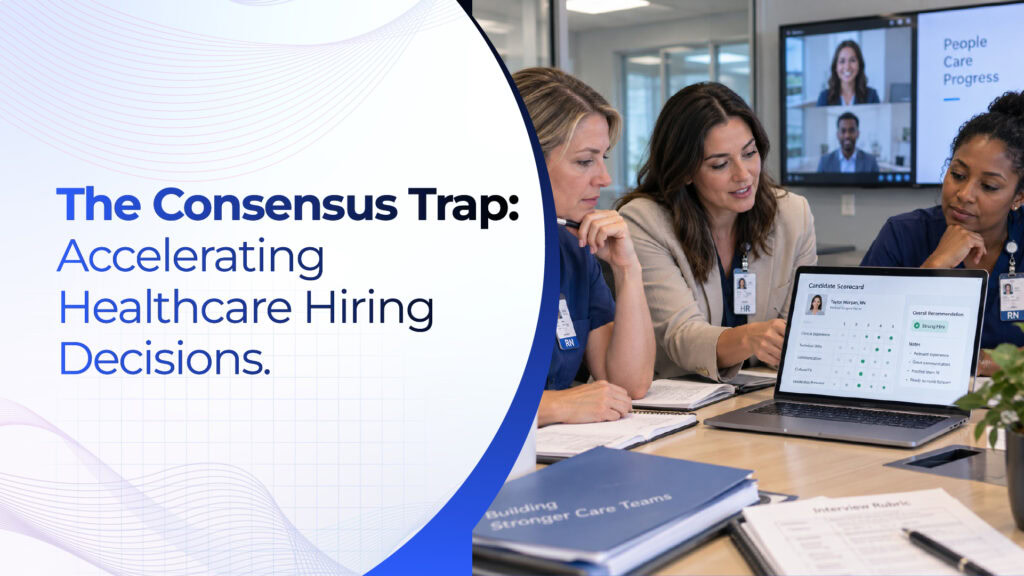
The primary defense against groupthink and decision paralysis is requiring independent, written feedback before any live group discussion ever occurs. Many healthcare organizations resist implementing interview scorecards, fearing it will add unnecessary administrative burden to already exhausted clinical staff who barely have time to conduct the interview itself. In reality, a standardized packet is the exact mechanism that produces faster consensus.
To achieve true hiring manager alignment healthcare leaders must force stakeholders to document their evaluations asynchronously. If a committee utilizes specific behavioral interview questions tied to a shared rubric, the post-interview debrief transforms from an hour-long subjective debate (“I just didn’t like their vibe”) into a swift, 10-minute data review (“They scored a 4/5 on crisis communication, but a 2/5 on EHR charting”).
By utilizing a standardized evaluation framework—like the comprehensive five-criteria scoring model utilized by an AI interviewer for hiring nurses—a committee can align around an objective baseline. When every stakeholder submits their score independently before the meeting, the committee only needs to debate the specific clinical competencies where their scores diverged. If everyone scored the candidate a 4 or 5 on clinical competency, you do not need to discuss it. You skip directly to the discrepancies, entirely eliminating circular conversations, anchored bias, and wasted administrative time.
How do you keep stakeholder input without handing them the veto?
A high-functioning clinical hiring process embraces the input of multiple stakeholders but firmly restricts who owns the final decision. To break the consensus trap, talent acquisition leaders must define roles explicitly during the intake phase, establishing a clear separation between data gatherers and decision-makers.

A proven model in healthcare recruitment is assigning specific lanes of responsibility:
- The Peer Interviewer (Charge Nurse): Their role is strictly to gather data on clinical competency and team fit. They do not get a vote on whether the person is hired; they provide an objective score on the candidate’s floor readiness.
- The HR Partner: Their role is the compliance gatekeeper. They validate licenses, background checks, and compensation alignment. They only have veto power if a strict legal or compliance standard is failed.
- The Unit Manager (The Decision Maker): This individual owns the outcome. If the unit manager has the data they need from the charge nurse and the clearance from HR, they must be empowered to make the hire immediately, even if the committee is not 100% unanimous in their personal opinions.
If your hiring committees are consistently paralyzed by subjective disagreements and slow debriefs, the solution is standardizing the exact data they evaluate. Rebecca AI Recruiter acts as the ultimate shared reference point for multi-stakeholder decisions. By conducting structured, automated interviews that score candidates against a rigid, unvarying rubric, Rebecca provides your entire hiring committee with an objective, data-backed baseline the moment the candidate finishes their screen. This allows clinical leaders to bypass subjective debate entirely, align around hard data, and issue offers before the competition even schedules their debrief.