In the high-stakes world of medical recruitment, a healthcare staffing agency operates under a brutal ticking clock. When a hospital or clinical facility issues a request for coverage, they rarely hand it to just one vendor. Instead, the order is blasted out to a network of competing agencies.
For years, the conventional wisdom in the staffing industry was that whoever had the largest database of nurses and allied health professionals would automatically win the placement. Agencies poured massive budgets into job board sponsorships, aggressive outreach campaigns, and social media advertising to stockpile talent.
Today, that conventional wisdom is failing. Agencies are discovering that they aren’t losing placements because they can’t find qualified clinicians; they are losing them because they cannot vet, credential, and submit those clinicians fast enough. If your agency is struggling with low submittal rates and lost revenue, your problem likely isn’t at the top of the funnel—it is trapped in the operational bottleneck of candidate screening.
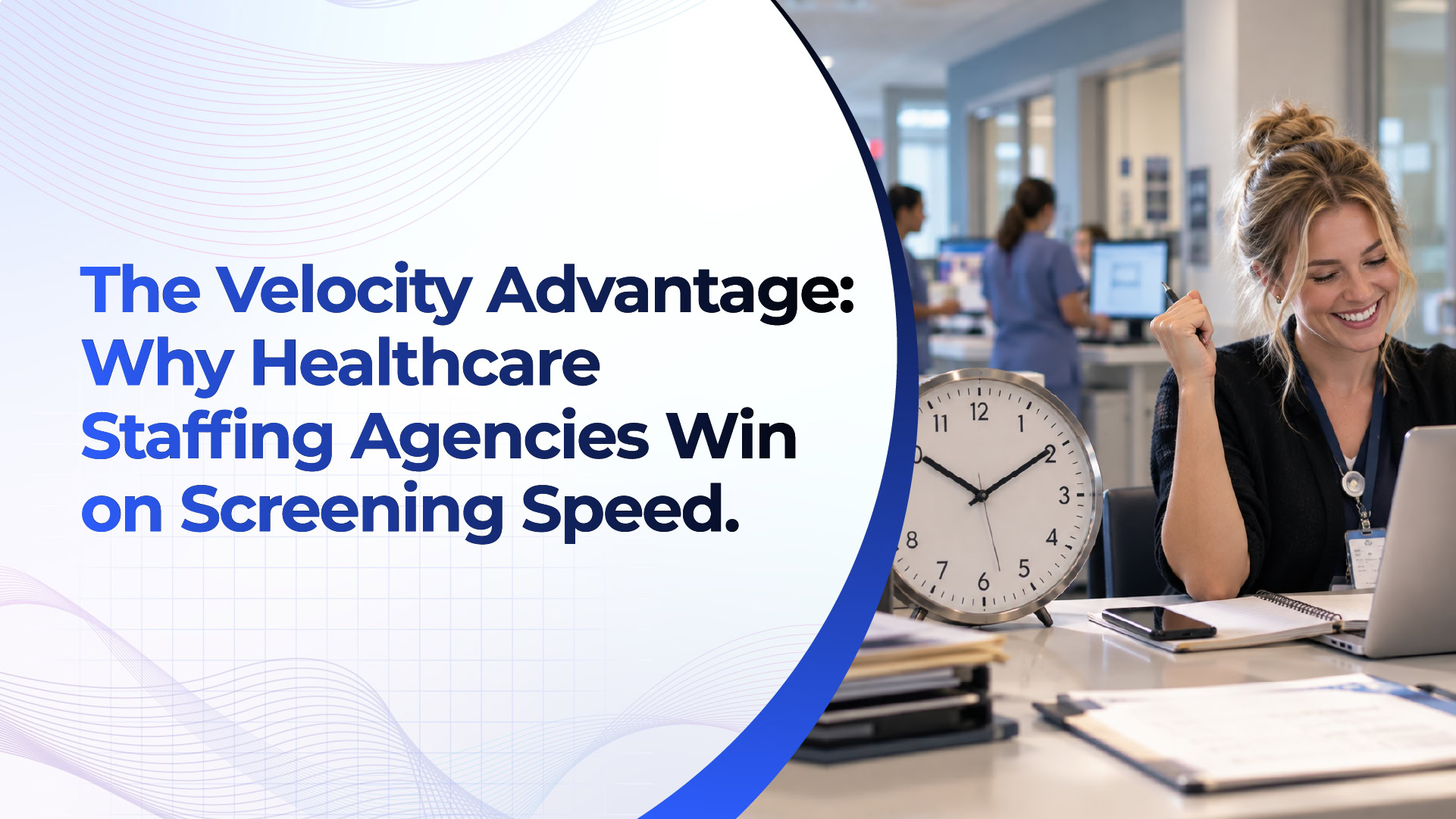
Why do healthcare staffing agencies compete on speed as much as candidate supply?
To understand why speed dictates revenue, you have to look at the structural business model of medical staffing. The vast majority of healthcare shift-matching operates on a contingency basis. As detailed in our breakdown of contingency vs retained recruiting, contingency means the agency only gets paid if their candidate is the one who ultimately fills the seat.
When a major health system releases an urgent contract for three ICU nurses, five different agencies might receive the exact same requisition simultaneously. Because the nursing talent pool is finite and heavily networked, it is highly likely that recruiters from three different agencies will source the exact same candidate on the exact same day.
If Agency A takes three days to schedule a phone screen, verify licenses, and format the resume for submission, they will lose. Agency B, utilizing rapid screening workflows, will submit that exact same candidate to the facility’s Vendor Management System (VMS) on day one. Agency B wins the placement, the margin, and the client’s trust, while Agency A is left with nothing but wasted sourcing spend. In this environment, your candidate supply is meaningless if your operational velocity cannot match the speed of the market.
Where do placements actually fall through, sourcing or screening?
The fatal break in the agency pipeline almost always occurs in the 48 hours immediately following a successful sourcing touchpoint.
Consider the daily life of a Registered Nurse (RN) or Respiratory Therapist. They work exhausting 12-hour shifts, often transitioning between days and nights. When a recruiter successfully sources them and asks for a 30-minute phone screen on a Tuesday afternoon, the clinician is either asleep, on the floor with a patient, or entirely exhausted.
This scheduling friction initiates a miserable game of phone tag. The recruiter calls, the nurse misses it. The nurse calls back on their break, the recruiter is on the other line. Days pass without meaningful progress. This exact administrative friction is one of the primary reasons why candidates ghost recruiters. The placement does not fall through because the candidate lost interest in the pay rate; it falls through because a competing agency made the qualification process frictionless and captured the candidate’s commitment first.
What does a fallen-through placement actually cost an agency?
When an agency loses a candidate to a slower screening process, the financial damage extends far beyond a single missed shift.
First, there is the immediate loss of placement margin, which can easily total thousands of dollars for a specialized 13-week travel contract. Second, there is the sunk cost of candidate acquisition. The agency paid for the job board clicks, the LinkedIn InMail credits, and the recruiter’s base hourly rate to find that candidate, yielding a negative return on investment.
However, the most severe cost is the damage to the client relationship. Hospitals monitor their agency vendors closely using strict performance scorecards. If an agency consistently fails to submit candidates within the first 24 to 48 hours of a requisition opening, the hospital’s VMS algorithm will deprioritize that agency. Over time, the agency will stop receiving top-tier shift requests entirely, effectively locking them out of their own client’s ecosystem.
How are leading agencies closing the screening gap?
To reduce time to fill healthcare staffing orders, elite agencies are decoupling the screening process from the recruiter’s physical schedule. They are eliminating the game of phone tag entirely by adopting asynchronous tools and intelligent automation.
By utilizing staffing agency interview automation, firms allow clinicians to complete their initial screening, verify their shift preferences, and answer critical behavioral questions on their smartphones at 2:00 AM after a shift ends. The recruiter wakes up the next morning to a fully vetted, scored, and ready-to-submit candidate profile.
While outcomes vary by organization, vendor-reported case results highlight the massive competitive advantage of this approach. For example, Hirevire, a video screening platform, reported that an agency utilizing asynchronous screening successfully cut their interview coordination time by a staggering 60%. Similarly, Screenz.ai, an AI interviewer platform, noted an illustrative benchmark where deploying automated interviews helped reduce total time-to-hire from 35 days down to just 21 days for healthcare roles. While these figures represent specific vendor case studies rather than universal industry averages, they perfectly illustrate the immense velocity gained the moment human scheduling constraints are removed from the screening phase.
What does an AI recruiter built for multi-facility agency work need to do differently?
A standard corporate applicant tracking system is fundamentally insufficient for an agency. To learn more about the specific operational architecture of agency workflows, refer to our foundational what is a staffing agency guide.
When an agency evaluates an AI interview tool for staffing agencies, the technology must be uniquely adapted to multi-facility routing. It cannot act as a generic chatbot; it must operate like a seasoned technical recruiter.
An agency-grade AI must be capable of dynamic cross-referencing. If a nurse applies for a night-shift ICU role at Hospital A, but the AI discovers during the automated screen that they only have pediatric experience, the system shouldn’t just reject them. It should instantly pivot, matching their verified pediatric credentials against an open day-shift order at Clinic B, retaining the candidate and saving a different placement. It must also autonomously verify non-negotiable compliance data—such as active state licenses, BLS/ACLS certifications, and exact availability—before a human recruiter ever spends a minute on the file.
Hold the Placement, Win the Shift In the healthcare staffing market, sourcing top-tier clinicians is only half the battle. If your agency relies on manual scheduling, live phone screens, and business-hours availability, your fastest competitors are stealing your placements while your recruiters are leaving voicemails.
An always-on screening mechanism is what empowers an agency to actually hold a placement once a candidate is sourced. By integrating Rebecca AI Recruiter, your agency can instantly deploy structured, multi-facility screening the second a clinician applies. Rebecca engages candidates 24/7, verifies credentials automatically, and routes fully vetted profiles to your recruiters’ desks—ensuring you always submit the best talent to your clients first.