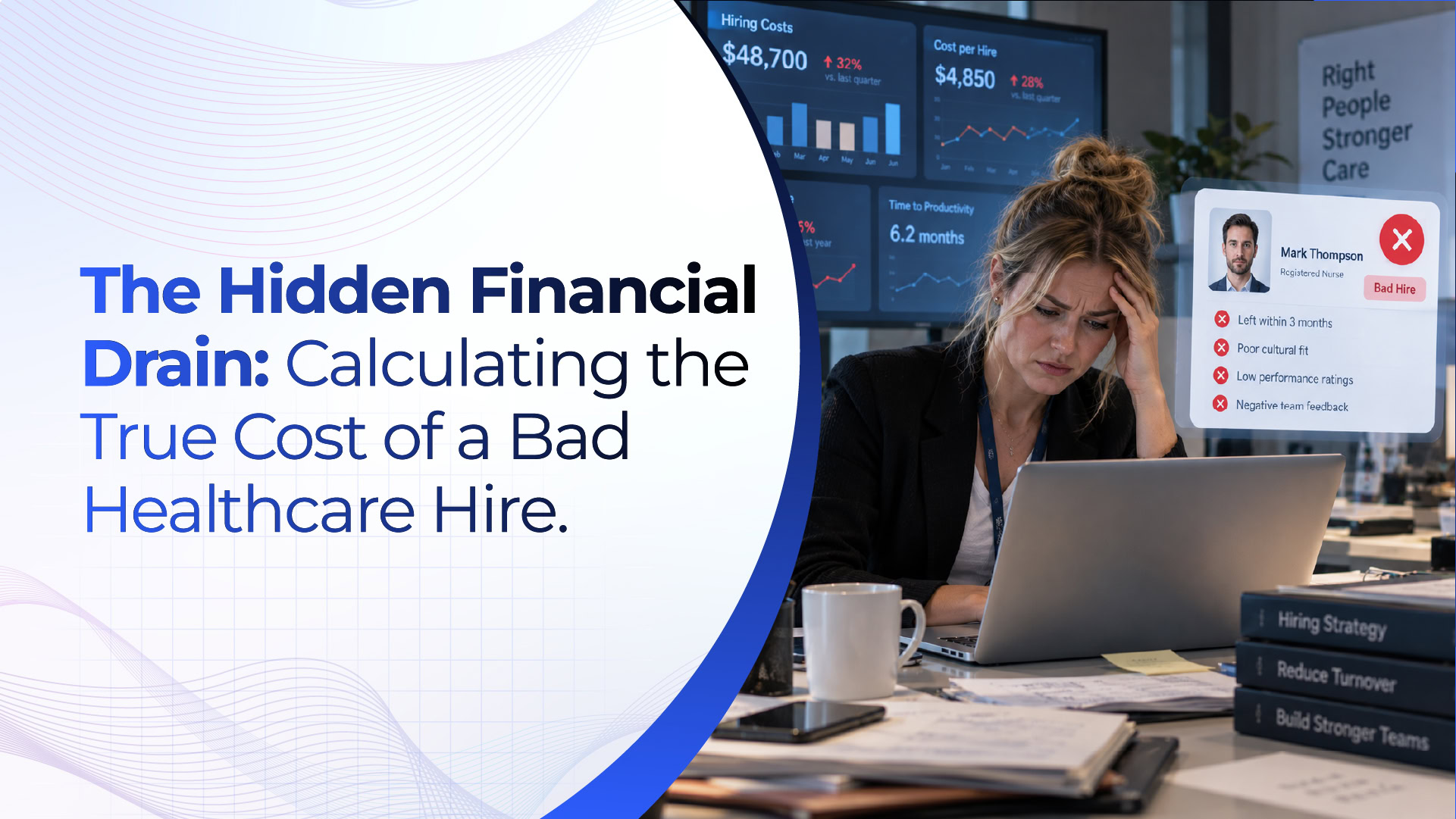
The healthcare industry is facing an unprecedented financial squeeze. Operating margins are razor-thin, premium labor costs are skyrocketing, and clinical burnout is at an all-time high. In response, hospital executives and talent acquisition leaders are desperately searching for ways to cut overhead and protect their budgets. Unfortunately, many organizations focus their cost-cutting efforts on the wrong end of the employee lifecycle. They attempt to reduce the immediate cost of recruiting without addressing the massive, compounding expense of clinical turnover.
In a clinical environment, a bad hire is not just an administrative inconvenience; it is a multi-thousand-dollar operational failure that directly impacts patient care, safety outcomes, and team morale. When talent acquisition teams rush the screening process to simply “get a warm body in the room,” they are trading a small upstream savings in time-to-hire for a catastrophic downstream expense in retention.
Understanding the true cost of a bad hire vs. cost to hire is the first step toward building a sustainable, financially sound recruitment model. Here is why the cost of nurse turnover is devastating hospital budgets, how poor screening guarantees high churn, and how investing in rigorous upstream evaluation protects your bottom line.

What does a single bad healthcare hire actually cost?
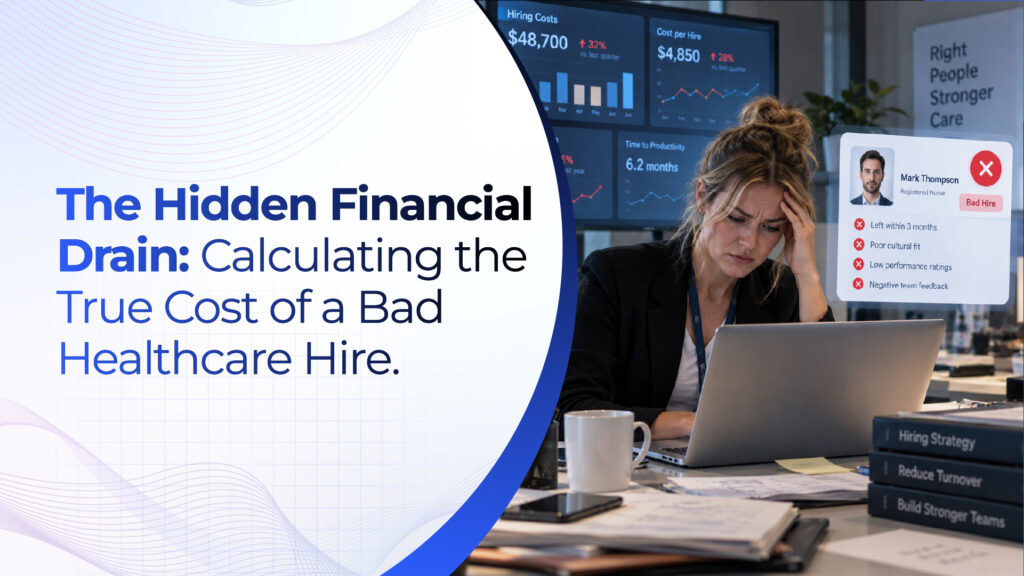
When a clinical employee resigns within their first year, the financial impact extends far beyond the HR department. The nurse turnover cost is a complex calculation that encompasses direct separation costs, lost productivity, premium agency labor required to cover the immediate vacancy, and the heavy burden of sourcing, interviewing, and onboarding a replacement.
According to the 2023 NSI National Health Care Retention Report, the average cost of turnover for a single bedside Registered Nurse (RN) is a staggering $52,350. For a mid-sized hospital experiencing standard industry churn, this translates to millions of dollars hemorrhaged annually just to maintain baseline staffing levels.
Crucially, this figure does not account for the hidden, unquantifiable cultural costs. When a bad hire is made, the existing clinical staff is forced to absorb the operational friction. Veteran nurses must spend valuable hours answering basic questions, correcting charting mistakes, and covering extra shifts when the underperforming hire inevitably calls out or quits. This accelerates burnout among your most reliable talent, triggering a dangerous domino effect of secondary resignations. In a candidate-driven market, you cannot afford to alienate your core staff by surrounding them with poorly vetted colleagues.
Does turnover really start at the interview, not the exit interview?
When a hospital experiences a sudden spike in clinical churn, leadership typically mandates exit interviews to uncover the root cause. While exit data is valuable, it is inherently reactive. By the time a nurse is walking out the door, the financial damage is already done. To truly reduce healthcare turnover through hiring, talent acquisition leaders must recognize a fundamental truth: retention does not begin during orientation; it begins during the very first interview.
High turnover is almost always a symptom of poor upstream evaluation. If a hiring committee relies on unstructured interviews, gut feelings, or rushed phone screens because they are desperate to fill a seat, they will inevitably misjudge a candidate’s clinical competency or cultural alignment.
For example, a candidate might possess an active license and a flawless resume, but if the interviewer fails to ask targeted behavioral questions about how the candidate handles high-stress trauma protocols or conflict with attending physicians, the candidate may quickly become overwhelmed on the floor. Within three months, that candidate will resign, citing “unmanageable stress” in their exit interview. The hospital will blame the stressful environment, when the true failure was an interview process that did not accurately assess the candidate’s baseline resilience. The overall quality of hire was doomed from the start.
What’s the math: screening cost vs. turnover cost?
Many healthcare organizations hesitate to invest in advanced screening tools, citing tight departmental HR budgets. However, this logic represents a fundamental misunderstanding of operational finance. The math heavily favors investing aggressively in the interview phase.
Consider the invisible cost of the screening process itself. When you pull a charge nurse or a unit director off the clinical floor for four hours a week to conduct unstructured interviews with poorly vetted candidates, you are burning expensive clinical time with zero guaranteed return.
Even if an organization spends an additional few hundred dollars per candidate on advanced assessments, specialized talent acquisition software, or extended interview panels, that upfront cost is statistically negligible compared to the alternative. If spending an additional $500 on rigorous, standardized evaluation prevents you from making just one bad hire, you have instantly saved your facility over $52,000. The return on investment is exponential. Cutting corners during the interview phase to save a few dollars is the equivalent of refusing to buy a smoke detector to save money, only to watch the entire facility burn down.
How does better screening upstream protect retention downstream?
Consistent, rigorous screening protects retention by ensuring absolute alignment between the candidate’s proven capabilities and the daily reality of your clinical floor. When a candidate is subjected to a standardized, objective evaluation, there are no surprises on Day 1. The hiring manager knows exactly what the clinician’s strengths are, and more importantly, they know exactly where the clinician will need targeted support during their new hire onboarding.
This level of precision is virtually impossible to achieve with manual, unstructured interviews. It requires a systemic change in how candidate data is collected and analyzed. This is exactly where automation and artificial intelligence are transforming healthcare recruitment.
By utilizing an AI interviewer for hiring nurses, hospitals can guarantee that every single applicant is evaluated against the exact same rigorous clinical rubric. The AI does not get tired, it does not suffer from unconscious bias, and it does not rush a phone screen because its next meeting is starting. According to case benchmarks from industry vendors like Screenz.ai, healthcare organizations implementing AI-driven structured interviews have observed significant, measurable improvements in long-term retention when tracking cohorts 18 months post-implementation. When you hire the right person for the right reasons, they stay.
How do you calculate your own healthcare hiring ROI?
Understanding the theoretical cost of turnover is important, but proving the financial impact to your Chief Financial Officer requires hard, localized data. To justify an investment in better screening technology, you must calculate the exact return on investment for your specific facility.
The calculation requires three baseline metrics: your current annual turnover rate, your total number of clinical employees, and your estimated cost per turnover. If you lack internal HR data, you can comfortably use the $52,350 benchmark for RNs to model your losses. By projecting a conservative 10% or 15% reduction in turnover driven by better upfront screening, you can easily demonstrate millions of dollars in reclaimed revenue.
Do not guess at these numbers, and do not let your CFO dismiss recruitment as a pure cost center. Use our free, interactive Recruitment ROI Calculator to instantly map your current turnover losses against the projected savings of a structured, automated screening process.
Protect Your Retention Budget Before the Offer is Made
If your talent acquisition strategy focuses solely on filling seats as fast as possible, you are actively fueling your own turnover crisis. True recruitment ROI is not measured by how quickly you hire a clinician; it is measured by how long that clinician stays and performs.
Rebecca AI Recruiter is designed to protect your retention spend by guaranteeing that every candidate you advance is objectively vetted, culturally aligned, and clinically capable. By conducting rigorous, structured interviews automatically, Rebecca stops bad hires from ever reaching the clinical floor. Stop paying for turnover. Calculate your ROI, and schedule a demo today to see how intelligent screening secures your talent pipeline and protects your bottom line.