Imagine you are on the phone with a potential customer and hear your name mentioned within the first three seconds of the call, along with a reference to the biggest pain point in your industry. The call is not filled with awkward scripted pauses or “let me connect you to someone else who will help you.”
This isn’t the future; this is how an AI sales agent is operating today. Open-minded revenue teams are swiftly and silently switching from traditional auto-dialers to using AI-powered sales agents.
In this blog post, how AI-powered calling agents are fundamentally different from a traditional auto-dialer, how real-time personalization can change the course of your sales pipeline, and lastly, provide guidance on choosing the best sales automation software for your team.
AI Sales Agent vs. Auto Dialer: What’s Actually Different?
An AI agent for sales is a true autonomous conversation system that does not simply dial a phone; it will listen, interpret what the prospect says, respond, and make real-time adjustments based on the way the prospect responds. Moreover, an AI sales agent can handle all of your prospects objection, qualify the prospect, make real-time updates to your CRM database, schedule follow-up calls, make high-intent transfers to live agents while talking to your prospects, and do all of this without ever reaching the end of a script.
The difference in capabilities and functionality is architectural in nature, where an auto-dialer is simply an amplification device (megaphone); an AI voice agent is a highly skilled communicator.
Below you will find a side-by-side comparison of the differences between the two and how they stack up according to the metrics that are most important to your team.
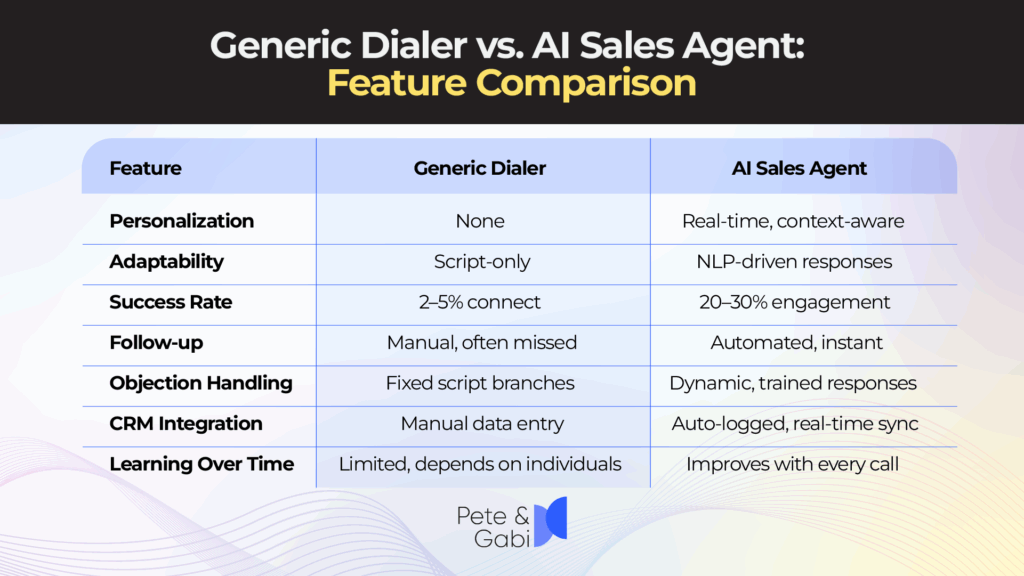
The statistics found in that table are no coincidence, as they are a product of the real-time interaction between conversational AI for sales processes and live data. Here is a look at how it works behind the scenes.
What powers real-time personalization in AI sales call agents?
When a call is connected, best AI sales call agent accesses multiple data sources at the same time:
CRM data: Company size, number and industry; history of previous interactions, current stage in the deal
Intent signals: Pages that have been looked at; content that has been downloaded by the prospect
Firmographic data: Revenue; number of employees; technology that is being used by the company
Live analysis: Detecting tone; keyword identification; identifying any patterns of objections
The system creates a conversational path in milliseconds that is uniquely created for every prospect. When a prospect raises a concern about budget, the AI will steer the conversation to ROI. The key difference between true conversational AI sales and scripted chatbots is the ability to respond dynamically instead of statically.
Why do generic dialers fail at personalization?
Let’s be frank about what generic dialers are actually costing your organization besides just the monthly fee.
Prospects will get fatigued and reject calls: There is very little chance of successfully connecting with someone via ‘cold-call’ telephone because this type of call (that feels impersonal) will only be able to connect you with approximately 6% of those you have ‘called.’
Reps burnout and make repetitive calls: Expecting your human reps to make low-impact calls that require a high volume of calls is a waste of money because they will ultimately leave. Also, those representatives that continue to stay (those that have been burning out) will not be good representatives.
Dialers do not register unqualified prospects: A generic dialing system will never physically hear what the prospect verbally expressed (expressed as hesitation), and therefore cannot ascertain that the prospect has just expressed a willingness to purchase something, thus, the system will wait for an actual sales person to figure it out after the transaction has occurred (if at all). AI will pick up those signals.
Inaccurate follow up to new leads: If your organization does not have a means in which your sales processes automatically have follow-ups built into them, you will allow all prospective new leads to go cold. Follow-ups typically occur within 24 hours of initial contact; dialers will not follow up; AI will.
Switching From an Existing Dialer? Here’s What Integration Looks Like
Moving off a legacy dialer doesn’t mean starting over. An AI calling agent connects directly to your existing CRM namely, Salesforce, HubSpot, Pipedrive, Zoho. So call history, contact records, and pipeline stage carry over from day one. There’s no rip-and-replace: your team keeps its workflow while the ai sales agent vs auto dialer shift happens in the background, with live calls handled by AI within days of setup.
Which industries benefit most from a B2B AI sales agent?
Any industry that employs a large number of outbound calls and has consistent qualifications can benefit from using AI agents for sales. Certain industries, however, will see more disproportionate benefits than others.
For B2B SaaS and technology solutions, AI sales agents perform consistent discovery on all conversations, identify key pain points, and provide multiple touches to their prospective customers. In the financial services industry, compliance-related regulations associated with high volume of outreach require that AI agents work within a precise regulatory framework to mitigate risk associated with non-compliance per regulation.
In Healthcare and Insurance industries, AI agents for sales qualify for consultations, appointments and explanations of benefits before a recruiter engages with the candidate. Whereas in real estate, AI agents will be able to respond to property inquiries within minutes of receipt including after the normal business hours to provide the agent an advantage over any other agents in the same marketplace.
In recruitment and staffing industries AI agents will automate the screening process of candidates and could do so on a much larger scale than any human recruiter through the qualification and pre-qualification of candidates before the recruiter contacts a candidate.
How does AI sales automation software handle objections?
AI sales automation tools use a pre-trained machine learning model based on thousands of actual conversations to do this and therefore create a full response immediately and with about the same tone as the conversation.
Here are just a few of the most common types of objections and how best AI sales automation software reacts to them:
“We are not interested in anything today”. The model will ask questions about the subject like when do you think you are likely to be ready? And suggest ways to keep in touch until they are ready.
“We currently use another vendor”. A good AI sales automation tool can identify problems the customer has with their current vendor and gain better information on how satisfied they are with their vendor and if there are any renewal dates in their contract.
“Send me something in the mail”. The software confirmed the customer was going to be sent something, ensured it would have the correct addresses and sent an automated email sequence to the customer’s account immediately following the call.
You don’t need a human to respond to these objections!
How do AI sales reps improve over time?
There is a key advantage that manual dialing cannot replicate, and that is the ability of AI reactivation agents that can learn.
From each objection handled to each conversion, even down to how many people hung up before an introduction can be made, all contribute to the data available. AI sales assistants improve the model as they use it over weeks and months to become more accurate at predicting which introductions are more popular by industry, and what time of day provides the best successful contact rate based on the segment being called.
Human sales reps also learn over time, but their knowledge leaves the company once they do. However, institutional learning within your AI dialers will remain within the system for as long as the system itself remains active.
The Bottom Line
Manual dialers without specific purposes used to be the best fit when sales volume was the only consideration. But now, personalization is what counts, and currently, no manual dialer out there has the capacity to offer real-time personalization for live conversations.
AI-based sales agents like Olivia AI by Pete & Gabi are now available that provide the full benefits of automated systems and also human-wise intelligence that your best human agent brings to a sales situation; they retain all of their call history information, they never tire, and they take the initiative to follow up and they improve during every call.
Frequently Asked Questions
What is the difference between AI sales dialers and traditional auto dialers?
A traditional auto dialer just connects calls faster, it doesn’t listen, adapt, or understand context. An AI calling agent built for real-time personalization pulls CRM data, intent signals, and live conversation cues to adjust its approach mid-call, something a script-based dialer simply can’t do.
What’s the difference between an AI dialer and a true conversational sales agent?
The difference is adaptability. A true conversational AI for sales agent responds dynamically to what a prospect says by handling objections, shifting tone, and pulling in relevant data in real time, instead of following a fixed call flow.
What should I look for when evaluating an AI sales agent?
Look for native CRM integration, real-time objection handling, live transfer to human reps, and proof of adaptive, not scripted conversation. These are the capabilities that separate a genuine ai sales agent vs auto dialer from a relabelled dialer with a chatbot bolted on.
What are automated sales follow-ups, and why do they matter?
Automated follow-up uses AI to trigger timely, personalized outreach after the first contact, so no lead goes cold from delay. Speed and consistency are what separate this from manual follow-up, which is inconsistent by nature.
Which sales automation platform should a growing startup choose?
A growing team should prioritize fast setup, easy CRM integration, and conversation quality over raw call volume, a platform that scales without needing a technical team to maintain it.
What should I expect from an AI sales agent demo?
A good demo shows live call handling such as real objections, edge cases, and a human handoff, not just a scripted walkthrough. Transparency here is a strong signal of how the AI performs outside the demo room.