

One of the biggest operational challenges a company faces in today’s highly competitive and fast-paced business environment is finding and securing the right talent quickly. When an organization needs to quickly scale headcount to launch a new product, navigate seasonal spikes in consumer demand, or find a highly specialized executive to guide corporate strategy, managing the entire recruitment lifecycle internally can put a serious strain on human resources bandwidth. When a critical role goes unfilled every single day, the business is losing revenue, productivity suffers and existing teams are burning out from the added workload. This is where third party talent partners come in.
If you are an employer, founder or hiring manager considering external recruitment support for the first time, it’s important to understand the specifics of industry models, pricing structures and operational workflows so that you can make a sound financial decision. In this comprehensive guide, we’ll cover the basics, the operation of staffing agencies, the most popular placement models you’ll find in the market today, and the typical fee structures you should expect when you are outsourcing your hiring pipeline.
What is a staffing agency, and how is it different from a job board or hiring in-house?
Staffing agency is a specialized company that connects employers with qualified candidates for temporary, contract or permanent job openings. These organizations are an extension of your business, rather than simply advertising an open position and hoping for the best. They aggressively recruit, vet and deliver a curated list of top tier professionals directly to your hiring managers.

To know what a staffing agency is, one must understand the difference between it and other standard hiring methods that companies typically use:
- Against a Job Board: A digital job board (like Indeed, ZipRecruiter, or LinkedIn) is essentially a passive bulletin board. You pay a fee to place an ad and then wait for candidates to apply. This often results in a flooded inbox with hundreds of unqualified resumes that your team has to manually review. But a recruitment firm is an active, white-glove service. Recruiters actively seek out passive talent, conduct initial interviews, check references and only present a small, highly qualified shortlist of vetted professionals.
- In-House Hiring vs. Versus: Hiring in-house means your internal HR team handles every step of the recruitment cycle. This includes writing the first job descriptions, managing software subscriptions, phone screens, calendar invites and onboarding paperwork. This gives total internal control but eats up huge amounts of internal bandwidth. Outsourcing this heavy administrative lifting to an external recruitment firm gives your company workforce flexibility and immediate access to a wide, pre-built external talent network.
What are the main types of staffing agencies (temp, temp-to-hire, direct placement, PEO)?
There are several different types of staffing agencies. These are categorized by the length of the contract, the level of the role, and who is the official employer of record for tax and payroll purposes. Completely different operating models are required for different business needs.
| Service Model | Contract Duration | Employer of Record (Payroll) | Best Business Use Case |
| Temporary / Contract | Short-term (Days to Months) | The Recruiting Firm | Covering seasonal production spikes, employee leaves of absence, or specialized short-term projects. |
| Temp-to-Hire | Trial period leading to permanent | Firm first, then the Client | Evaluating a worker’s on-the-job performance and cultural fit before making a full-time commitment. |
| Direct Placement | Permanent (Immediate) | The Client Company | Filling mid-level to executive roles where immediate, full-time commitment and integration are required. |
| PEO (Professional Employer Org.) | Long-term / Ongoing | Co-employment (PEO & Client) | Outsourcing total HR administration, payroll processing, and benefits pooling for an entire workforce. |
(Source: Adapted from the American Staffing Association Definitions of Staffing Services)
Understanding the Four Core Industry Model Types
- Temporary and Contract Help: The firm employs its own people, and provides them to assist a client’s workforce. It is widely used when employes are absent (e.g., parental leave), when there are temporary skill shortages, when there are seasonal workloads (e.g., retail holiday rushes or tax season for accounting firms), and during special technical projects.
- Temp-to-Hire (Contract-to-Hire): This agreement involves the employe being hired by a client for a specified time frame, usually 90 to 180 days, as a trial period. This is the time that both the worker and the employer assess the working relationship. If the trial is successful and the candidate performs well, the client moves the worker to a permanent employment relationship seamlessly.
- Direct Placement Services: This service, sometimes called direct hire or permanent placement, helps job seekers find potential employers and allows for an immediate permanent employment relationship. The external recruiter is strictly a matchmaker and negotiator; the candidate is on the client’s payroll and benefits plan from day one.
- Professional Employer Organization (PEO): The PEO relationship is much more than recruiting. In this model, a business creates a formal “co-employment” relationship with the external firm, which puts all or most of its workforce on the external firm’s payroll. The PEO takes full legal responsibility for payroll management, workers’ compensation, health benefits pooling and core human resource compliance, enabling the client company to concentrate fully on day-to-day operations and growth.

How does the staffing agency placement process actually work, step by step?
When a company chooses to outsource an open role, the talent partner takes the entire funnel. The placement process is well-structured and usually consists of five basic stages where quality control is monitored from beginning to end.
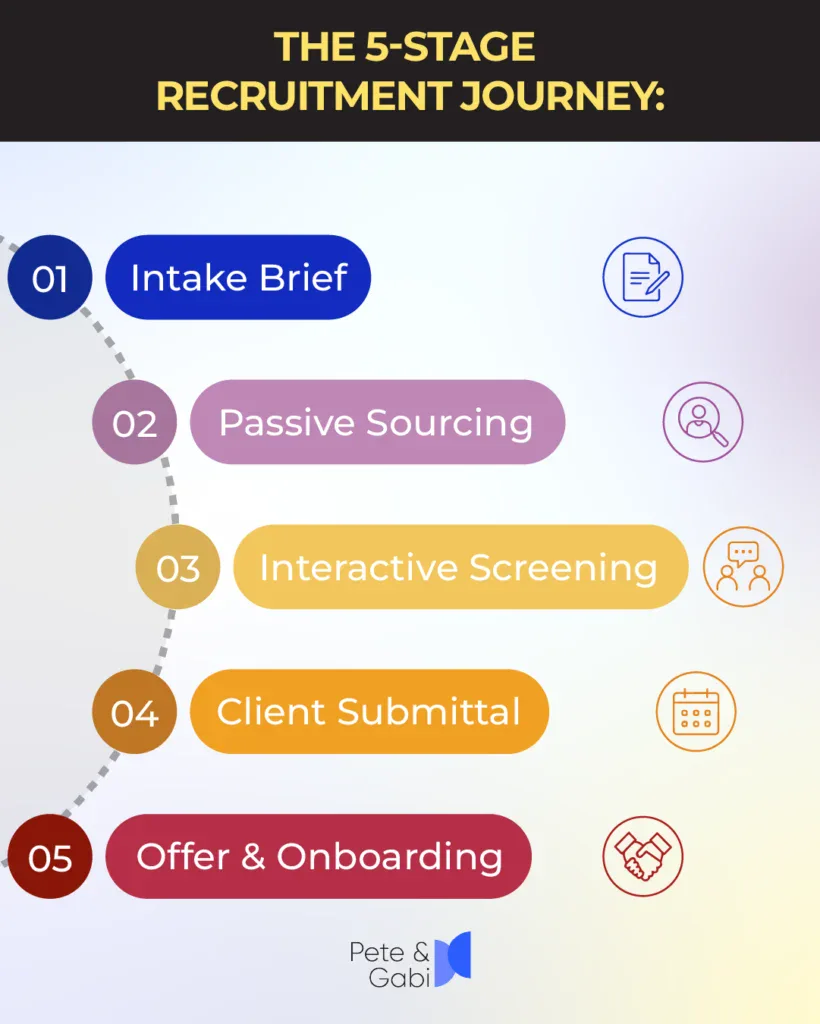
A detailed, step-by-step breakdown of the operational workflow, to really understand the mechanics of the service:
- Step 1: Client Intake and Alignment The recruitment partner meets directly with the employer or hiring manager to understand the open role in deep detail. They go beyond the job description to outline the needed technical skills, soft skills, cultural fit for the company, salary budget and hard timeline for hiring.
- Step 2: Sourcing & Outreach: The company leverages its existing talent network database and sophisticated search algorithms to identify matching candidates. Specialized recruiters pay close attention to passive job seekers – high performing professionals who are currently employed, not actively surfing job boards, but are open to lucrative new opportunities.
- Step 3: Screening and Vetting The recruitment firm conducts rigorous preliminary interviews, administers technical skills tests and performs reference checks before an employer ever sees a resume. This is a quality-control firewall to ensure that only the most qualified move forward.
- Step 4: Submittal and Client Interviews: The firm will provide the client with a narrowed list of the very best candidates (generally only 3 to 5 highly-vetted individuals). The client then completes a final round of interviews on their own to determine candidate fit and team chemistry.
- Step 5: Placement and Onboarding: After the employer makes the final choice, the recruitment partner will mediate the process to help negotiate the offer and ensure both parties are satisfied with the compensation package. Depending on the contract type, the firm may also handle payroll setup, background checks and onboarding logistics to ensure a smooth start date.
How do staffing agencies get paid, and who covers the fee?
The employer or client company pays the recruiting firm, not the job seeker. One of the cardinal rules of the industry is that a legitimate recruitment firm will never, ever charge a candidate for finding work.
If you’re a business leader who has a hiring budget, it’s good to understand how staffing agencies are paid. Financial structure depends on the type of placement service provided to your company:
| Fee Structure Type | How It Is Calculated by the Firm | When the Client Pays | Primary Service Model |
| Contingency Fee | 15% to 30% of the candidate’s first-year annual base salary. | Paid only upon a successful candidate hire and start date. | Direct Placement / Permanent Hire |
| Retained Fee | Fixed total fee or percentage, paid out in scheduled project milestones. | Upfront deposit, at the interview stage, and upon final hire. | Executive Search / Specialized Leadership |
| Hourly Markup | Base hourly wage of the worker + a markup percentage (usually 20% to 50%). | Billed incrementally on a regular weekly or bi-weekly cycle. | Temporary & Contract Staffing |
(Source: Standard industry benchmarks aligned with American Staffing Association Economic Research)
- Contingency Fees: Firms typically operate on a contingency basis when providing permanent direct placement services, which means the service is risk-free to the employer during the search phase. Staffing agency fees are charged only when there is a hire. In this model, the client only pays the invoice when the employe is hired, accepts the offer and starts their first day of work.
- Retained Search Fees: Employers may use a retained search firm to fill C-suite executive roles or other highly specialized technical positions. In this model, the client will pay a portion of the fee upfront, to reserve the firm’s dedicated and undivided resources, as well as its research teams. The remainders are paid out in scheduled milestones as candidates are screened and hired .
- Hourly Markups: The recruitment firm is directly responsible for payroll for temporary and contract workers. The client pays an hourly rate that is a markup of a set percentage on the worker’s take-home wage. This markup is necessary to pay the firm’s administrative costs, employer payroll taxes (e.g., FICA), workers’ compensation insurance, unemployment insurance, and profit margin for the firm.
What are the pros and cons of using a staffing agency vs. hiring in-house?
The biggest benefit of working with external talent partners is the ability to quickly access highly flexible, specialized talent without adding to your internal headcount. The main disadvantage is the initial financial outlay compared to doing the process internally.
| Strategic Consideration | Partnering with an External Talent Firm | Managing the Hiring Process In-House |
| Speed to Hire | Exceptionally fast; immediate access to pre-vetted databases and active recruiter networks. | Generally slower; highly dependent on job board posting response times and organic reach. |
| Talent Access | Direct, proactive access to passive candidates and specialized, niche talent pools. | Often limited strictly to active job seekers who apply directly to your website. |
| Upfront Financial Cost | Direct placement fees (15%–30%) or ongoing hourly service markups. | Internal recruiter base salaries, ATS software tools, and paid job ad spend. |
| Internal Team Bandwidth | Low internal burden; resume sorting, screening, and initial vetting are completely outsourced. | High internal burden; HR must manage hundreds of resumes and constant phone tag. |
| Cultural Control | External recruiters must be carefully briefed and calibrated on your exact company culture. | Total, uncompromised internal control over cultural alignment and employer brand messaging. |
Ultimately, while the upfront cost of an external partner may seem high, many businesses find that this expense is vastly offset by avoiding the severe financial impact of vacant roles, lost productivity, or the devastating cost of making a bad hire on their own.

How is AI changing what a staffing agency can deliver for its clients?
Artificial intelligence is changing the workforce solutions industry, allowing recruitment firms to source, screen and place candidates much faster and with a lot more accuracy than traditional manual methods ever could.
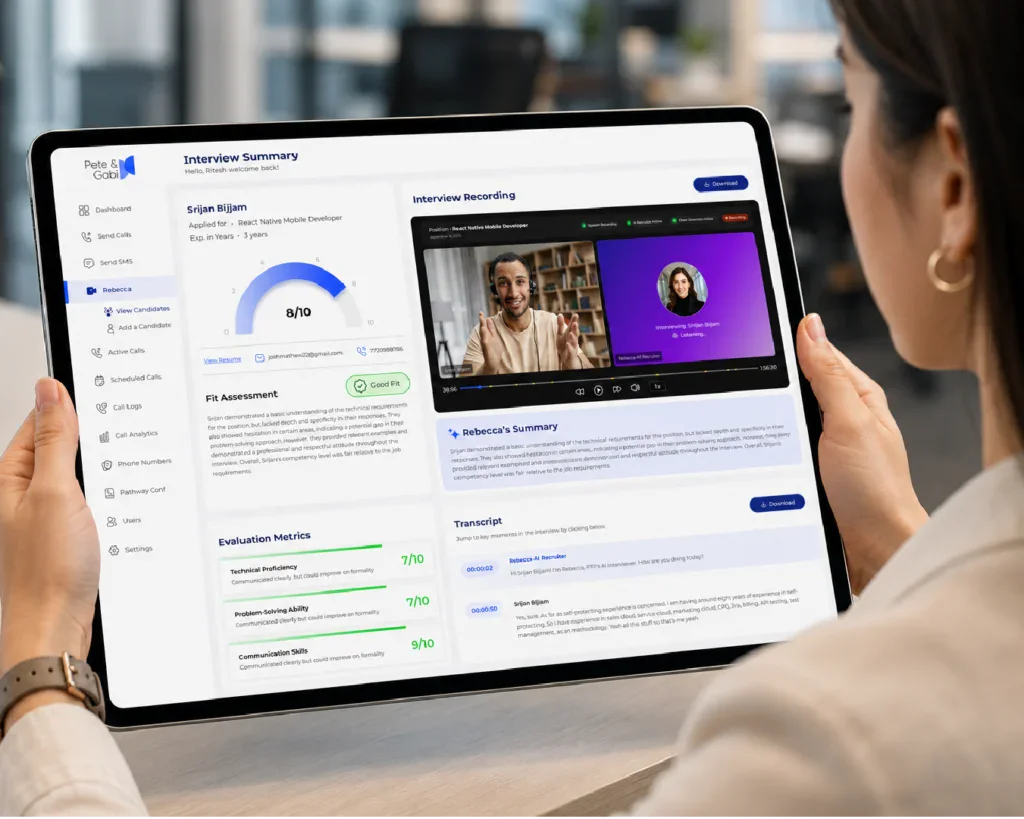
In the past, outside talent firms relied on manual resume parsing, basic keyword searches and endless phone tag to qualify candidates. The landscape is changing fast today. To remain competitive and provide best-in-class talent to their clients quickly, modern firms are embedding sophisticated generative AI and automation technology right into their day-to-day workflows.
Using smart screening tools, these companies can instantly assess a candidate’s core competencies, automate complex interview scheduling across time zones, and ensure a highly objective screening process with reduced bias. This technological leap means that when a client asks for a shortlist of candidates, the recruitment partner can deliver a shortlist in hours, not weeks, of perfectly matched, highly vetted candidates.
Many forward-thinking companies today are using intelligent conversational platforms like Rebecca AI Recruiter to run interactive voice screens. These tools act as a 24/7 digital recruiting assistant, dynamically assessing candidate competencies in real time and ensuring only the very best of the best talent reaches the employer’s desk for a final interview. To learn more about how this specific technology is changing the hiring process, check out our detailed guide about how staffing agencies are using AI to get candidates hired faster.
If you’re currently working on sourcing external partners to fill hiring needs for your business, check out our guide to the best recruiting agencies in the USA for employers in 2026. Also, knowledge of the bigger nuances of the staffing and recruitment industry will enable you to confidently choose a partner that has the modern tools to support your long-term business growth.