The pressure to scale their candidate screening processes for talent acquisition teams has driven a dramatic increase in the use of automated assessment tools. When faced with a huge influx of applicants for high priority roles, traditional manual phone screens just can’t keep up with the demand. To overcome the operational bottleneck, companies are aggressively adopting artificial intelligence. But the HR technology market is currently awash in a confusing mix of legacy systems, simple one-way recording tools, and next-generation conversational voice agents. That noise makes it really hard to figure out what solution will actually improve your hiring pipeline, without alienating your applicants.

If you’re a talent leader or an operations director tasked with finding the best evaluation technology, it’s absolutely necessary to do a thorough ai video interview platform comparison before signing a long-term contract. This guide provides a detailed comparison of the key functional and philosophical differences among the leading vendors in the market. We’ll compare Rebecca to industry leaders like Sever.ai and HireVue, highlight the glaring functional differences between live adaptive voice and static video recordings, and give you the tough, hard-hitting questions you need to ask before you buy the best ai video interview software for your organization.
What should you actually compare when evaluating AI video interview platforms?
As organizations begin to evaluate vendors for an ai video interview platform comparison, one common mistake is to focus only on software pricing, or the number of features that are listed on a sales sheet. But the true value of recruitment automation is in candidate adoption and operational efficiency. If a platform is hard to use, candidates will walk away from the interview. If it doesn’t integrate natively with your existing tech stack, it’ll just create more admin work for your recruiters.
“Best interviewing platforms make this process easier and more streamlined,” and “integrate seamlessly with existing Applicant Tracking Systems (ATS),” say G2’s independent technology analysts. When considering the best ai video interview software, talent acquisition teams should consider four key pillars of tools:
- Candidate Experience and Format: Does the platform force candidates to record answers to text prompts on a screen (one-way video), or does it engage them in a natural, fluid conversation?
- Evaluation and Scoring: How does the artificial intelligence evaluate the applicant? Is it analyzing facial expressions and eye contact, or just assessing the substance of their spoken answers against a structured rubric?
- ATS Integration: Does the platform push completed scorecards, audio transcripts, and media files directly back into your primary database (Workday, Greenhouse, Lever etc.) natively?
- Anti-Cheat and Authentication Mechanisms: Does the system confirm the identity of the candidate and detect the use of unauthorized AI prompters during the assessment?
Understanding how vendors approach these four pillars is the key to differentiating a truly intelligent evaluation co-pilot from a simple recording repository.
The Head-to-Head Market Comparison
| Feature Category | Rebecca AI | Sever.ai | HireVue |
| Primary Format | Live, adaptive conversational voice | Automated one-way video & text bots | Pre-recorded video & game-based assessments |
| Evaluation Focus | Content, competency, and technical depth | Visuals, voice, and text parsing | Facial micro-expressions (historically) and text analysis |
| ATS Integrations | Deep native syncing (Workday, Greenhouse, etc.) | Standard enterprise integrations | Enterprise-heavy (Workday, SAP, Oracle) |
| Ideal Customer Profile | Mid-market & fast-scaling staffing agencies | Regional enterprise & high-volume retail | Global enterprise corporations |
| Anti-Cheat Defenses | Voice authentication and real-time probing | Video monitoring & baseline text analysis | Video monitoring & browser lockdowns |
How does Rebecca compare to Sever.ai on interview format, scoring, and integrations?
If your company is conducting a high-volume hiring campaign, a sever.ai video interview is a tried and true tool in some regional markets. Originally built for large-scale enterprise use, the platform provides automated business processes such as video interviewing, voice calls and text evaluation. It is designed to evaluate thousands of applications simultaneously, asking pre-set questions and analyzing the candidate’s video, voice and text responses.
A typical sever.ai video interview scale is strong, but the candidate experience can feel a bit rigid. The interaction can feel more like a digital interrogation than a two-way conversation, because it’s based on pre-configured questions and static video capture. The candidates respond to prompts on a screen, and the system parses their answers after.
If you’re actively looking for a modern sever.ai alternative, Rebecca AI offers a fundamentally different approach to candidate evaluation. Rather than capturing one-way video, Rebecca uses live, adaptive conversational voice.
When a candidate talks to Rebecca, the AI listens to the answer and dynamically comes up with relevant probing follow-up questions in real-time. Rebecca will, without hesitation, ask any candidate who says they know Python to explain a complex algorithmic challenge. This adaptability means that candidates can’t depend on prepared answers or read from a script. Rebecca also has very deep integrations with popular US-centric ATS solutions like Greenhouse, Lever and Ashby, which makes it a very nimble sever.AI solution for modern, tech-driven staffing teams that need immediate data synchronization without extensive IT setup.
How does Rebecca compare to HireVue for mid-market and staffing-focused teams?
HireVue is perhaps the most recognizable legacy brand in the digital recruiting space. The one-way recorded video interview was pioneered by HireVue, which was built for huge, Fortune 500 enterprise corporations. It also offers game-based tests and coding challenges to screen tens of thousands of applicants for global graduate schemes and high-turnover jobs.
But HireVue’s sheer size can be its greatest weakness. For mid-market companies and fast-moving staffing agencies, implementing HireVue can be like buying a commercial airliner to cross a small lake. The implementation cycles are long, the platform is bulky and the pricing structure is heavily geared toward massive corporate budgets. More importantly, the candidate’s sentiment around one-way recorded interviews has become very negative in the last few years. Job seekers say that talking to a blank screen can feel deeply impersonal and anxiety-inducing.
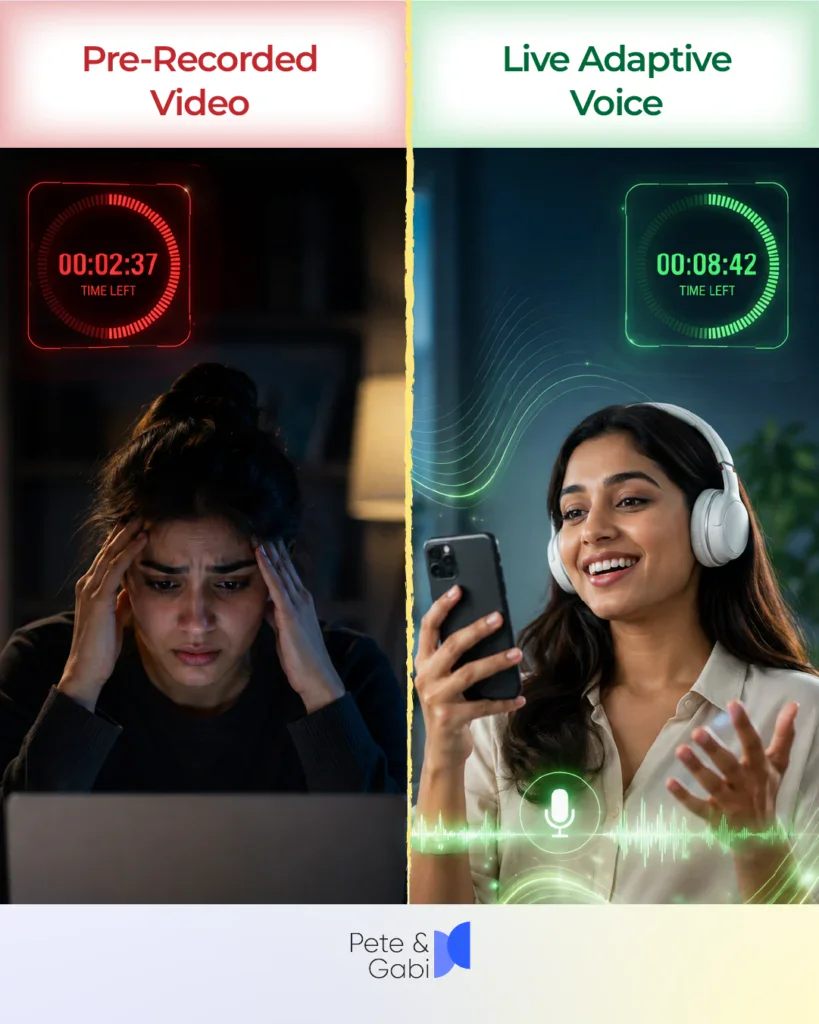
Rebecca is a highly agile hirevue alternative with a laser focus on conversational intelligence. It strips away the bloat. Rebecca removes the awkwardness of staring at a webcam with a timer counting down, and focuses on an adaptive, voice-first approach. Candidates will have a natural, conversational interview. Rebecca provides a streamlined, highly effective hirevue alternative that respects the candidate’s dignity while delivering strict, rubric-based scorecards straight into your current applicant tracking system (ATS) for staffing agencies and mid-market teams that must implement screening technology in days rather than months.
What do live, adaptive voice interviews offer that pre-recorded one-way video doesn’t?
The biggest evolution in HR technology over the last three years has been moving from static data collection to dynamic interaction.
A one-way pre-recorded video interview is completely static. The employer submits five questions. The candidate reads the prompt on his screen, records a two-minute answer, looking at himself, and hits submit. They panic if they trip over a word. The software can’t explain. It can’t read the room. It can’t adapt. For example, a vague answer to “leading a marketing campaign” from a candidate is accepted by the system and human recruiters are left to guess the applicant’s true level of expertise.
On the other hand, a live, adaptive voice interview functions with the same human-like curiosity and empathy. If a candidate starts to give a vague answer, the intelligent agent immediately senses the lack of depth and asks a follow-up clarifying question. “You said you led the campaign,” it might say. “Can you tell me exactly what channels you ran and what the final ROI was?”
This conversational tone relaxes the candidate. They’re not doing it for a camera, they’re just chatting.” This adaptive probing is the difference between a true evaluation and a mere repository of recordings. It helps the employer get to the heart of a candidate’s experience, it prevents applicants from employing AI co-pilots to write generic answers on a second screen (as they don’t know what the follow-up questions will be), and it provides a dramatically improved candidate experience, mimicking a real life phone conversation with a human recruiter.
What questions should you ask any AI video interview vendor before you sign?
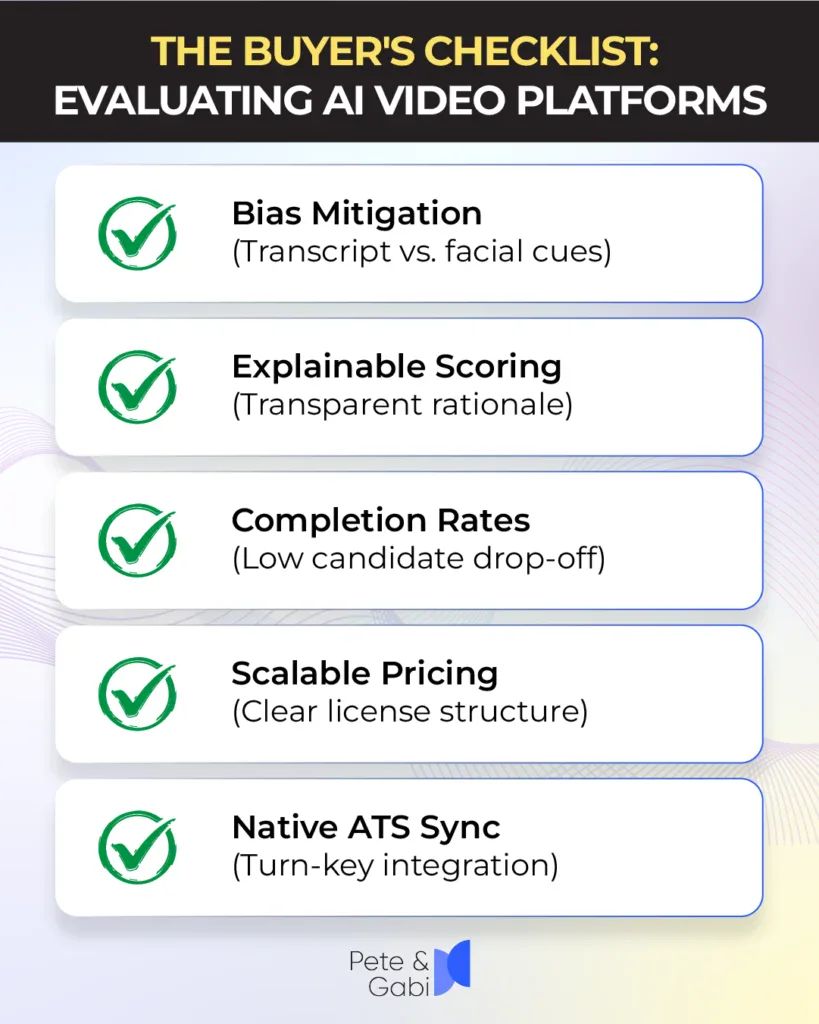
To ensure you are getting the best platform for your recruitment stack, you need to look past the marketing gloss and demand tough technical transparency. According to SelectSoftware Reviews, when considering pricing and features, buyers should factor in how deep the integration is and the needs of their team in terms of operations, as well as the number of seats they need and the number of interviews they conduct each month.
Before you sign a contract with any vendor, ask clear, verifiable answers to these operational questions:
- How to combat algorithmic bias? Are you letting your AI judge candidates on visual cues, facial expressions and eye contact (which can be a major penalty for candidates with neurodivergent traits, disabilities or different cultural backgrounds) or are you strictly judging the anonymized transcript of their spoken answers?
- Are your scores totally transparent? Is the system a “black box” algorithm, or does it provide a transparent, human-readable rationale of exactly why a candidate got a certain score?
- What was the historical completion rate of candidates? High drop off rates mean a frustrating user interface or no mobile optimization or a very invasive assessment process that scares away top tier talent.
- What is your pricing structure and scale? Do you charge per individual interview, per recruiter seat, or an annual flat enterprise license?
- How quickly and how deeply can this be embedded?” Does this mean months of custom API development for your internal IT team, or do you have a native, turn-key integration for your specific Applicant Tracking System?
Which platform fits your hiring volume and team size?
Ultimately, the decision on what assessment tech to use is dictated by the shape of your hiring funnel, the bandwidth of your internal team, and how much you value the candidate experience. If you are a global legacy enterprise brand that is trying to filter 100,000 retail applications a month with pre-recorded visual assessments, platforms like HireVue or Sever.ai may fit your overall compliance architecture.
However, if you are a modern mid-market enterprise, a highly specialized staffing agency, or a fast-scaling tech company that values candidate experience, agility and speed, then conversational voice automation is the way to go.
For more on the software landscape, check out our dedicated resource on how to find the best ai video interview platform. You can also get into the nitty-gritty of certain head-to-head match-ups and explore how Rebecca compares to Ribbon AI to see why Rebecca is the better AI voice interviewer. Or learn the differences in how Rebecca compares to Alex.
If you’re ready to leave those clunky one-way video portals behind, safeguard your brand image, and join the future of interactive, real-time candidate evaluation, check out Rebecca AI Recruiter today. Give your hiring managers the smart tools they need to better assess talent, faster.