One of the most expensive operational failures in corporate talent acquisition is assuming that because you manage people you know how to interview them. Departmental leaders are usually promoted on the basis of their technical expertise or strategic vision, but are seldom given formal training on how to systematically evaluate a candidate’s predictive job performance.
Without specific interview training for hiring managers, the recruitment pipeline becomes a series of unstructured conversations based on “gut feelings.” This subjectivity results in significant unconscious bias, a dramatic increase in time-to-hire, and costly mis-hires.
Using a standardized coaching framework with internal stakeholders, turns the interview from a risky guessing game into a rigorous data collection exercise. Knowing exactly how to design this coaching will transform your hiring managers into precision evaluators, not casual conversationalists.
Why are most hiring managers never actually trained to interview?
Nearly all of the training dollars that corporations spend are on technical skills specific to the job, leadership development, or basic HR compliance. Interviewing is erroneously considered a soft skill that professionals will naturally discover over time.

Since a hiring manager may only open a requisition once or twice a year, talent acquisition teams often don’t have the bandwidth to do formal training for every individual leader. Instead, recruiters just send across a resume and calendar invite, assuming the manager knows what to ask. This produces a systemic blind spot. If hiring managers are not trained on how to use standardized rubrics, they go back to what they are comfortable with, which is often asking theoretical questions, talking about common personal interests or aggressively selling the company and taking over the conversation.
What are the most common interview mistakes untrained hiring managers make?
Without hiring manager interview training, departments fall into predictable patterns of failure. The Halo Effect is a common problem for untrained interviewers who are prone to like candidates who are like them, even if they are not even conscious of it. They also often violate the 80/20 rule, spending most of the interview time pitching the company rather than listening to the candidate’s historical evidence.
Also, untrained evaluators often ask leading questions that subconsciously provide the candidate with the right answer or, worse, get into non-compliant, legally risky conversational territory about a candidate’s personal life. The result is a finished interview that gives no objective data about the candidate’s real ability to do the job.
What does a 30-minute interview-training session for a hiring manager need to cover?
Interview skills training must be highly concentrated, entirely practical and strictly devoid of theoretical HR lectures to respect executive bandwidth. There should be a mandatory 30 minute operational prep session deployed before any manager is allowed to lead an interview loop.
This shortened training module must include:
- Unconscious Bias Awareness: Recognizing the tendency of subjective preferences to masquerade as “culture fit” and how to intentionally distinguish between likability and competency.
- The STAR Technique for Interviewing: Training managers to go further than vague answers, by inquiring about Specific Situations, Tasks, Actions, and Results.
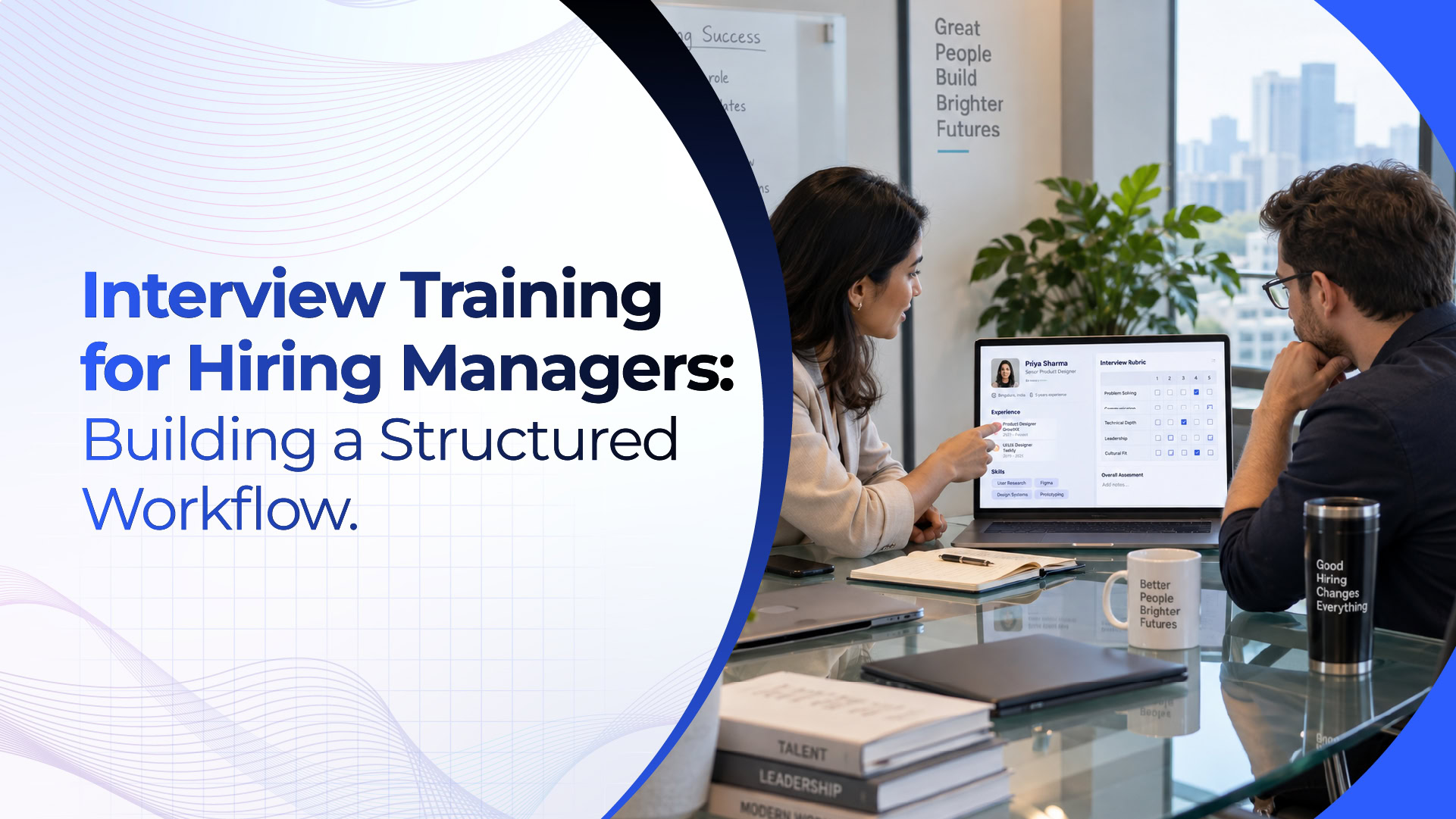
- Rubric Enforcement: Walking through the specific interview scorecard to ensure the manager understands exactly what behavioral evidence constitutes a “1” versus a “5”.
- Legal Compliance: A brief review of the no-go questions to protect the organization from liability.
How do you get hiring managers to actually follow a structured format instead of freelancing?
Enforcing structure means linking the hiring manager’s compliance to their own pain points from an operational standpoint. Department heads hate long vacancies and the pain of handling underperforming employees.
According to research compiled by LinkedIn Talent Solutions, structured interviews far outperform unstructured methods, leveling the playing field and removing guesswork. Adoption rates soar when the structured format is sold as a tool for efficiency, not HR bureaucracy.
The enforcement is by gating the process. Talent acquisition teams need to have a strict policy of no debrief meetings, no offers, until scorecards are complete and supported by documented evidence. If a manager deviates from the script and does not collect the required rubric data, the interview is considered incomplete.
What’s the recruiter’s role in coaching a hiring manager before an interview loop?
The relationship between the talent acquisition team and departmental leadership is a strategic partnership. As outlined in the operational boundaries of the recruiter vs. hiring manager dynamic, the recruiter acts as the internal talent advisor.
The recruiter is directly responsible for a 10-minute calibration sync 48 hours before the start of the interview loop. In this sync, the recruiter assigns specific competency lanes to specific interviewers to avoid redundant questions. Recruiter also provides the hiring manager with the pre-interview briefing template so that the manager walks into the room knowing exactly what data they’re responsible for mining.
How does inconsistent interviewing show up later as a bad-hire or quality-of-hire problem?
When organizations fail to establish how to train hiring managers to interview, the downstream consequences are severe and financially damaging. Candidates hired through unstructured, “gut feel” interviews frequently lack the core competencies required for the role, leading directly to high first-year turnover.
Inconsistent interviewing also creates a chaotic candidate experience. Top-tier professionals evaluate the competence of their future employer based on the rigor of the interview process. A rambling, unstructured conversation signals poor internal leadership, causing elite talent to withdraw their applications entirely.
Standardizing the interview process across an entire organization is the only way to ensure reliable quality-of-hire. For teams lacking the internal bandwidth to coach every manager individually, intelligent screening tools like Rebecca AI Recruiter automatically enforce a consistent, structured rubric for every candidate. By capturing objective, evidence-based data upstream, Rebecca provides hiring managers with a precise evaluative framework without requiring a manual training session for every new requisition.