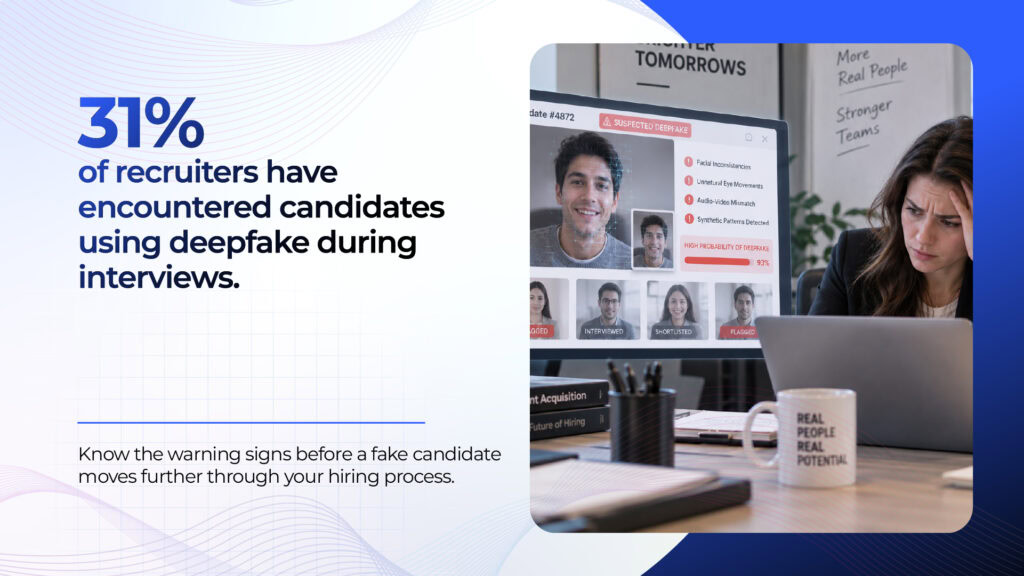
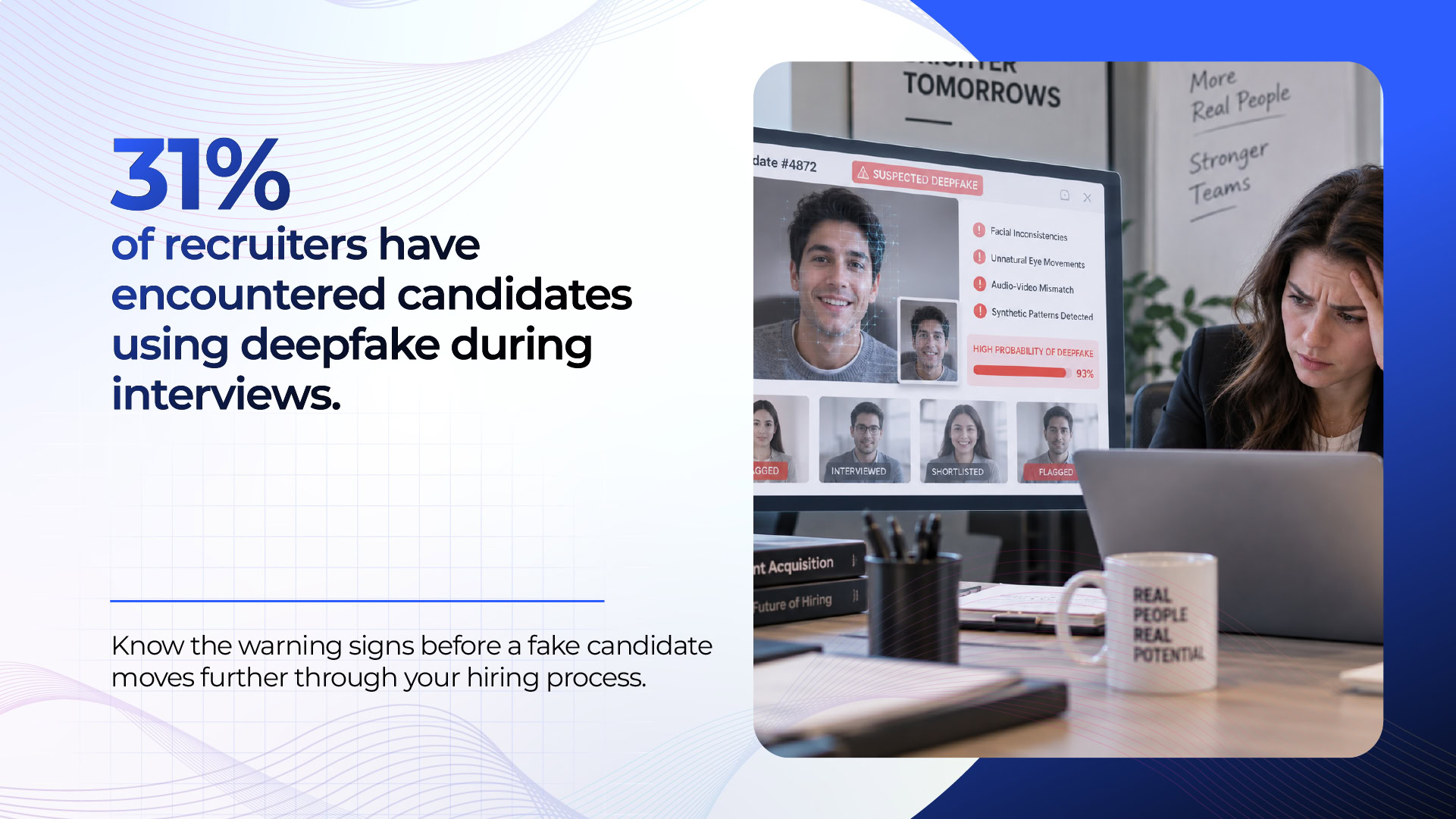
In the current landscape, a candidate listed in your open req list maybe in fact just is not who they claim to be. According to predictions made by Gartner, by the year 2028 there will be one fake candidate profile in every four genuine profiles on the planet, and in the recent survey of more than four thousand recruiters conducted by Greenhouse, it was revealed that 31% of them have already conducted interviews, where they suspected or confirmed the presence of deepfake technology in the video streams.
The present problems regarding the deepfake candidate detection are described in this guide, concerning the signs indicating that a certain candidate is fake, the functions of the system that may help in the detection of deepfake technology besides the common interviews with the help of the video calls, which do not help in this matter.
How Common Is Deepfake Candidate Fraud, Really?
The figures are spooking the experts in this space because their claims that this issue falls under the category of “outlier cases” cannot be trusted now.
In a survey conducted by Gartner of 3,000 job applicants, 6% confessed to perpetrating interview fraud, either impersonating someone else or letting someone else impersonating them. This is certainly the minimum estimate because the interview fraud does not only happen in one particular manner, but the survey makes it clear that the interview fraud does take place.
The research conducted recently involving tens of thousands of real interviews revealed that the cheating with the assistance of artificial intelligence has been discovered in more than a third of all interviews conducted. About 41% of organizations have acknowledged that although they have hired fraudulent candidates, they did not realize that it happened.
A survey has shown evidence that over half of job seekers manipulated their applications by means of AI tools, while another research has reported that about 38% of employers caught their applicants using deepfakes or AI voice prior to or during interviews.
The study also showed that 1 out of 6 employers had experience in identity fraud affecting their recruiting processes, while 30% are not sure whether they had such experience.
The danger is not just from unscrupulous individuals. Alerts issued recently by the FBI and its partners reported a North Koran network financed by the government that acquires fictitious identities and utilizes AI tools to work from a distance and send dot income to arms programs. Other court cases from the Justice Department are proving that more than 300 American companies have just recently been hiring people who have shown links to these networks.
So, it is a quantity issue rather than an exceptions issue. Whatever level of interview you have now, every percentage of your pool likely includes a candidate who is synthetic or impersonated.
How Deepfake and Proxy Interview Fraud Works
Two different kinds of mechanistic approaches can be isolated here, since they require distinct detection strategies.
Real-time deepfake face-swapping: It is a live filter that transforms the individual’s face, and sometimes his or her voice, during a video call, utilizing typical web camera applications. There is no need for post-production. The latest generation of software is specifically designed to withstand video compression on Zoom, Meet, and Teams, thus making it capable of breaking down without looking bad. Researchers from Palo Alto Networks have demonstrated that it takes as little as 70 minutes for a newcomer to create a phony candidate who can pass the video interview.
Proxy interviewing: No AI is needed for this process. A skilled person simply attends the interview on behalf of the real candidate. This technique is also called deepfake fraud and can be combined with a real-time face-swapping filter.
Both make use of the same loophole: A video meeting provides you with a visage and sound, but nothing to verify whose visage and sound you are getting. It is this loophole that determines the design of two different types of deep fake interviews and the main detection tools.
The Warning Signs: How to Spot a Deepfake Candidate in Real Time
Deepfake technology has come a long way but is still imperfect. There are certain aspects that users should keep an eye on.
Edge artifacts: The most common artifacts in a deepfake usually involve a blurring, flickering, or halo appearance at the junction of the face and hair or between the face and sunglasses. So, when the person turns the head quickly or moves a hand in front of the face, it can be easily detected.
Lighting mismatches: If the lighting on the face seems different from the lighting on the visible background or other parts of the body, or if shadows do not move naturally when the candidate changes position, this is an indicator of deepfake.
Lip-sync drift: The lips of a person who is using a deepfake often seem slightly out of sync with the spoken audio. This effect is more noticeable with consonants and quick changes of speech.
Blinking and Micro expression Anomalies: Infrequent blinking or absence of a reaction on the face during moments that would usually elicit even a slight response.
Three Finger and profile test: Ask the candidate to hold his/her hand in a specific position in front of the face or to just briefly turn to a side profile.
Behavioral discrepancies: information from the CV does not correspond to the information provided in the conversation; the answers to individual questions are too generic, or the candidate hears and does not understand certain information.
None of these alone is proof: These indicators on their own are not enough. Only in sum with each other create a strong enough pattern to stop and verify.
Beyond Video: Detecting Voice Cloning and Audio Manipulation
Voice cloning detection methods are important because fraud involving only audio is usually more difficult to catch compared to visual deepfake. Since there’s no image to analyse and a phone screen adds an extra layer of concealment. Here are ways to detect voice cloning:
Flat or uniform prosody: Cloned voices have less natural pitch changes, breath noises and minor hesitations compared to genuine speech.
Undesirable tempo under duress: Voice cloning mimics inflections but maintains the same pattern regardless of the mood of the question.
Mismatch between sound and visuals: During video conferences, even slight inconsistency between sound and facial expression (e.g. cheerful tone along with flat expression) is a good warning signal.
Background inconsistency: Talking about the audibility of the room noise, sound environment misfits the visible area, and odd sounds of the microphone sometimes mean that there is an earpiece that gives the audio input.
It’s important to say it openly: being totally sure in measures against cloned voices goes beyond just using the skills of a good interviewer. It’s a different field than regular anti-cheat tools, and it is worth saying so beforehand.
Why Remote Hiring Makes Interview Security Harder
In-person interviews had obstacles built in because you could see the whole room, check the physical ID, and read body language, but digital interviews give all that convenience to the candidate. They choose the camera angle, lighting, and background and even dictate what programs will be working on their computer during the interview.
Most video calling services do not even see that layer. A candidate may have a second monitor on which answers generated by AI are displayed, someone else taking over the screen via remote access, or even an app showing them text in real time. This means that regardless of how informative the video call may be this piece of information will always remain hidden from view. The security of remote interviews must deal with everything that occurs on the device instead of just what can be seen on the camera. Although like being able to identify fake faces, this situation poses an equally severe problem for remote interviews.
How AI Interview Cheating Detection Works
Purpose-built detection methods typically function along various levels since each of them can identify a variety of failures, such as:
Liveness detection: Challenge-response assessment which involves the individual in question, asking them to perform an unplanned action, for instance, change position, turn their head, or repeat a random phrase, as far as it is successful to disrupt real-time deepfake technologies that are trained on the less discernible cases.
Gaze and attention tracking: Identifies those whose eyes constantly wander to a different screen or somewhere outside of the frame of the camera, a regular indicator that indicates the person is reading rather than answering.
Biometric identity matching: Verification of the live video stream in comparison with a verified ID photo made at some other moment of time, enabling a real-time identification of the person on the video.
Session risk scoring: Instead of a simple yes/no answer, most recently developed platforms usually incorporate gaze, timing audio, and environmental indicators into a risk score for human examination, given that studies show that unprepared people are able to detect deepfakes correctly only 50% of the time, ensuring minimal chances of success.
It is essential to understand that tools for liveness detection and biometric identity matching should be viewed as separate products from application monitoring and processing tools. While some companies offer products that combine the two types of solutions, many specialize in just one type. It is essential to determine whether a product offers layered solutions, such as video and audio biometrics vs. application and device monitoring, rather than worrying about how to classify the product.
Why Identity Verification Should Be Built into Every Interview
A significant portion of businesses do not conduct any identity verification of their recruits. There is no review of papers nor any cross-referencing with state ID. Essentially, they are just relying on the assumption that the individual on a video call is indeed the same person as described in their resume.
Identity verification software fills this gap by providing verification of an individual’s ID at the moment of scheduling of an interview, along with the verification of the liveliness of the individual at the moment of interviews so that it is possible to ensure the authenticity of the photo on the ID as well as that of the candidate on the call.
It is usually an external module that has nothing to do with anti-cheat software or application-scanning tools, often located at the beginning of the interview scheduling process.
See How Rebecca Guard Works
Building an Interview Fraud Prevention Strategy That Doesn’t Hurt Candidate Experience
A strong interview fraud prevention plan ought to solve two problems simultaneously: preventing dishonest candidates from cheating while not making honest applicants suspicious. Some helpful practical principles:
State your policy about using AI: Make it clear to everyone what is acceptable and what’s not before having an interview. Ambiguity works with dishonest candidates; it does not affect straightforward applicants.
Use several verification methods: No signal, whether visual, audio, behavioral or device-related can work by itself; you should always combine and analyze the situations that were flagged rather than review the whole recording.
Ask follow-up questions: Following up is one of the easiest ways to find out whether someone is using AI to answer your questions; however, that is not the only possibility to get the truth.
Confirm the identity before the interview takes place: Checking the ID as well as conducting live checks when arranging the interview takes care of the possibility of impersonation at an early stage of recruitment.
Reach a proper level of tolerance: One’s anxiety, accent, and cutting-edge technology might signal fraudulent actions. A system that doesn’t separate between these issues is punishing honest candidates behind the scenes.
Choose the appropriate level of checks: A first-round interview screening cannot be as thorough and lengthy in comparison with a final staffing round interview.

Where Rebecca Guard Fits
Distinction of AI integrity interview tools is crucial because of distinctive risks to be improved. According to Rebecca Guard, which works at the application level, it is responsible for the detection of prohibited software such as software for generating AI answers, remote-access tools, and transcription tools before and during interviews.
Rebecca Guard does not involve analysis of faces, voice, or behavior; hence it is not capable of deepfake detection, including swapped faces or cloned voices. The system also does not record screens or save any information about any activity of a user. The system which is lightweight is only able to gather data required for detecting prohibited applications and uninstall itself roughly an hour after downloading.
Impersonation and synthesizing identity issues can be solved by using the combination of Rebecca Guard and dedicated tools for liveness detection and identity verification. Thus, the combination of the two systems solves the problem of software running on the devices and the person being in front of the camera.
The Bottom Line
Detecting deep-fake candidates is no longer a distant danger in hiring practice. Nowadays, it represents a present value which can already be reflected by the rate of double-digit interviews done in the context of the method. Interviewers who are aware of visual, audio, and behavioral indicators will probably catch more fakes than the minimally approved interviewers will. However, manual control, even if it works, cannot provide adequate help in most cases. The best solution is to combine human control with the appropriate instrument as a response to a given type of fraud (biometric, device-based, or individual fraud).