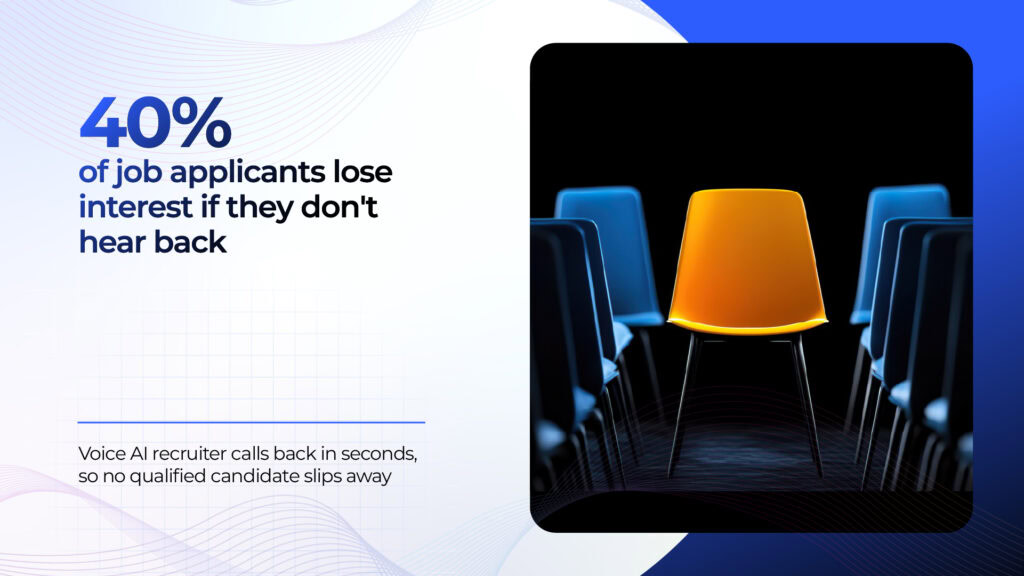
Recruiting teams are overwhelmed today. Recruiters have to handle an endless stream of applicants, screen calls, and follow up, and even in the face of such madness some candidates quit because there is just no response. In fact, 40% of job applicants lose interest if they don’t hear back. This is the exact issue that the conversational AI recruiting is built to solve. AI recruiting is built to solve.
An AI voice recruiter performs all the necessary actions of a recruiter including making calls, texting candidates, scheduling interviews, answering the questions, and keeping the applicants engaged. Instead of just an ordinary chatbot, a voice AI recruiter tool understands natural language, talks in real time, and has meaningful conversations with candidates on the phone.
In the article, we will review the functions of an AI recruiting agent, how AI agents recruiting work, what industries benefit the most, and what the most common doubts of employers are.
What Is an AI Voice Recruiter?
An AI voice agent for recruitment is a concept we can call automation powered by modern automatic speech processing technologies. The purpose of such an AI is to mechanize tasks connected to hiring processes that are repetitive and require no human reasoning.
A typical AI recruiter voice agent can:
- Contact candidates immediately after they send their applications;
- Ask different preliminary questions related to the job position such as working hours, skills, and salary expectations;
- Provide answers to the questions and concerns of candidates connected to the proposed job or the hiring firm;
- Book appointments at the recruiter’s calendar;
- Set reminders and notifications;
- Bring candidates back after being silent.
Since the AI operates via voice, it doesn’t create barriers, as opposed to automated surveys.
How Conversational AI Recruiting Agents Work
Conversational AI recruiting software typically runs on four connected layers working together in real time.
1. Speech Recognition (Listening)
AI agent is able to instantly convert speech to text while also translating context and tone as well, contrary to merely matching keywords.
2. Natural Language Understanding (Comprehension)
This technology plays a crucial role in AI agents for recruiting, as it knows how to interpret what the candidate means, follow up appropriately, and make instant adjustments in case the candidate deviates from its script in this way mimicking an experienced human recruiter that would know how to get the conversation back on track.
3. Conversational Logic (Decision-Making)
The AI recruiter agent is based on answers from the candidate that allows the agent to define the next line of questioning or whether the conversation should advance, or it must end as the candidate does not fit the position.
4. Voice Synthesis (Speaking)
The AI recruiting tool not only gains understanding of the conversation but is able to respond to the candidate by employing natural sounding human-like voice.
All this happens within seconds, servicing large numbers of candidates simultaneously while no human team can do so.
Why Recruiting Teams Are Adopting AI Voice Agents
The primary reason companies hire an AI voice agent for recruitment operations is not only cost efficiency but also speed and reliability of the operation, as today’s job seekers want to hear back on their application almost instantly. The time gap of even a single day can result in losing a preferred candidate to a less qualified recruit who calls first.
This is where AI agents for recruiting that automate candidate follow-ups and improve completion rates overall contribute. The voice agent will:
- Contact candidates almost immediately after submitting their application
- Redial at the best times to reach unsuccessful candidates
- Remind candidates through text message
- Keep candidates interested in the position by conducting multiple follow-ups
As a result, organizations experience an increase in the rate of screening to interview completion, the time taken to hire is reduced and recruiters have more time to make final hiring decisions instead of wasting time looking for candidates who are not showing up for their interviews.
Other core benefits of conversational AI for recruiting include:
- Candidates being able to communicate 24/7 according to their schedule;
- Ability to screen candidates uniformly and fairly as every candidate is screened using the same screening questions in the same manner;
- Communicate with candidates in various languages giving access to larger talented candidate pool;
- Integrating into current ATS systems so that all data is automatically supplied to the system;
- Handle the increase in recruitment process during certain time of the year.
AI Voice Recruiting Across Industries
The implementation of an AI recruiter may vary across industry sectors, but the basic operations of AI technology remain constant. In some industries, however, AI-driven conversational technology has disrupted and improved the traditional processes of hiring.
1. Healthcare
The healthcare sector has a special characteristic of being subject to pressure about timing. With numerous vacancies in nursing, understaffed hospitals and governments’ hospitals suffering from constant rotation, every vacancy has a relevant business meaning. AI voice recruiter applied in healthcare has reached the point of artificial screening applicants about licensing and certification requirements as well as availability of shifts and vacancies.
2. Staffing & Recruiting
Staffing companies are about the speed and quantity of workers hired. The introduction of conversational AI recruiting agents allows hiring specialists to scan a few applicants at the same time according to all the relevant requirements for several vacancies.
3. Hospitality
With constant high turnover in teams, driven by seasonality or high volumes for recruitment, hotels, restaurants, and event venues prefer to work with AI personnel in recruiting hospitality. AI agents for recruitment are capable of performing initial outreach and scheduling at a rapid rate so that the hiring manager will not be crushed under the weight of resumes.
4. Telecommunications
Telecommunication companies regularly hire call center operators, field technicians, and sales department employees in bulk. Voice AI recruiter allows the business to recruit easily, as voice AI can handle a large number of applications with the same screening criteria.
5. Insurance
Insurance job recruitment generally involves checking the candidate’s license and complying with certain criteria of employment. The use of AI recruiting agent helps with the verification of those parameters in the very first conversation during the recruitment process itself, thus enabling the recruiter to avoid disqualification of candidates later.
6. Automotive
Dealerships and automotive repair centers work on sales, repairs, and technician jobs continuously and thus benefit from the use of AI voice agents for recruitment. It helps maintain a steady stream of applicants without adding anything to the recruiters’ workload.
An AI Recruiter Built for Real Hiring Teams
If you are interested in the AI voice agent for recruiting solutions, consider Rebecca AI as the best solution to a unique problem in the recruitment industry: candidate abandonment. Rebecca AI takes care of all parts of the recruitment process, such as first contact with candidates, pre-screening calls, follow-ups and interviews. Simply put, Rebecca AI works alongside recruiters as assistant instead of just being any kind of bot used in the recruitment process.
Final Thoughts
The use of the Conversational AI recruiting process does not mean that the human element would disappear from hiring. In fact, it solely focuses on removing barriers from the process. The earlier companies start using AI voice agent for recruitment operations, the faster they will be able to hire.

FAQs
1. What is the difference between an AI voice recruiter and a chatbot?
A chatbot typically handles short, text-based interactions. An AI voice recruiter conducts full spoken conversations over the phone, understanding context, tone, and follow-up questions the way a live recruiter would.
2. Can an AI recruiter agent fully replace human recruiters?
No. AI agents for recruiting are built to handle repetitive, high-volume tasks like screening and scheduling, not final hiring decisions. Human recruiters remain essential for judgment, relationship-building, and closing candidates.
3. How does conversational AI recruiting improve candidate experience?
By responding instantly, being available around the clock, and never leaving candidates waiting for days without an update, which is one of the top reasons candidates disengage from a hiring process.
4. Is conversational AI recruiting software difficult to integrate with existing systems?
Most modern platforms are designed to connect directly with popular ATS and HR systems, so data on candidates, interviews, and screening results syncs automatically without manual entry.
5. Which industries benefit most from an AI voice agent for recruitment?
High-volume, high-turnover industries see the fastest ROI, including healthcare, staffing, hospitality, telecommunications, insurance, and automotive, though the technology adapts to nearly any hiring volume or role type.
6. Do candidates respond well to speaking with an AI recruiter voice agent?
Yes, when done well. Candidates generally respond positively when the AI voice agent sounds natural, answers questions clearly, and gets them to the next step faster than a traditional application process.
Related Sources