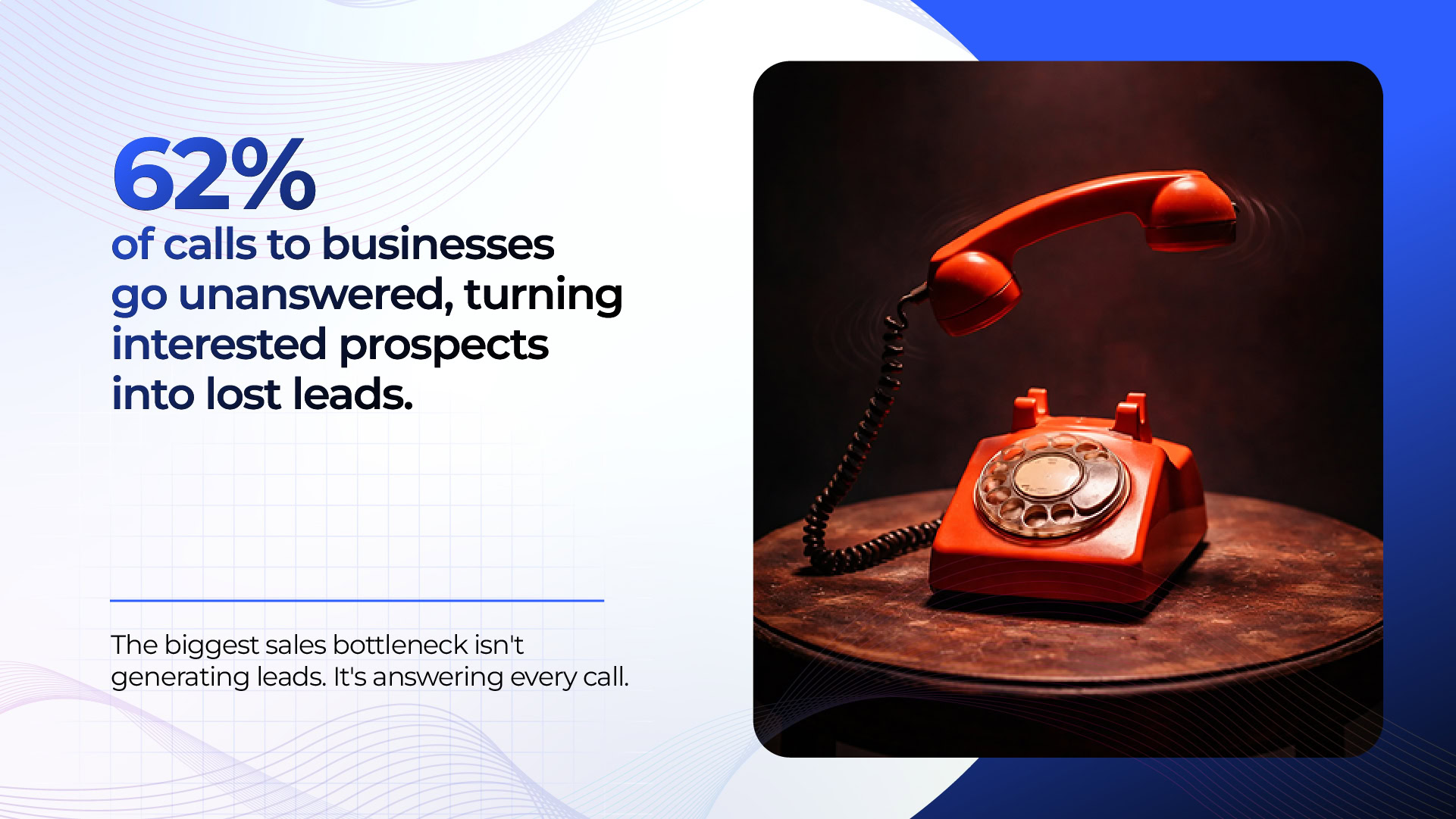
For every missed call, your business also misses the opportunity to convert a prospect into a customer. Surprisingly, a study revealed that around 62% of calls made to small businesses remain unanswered, and a whopping 85% of those people never bother to call again. The real sales bottleneck isn’t generating leads. It’s answering every call.
Traditionally, the solution was to add more people or outsource calls to an answering service like IVR. However, both approaches have their challenges. People are limited when it comes to working hours and must be paid no matter whether their phones have been ringing or not. Thanks to AI calling agents, all of these negatives can be eliminated.
Unlike chatbots and simple IVR menus, a purpose-built AI calling agent can hold real conversations. It can hear, talk, qualify, and direct leads as an ordinary salesperson would, but it can do this without having to deal with different calls or requests.
Why Inbound Calls Are the Leads You Can’t Afford to Lose?
Inbound leads indicate a strong desire to go through with a purchase. By calling you instead of filling out a contact form, they are looking for an answer immediately. Because of their strong desire and urgency, phone leads convert much better than leads that come via web forms. However, this same urgency becomes a disadvantage when the call is not answered. The client who wanted to buy from you five minutes ago is probably already speaking to your rival who happened to pick up the phone.
The problem is not the sales skills that are used. The problem is that there is not enough capacity. It does not matter if it is a front desk employee, a small sales team, or one business owner, they all have difficulties in answering all the calls simultaneously, especially if it is a busy hour and there is a marketing campaign in progress which has suddenly led to doubling the expected number of calls.
How AI Calling Agent Closes the Capacity Gap
The capacity issue is resolved by an AI-based voice agent, which does not restrict the number of calls being worked on at the same time. Instead of having one rep, one line, and one conversation at a time as humans would do, the AI-based voice agent is able to interact with many customers at the same time.
First, the AI voice agent answers the call within seconds of the caller having made it before he or she cooled. The AI agent asks questions that show that he is aware of the context in the call being made and what the caller wants from the call whether it is about pricing, availability, a product, or an appointment. AI voice agent listens to the busy signals and objections while talking, replying with questions on the go and not sticking to a fixed script. Upon qualifying the lead, the agent either books an appointment directly in the sales team’s calendar or hands the call over to the rep with all the information provided so that such information is not asked for again. Every outcome, whether qualified, not interested, or needs a follow-up, gets logged straight into the CRM automatically.
Olivia AI, developed by Pete & Gabi, operates in accordance with this model to maximize customer conversations through automation. She is designed in a way which allows her to receive all incoming calls, carry out automatic qualification, and transfer customers ready to buy to a live rep in real time. Since there are no human bottlenecks at any point of the workflow, companies can boast of capturing 100% of incoming calls instead of just around 38%.
What Changes When You Stop Missing Calls
The advantage of the approach has to do with more than just reduced instances of missed phone calls or customers rejecting them where somebody has already answered the call at the first instance.
If you look at traditional assessment techniques, they give way to ideal ones. For every sales team, it is a known fact that if they get in touch with a potential buyer within five minutes, they will have much bigger chances of getting a lead in the sales funnel, yet not many teams can achieve that in their work. The reason why is very simple. AI just makes it possible due to the fact that it allows the answering machine to answer the phone call immediately after it arrives.
Moreover, it does not just replace the game. The answers provided by a human sales agent vary a great deal depending on the time of the day, their mood, and emotional state.
Only leads which can be worked with are transferred to sales agents. Instead of spending hours engaging with unqualified customers, sales agents work only with qualified potential buyers, allowing them to direct their efforts on closing instead of qualifying customers.
The table below illustrates what traditional call assessment looks like compared to AI-based call assessment.
| Factor | Traditional Inbound Handling | AI-Handled Inbound Calls |
| Answer rate | Roughly 38–75% depending on staffing and hours | Effectively 100%, including after hours |
| Response time | Minutes to hours, or a missed call to voicemail | Immediate, within seconds |
| Coverage | Business hours only, subject to staff availability | 24/7, including weekends and holidays |
| Qualification consistency | Varies by rep experience and mood | Consistent process every time |
| Cost to scale | Requires hiring more reps as volume grows | Scales instantly without added headcount |
| CRM updates | Manual entry, often delayed or skipped | Logged automatically and in real time |
| Lead handoff | Cold transfer, rep re-asks basic questions | Warm transfer with full context attached |
Objections, Handled Without Losing the Deal
Business entities are reluctant to implement automated calls for the fear of a machine sounding unnatural and fumbling the conversation when faced with complex questions. AI sales automation software has been created to handle many situations including pricing disputes or general hesitations like the human rep. That is, to ask questions that address the concerns and either solve them or escalate the matter to humans if there is need for one. The purpose of AI is not to replace the expertise of the human reps but rather make sure that customers receive good quality help as soon as they call, and only real salespeople deal with hot customers.
Getting Started Without Overhauling Your Stack
Installing a AI IVR alternative tool usually doesn’t require removing the phone system or CRM you have been using up until now. Olivia and other similar tools can integrate directly with your CRM and leverage the information from the existing database of customers and leads from the very first day of the switch. Since the model works with your current system and does not replace it, the actual switch goes smoothly and without interruption of work.
However, the biggest change that comes with using AI for sales is not a technical one: the company itself must start viewing missed calls as a thing from the past and get used to the marketing principle of call coverage. Once the company’s phone assistance starts covering every inbound call, there will be less need to ask, “How many leads have been lost this month?”
Frequently Asked Questions
Which businesses benefit most from AI-handled inbound sales calls?
When it comes to phone calls for generating business revenue, it is true that the impact becomes most apparent in markets with a great deal of calls and less personnel. Examples of those industries include home service providers, healthcare, real estate, insurance, and hospitality. When it comes to missed calls, if customers are currently either going to voicemail or ringing during plus hours, it should be seen as interest in deploying AI call handling software.
Which type of leads should be routed to a human instead of the AI closing the loop?
Typically, leads that are ready to make a purchase, have specialized needs or must negotiate pricing, are transferred to the live agent with comprehensive context, while simple questions and tasks are performed by the AI agent.
How does an AI sales agent know which questions to ask a caller?
AI calling agent executes a combination of conversation flow together with access to a particular customer account or customer relationship management tools which allow asking the questions that are relevant and use a grammar that goes well with what the agent already knows.
How quickly can an AI agent answer an inbound call compared to a human team?
The AI agent is able to respond practically in one or two rings, regardless of the time of day and the number of calls received at the same time while the number of human operators is always limited by the number of people working at a moment.
How does the AI agent handle a caller who is upset or has a complaint mixed in with a sales inquiry?
The agent is able to pick up on the caller’s intonation, determine the intent of the call, solve the problem if possible, and transfer the conversation to a human operator is needs arise instead of trying to stick to a call that needs some compassion and discretion.
Which CRMs and systems typically integrate with AI calling platforms?
AI-enabled calling services such as Olivia AI integrate seamlessly with popular CRM systems such as Salesforce, HubSpot, Pipedrive, and Zoho so that they have access to existing client information as well as instantaneously sharing the outcome of every call.